Approval of Minutes and if requesting credits, please post Update - - PowerPoint PPT Presentation

approval of minutes
SMART_READER_LITE
LIVE PREVIEW

Approval of Minutes and if requesting credits, please post Update - - PowerPoint PPT Presentation

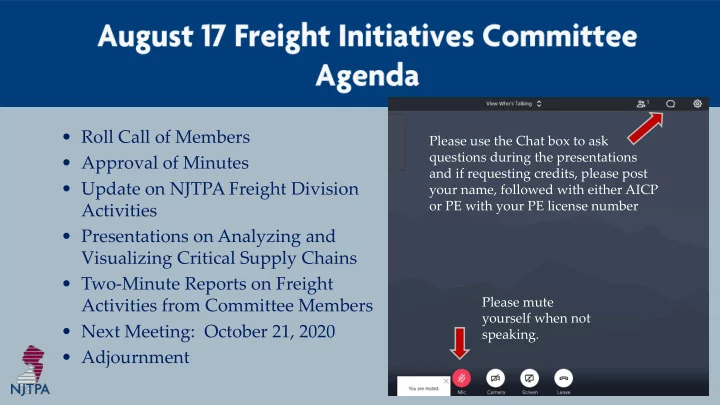
Roll Call of Members Please use the Chat box to ask questions during the presentations Approval of Minutes and if requesting credits, please post Update on NJTPA Freight Division your name, followed with either AICP or PE with your


slide-1
SLIDE 1
  • Roll Call of Members
  • Approval of Minutes
  • Update on NJTPA Freight Division

Activities

  • Presentations on Analyzing and

Visualizing Critical Supply Chains

  • Two-Minute Reports on Freight

Activities from Committee Members

  • Next Meeting: October 21, 2020
  • Adjournment

Please mute yourself when not speaking. Please use the Chat box to ask questions during the presentations and if requesting credits, please post your name, followed with either AICP

  • r PE with your PE license number
slide-2
SLIDE 2
  • Update on Industrial Real Estate
  • Truck Driver Survey Report
  • September 10 Truck Parking

Workshop

  • 2050 Freight Industry Level

Forecasts Study

  • Freight Concept Development

Program

Learn more at www.njtpa.org/freight View and download the summary at: https://map-forum- njtpa.hub.arcgis.com/pages/freight

slide-3
SLIDE 3
  • NJTPA 2050 Freight Industry Level

Forecasts Study, Jakub Rowinski, Central Staff and Chris Lamm, Cambridge Systematics

  • Freight Fluidity Project, Chandra

Bonzie, Federal Highway Administration, US Department of Transportation

  • FEWSION, Benjamin L. Ruddell,

Northern Arizona University

Please mute yourself when not speaking. Please use the Chat box to ask questions during the presentations and if requesting credits, please post your name, followed with either AICP

  • r PE with your PE license number
slide-4
SLIDE 4

Freight Initiatives Committee

August 17, 2020

2050 Freight Industry Level Forecasts

Jakub Rowinski, NJTPA Chris Lamm, Cambridge Systematics, Inc.

slide-5
SLIDE 5

Goals and Objectives

  • 1. Develop a clear, accurate and

comprehensive picture of current and future regional freight activity

  • ut to 2050
  • 2. Update and enhance the NJTPA

Freight Forecasting Tool

  • 3. Prepare regional, county, and top

commodity profiles

slide-6
SLIDE 6
  • Previous Studies

– 2040 Freight Industry Level Forecasts – Regional Freight Commodity Profiles

  • Key Products

– Freight Forecasting Tool (FFT) – Profiles

  • New for the 2050 Study

– Freight Analysis Framework (FAF) – E-Commerce

Background

slide-7
SLIDE 7

Methodological Overview

slide-8
SLIDE 8
  • Employment and trip

generation by county

  • Business-Economic

Area Make/Use Tables

  • Carload Waybill

Sample

  • Terminal Locations

FAF Disaggregation

slide-9
SLIDE 9

Two Analysis Components:

E-Commerce Trip Table Development

Market Demand Delivery Vehicle Travel Pattern

E- Commerce Delivery Vehicle Trip Table

slide-10
SLIDE 10

E-Commerce Market Demand

Total packages delivered annually:

88.1M

Total items delivered annually:

126.1M

Avg of 1.4 items per package

Source: Rakuten Intelligence, 2019 Source: Cheng Solutions and Cambridge Systematics, 2020

slide-11
SLIDE 11

Map Logistics Chains and Facilities

Facility locations and daily delivered packages by zip code and carrier

slide-12
SLIDE 12

Trip Table

Develop carrier-specific load factors and estimate trips from each facility to each Traffic Analysis Zone (TAZ)

slide-13
SLIDE 13
  • Produce year 2050 forecast
  • utputs
  • “What if” scenario capability
  • Streamline data management

and processing using R

FFT Updates

slide-14
SLIDE 14
  • 16% growth in

tonnage in 2050

  • 15% growth in

value in 2050

  • 78% of tons move

by truck

Commodity Flow Output

100 200 300 400 500 600 700 800 900 Tons (millions) Value (billions $)

NJTPA Region Freight Flows, 2020 and 2050, by Weight and Value

2020 2050

Tons by Mode, 2020

slide-15
SLIDE 15

Energy products, construction materials, and food and beverages are the top commodities by weight

Commodity Flow Output

40,000 80,000 120,000 160,000 Energy Construction Materials Food and Beverages Chemicals Warehouse and Terminal Moves Waste Machinery, Electronics, Transp Equip Paper and Printed Materials Textiles and Leather Durable Goods Pharmaceuticals

Thousands of Tons by Commodity Group, 2020-2050

2020 2050

slide-16
SLIDE 16

NJRTM-E Assignment

  • The commodity trucks were

assigned over the NJRTM-E

  • Ability to assign all commodity

trucks or specific commodity bundle trucks

slide-17
SLIDE 17

Meetings covered:

– Study overview – Data highlights – Validation (especially business locations)

Subregional Webinars

slide-18
SLIDE 18
  • Regional Freight Profile
  • 15 Subregional Freight Profiles
  • 12 Regional Commodity Profiles
  • Final Report and profiles are on

NJTPA’s website:

njtpa.org/2050FreightForecasts

Study Products

slide-19
SLIDE 19

Thank You!

Jakub Rowinski jrowinski@njtpa.org

slide-20
SLIDE 20

Click to edit Master title style

FHWA FREIGHT FLUIDITY PROGRAM

Chandra Bondzie, FHWA Presentation to North Jersey Transportation Planning Authority August 17, 2020

slide-21
SLIDE 21

FLUIDITY BRIDGES AND LEVERAGES EXISTING DATA PROGRAMS

2

Economic Data

“What and how much freight is moving, and where?” Sources: Freight Analysis Framework, Bureau of Economic Analysis, Carload Waybill Sample

Freight Fluidity Program

“Freight system performance from users’ perspective” Sources: Economic, Performance, and Vendor Data sources

Network Performance Data

“How is the network performing?” Sources: National Performance Measures Research Dataset (NPMRDS), Highway Performance Monitoring System, Carload Waybill Sample, Automatic Identification System Analysis Package (AISAP)

Fluidity is a bridge between economic and network data, showing how freight flows and facility measures merge into effects on multi- stage, multimodal industrial performance

Source: FHWA

slide-22
SLIDE 22

THE PRODUCT

 A new USDOT-owned database of information, with a visualization and mapping tool to record and report three types of performance metrics across multiple modes, scalable to future expansion and enhancement.  A major advance beyond highway-only metrics, allowing us to measure performance from the supply chain perspective and identify critical flows/connections, bottlenecks and improvement opportunities over the larger multimodal system.

3

Source: FHWA

slide-23
SLIDE 23

30 major U.S. companies identified to represent a broad cross-spectrum of industry sectors, commodities, modes  24 at national level, 6 regionally focused on NY/NJ and Chicago areas  Through interviews, industries shared “wiring diagrams” of their most critical supply chains, without revealing other business-sensitive information

DATA – SUPPLY CHAIN DEFINITION

4

Contribution to national gross domestic product (GDP) and projected growth among freight-dependent industries Geographic coverage of U.S.: regions, urban centers, rural areas, gateways, corridors, direction of travel Contribution to regional GDP and projected growth among freight-dependent industries Industry importance to resilience of other supply chains and of population Industry importance to U.S. trade Modal and travel distance diversity

slide-24
SLIDE 24

 Customer Prices:

 Truck and Rail Intermodal Price data purchased from commercial aggregator  Rail Carload Price data estimated by consultant team from Surface Transportation Board (STB) Waybill

 Travel Time (with Reliability measured as variations in travel time)

 Water data provided by U.S. Army Corps of Engineers Automatic Identification System, with detailed analysis by the Bureau of Transportation Statistics – 25%, 50%, 75% percentiles  Rail carload and intermodal travel time data purchased from commercial aggregator – 50% and 95% percentiles -- some routes not available  Truck data developed through analysis of FHWA’s National Performance Management Research Data Set (NPMRDS)  FHWA acquired first NPMRDS in July 2013, second version in April 2017; see https://ops.fhwa.dot.gov/perf_measurement/index.htm  Aggregates observed travel times from vehicle-based probes on Traffic Message Channels (TMCs) over five minute intervals, continuously, for freight and passenger vehicles

DATA – PERFORMANCE METRICS

5

slide-25
SLIDE 25

 Two integrated platforms, both from existing suite of FHWA freight measurement tools:

 Excel database and Tableau data analysis/visualization  FHWA/HOFM GIS data visualization tools, fed from database

 The software platforms meet key criteria:

 Ability to hold and process large data sets in time series  Accessibility of data to internal and external users, via export into common formats such as spreadsheet software, and directly on the platform without purchase of special tools.  Ability to restrict access to certain types or levels of data  Varied and high quality graphical and cartographical displays  Stability as dependable, tested tools

 Open-ended to support additional industries, travel lanes, modal details, data periods, performance calculations – maintainable, expandable

SOFTWARE PLATFORMS

6

slide-26
SLIDE 26

MODE/ GEOGRAPHY COVERAGE

7

  • Each data record has

an assigned path including NHS segment, rail network, waterway network that allows any data attribute or value to be displayed at a path level.

  • Captures moves in

almost every State, most major metro areas, the national highway freight network from the limited 30 industry sample  417 Mapped Moves: Truck (336), Rail IMX (28), Rail Carload (20), Water (28), Air (1)

Source: FHWA

slide-27
SLIDE 27

INDUSTRY COVERAGE

8

 30 Industries: 14 Manufacturing, 8 Retail, 4 Mining, 2 Agricultural Production (in addition to food manufacturing), 2 Transportation/Logistics

Source: FHWA

slide-28
SLIDE 28

Dashboards for Travel Time, Unreliability, and Price by path, mode, and industry cluster; maps showing each quarter or changes; charts showing quarterly data; can filter by mode, industry, geography, etc.

SYSTEM-LEVEL ANALYSIS

9

Source: FHWA

slide-29
SLIDE 29

SUPPLY CHAIN-LEVEL ANALYSIS

10

Industry Example: Home Improvement

  • Multimodal; five stages from port to

retail outlet; alternate rail routes

  • Half the cost is for four drayage

stages of less than 250 miles total

  • Import stage reliability worse than

delivery stage reliability

Port to Crossdock Crossdock to Rail Terminal Rail Linehaul Rail Terminal to DC DC to Retail Outlet TOTAL Truck Truck Rail IMX Truck Truck Miles 6 25 2200 109 103 2443 2017.4 Total Cost per Unit ($) 489 526 2616 699 692 5022 2017.4 Linehaul Cost per Unit ($) 487 518 2298 659 653 4615 2017.4 Fuel Cost per Unit ($) 2 8 319 40 38 407 2017.4 Mean Truck Travel Time (hrs) 0.3 0.7 1.9 1.8 4.7 2017.4 Cross Modal Reliability (95%/50%) 1.5 1.6 1.1 1.3

Source: FHWA

slide-30
SLIDE 30

STATEWIDE ANALYSIS

11

State Example: Missouri

  • Truck, rail intermodal, rail

carload, and water flows

  • Inbound, outbound,

through

  • Ability to track multi-state

performance metrics for a limited sample of industries

  • Opportunity to build on

national platform to increase coverage for industries and moves most significant to each State

  • Could help states better

fulfill FAST-Act mandate to address multi-State freight planning factors

Source: FHWA

slide-31
SLIDE 31

 Public Agencies (Federal, State, Metropolitan Planning Organization [MPO]/Regional)

 Monitor Key Performance Indicators (KPIs), comparable to how freight system users monitor themselves, that have critical impacts on industry competitiveness  Supports economic development strategies by identifying transportation connections relied on by critical industries  Supports timely response to questions about supply chain disruptions, resiliency and redundancy, alternative service options for critical industries, last mile connectivity, and other freight transportation issues  Provides working tool that complements and combines with others in the public agency toolbox

 Private Sector

 Potential resource to provide benchmarking data to smaller/rural industries without access to this information

OTHER APPLICATIONS

12

Source: FHWA

slide-32
SLIDE 32

Looking Ahead

Conduct continued outreach to State DOTs, MPOs and others to create awareness of tool and capabilities

 Through Transportation Research Board (TRB), American Association of State Highway Transportation Officials (AASHTO), Association of Metropolitan Planning Organizations (AMPO) event presentations in 2020 Expand Freight Fluidity community  Webinar series with U.S. and Canadian Freight Fluidity community

FHWA Office of Freight Management and Operations (HOFM) examines adding additional capabilities in tool

 Additional quarters, industry sectors, applications  Evaluation of new data sources  Pilot use of tool

13

slide-33
SLIDE 33

MORE INFORMATION

Chandra Bondzie FHWA HOFM chandra.bondzie@dot.gov 202-366-9083

14

slide-34
SLIDE 34

FEWSION supply chain Visual Analysis

For North Jersey Transportation Planning Authority August 17th, 2020

1

slide-35
SLIDE 35

What is FEWSION?

The Big Idea: rapid, local, visual, global, multi-domain / all-hazard supply chain intelligence and visual analysis NSF/USDA funded basic research: The first complete mesoscale database + visualization of the U.S. supply chains, network vulnerability, and resilience.

2

https://fewsion.us

ACI-1639529, INFEWS/T1: Mesoscale Data Fusion to Map and Model the U.S. Food, Energy, and Water (FEW) System

slide-36
SLIDE 36

Hurricane Harvey and Harris County, TX (Houston) Satellite Image Credits: NASA/NOAA GOES Project, https://www.nasa.gov/feature/goddard/2017/harvey-atlantic-ocean

3

FEWSION Core Competencies for Freight Planning

Capabilities

  • Identify likely knock-on supply chain impacts
  • Identify key distribution hubs, corridors, vulnerabilities
  • Identify shifts in supply chain flows
  • (pending) link to realtime freight data streams
  • (pending) facility-level and routing data
  • (pending) rerouting and adaptation gaming

Value Added

  • Visualization makes it rapidly accessible
  • Expert value added: translation and estimation
  • Expert value added: whole-system / multi-domain context
slide-37
SLIDE 37

4

FEWSION has already supported FEMA for CONUS Emergency Management Planning and Response

  • New Madrid “Shake and Fury” 2019
  • Hurricane Harvey
  • Hurricane Florence
  • LA “ShakeOut” 2018
  • Wasatch 2020
  • Hurricane Irma power outage in Florida
  • Seattle, Chicago, Houston, DC CRTE w/ANL
slide-38
SLIDE 38

5

Example: Southern California ShakeOut (Southern San Andreas 8.7 Scenario)

slide-39
SLIDE 39

Dependency on LA-sourced Natural Gas

6 Data Source: FEWSION Database v. 1.0 (2019)

slide-40
SLIDE 40

National Dependence on Food Commodities FROM the LA Metropolitan Area

7 Data Source: FEWSION Database v. 1.0 (2019)

slide-41
SLIDE 41

Dependency of US counties on IMPORTS through LA (via Port of Los Angeles)

LA Imports tend to be Asian-sourced commodities such as:

8 Data Source: FEWSION Database v. 1.0 (2019) Top 3 Imports (tons) Top 3 Imports ($MM) Electronics Crude petroleum Textiles/leather Electronics Motorized vehicles Textiles/leather

slide-42
SLIDE 42

9

Regional and Last-Mile datasets can be aligned (LA Grocery Example)

FE FEWSION Mesoscale ANL GR GRID-M Las Last Mile ile

slide-43
SLIDE 43

10

How do you view US FEWSION data?

  • FEW-ViewTM is an interactive

data portal to interact with FEWSION data.

  • Users can generate custom

supply chain maps on-the-fly to suit their current needs

  • This public portal accesses
  • nly a small fraction of the

FEWSION database at present (v1)…

https://fewsion.us/FEW-View

slide-44
SLIDE 44

11

Questions?

Benjamin L. Ruddell, Ph.D., P.E. Northern Arizona University Director, School of Informatics, Computing, and Cyber Systems Director, FEWSION Project, https://fewsion.us

slide-45
SLIDE 45

Appendix

12

slide-46
SLIDE 46

13

FEWSION Source Databases

County Data

  • U.S. Census Population Data
  • U.S. Census Economic Census
  • Bureau of Labor Statistics
  • U.S. Geological Survey
  • U.S. Department of Agriculture

National Agricultural Statistics

  • U.S. Department of Agriculture

Economic Research Service

Metro Area Data

  • U.S. Census Commodity Flow Survey
  • Oak Ridge National Laboratory/ U.S.

Department of Transportation Freight Analysis Framework

Point Data

  • U.S. Energy Information Administration
  • U.S. Environmental Protection Agency
  • U.S. Department of Homeland Security
  • U.S. Department of Agriculture CropScape

Other Data

  • DHS HIFLD Open Data
  • National Renewable Energy

Laboratory ReEDS Energy & Power Flow Data

  • National Renewable Energy

Laboratory ReEDS Water Withdrawal and Consumption Data

  • U.S. Foreign Trade Data
  • Global Water Productivity Data
  • Water Footprint Network
slide-47
SLIDE 47

FEWSION Standard Supply Chain

slide-48
SLIDE 48
slide-49
SLIDE 49

FEWSION Supply Chain Data Model

Producer (Origin) Route Producer (Destination)

16

Route may include n steps occur in parallel and series and can contain:

  • Transport mode/route
  • Distribution/storage
  • Transport Mode
  • Retail/Sale
  • Capacity and Utilization

Examples: Manufacturer, Snowpack, Distributor, Farm Examples: Retailer, Manufacturer, Refinery, Distributor Output Input Commodity / Supply Chain Flow

slide-50
SLIDE 50

17

  • 46 Commodity categories (SCTG+FEWSION)
  • Food
  • Pharmaceuticals
  • Fuels (Natural Gas, Diesel, Gasoline, Coal)
  • Electricity
  • Water
  • … and everything else as well
  • 3,143 Counties and 8 Foreign Regions
  • 7 transportation modes (Pipeline, Electric Grid, Rail, etc.)
  • 2012 annual data

FEWSION Database™ 1.0: Comprehensive Commodity Flow Mapping for the United States

slide-51
SLIDE 51

18

FEWSION for Community Resilience (F4R™)

  • Participatory last mile mapping process

(including students & volunteers, but also emergency managers)

  • What facilities and people are

responsible for those flows indicated by FEWSION data?

Flagstaff, Arizona Grocery Retail and Distribution (last mile)

https://fewsion.us/f4r/

slide-52
SLIDE 52
  • Roll Call of Members
  • Approval of Minutes
  • Update on NJTPA Freight Division Activities
  • Presentations on Analyzing and Visualizing Critical

Supply Chains

  • Two-Minute Reports on Freight

Activities from Committee Members

  • Next Meeting: Wednesday October

21, 2020 on the Pharma and Food/Beverage Supply Chains

  • Adjournment

Thank you. Stay healthy and safe.

Please mute yourself when not speaking. Please use the Chat box to ask questions during the presentations and if requesting credits, please post your name, followed with either AICP

  • r PE with your PE license number