& appropriate treatment technology for reuse 5 th Regional SUWA - - PowerPoint PPT Presentation

appropriate treatment technology for reuse 5 th regional
SMART_READER_LITE
LIVE PREVIEW

& appropriate treatment technology for reuse 5 th Regional SUWA - - PowerPoint PPT Presentation

Environmental Effects of Wastewater use in Agriculture & appropriate treatment technology for reuse 5 th Regional SUWA , Bali Sick Water Definition of Wastewater A combination of one or more of: - domestic effluent consisting of


slide-1
SLIDE 1

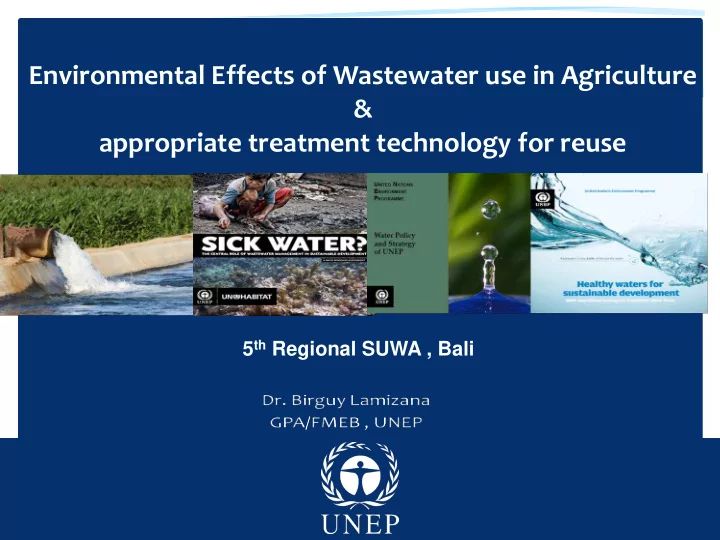
Environmental Effects of Wastewater use in Agriculture & appropriate treatment technology for reuse

5th Regional SUWA , Bali

slide-2
SLIDE 2

A combination of one or more of:

  • domestic effluent consisting of blackwater (excreta, urine and faecal

sludge) and greywater (kitchen and bathing wastewater);

  • water from commercial establishments and institutions, including

hospitals;

  • industrial effluent, stormwater and other urban run-off;
  • agricultural, horticultural and aquaculture effluent, either dissolved or as

suspended matter

(definition adapted from Raschid-Sally and Jayakody, 2008)

“Sick Water” Definition of Wastewater

slide-3
SLIDE 3

UNEP/GEF WIO-LaB Project 3

Wastewater………a global issue?

slide-4
SLIDE 4

Sewage systems are lacking, under- dimensioned or decayed

Wastewater management….a big challenge

slide-5
SLIDE 5
  • Water security
  • Ecology
  • Ecosystem Services
  • Biodiversity

Impacts of wastewater use in agriculture……

  • Loss of food security
  • Loss of fisheries, livelihoods
  • Loss of blue carbon sinks
  • Economic loss :
  • Healthy reefs can produce up to 35 tons of fish/km2/year
slide-6
SLIDE 6

UNEP/GEF WIO-LaB Project 6

Dead zones are spreading………

  • Dead zones are now thought to affect more than

245 000km2 of marine ecosystems, predominantly in the northern hemisphere (Diaz and Rosenberg, 2008)

slide-7
SLIDE 7

Impacts on climate Change

  • High-intensity rainfall events leading to surface runoff and

transport of salts and contaminants from soils irrigated with untreated or inadequately treated wastewater to nearby good soils irrigated with freshwater or rain-fed

  • Wastewater generates methane (21 times more powerful than

CO2) and nitrous oxide (310 time more powerful than CO2).

  • CH4 & NO2 will rise 25% and 50% respectively in just a decade
  • Nutrients increase acidification of freshwater
slide-8
SLIDE 8

Simplified scheme of agricultural wastewater use & effects on environment (adapted from WHO Guidelines)

WW treatment plan (in developing countries)

Evaporation Aquifer

Consumer Crops Cattle Water Sewage Industri al discharg e Sewage system Aquaculture Aquatic plants Storage dam Infiltration Aquatic plants Irrigation channels Infiltration Water + salts Soils (retains metals, organic matter & phosphorus) Compounds & water absorption by plants Sprinkler s Cattle consuming irrigated crops Irrigation drainage Lake

slide-9
SLIDE 9

But, wastewater is a needed resource…..

slide-10
SLIDE 10

a) Innovative water technology

  • Reduce the discharge of WW,

treat & re-use

b)Inventive governance & management

  • Intelligence water use: Different

water uses need different water Quality

  • Promote the 3 R approach-

Reduce-remediate-reuse

Trends in industrialized countries reversed but are on the increase in developing countries

Shortcutting the trends…..a must

slide-11
SLIDE 11

A need for decentralised Technologies ....

  • Septic Tanks, Constructed Wetlands, Composting Toilets,

Biodigestor, Anaerobic Filter, Duckweed Lagoons

  • Collection, treatment, and final disposition of the WW on/or close to the

location;

  • Useful in treating wastes from residences, households, small villages,

isolated communities, etc.

Advantages for decentralized systems:

Economy of structural arrangements such as transportation, reservation and elevation;

Possibility for reuse of the effluent and potentiality for aquifer recharging;

A problem in a unit doesn’t collapse the whole system;

Development of the local potentialities: small systems can be designed, built and managed by local professional, improving the local economy.

slide-12
SLIDE 12

Ecological Sanitation (EcoSan) Stages (or Phases)

Waste segregation and possible utilization options. (UNESCO/IHP & GTZ, 2006)

slide-13
SLIDE 13

Ecological Sanitation (EcoSan)

  • Ecological Sanitation is a

decentrilised sanitation system that understands human excreta,

  • rganic wastes and wastewater as

a resource (not as a waste) with high potential for reuse and recycling.

  • EcoSan systems enable a

complete recovery of nutrients in household wastewater and their reuse in agriculture. They also help preserve soil fertility and safeguard long-term food security. Moreover, they minimise the consumption and pollution of water resources.

slide-14
SLIDE 14

Septic Tank

  • The aim of primary treatment

is to separate out heavy constituents (suspended solids) and particularly light constituents (floating solids and scum) from the sewage.

  • Due to its low treatment

efficiency in terms of nutrient removal, a secondary treatment is recommended to polish the final effluent.

  • This system consists of a closed, often prefabricated tank and

is usually applied for primary sewage treatment. The treatment consists of sedimentation, flotation and digestion procedures.

  • Septic tank is designed to receive all kinds of domestic wastes

(kitchen, domiciliar laundries, washrooms, latrines, bathrooms, showers, etc) and it is economically viable to attend to 100 inhabitants.

slide-15
SLIDE 15

Constructed Wetland

  • Constructed Wetlands are man-made systems which aims to simulate

the treatment processes in natural wetlands by cultivating emergent plants e.g. reeds (Phragmites), bulrushes (Scirpus), and cattails (Typha) on sand, gravel, or soil media.

  • Constructed wetlands can serve the

same small communities as natural wetlands and can be incorporated into the treatment systems for larger communities as well;

  • They are subdivided, basically, into

two wide groups: (i) Surface Flow (the water or sewage flows through the soil surface); and (ii) Subsurface Flow. (Vertical and Horizontal Flow)

slide-16
SLIDE 16

Subsurface Vertical Flow Constructed Wetland (SVFW)

  • In SVFW the wastewater is loaded onto the planted filter bed’s
  • surface. The pollutants are removed or transformed by

microorganisms that are attached to the filtersand and the plants’ root system.

  • Due to the biofilm presents in the

filter material, and high Oxygen concentration in the system, vertical flow systems have been applied for both BOD5 and SS removal and nitrification promotion;

  • However, it is important ensure that

the filter is not saturated or covered with water in order to secure a high

  • xygen level in the filter.
slide-17
SLIDE 17

Subsurface Horizontal Flow Constructed Wetland (SHFW)

  • In SHFW the sewage is uniformly fed in the inlet work and due to a

longitudinal slight slope (~1%) the liquid flows through the pores

  • f the filter bed until it reaches the outlet work.
  • SHFW usually provide high treatment

effect in terms of removal of organics (BOD5, COD) and suspended solids (SS). The removal of nitrogen and phosphorus is lower but comparable with conventional treatment technologies which do not include special nutrient removal step.

slide-18
SLIDE 18

Composting Toilets

  • A composting toilet system contains and processes excrement, toilet

paper, carbon additive, and sometimes, food waste.

  • As a nonwater-carriage system, a composting toilet relies on

unsaturated conditions where aerobic bacteria break down waste.

  • When exposed to an unfavorable

environment for an extended period of time, most pathogenic microorganisms will not survive. However, caution is essential when using the compost end-product and liquid residual in case some pathogens survive.

  • The composting unit must be constructed

to separate the solid fraction from the liquid fraction and produce a stable, humus material with less than 200 MPN per gram of fecal coliform.

  • If sized and maintained properly, a

composting toilet breaks down waste 10 to 30% of its original volume.

slide-19
SLIDE 19

Biogas Digestor

  • Biogas latrines and communal biogas plants are, in principle, a

more advanced form of the septic tank system.

  • When human excreta is combined with animal and agricultural

wastes and water, it will give off gas as it decomposes.

  • The mix of gases produced is called ‘biogas’ which can be used for

cooking and lighting.

  • Biogas plants typically store

the wastes for about 30 days which can remove some of the pathogenic organisms but by no means all.

slide-20
SLIDE 20

Anaerobic Filter

  • Anaerobic filters are used for wastewater with a low content of

suspended solids (e.g. after primary treatment in septic tanks) and narrow COD/BOD ratio. Biogas utilisation may be considered in case of BOD > 1.000 mg/l.

  • The anaerobic filter, also known

as fixed bed or fixed film reactor, includes the treatment of non- settleable and dissolved solids by bringing them in close contact with a surplus of active bacterial mass.

  • The larger the surface for

bacterial growth, the quicker is the digestion.

slide-21
SLIDE 21

Duckweed-Based Wastewater Stabilizations Ponds

  • In general, duckweed ponds are used to treat domestic or

agricultural wastewaters.

  • Lemnaceae have the greatest capacity in absorbing macro-elements

(e.g. nitrogen, phosphorus, potassium, calcium, sodium and magnesium among others);

  • Effluents with both a high BOD and

nutrient load may require adequate primary treatment to reduce the organic load.

  • Plants must be harvested regularly in
  • rder to prevent dead plants forming

bottom sludge.

slide-22
SLIDE 22

CH4

CO2

Electricity generator by Biogas

Food

Methane Combustion= CO2

Swine waste

Duckweeds Lagoon

slide-23
SLIDE 23

Targeted and sustained investments are necessary to:

  • Reduce volume and extent of water pollution
  • Capture water once polluted
  • Treat polluted water for return to environment
  • Safely reuse and recycle ww conserving water & nutrients
  • Provide a platform for the development of new and

innovative technologies & management practices  social, economic and environmental dividends exceeding original investments

Conditions for success:

slide-24
SLIDE 24
  • A. Tackle immediate consequences
  • Adopt a multi-sectoral approach
  • Use a cocktail of innovative approaches
  • Innovative financing
  • B. Thinking must be long-term:
  • plan wastewater management against

future scenarios.

  • Solutions must be socially and culturally

appropriate, as well as economically and environmentally viable into the future.

  • Education must play a central role

Conditions for success: From the Sick Water report

slide-25
SLIDE 25

THANK YOU