1 Infrastructure Requirements Limit Reuse Planned Indirect Potable - - PDF document

1
SMART_READER_LITE
LIVE PREVIEW

1 Infrastructure Requirements Limit Reuse Planned Indirect Potable - - PDF document

Overview of Presentation DIRECT POTABLE REUSE: A PATH FORWARD: Take Home Message Reuse Opportunities De Facto and Planned Indirect Potable Reuse 2012 WATER REUSE CONFERENCE Proposed Direct Potable Reuse Strategies Boise, ID


slide-1
SLIDE 1

1

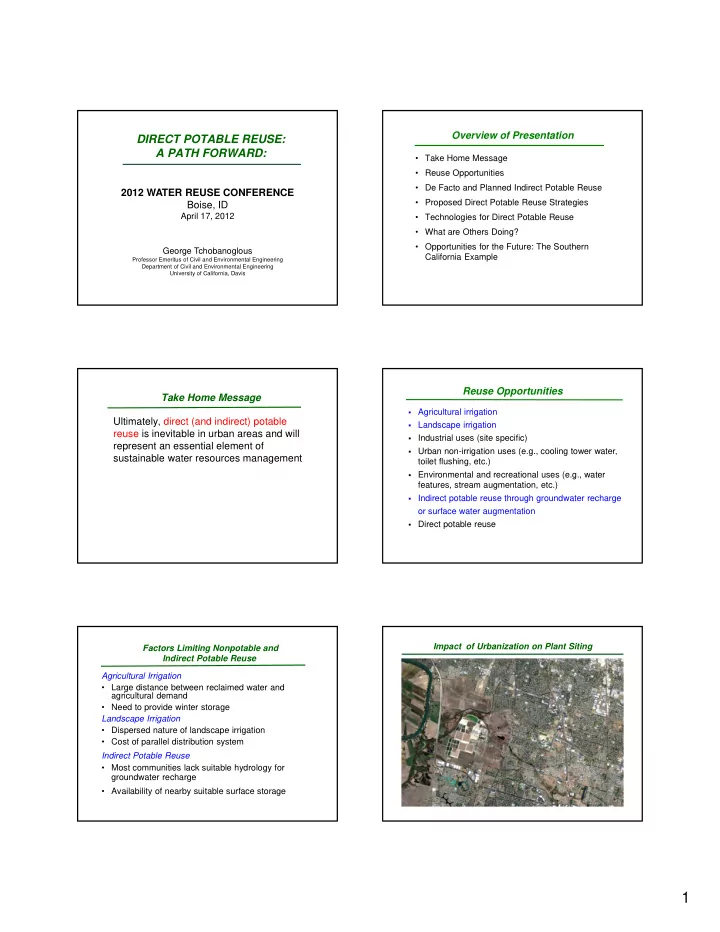
DIRECT POTABLE REUSE: A PATH FORWARD:

2012 WATER REUSE CONFERENCE Boise, ID

April 17, 2012 George Tchobanoglous

Professor Emeritus of Civil and Environmental Engineering Department of Civil and Environmental Engineering University of California, Davis

Overview of Presentation

  • Take Home Message
  • Reuse Opportunities
  • De Facto and Planned Indirect Potable Reuse
  • Proposed Direct Potable Reuse Strategies
  • Technologies for Direct Potable Reuse
  • What are Others Doing?
  • Opportunities for the Future: The Southern

California Example

Take Home Message Ultimately, direct (and indirect) potable reuse is inevitable in urban areas and will represent an essential element of sustainable water resources management Reuse Opportunities

  • Agricultural irrigation
  • Landscape irrigation
  • Industrial uses (site specific)
  • Urban non-irrigation uses (e.g., cooling tower water,

toilet flushing, etc.)

  • Environmental and recreational uses (e.g., water

features, stream augmentation, etc.)

  • Indirect potable reuse through groundwater recharge
  • r surface water augmentation
  • Direct potable reuse

Factors Limiting Nonpotable and Indirect Potable Reuse Agricultural Irrigation

  • Large distance between reclaimed water and

agricultural demand

  • Need to provide winter storage

Landscape Irrigation

  • Dispersed nature of landscape irrigation
  • Cost of parallel distribution system

Indirect Potable Reuse

  • Most communities lack suitable hydrology for

groundwater recharge

  • Availability of nearby suitable surface storage

Impact of Urbanization on Plant Siting

slide-2
SLIDE 2

2

Infrastructure Requirements Limit Reuse (Purple pipe may be a bad investment)

Courtesy City of San Diego

Planned Indirect Potable Reuse (Environmental Buffer Required)

Upper Occoquan, San Diego, CA (Proposed) Surface Water Buffer OCWD Groundwater Buffer

Barrier Injection Wells

Kraemer/Miller Spreading Basins, OCWD San Vincente Reservoir, San Diego County San Vincente Reservoir, San Diego County

slide-3
SLIDE 3

3

Driving Forces for Direct Potable Reuse

  • De facto indirect potable reuse is largely unregulated
  • Infrastructure requirements limit reuse opportunities
  • Population growth, demographics, and global

warming will result in unsustainable situation

  • Lack of an environmental buffer
  • Existing and new technologies can and will meet the

water quality challenge

  • The value of water will increase significantly in the

future

  • Stringent environmental regulations

De Facto Indirect Potable Reuse is a Well Established Practice

(Regulated: secondary effluent (?): Unregulated: ag runoff, urban stormwater, highway runoff)

De Facto Indirect Potable Reuse

Courtesy City of San Diego

Infrastructure Requirements Using Existing Water Supply Storage Reservoirs

Courtesy City of San Diego

Impact of Coastal Population Demographics Hyperion WWTP, Los Angeles, CA

So What is the Issue? If a significant amount of wastewater is to be recycled from large cities without the availability of suitable environmental buffers (either groundwater or surface water), then direct potable reuse, with adequate protective measures will have to be implemented

slide-4
SLIDE 4

4

Proposed DPR Strategy Planned Indirect and Direct Potable Reuse

Upper Occoquan, San Diego, CA (Proposed) Surface Water Buffer OCWD Groundwater Buffer

Typical Flow Diagram Now Used for the Production of Purified Water

Adapted from OCWD

Microfiltration, Cartridge Filters, Reverse Osmosis, and Advanced Treatment (UV), OCWD

Decarbonator (CO2 Stripping) Lime Saturator (pH adjustment Orange County Water District, OCWD Kraemer/Miller Spreading Basins, OCWD and Legacy Regulations

slide-5
SLIDE 5

5

Potential DPR Flow Diagrams What are Others Doing?

  • Windhoek, Namibia
  • Pure Cycle Corporation
  • Cloudcroft, New Mexico
  • Big Springs, Texas

Direct Potable Reuse in Windhoek, Namibia

Treatment Process Flow Diagram Windhoek, Namibia Treatment Process Flow Diagram Pure Cycle Corporation (c.a. late 1970s) Treatment Process Flow Diagram Pure Cycle Corporation (c.a. late 1970s)

slide-6
SLIDE 6

6

Treatment Process Flow Diagram Cloudcroft, NM (c.a. 2011) Treatment Process Flow Diagram Big Springs, Texas (c.a. 2011) Proposed DPR Strategy

To Protect Public Health

An engineered buffer can be used in place of an environmental buffer with greater control over water quality

Proven and Conceptual Engineered Buffer Systems Impact of DPR on Future WWTP Design

  • Targeted source control program
  • Modification of raw wastewater characteristics
  • Elimination of untreated return flows
  • Flow equalization
  • Operational mode for biological treatment
  • Improved design and monitoring
  • Ongoing pilot testing
  • Alternative advanced treatment process flow

diagrams

slide-7
SLIDE 7

7

Alternative DPR Flow Diagrams With and Without Reverse Osmosis With Engineered Buffer Future Opportunities for DPR: The Southern California Example Electric Power Consumption in Typical Urban Water Systems

System Power consumption, kWh/Mgal Northern California Southern California

Supply and conveyance 150 8900 Water treatment 100 100 Distribution 1200 1200 Wastewater treatment 2,500 2,500 TOTAL 3,950 12,700

Opportunities for the Future: The Southern California Example

Wastewater Management Infrastructure Benefits of the Southern California Example

  • Reliable alternative source of supply, more secure

from natural disasters

  • Lower cost and reduced energy usage
  • More water available for agricultural use, especially

during drought periods

  • Environmental benefits for Bay Delta habitat

restoration

slide-8
SLIDE 8

8

Research Needs in Direct Potable Reuse

  • Sizing of engineered storage buffer
  • Treatment train reliability
  • Blending requirements
  • Enhanced monitoring techniques and methods
  • Equivalent advanced treatment trains
  • Communication resources for DPR
  • Acceptance of direct potable reuse

Some Recent Publications Closing Thoughts Ultimately, direct (and indirect) potable reuse is inevitable in urban areas and will represent an essential element of sustainable water resources management

  • Technology is not an issue
  • Must think of wastewater differently
  • To make it a reality, bold new planning

must begin now!!

  • The public is supportive

THANK YOU FOR LISTENING