
SLIDE 1
Apple Magic Mouse Redesign
5.18.18 Reid Parsekian
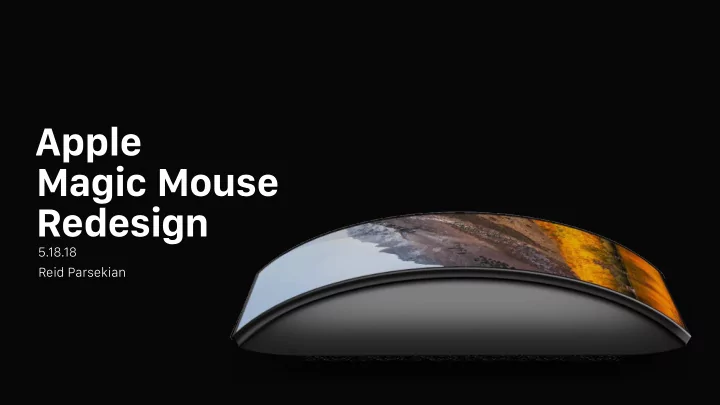
Apple Magic Mouse Redesign 5.18.18 Reid Parsekian Background - - PowerPoint PPT Presentation
Apple Magic Mouse Redesign 5.18.18 Reid Parsekian Background Background Magic Mouse Redesign History The Lisa Mouse began as one of the first commercial mice available to consumers. Over the years Apple has maintained a distinct form and
5.18.18 Reid Parsekian
The Lisa Mouse began as one of the first commercial mice available to
has maintained a distinct form and function with its mice that reflects its design philosophies.
1983
Lisa Mouse
1986
Bus Mouse
1993
Bus Mouse II
1998
USB Mouse
2000
Pro Mouse
2003
Wireless Mouse
2005
Mighty Mouse
2009
Magic Mouse
On October 13, 2015, Apple released a second generation Magic Mouse that charges via a Lightning Connector. Similar to the previous generation, the Magic Mouse 2 features multi-touch gesture controls, wireless Bluetooth capabilities and laser-tracking. It remains the most recent mouse Apple has released today.
This is Joe, he’s 36 years old and works as a music producer in Los Angeles. He is what you would call a “Pro” user in the world of Apple because of his high proficiency with computer software. Joe is always looking for ways to become more productive, as every second counts in the music industry. He often is reimbursed for purchasing equipment that improves the quality of his work. Joe uses his iPhone to keep in touch with his colleagues and
playing Xbox One with his friends.
For the last ten years, iPhone has drastically transformed the way we interact with electronic devices. The majority of human interaction with devices is now done solely with touch. We use our fingers to make bids on eBay, take extravagant selfies, and even order Peruvian food. Who needs an old mouse in today’s world?
With the release of the new 2017 MacBook Pro, Apple unveiled the Touch Bar; the next evolution of key- board input. The multi-touch enabled OLED strip brings new capabilities to Mac that can
The next logical innovation:
Until now, screens have played a very small role in computer mouse design. Few companies have attempted to implement this technology, all of which resulted in impractical designs and do not meet the high standards Apple wishes to achieve. The screens on these devices offer no additional benefits and act merely as a gimmick or aesthetic pleasure.
Like with the Touch Bar, Apple wishes to bring deep and useful control to Pro users that wasn’t possible before.
Size and Weight
Height: 0.85 inch (2.16 cm) Width: 2.25 inches (5.71 cm) Depth: 4.47 inches (11.35 cm) Weight: 6.14 ounces (174 grams)
Display
5.2-inch curved OLED Multi-Touch display 1362-by-620-pixel resolution at 288 ppi 3D Touch with palm rejection Fingerprint-resistant oleophobic coating
General
Apple T2 Chip Built-in rechargeable lithium-ion battery Bluetooth 5.0 Lightning port
The area where your fingers rest is free from any UI elements at all times. This lets you stick to what a mouse does best; clicking.
With Magic Mouse Touch, you can tap, swipe, pinch, or spread one or more fingers to perform useful actions, just like you always have.
At any given time, swipe down from the top to open the control center.
Magic Mouse Touch changes automatically based
already know how to use, like in Safari.
When you right click, now all the control is at your
bookmark or printing a document is effortless.
Magic Mouse Touch features the same capacitive touch-screen technology as iPhone, making it up to 200 times more precise than before.
Magic Mouse Touch supports countless 3rd party applications right out of the box, with more to come on the way. For example, switching between tools in Adobe Photoshop has never been easier, or more tactile.
When clicking a text field, Magic Mouse Touch automatically