APNA 29th Annual Conference Session 3034: October 30, 2015 - - PDF document

apna 29th annual conference session 3034 october 30 2015
SMART_READER_LITE
LIVE PREVIEW

APNA 29th Annual Conference Session 3034: October 30, 2015 - - PDF document

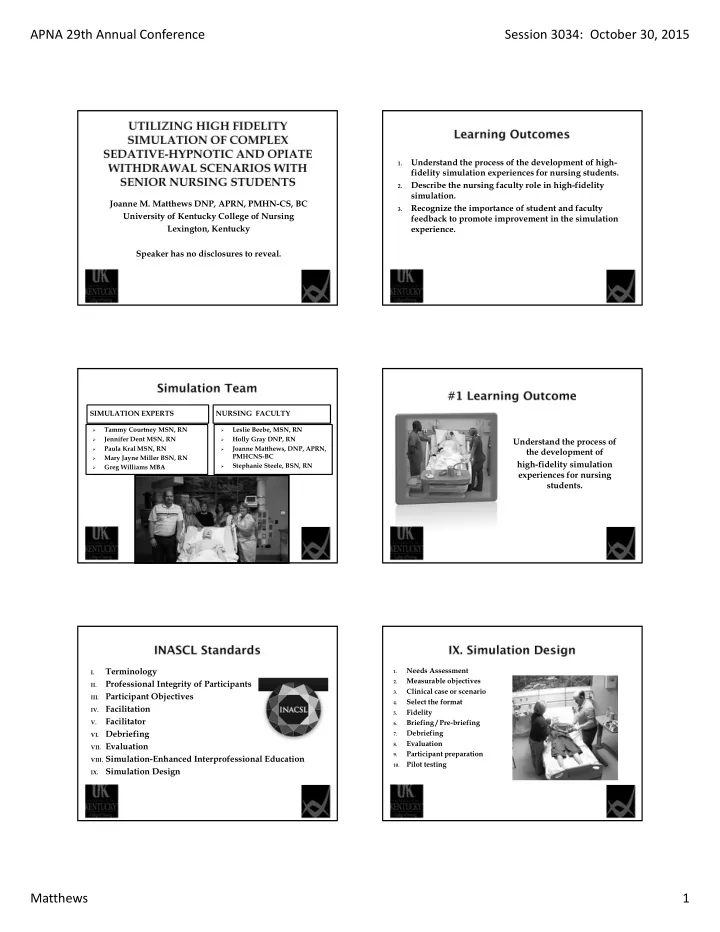
APNA 29th Annual Conference Session 3034: October 30, 2015 Understand the process of the development of high- 1. fidelity simulation experiences for nursing students. Describe the nursing faculty role in high-fidelity 2. simulation. Joanne M.


slide-1
SLIDE 1

APNA 29th Annual Conference Session 3034: October 30, 2015 Matthews 1

Joanne M. Matthews DNP, APRN, PMHN-CS, BC University of Kentucky College of Nursing Lexington, Kentucky Speaker has no disclosures to reveal.

1.

Understand the process of the development of high- fidelity simulation experiences for nursing students.

2.

Describe the nursing faculty role in high-fidelity simulation.

3.

Recognize the importance of student and faculty feedback to promote improvement in the simulation experience.

SIMULATION EXPERTS NURSING FACULTY

  • Tammy Courtney MSN, RN
  • Jennifer Dent MSN, RN
  • Paula Kral MSN, RN
  • Mary Jayne Miller BSN, RN
  • Greg Williams MBA
  • Leslie Beebe, MSN, RN
  • Holly Gray DNP, RN
  • Joanne Matthews, DNP, APRN,

PMHCNS-BC

  • Stephanie Steele, BSN, RN

Understand the process of the development of high-fidelity simulation experiences for nursing students.

I.

Terminology

II.

Professional Integrity of Participants

  • III. Participant Objectives
  • IV. Facilitation

V.

Facilitator

  • VI. Debriefing
  • VII. Evaluation
  • VIII. Simulation-Enhanced Interprofessional Education

IX.

Simulation Design

1.

Needs Assessment

2.

Measurable objectives

3.

Clinical case or scenario

4.

Select the format

5.

Fidelity

6.

Briefing / Pre-briefing

7.

Debriefing

8.

Evaluation

9.

Participant preparation

10.

Pilot testing

slide-2
SLIDE 2

APNA 29th Annual Conference Session 3034: October 30, 2015 Matthews 2

Why this topic?

  • All nurses care for patients with substance use disorders (SUDs).
  • Approximately 25-40% of all hospitalized non-mental health

patients have a substance use disorder.

  • Increased the number of patients admitted to inpatient psychiatric

units with a dual diagnosis.

  • Inconsistent practice for patients experiencing withdrawal.
  • Leading to confrontational nurse-patient interactions
  • Decreased nurse and patient satisfaction
  • Poorer patient care outcomes.
  • Suicide has been ranked one of the top 5 sentinel events 2004-2014.

Why use simulation?

  • Simulation experiences promote a safe, non-competitive

learning environment fostering student clinical judgment and reasoning.

  • Provide feedback to students and instructors.
  • Highly rated by students to enhance retention of content.

1.

Identifies the signs and symptoms of sedative-hypnotic (alcohol) and opioid withdrawal.

2.

Applies the nursing process in safely caring for a patient during medically assisted withdrawal.

3.

Uses a standardized assessment protocol to determine medication management of withdrawal symptoms.

4.

Cooperates with others using an objective approach in problem solving.

5.

Applies knowledge to influence decisions regarding plan

  • f care for patient based on the patient’s assessment.

6.

Initiates correct nursing skill based on assessment of patient.

7.

Identifies changes in patient condition.

8.

Demonstrates therapeutic communication with patient.

9.

Collaborates effectively with team members.

  • 1. Millie Potter:

Caring for a patient experiencing severe alcohol withdrawal with delirium tremens and hallucinations with history of falls and c/o vomiting blood..

  • 2. Randy Smith:

Caring for a patient experiencing opioid withdrawal with a suspected overdose and suicidal ideation with IV drug abuse and psychosocial needs .

  • 2 one-hour simulation experiences
  • First semester senior nursing students enrolled in Psychiatric

Nursing

  • High fidelity mannequins
  • Mock hospital rooms
  • Audio/visual observation
  • Respond to students in real time.
  • EBP assessment instruments
  • Realistic treatment protocols

Mock Hospital Room

slide-3
SLIDE 3

APNA 29th Annual Conference Session 3034: October 30, 2015 Matthews 3

  • Voiceover
  • Practice scenarios
  • Instruments:
  • The Clinical Institute

Withdrawal Assessment of Alcohol Scale, Revised (CIWA-Ar)

  • The Clinical Opiate

Withdrawal Scale (COWS)

  • CAGE-Aid
  • ASQ Suicide Risk

Assessment

  • Divided clinical groups into TEAMS: 4-5 for each scenario
  • Defined role descriptions and responsibilities
  • Team leader
  • Assessment
  • Documenter
  • Medication administration
  • Given SBAR report to all students.
  • Introduced to room /room boundaries.
  • Opportunity to ask questions.
  • Team conferenced to set plan of action.

Ask positive questions first.

  • What went well?
  • What did you like most?
  • What did you learn?
  • Do you have any questions?

Socratic Questioning

  • How did the team make the

decision to give acetaminophen instead of ibuprofen?

  • What other interventions might

have been considered to decrease the patient’s anxiety?

  • What was the impact of the

patient’s behavior (hallucinations and yelling) on the team’s ability to think critically or provide care?

  • One take-away point from

each participant.

  • Acted as summary

Describe the nursing faculty role in high-fidelity simulation.

  • Utilize INACSL standards
  • Obtain peer review of content
  • and scenarios
  • Collaborate with simulation experts
  • Content development
  • During simulation
  • In debriefing
  • Foster positive learning environment
slide-4
SLIDE 4

APNA 29th Annual Conference Session 3034: October 30, 2015 Matthews 4

Start Stop Qty/ Alert Administer CIWA-Ar per protocol PRN / ONE TIME DOSE / OTHER / LISTED BELOW Start Stop Qty/ Alert Valium 10mg prn per protocol PO For repeat CIWA-AR score of 15 or greater Start Stop Qty/ Alert Vistaril 25mg – 50 mg PO Every 8 hours prn for sleep or anxiety Start Stop Qty/ Alert Phenergan 25mg IM every 4-6 hours prn for observed vomiting Start Stop Qty/ Alert Ibuprofen 600 mg PO q6h prn pain Start Stop Qty/ Alert Trazadone 50mg PO qhs prn sleep. May repeat in 1 hour. Start Stop Qty/ Alert Acetaminophen 650 mg PO q4h prn pain or fever above 101 degrees F

Faculty Role

Nurture, nurture, nurture.

Recognize the importance

  • f student and faculty

feedback to promote improvement in the simulation experience.

Performed a retrospective review of nursing student responses to survey questions evaluating a simulation experience.

  • Total responding: n = 118
  • 81 students in Fall 2014 (n = 66)
  • 80 students in Spring 2015 (n = 52)
  • Age range between 20 and 35 years

University of Kentucky IRB Exemption Certification # 15-0507-X2B

  • Students provided voluntary unsupervised feedback via a

computerized survey.

  • Responses were anonymous with no identifying information.
  • The exercise was formative and ungraded.
  • Responses were collated by the simulation team and sent to the

faculty coordinator/PI of study. Quantitative Evaluation Added The Following Questions

  • Active Learning
  • Collaboration
  • Diverse Ways of Learning
  • High Expectations
  • Objectives and Information
  • Support
  • Problem Solving
  • Feedback / Guided Reflection
  • Fidelity / Realism
  • Satisfaction with Current

Learning

  • Self-Confidence in Learning
  • What skill or aspect

challenged you the most?

  • Did you feel prepared to

handle it?

  • What would you change

about this simulation to improve it for future students?

  • What did you find

particularly helpful or weak about the debrief discussion? Fall 2014 & Spring 2015 Qualitative Evaluation in Spring 2015

Quantitative Results

slide-5
SLIDE 5

APNA 29th Annual Conference Session 3034: October 30, 2015 Matthews 5

Quantitative Results Qualitative Results

21 8 6 3 2 2

What skill or aspect of this simulation challenged you the most? n = 66

30

Qualitative Results

79% 21%

Qualitative Results

20 20 5 4 2 6

Qualitative Results

  • Patient centered care
  • Teamwork and collaboration
  • Using EBP
  • Safety
  • QI
  • Informatics
slide-6
SLIDE 6

APNA 29th Annual Conference Session 3034: October 30, 2015 Matthews 6

  • Pre-Briefing
  • Medication Order Sheet
  • Opioid Protocol
  • Fidelity
  • Scenario
  • Have fun!
  • Be open to

feedback!

  • Encourage learning!
  • Be willing to change!
  • Courtney, T. (2015). Debriefing. PowerPoint presentation at the

University of Kentucky College of Nursing, Lexington, KY.

  • Gore, T. (2015, August). Curriculum Integration of the INASCL

Standards of Best Practice: Simulation. PowerPoint presentation at the University of Kentucky College of Nursing, Lexington, KY.

  • Jeffries, F.R. (2005). A Framework for designing, implementing, and

evaluating: Simulations used as teaching strategies in nursing. Nursing Education Perspectives 26 (2)96-103.

  • The International Nursing Association for Clinical Simulation &

Learning accessed at http://www.inacsl.org/i4a/pages/index.cfm?pageid=1