APNA 29th Annual Conference Session 2024: October 29, 2015 - - PDF document

apna 29th annual conference session 2024 october 29 2015
SMART_READER_LITE
LIVE PREVIEW

APNA 29th Annual Conference Session 2024: October 29, 2015 - - PDF document

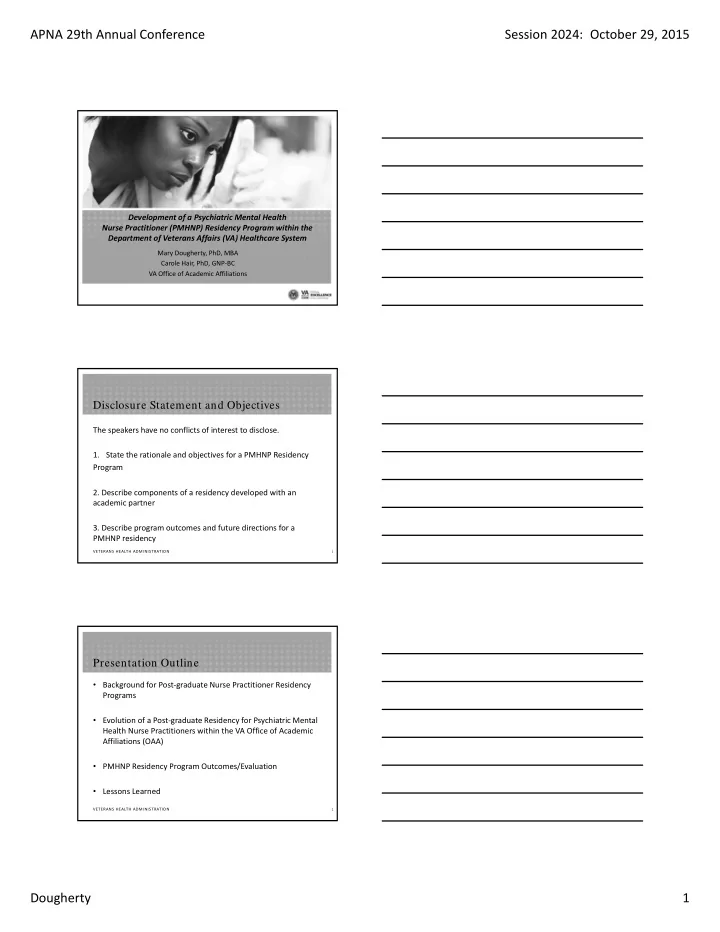
APNA 29th Annual Conference Session 2024: October 29, 2015 Development of a Psychiatric Mental Health Nurse Practitioner (PMHNP) Residency Program within the Department of Veterans Affairs (VA) Healthcare System Mary Dougherty, PhD, MBA Carole Hair,


slide-1
SLIDE 1

APNA 29th Annual Conference Session 2024: October 29, 2015 Dougherty 1

Development of a Psychiatric Mental Health Nurse Practitioner (PMHNP) Residency Program within the Department of Veterans Affairs (VA) Healthcare System

Mary Dougherty, PhD, MBA Carole Hair, PhD, GNP‐BC VA Office of Academic Affiliations

VETERANS HEALTH ADMINISTRATION

Disclosure Statement and Objectives

The speakers have no conflicts of interest to disclose.

  • 1. State the rationale and objectives for a PMHNP Residency

Program

  • 2. Describe components of a residency developed with an

academic partner

  • 3. Describe program outcomes and future directions for a

PMHNP residency

1

VETERANS HEALTH ADMINISTRATION

Presentation Outline

  • Background for Post‐graduate Nurse Practitioner Residency

Programs

  • Evolution of a Post‐graduate Residency for Psychiatric Mental

Health Nurse Practitioners within the VA Office of Academic Affiliations (OAA)

  • PMHNP Residency Program Outcomes/Evaluation
  • Lessons Learned

2

slide-2
SLIDE 2

APNA 29th Annual Conference Session 2024: October 29, 2015 Dougherty 2

VETERANS HEALTH ADMINISTRATION

Background Post-Graduate Nurse Practitioner Residencies

Survey of 562 NPs (Hart & Macnee, 2007)

  • 87% of NPs indicated they would have benefited from

a post‐graduate NP residency program Call to develop residencies for all new graduates

  • Carnegie Foundation Study – Benner (2010)
  • IOM Report (2010)

Organizational support for post‐graduate NP residencies

  • FQHC‐Based Residency Training ‐ Flinter (2011)
  • What Nurse Executives Need to Know ‐ Bush (2014)

See handout for references

3

VETERANS HEALTH ADMINISTRATION

Office of Academic Affiliations (OAA) Psychiatric Mental Health Nurse Practitioner Residency Evolution

Expansion/Academic Year (AY)

Phase 1 AY 2012‐2013 Phase 2 AY 2013‐2014 Phase 3 AY 2014‐2015

Expansion Initiative

  • Interdisciplinary Mental Health

Initiative

– Interprofessional education focused RFP – Nurse practitioner residents included – OAA funds NP resident stipends and benefits

  • Psychiatric Mental Health NP

(PMHNP) Residency

– NP‐specific PMHNP residency RFP – OAA funds NP resident stipends and benefits

  • VA Nursing Academic Partnerships

(VANAP) Graduate Education (GE)

– PMHNP Education & Residency RFP – OAA funds NP trainee stipends and residency stipends and benefits – OAA funds VA and SON faculty salaries

4

VETERANS HEALTH ADMINISTRATION

Challenges with Phase 1 (AY 2012-2013)

Recruitment of Residents

  • Stipend barrier (stipends not competitive with new NP

salaries)

  • Residency not required for practice
  • Variable Human Resources Department assistance for
  • nboarding trainees due to misunderstanding of the PMHNP

resident role

  • Residency program marketing challenges

5

slide-3
SLIDE 3

APNA 29th Annual Conference Session 2024: October 29, 2015 Dougherty 3

VETERANS HEALTH ADMINISTRATION

Challenges with Phase 1 (AY 2012-2013)

Minimal Residency Educational Infrastructure

  • Faculty/Program Director Release Time for Role
  • Administrative/Academic Competency of Program Directors

– Ability to develop curriculum, PMHNP competencies, program evaluation – Lack of curriculum, experiential learning objectives, evaluation plan/methods – Limited communication with all pertinent stakeholders – Devolution of residency to an on the job orientation versus educational program

6

VETERANS HEALTH ADMINISTRATION

Phase 2 (AY 2013-2014): PMHNP Residency

New Program Requirements to Meet Phase 1 Challenge

  • Structured residency: academic partner preferred
  • Release time for VA residency Program Director
  • Development of curriculum with Veteran‐centric

competencies

  • Didactic and experiential interprofessional education with

Psychiatry, Pharmacy, Social Work and Psychology

  • Program evaluation including resident demographics,

competency evaluation, program satisfaction, recruitment and retention

7

VETERANS HEALTH ADMINISTRATION

Challenges with Phase 2 (AY 2013-2014)

  • Academic collaboration and participation variable
  • Release time and ability of Program Director (PD) to develop

curriculum, competency assessments and program evaluation

  • Facility understanding and acceptance of residency for NP’s
  • Ability of PD to advocate, negotiate and lead new program
  • PD knowledge, skills and ability to develop, implement and

manage an academic residency

  • Resistance to NP residency by established professional

leadership

  • Barriers to resident recruitment due to low stipend level

8

slide-4
SLIDE 4

APNA 29th Annual Conference Session 2024: October 29, 2015 Dougherty 4

VETERANS HEALTH ADMINISTRATION

Challenges with Phase 2 (AY 2013-2014)

  • Recruitment of residents a challenge

– 50% fill rate at pilot sites – National Survey of NP residency stipends and benefits conducted* – Issue Brief presented to OAA leadership – Recommendation approved to increase stipend to $65K plus geographic pay adjustment

*See handout for a description of the OAA PMHNP Compensation Review Process

9

VETERANS HEALTH ADMINISTRATION

Phase 3: VANAP-GE (RFP) AY 2014-2015 and AY 2015-2016

OAA Funding Provided for Nurse Practitioner Educational Continuum and Development of Educational Infrastructure:

  • VA/SON Program Directors funded at 0.5 FTE each for 5 years
  • VA/SON faculty funded for PMHNP student and resident

education

– 1 VA and 2 SON faculty positions funded in year 1 and 5 – 2 VA and 3 SON faculty positions funded in years 2, 3 and 4

  • PMHNP NP students ‐ 6 stipends per year
  • Post‐graduate PMHNP residents ‐ 4‐6 resident salary/benefits

per year

– Funding for residents begins in year 2 of the partnership

10

VETERANS HEALTH ADMINISTRATION

Phase 3: VANAP-GE (RFP) AY 2014-2015 and AY 2015-2016

Expected program outcomes:

– (a) increase in PMHNP student enrollment

– (b) Veteran‐centric SON PMHNP curriculum revisions – (c) VA faculty development – (d) Veteran focused practice and education initiatives – (e) VA and SON scholarship (e.g., presentations, posters, manuscripts) – (f) Recruitment and retention of PMHNPs within the VA – (g) Interprofessional education – (h) Faculty practice within the VA facility

11

slide-5
SLIDE 5

APNA 29th Annual Conference Session 2024: October 29, 2015 Dougherty 5

VETERANS HEALTH ADMINISTRATION

Phase 3: VANAP-GE (RFP) AY 2014-2015 and AY 2015-2016

Additional Partnerships Requirements:

  • Development of governance, communication, strategic,

recruitment and retention plans

  • Development and implementation of curriculum and resident

competency assessment

  • Participation in national VANAP‐GE program evaluation
  • Participation in development of accreditation standards for

NP residency program

12

VETERANS HEALTH ADMINISTRATION

Phase 3: VANAP-GE (RFP) AY 2014-2015 and AY 2015-2016

AY 2014‐2015 VANAP‐GE initiated with one partnership

  • Focus on PMHNP education and development of PMHNP post‐graduate

residency – University of Alabama at Birmingham and Birmingham VA

AY 2015‐2016 Six VANAP GE Partnerships awarded July 1, 2015

  • OAA RFP included options to develop Psychiatric Mental Health,

Adult/Gerontology or Acute Care NP residencies

  • Two of the six VANAP‐GE partnerships will develop PMHNP education and

PMHNP post‐graduate residencies – University of Utah and Salt Lake City VA – University of California San Francisco and San Francisco VA

13

VETERANS HEALTH ADMINISTRATION

NP Student and Resident Competencies

PMHNP residency competencies build upon and do not replicate competencies developed by the National Organization of Nurse Practitioner Faculties (NONPF)

  • Core Competencies for NPs
  • Psychiatric Mental Health NP Competencies

OAA funded PMHNP residency pilot program focuses on developing Veteran‐ centric care competencies

  • Care of the Veteran population within the VA Healthcare System
  • Care of Veterans with complex mental health needs and

comorbidities

  • Interprofessional practice with other VA health professionals
  • Quality improvement activities focused in improving care for

Veterans

14

slide-6
SLIDE 6

APNA 29th Annual Conference Session 2024: October 29, 2015 Dougherty 6

VETERANS HEALTH ADMINISTRATION

PMHNP Resident Competency Assessment Instrument Development

Instrument developed by a taskforce of PMHNPs, NP educators and Psychiatric Mental Health Nurse Consultants

  • Instrument based on the Core Competencies for Integrated Behavioral

Health and Primary Care developed by the SAMHSA‐HSRA Center for Integrated Health Solutions (2014)

  • Content of instrument reviewed by an interprofessional team
  • Electronic format for instrument developed for data entry/retrieval
  • Instrument pilot tested during academic year 2014‐2015
  • Instrument revised based on resident and preceptor feedback
  • Fewer sub‐competencies
  • Guidelines for use of instrument developed
  • Addition of preceptor evaluation at one month

15

VETERANS HEALTH ADMINISTRATION

Status of PMHNP Residency Program Curriculum Development

Development of standardized residency curriculum

  • Curriculum is Veteran and VA care focused
  • Curriculum is competency‐based using the 9 SAMHSA‐HSRA Core

Competencies plus Leadership & Professional Development

  • Workgroup developing standardized didactic and experiential

curriculum components for 10 Core Competency Topics

16

  • Screening & Assessment
  • Care Planning & Care Coordination
  • Intervention
  • Interpersonal Communication
  • Collaboration & Teamwork
  • Cultural Competence & Adaptation
  • Practice‐Based Learning &

Quality Improvement

  • System Oriented Practice
  • Informatics
  • Leadership & Professional

Development

VETERANS HEALTH ADMINISTRATION

Status of PMHNP Residency Program Evaluation

Partnership‐specific formative and summative evaluations

  • Resident evaluation of clinical experiences
  • Resident evaluation of preceptors
  • Resident focus groups for program feedback
  • Preceptor evaluation of resident performance
  • Stakeholder satisfaction surveys (preceptors, faculty, VA and

SON leaders)

  • Recruitment and retention of residents after program

completion

17

slide-7
SLIDE 7

APNA 29th Annual Conference Session 2024: October 29, 2015 Dougherty 7

VETERANS HEALTH ADMINISTRATION

Status of PMHNP Residency Program Evaluation

National OAA Residency Program Evaluation based aggregate program data

  • Achievement of expected resident competencies

Competency assessment data entered into an OAA web‐based portal

  • VA Learners’ Perceptions Survey (2003) for measuring program satisfaction

LPS completed by residents directly into an OAA web‐based portal

  • Aggregate recruitment and retention of PMHNPs
  • Analysis of value of the program to partnering organizations
  • Return on Investment (ROI) business model NOT used
  • Additional evaluation metrics under consideration as the program

develops

18

VETERANS HEALTH ADMINISTRATION

Lessons Learned

Strategies for Developing Successful Academic- Practice Residency Partnerships

  • Organizational and nursing leadership support and

participation is critical

  • A governance plan which delineates the program structure,

processes and evaluation framework is required

  • Defined curriculum with experiential learning objectives and

evaluation needs to be developed

  • Need for alignment of resident capstone project with Veteran‐

centric population health priorities

  • Formative and summative evaluation plan required with plans

for implementation of recommendations

– Stakeholder/resident feedback; employer feedback/resident tracking

19

VETERANS HEALTH ADMINISTRATION

Lessons Learned

Strategies for Developing Successful Academic- Practice Residency Partnerships

  • Alignment with other health care professions clinical

residencies

– Didactic and experiential education with Psychiatry, Pharmacy, SW and Psychology

  • Program Director(s): clinical, management and educational

competency are required for successful program leadership

  • Academic collaboration needed for development of

curriculum, program evaluation and scholarship (presentations, publications, grant funding)

  • Faculty development plan to achieve comprehensive teaching

and faculty competency

20

slide-8
SLIDE 8

APNA 29th Annual Conference Session 2024: October 29, 2015 Dougherty 8

VETERANS HEALTH ADMINISTRATION

Lessons Learned

Strategies for Developing Successful Academic- Practice Residency Partnerships

  • Annual strategic review and planning meeting with SON and

VA program leaders

  • Participation in national program calls and commitment to

contacting OAA when confronted with challenges

  • Value Analysis completion and presentation to key
  • rganizational leaders to support program sustainability
  • Participation in OAA consultation and mentoring program*

*See handout for description of the OAA Coaching and Mentoring Service

21

VETERANS HEALTH ADMINISTRATION

Future Plans

  • Conduct a Value Analysis of the PMHNP Residency
  • Value components: quality of education, resident satisfaction

and competency, development of Veteran‐centric curriculum, practice and education initiatives, recruitment and retention

  • Shift from a pilot residency status to a permanent program

with consistent annual OAA funding to the sponsoring VA healthcare facility

  • Continue participation in national dialogue for accreditation
  • f nurse practitioner residency programs
  • Participate in development of NP residency accreditation

standards and process for obtaining residency accreditation

22

VETERANS HEALTH ADMINISTRATION

Comments/ Questions?

If not now, please feel free to contact us: mary.dougherty@va.gov or by phone at 202‐527‐2357 or carole.hair@va.gov or by phone at 858‐642‐3485

23