Ten Years of An Integrated Resident and Fellow Quality Improvement - - PowerPoint PPT Presentation

ten years of an integrated resident and fellow quality
SMART_READER_LITE
LIVE PREVIEW

Ten Years of An Integrated Resident and Fellow Quality Improvement - - PowerPoint PPT Presentation

3/30/2016 BUILDING A RESIDENT AND FELLOW QUALITY AND SAFETY PROGRAM AT UCSF Ten Years of An Integrated Resident and Fellow Quality Improvement Program at UCSF GME Hospital Program Educational goals: Front line provider Operational goals


slide-1
SLIDE 1

3/30/2016 1

Ten Years of An Integrated Resident and Fellow Quality Improvement Program at UCSF

Robert B. Baron, MD, MS

Professor of Medicine Dean, Graduate and Continuing Medical Education University of California, San Francisco

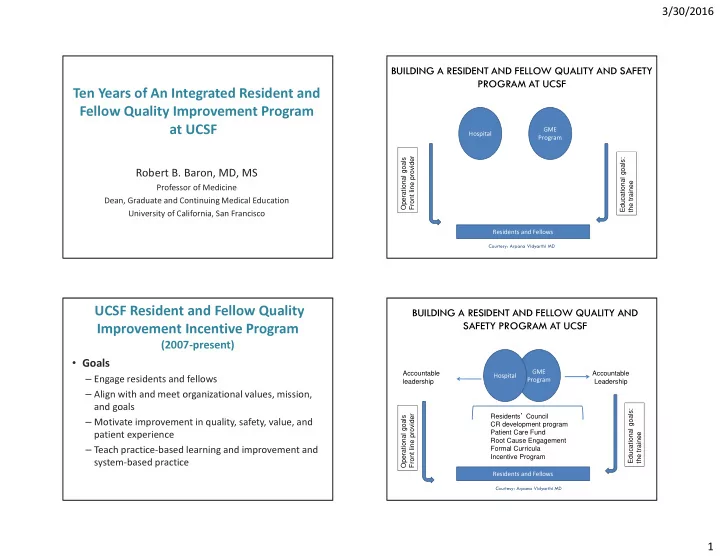
BUILDING A RESIDENT AND FELLOW QUALITY AND SAFETY PROGRAM AT UCSF

GME Program Hospital Residents and Fellows Operational goals Front line provider Educational goals: the trainee

Courtesy: Arpana Vidyarthi MD

UCSF Resident and Fellow Quality Improvement Incentive Program

(2007-present)

  • Goals

– Engage residents and fellows – Align with and meet organizational values, mission, and goals – Motivate improvement in quality, safety, value, and patient experience – Teach practice-based learning and improvement and system-based practice BUILDING A RESIDENT AND FELLOW QUALITY AND SAFETY PROGRAM AT UCSF

GME Program Hospital Residents and Fellows Operational goals Front line provider Educational goals: the trainee Accountable Leadership Accountable leadership Residents’ Council CR development program Patient Care Fund Root Cause Engagement Formal Curricula Incentive Program

Courtesy: Arpana Vidyarthi MD

slide-2
SLIDE 2

3/30/2016 2

UCSF Resident and Fellow Quality Improvement Incentive Program

(2007-present)

  • All-program goals

– 3 goals for all residents – Patient satisfaction, quality, resource utilization

  • Program-specific goals

– Residencies and fellowships design their own – Twenty five programs this year

  • Financial bonus per trainee. “All for One”

– Part of annual Health System budget ($1.2M per year) – Clear return on investment

Results 2007 - 2015

  • All-program goals

– Two-thirds of goals met

  • Program-specific goals

– Three-quarters of goals met

  • Financial bonus per trainee.

– Approximately $800 per trainee received each year

All-program Goals

Satisfaction Quality/Safety Operational 2007 Patient Survey Composite Documentation 2008 Patient Survey Pain Management CMS/TJC 2009 Patient Survey Pain Management Documentation 2010 Patient Survey Hand Hygiene Lab testing 2011 Patient Survey Hand Hygiene Lab testing 2012 Patient Survey Hand Hygiene Lab testing 2013 Patient Survey Hand Hygiene Discharge by noon 2014 Patient Survey Cost per discharge Discharge by noon 2015 Patient Survey Influenza Discharge by noon 2016 Patient Survey Clostridium difficile infections Cost per discharge

Discharge Before Noon

slide-3
SLIDE 3

3/30/2016 3

Hand Hygiene Compliance

Anesthesia Accurate use of neuromuscular transmission module in 50% of cases meeting criteria Cardiovascular Disease fellowship Provide a standardized consent video and printed post-procedure reports to 75% of patients Dermatology Distribute an Atopic Dermatitis Action Plan to 75% of eligible patients, or document reason if not appropriate Emergency Medicine Use post-intubation sedation in 80% of RSI cases Gynecologic Oncology Discharge 75% of laparoscopic cases prior to noon on the first post-operative day Hematology and Oncology Vaccinate 90% of eligible patients against Hepatitis B Hospice and Palliative Medicine Increase the use of POLST to greater than 50% of discharged patients who have chosen DNR or partial code status Internal Medicine Reduce the total number of phlebotomy draws per patient day by 5% Neurology Document an initial NIHSS score in code stroke admission notes for 90% of patients after a code stroke Neurosurgery Participate in a postoperative debrief checklist in 80% of cases Obstetrics and Gynecology Comply with new guidelines for urinary catheter removal in 80% of patients Orthopaedic Surgery Achieve 95% completion rate of either a brief operative note or a complete operative report within 30 minutes of leaving the PACU or arriving in the ICU.

Program-Specific Goals 2014-2015

Otolaryngology Refer 80% of inpatients smokers to smoking cessation resources Pediatrics

Screen and refer 80% of parents or teens for smoking, with referral for smoking cessation

Plastic Surgery Complete a postoperative checklist for microvascular free flap patients in the ICU within 90 minutes, with 90% compliance Psychiatry Provide intervention and document appropriate recommendations for 65% of patients with alcohol dependence or abuse Pulmonary CC Fellows Provide written notification to referring providers within 48 hours in 75% of patients who have significant hypoxemia during pulmonary testing (excludes those referred for immediate intervention) Radiation Oncology Complete a treatment planning session within 3 business days of initial consultation for 60% of patients treated with 3D radiation for painful bone metastases Radiology Finalize 80% of imaging reports for PE, subarachnoid, stroke, CTA by noon Surgery Increase discharge before noon of patients on the General Surgery services to greater than 30% Transplant Hepatology Perform abdominal imaging every 6 months for hepatocellular cancer (HCC) screening in over 80% of males >40 years and females >50 years of age who self-identify as being of Asian race/ethnicity Urology Increase usage of oral antimicrobials to 80% of eligible GU endoscopic cases

Program-Specific Goals 2014-2015

Internal Medicine
slide-4
SLIDE 4

3/30/2016 4

Urology Conclusions

  • An institution-wide strategic approach is feasible

and effective to improve quality, safety, value, and experience

  • Projects work best when interprofessional
  • The program enhances resident and fellow

competence in PBLI and SBP

  • A financial incentive may add value
  • Despite significant costs there is a clear return on

investment

  • Health professionals in training can be part “part
  • f the solution” to improve health care

Acknowledgements and Additional Information

  • Key teammates

– Glenn Rosenbluth MD (GME) – Arpana Vidyarthi MD (GME) – Adrienne Greene MD (CMO) – Mark Laret (CEO)

  • More information

– UCSF GME website (year by year projects and results) – Vidyarthi AR, et al. Acad Med, 2014 (program overview) – Vidyarthi AR, et al. Amer J Med Qual, 2015 (lab tests) – Rosenbluth G, et al. Amer J Med Quality, 2015 (hand hygiene)