AP Chemistry Aqueous Equilibria II: Ksp & Solubility Products - - PDF document

ap chemistry
SMART_READER_LITE
LIVE PREVIEW

AP Chemistry Aqueous Equilibria II: Ksp & Solubility Products - - PDF document

Slide 1 / 91 Slide 2 / 91 AP Chemistry Aqueous Equilibria II: Ksp & Solubility Products Slide 3 / 91 Slide 4 / 91 Table of Contents: K sp & Solubility Products Click on the topic to go to that section Introduction to Introduction to


slide-1
SLIDE 1

Slide 1 / 91 Slide 2 / 91

AP Chemistry

Aqueous Equilibria II: Ksp & Solubility Products Slide 3 / 91

Click on the topic to go to that section

Table of Contents: Ksp & Solubility Products

· Introduction to Solubility Equilibria · Calculating Ksp from the Solubility · Calculating Solubility from Ksp · Factors Affecting Solubility · Precipitation Reactions and Separation of Ions

Slide 4 / 91

Introduction to Solubility Equilibria

Return to the Table of Contents

Slide 5 / 91

Introduction to Solubility Equilibria

Many shells are made of relatively insoluble calcium carbonate, so the shells are not at huge risk of dissolving in the ocean.

Slide 6 / 91

Introduction to Solubility Equilibria

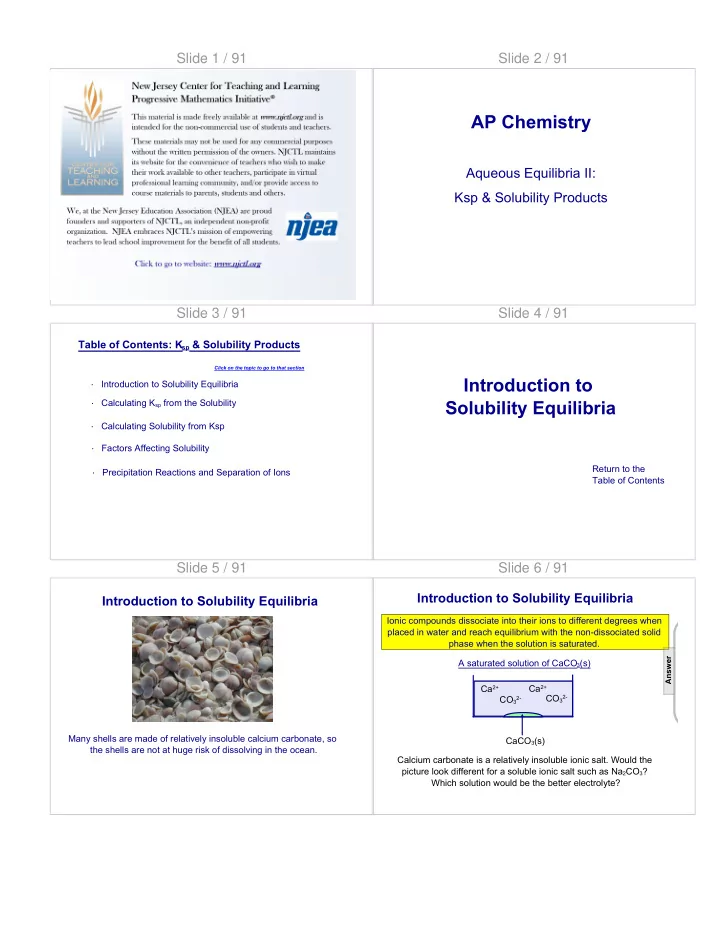
Ionic compounds dissociate into their ions to different degrees when placed in water and reach equilibrium with the non-dissociated solid phase when the solution is saturated. A saturated solution of CaCO3(s) CaCO3(s) Ca2+ Ca2+ CO32- CO32- Calcium carbonate is a relatively insoluble ionic salt. Would the picture look different for a soluble ionic salt such as Na2CO3? Which solution would be the better electrolyte?

Answer

slide-2
SLIDE 2

Slide 7 / 91

Introduction to Solubility Equilibria

Consider the equilibrium that exists in a saturated solution of CaCO3 in water: CaCO3(s) ↔ Ca2+(aq) + CO32-(aq) Unlike acid-base equilibria which are homogenous, solubility equilibria are heterogeneous, there is always a solid in the reaction.

Slide 8 / 91

Introduction to Solubility Equilibria

The equilibrium constant expression for this equilibrium is Ksp = [Ca2+] [CO32−] where the equilibrium constant, Ksp, is called the solubility product. There is never any denominator in K

sp expressions

because pure solids are not included in any equilibrium expressions.

Slide 9 / 91

The degree to which an ionic compound dissociates in water can be determined by measuring it's "Ksp" or solubility product equilibrium constant.

Solubility Equilibrium

CaCO3(s) --> Ca2+(aq) + CO32-(aq) Ksp @ 25 C = 5.0 x 10⁻⁹ MgCO3(s) --> Mg2+(aq) + CO32-(aq) Ksp @ 25 C = 6.8 x 10⁻⁶ In both cases above, the equilibrium lies far to the left, meaning relatively few aqueous ions would be present in solution. Which saturated solution above would have the higher conductivity and why? Answer

Slide 10 / 91

1 Which Ksp expression is correct for AgCl?

A

[Ag+]/[Cl-]

B

[Ag+][Cl-]

C

[Ag2+]2[Cl2-]2

D

[Ag+]2[Cl-]2

E

None of the above.

Slide 10 (Answer) / 91

1 Which Ksp expression is correct for AgCl?

A

[Ag+]/[Cl-]

B

[Ag+][Cl-]

C

[Ag2+]2[Cl2-]2

D

[Ag+]2[Cl-]2

E

None of the above.

[This object is a pull tab]

Answer B AgCl(s) # Ag+(aq) + Cl-(aq) Ksp = [Ag+][Cl-]

Slide 11 / 91

2 Given the reaction at equilibrium: Zn(OH)2 (s) Zn2+ (aq) + 2OH- (aq) what is the expression for the solubility product constant, Ksp, for this reaction?

A

Ksp= [Zn2+][OH-]2 / [Zn(OH)2]

B

Ksp= [Zn(OH)2] / [Zn2+][2OH-]

C

Ksp= [Zn2+][2OH-]

D

Ksp= [Zn2+][OH-]2

slide-3
SLIDE 3

Slide 11 (Answer) / 91

2 Given the reaction at equilibrium: Zn(OH)2 (s) Zn2+ (aq) + 2OH- (aq) what is the expression for the solubility product constant, Ksp, for this reaction?

A

Ksp= [Zn2+][OH-]2 / [Zn(OH)2]

B

Ksp= [Zn(OH)2] / [Zn2+][2OH-]

C

Ksp= [Zn2+][2OH-]

D

Ksp= [Zn2+][OH-]2

[This object is a pull tab]

Answer D Ksp= [Zn2+][OH-]2

Slide 12 / 91

3 Which Ksp expression is correct for Fe3(PO4)2?

A

[Fe2+]3[PO 43-]2

B

[Fe2+]3/[PO43-]2

C

[Fe3+]2[PO43-]2

D

[Fe2+]2/[PO43-]2

E

None of the above.

Slide 12 (Answer) / 91

3 Which Ksp expression is correct for Fe3(PO4)2?

A

[Fe2+]3[PO 43-]2

B

[Fe2+]3/[PO43-]2

C

[Fe3+]2[PO43-]2

D

[Fe2+]2/[PO43-]2

E

None of the above.

[This object is a pull tab]

Answer A Fe3(PO4)2(s) # 3 Fe2+(aq) + 2PO43-(aq) Ksp = [Fe2+]3[PO43-]2

Slide 13 / 91

4 When 30 grams of NaCl are mixed into 100 mL of distilled water all of the solid NaCl dissolves. The solution must be saturated and the Ksp for the NaCl must be very high. True False

Slide 13 (Answer) / 91

4 When 30 grams of NaCl are mixed into 100 mL of distilled water all of the solid NaCl dissolves. The solution must be saturated and the Ksp for the NaCl must be very high. True False

[This object is a pull tab]

Answer

False The solution in this case is

  • unsaturated. It has the

capacity to dissolve more salt.

Slide 14 / 91

5 The conductivity of a saturated solution of Ag2CO3 would be expected to be less than the conductivity of a saturated solution of CaCO3. Justify your answer. True False

slide-4
SLIDE 4

Slide 14 (Answer) / 91

5 The conductivity of a saturated solution of Ag2CO3 would be expected to be less than the conductivity of a saturated solution of CaCO3. Justify your answer. True False

[This object is a pull tab]

Answer False For solutions of the same concentration, Ag2CO3 would dissociate into more ions so therefore it would have a greater conductivity

Slide 15 / 91

The term solubility represents the maximum amount

  • f solute that

can be dissolved in a certain volume before any precipitate is

  • bserved.

The solubility of a substance can be given in terms of grams per liter g/L

  • r in terms of

moles per liter mol/L The latter is sometimes referred to as molar solubility. For any slightly soluble salt the molar solubility always refers to the ion with the lower molar ratio.

Solubility Slide 16 / 91

Example #1 Consider the slightly soluble compound barium oxalate, BaC2O4. The solubility of BaC

2O4 is 1.3 x 10⁻³ mol/L.

The ratio of cations to anions is 1:1. This means that 1.3 x 10⁻³ moles of Ba

2+ can dissolve in one liter.

Also, 1.3 x 10⁻³ moles of C

2O42- can dissolve in one liter.

What is the maximum amount (in grams) of BaC

2O4 that could

dissolve in 2.5 L (before a solid precipitate

  • r solid settlement
  • ccurs)?

Solubility Slide 17 / 91

Example #1 What is the maximum amount (in grams) of BaC2O4 that could dissolve in 2.5 L (before a precipitate occurs)? 0.73g is the maximum amount of BaC2O4 that could dissolve in 2.5 L before a precipitate forms.

Solubility

The solubility of BaC

2O4 is 1.3 x 10⁻³ mol/L.

BaC2O4 (s) --> Ba2+ (aq) + C2O42-(aq) 1.3 x 10⁻³ mol BaC2O4 3.25 x 10 - 3 g 2.5L x -------------------- = BaC 2O4 1 liter 3.25 x 10- 3 g x 1 mole = 0.73g BaC2O4 BaC2O4 225.3 g

Slide 18 / 91

Example #2 Consider the slightly soluble compound lead chloride, PbCl2. The solubility of PbCl2 is 0.016 mol/L. The ratio of cations to anions is 1:2. This means that 0.016 moles of Pb 2+ can dissolve in one liter. Twice as much, or 2(0.016) = 0.032 moles of Cl- can dissolve in one liter.

Solubility Slide 19 / 91

Example #3 Consider the slightly soluble compound silver sulfate, Ag2SO4. The solubility of Ag2SO4 is 0.015 mol/L. The ratio of cations to anions is 2:1. This means that 0.015 moles of SO 42- can dissolve in one liter. Twice as much, or 2(0.015) = 0.030 moles of Ag+ can dissolve in one liter.

Solubility

slide-5
SLIDE 5

Slide 20 / 91

Remember that molar solubility refers to the ion with the lower mole ratio. It does not always refer to the cation, although in most cases it does.

Solubility

Compound Molar Solubility of Compound [Cation] [Anion]

BaC2O4

1.3 x 10⁻³ mol 1.3 x 10⁻³ mol 1.3 x 10⁻³ mol

PbCl2

0.016 mol/L 0.016 mol/L 0.032 mol/L

Ag2SO4

0.015 mol/L 0.030 mol/L 0.015 mol/L

Slide 21 / 91

6 If the solubility of barium carbonate, BaCO3 is 7.1 x 10⁻⁵ M, this means that a maximum of _______barium ions, Ba2+ ions can be dissolved per liter of solution. A 7.1 x 10⁻⁵ moles B half of that C twice as much D

  • ne-third as much

E

  • ne-fourth as much

Slide 21 (Answer) / 91

6 If the solubility of barium carbonate, BaCO3 is 7.1 x 10⁻⁵ M, this means that a maximum of _______barium ions, Ba2+ ions can be dissolved per liter of solution. A 7.1 x 10⁻⁵ moles B half of that C twice as much D

  • ne-third as much

E

  • ne-fourth as much

[This object is a pull tab]

Answer

A The ratio of ions is 1:1 the maximum amount of Ba2+ is 7.1 x 10⁻⁵ moles per 1 liter.

Slide 22 / 91

7 If the solubility of barium carbonate, BaCO3 is 7.1 x 10⁻⁵ M, this means that a maximum of _______carbonate ions, CO3

2- ions can be dissolved per liter of solution.

A 7.1 x 10⁻⁵ moles B half of that C twice as much D

  • ne-third as much

E

  • ne-fourth as much

Slide 22 (Answer) / 91

7 If the solubility of barium carbonate, BaCO3 is 7.1 x 10⁻⁵ M, this means that a maximum of _______carbonate ions, CO3

2- ions can be dissolved per liter of solution.

A 7.1 x 10⁻⁵ moles B half of that C twice as much D

  • ne-third as much

E

  • ne-fourth as much

[This object is a pull tab]

Answer

A The ratio of ions is 1:1 the maximum amount of CO32- is 7.1 x 10⁻⁵ moles per 1 liter.

Slide 23 / 91

8 If the solubility of Ag

2CrO4 is 6.5 x 10⁻⁵ M, this means

that a maximum of _______silver ions, Ag+, can be dissolved per liter of solution. A 6.5 x 10⁻⁵ moles B twice 6.5 x 10

  • 5 moles

C half 6.5 x 10⁻⁵ moles D

  • ne-fourth 6.5 x 10⁻⁵ moles

E four times 6.5 x 10⁻⁵ moles

slide-6
SLIDE 6

Slide 23 (Answer) / 91

8 If the solubility of Ag

2CrO4 is 6.5 x 10⁻⁵ M, this means

that a maximum of _______silver ions, Ag+, can be dissolved per liter of solution. A 6.5 x 10⁻⁵ moles B twice 6.5 x 10

  • 5 moles

C half 6.5 x 10⁻⁵ moles D

  • ne-fourth 6.5 x 10⁻⁵ moles

E four times 6.5 x 10⁻⁵ moles

[This object is a pull tab]

Answer

B The ratio of ions is 2:1. The molar solubility always refers to the ion of the lowest mole ratio, in this case CrO42-. Therefore, the maximum amount of Ag+ is twice 6.5 x 10⁻⁵ moles per 1 liter.

Slide 24 / 91

Calculating Ksp from the Solubility

Return to the Table of Contents

Slide 25 / 91

Sample Problem The molar solubility of lead (II) bromide, PbBr2 is 1.0 x 10⁻² at

  • 25oC. Calculate the solubility product, K sp, for this compound.

Calculating Ksp from the Solubility

The molar solubility always refers to the ion of the lower molar ratio, therefore [Pb

2+] = 1.0 x 10

  • 2 mol/L and

[Br-] = 2.0 x 10

  • 2 mol/L

Substitute the molar concentrations into the K sp expression and solve. Ksp = [Pb2+][Br-]2 = (1.0 x 10

  • 2)(2.0 x 10⁻²)2

= 4.0 x 10⁻⁶

Slide 26 / 91

9 For the slightly soluble salt, CoS, the molar solubility is 5 x 10⁻⁵ M. Calculate the Ksp for this compound.

A

5 x 10⁻⁵

B

1.0 x 10 -4

C

2.5 x 10 -4

D

5 x 10⁻¹⁰

E

2.5 x 10 -9

Slide 26 (Answer) / 91

9 For the slightly soluble salt, CoS, the molar solubility is 5 x 10⁻⁵ M. Calculate the Ksp for this compound.

A

5 x 10⁻⁵

B

1.0 x 10 -4

C

2.5 x 10 -4

D

5 x 10⁻¹⁰

E

2.5 x 10 -9

[This object is a pull tab]

Answer E Ksp = [Co2+][S2-] Ksp = (5 x 10⁻⁵ M)2 Ksp = 2.5 x 10⁻⁹

Slide 27 / 91

10 For the slightly soluble salt, BaF 2, the molar solubility is 3 x 10⁻⁴ M. Calculate the solubility-product constant for this compound.

A

9 x 10⁻⁴

B

9 x 10⁻⁸

C

1.8 x 10⁻⁷

D

3.6 x 10 -7

E

1.08 x 10 -10

slide-7
SLIDE 7

Slide 27 (Answer) / 91

10 For the slightly soluble salt, BaF 2, the molar solubility is 3 x 10⁻⁴ M. Calculate the solubility-product constant for this compound.

A

9 x 10⁻⁴

B

9 x 10⁻⁸

C

1.8 x 10⁻⁷

D

3.6 x 10 -7

E

1.08 x 10 -10

[This object is a pull tab]

Answer E Ksp = [Ba2+][F-]2 [Ba2+] = 3 x 10⁻⁴, [F-] = 6 x 10⁻⁴ Ksp = (3 x 10⁻⁴)(6 x 10⁻⁴)2 Ksp = 1.08 x 10⁻¹⁰

Slide 28 / 91

11 For the slightly soluble salt, La(IO3)3, the molar solubility is 1 x 10⁻⁴ M. Calculate Ksp.

A

3 x 10-12

B

3 x 10-16

C

2.7 x 10⁻¹¹

D

2.7 x 10 -15

E 1 x 10 -12

Slide 28 (Answer) / 91

11 For the slightly soluble salt, La(IO3)3, the molar solubility is 1 x 10⁻⁴ M. Calculate Ksp.

A

3 x 10-12

B

3 x 10-16

C

2.7 x 10⁻¹¹

D

2.7 x 10 -15

E 1 x 10 -12

[This object is a pull tab]

Answer B Ksp = [La3+][IO3-]3 [La3+] = 1 x 10⁻⁴, [IO3-] = 3(1x 10⁻⁴) Ksp = (1 x 10⁻⁴)(3 x 10⁻⁴)3 Ksp = 3 x 10-16

Slide 29 / 91

12 For the slightly soluble compound, Ca3(PO4)2, the molar solubility is 3 x 10⁻⁸ moles per liter. Calculate the Ksp for this compound.

A

9.00 x 10 -16

B 1.08 x 10-38 C 8.20 x 10⁻³² D 1.35 x 10⁻¹³ E 3.0 x 10⁻²⁰

Slide 29 (Answer) / 91

12 For the slightly soluble compound, Ca3(PO4)2, the molar solubility is 3 x 10⁻⁸ moles per liter. Calculate the Ksp for this compound.

A

9.00 x 10 -16

B 1.08 x 10-38 C 8.20 x 10⁻³² D 1.35 x 10⁻¹³ E 3.0 x 10⁻²⁰

[This object is a pull tab]

Answer C Ksp = [Ca2+]3[PO43-]2 [PO43-] = 3 x 10⁻⁸ The ratio of Ca2+ to PO43- 3:2 [Ca 2+] = 3 x 10-8 x 3/2 = 4.5 x 10⁻⁶ Ksp = (4.5 x 10⁻⁶)3(3 x 10⁻⁸)2 Ksp = 8.20 x 10⁻³²

Slide 30 / 91

13 The concentration of hydroxide ions in a saturated solution of Al(OH)

3 is 1.58x10⁻¹⁵. What is the Ksp of

Al(OH)3?

slide-8
SLIDE 8

Slide 30 (Answer) / 91

13 The concentration of hydroxide ions in a saturated solution of Al(OH)

3 is 1.58x10⁻¹⁵. What is the Ksp of

Al(OH)3?

[This object is a pull tab]

Answer Al(OH)3(s) # Al

3+(aq) + 3OH-(aq)

K

sp = [Al3+][OH-]3

The ratio of Al3+ to OH- is 1 to 3. [Al3+] = (1/3) 1.58x x 10

  • 15= 5.3 x 10 -16

K

sp= (5.3 x 10

  • 16)(1.58 x 10
  • 15)3

K

sp = 2.1 x 10 -60

Slide 31 / 91

14 What is the Ksp of Fe(OH)3(s) if a saturated solution of it has a pH of 11.3? A 2.0 x 10⁻¹² B 1.6 x 10⁻¹⁵ C 2.1 x 10-46 D 1.4 x 10⁻⁸ E 5.4 x 10⁻¹⁶

Slide 31 (Answer) / 91

14 What is the Ksp of Fe(OH)3(s) if a saturated solution of it has a pH of 11.3? A 2.0 x 10⁻¹² B 1.6 x 10⁻¹⁵ C 2.1 x 10-46 D 1.4 x 10⁻⁸ E 5.4 x 10⁻¹⁶

[This object is a pull tab]

Answer

E Fe(OH)3 (s) # Fe

3+(aq) + 3OH-(aq)

Ksp = [Fe3+][OH-]3 pH = 11.3, pOH = 3.7 [OH-] = 10 -3.7 = 2.0 x 10⁻⁴ The ratio of [Fe3+] to [OH-] to = 1:3 [Fe3+] = 1/3 x 2.0 x 10-4 = 6.7 x 10⁻⁵ Ksp = (6.7 x 10⁻⁵)(2.0 x 10⁻⁴)3 Ksp = 5.4 x 10 -16

Slide 32 / 91

Calculating Solubility from the Ksp

Return to the Table of Contents

Slide 33 / 91

Calculating Solubility from the Ksp

Example: What is the molar solubility of a saturated aqueous solution of BaCO3? (Ksp @25 C = 5.0 x 10⁻⁹) BaCO3(s) --> Ba2+(aq) + CO32-(aq) Ksp = 5.0 x 10-9 = [Ba2+][CO32-] Since neither ion concentration is known, we will substitute "x" for the [Ba2+] and "x" for the [CO32-]. 5.0 x 10-9 = (x)(x) = x2 "x" = [Ba2+] = [CO32-] = 7.07 x 10⁻⁵ M Since 1 Ba2+ or 1 CO32- are required for 1 BaCO3, the molar solubility of the BaCO3(s) = 7.07 x 10⁻⁵ M.

Slide 34 / 91

Calculating Solubility from the Ksp

Example: What is the molar solubility of a saturated aqueous solution of PbI2? (Ksp @25 C = 1.39 x 10⁻⁸) PbI2(s) --> Pb2+(aq) + 2I-(aq) Ksp = 1.39 x 10-8 = [Pb2+][I-]2 Since neither ion concentration is known, we will substitute "x" for the [Pb2+] and "2x" for the [I-]. 1.39 x 10-8 = (x)(2x)2 = 4x3 "x" = [Pb2+] = 1.51 x 10⁻³ M Since 1 Pb2+ required 1 PbI2, the molar solubility of the PbI2(s) = 1.51 x 10⁻³ M.

slide-9
SLIDE 9

Slide 35 / 91

15 Calculate the concentration of silver ion when the solubility product constant of AgI is 1 x 10-16.

A

0.5 (1 x 10-16)

B

2 (1 x 10-16)

C

(1 x 10-16)2

D

(1 x 10-16)

Slide 35 (Answer) / 91

15 Calculate the concentration of silver ion when the solubility product constant of AgI is 1 x 10-16.

A

0.5 (1 x 10-16)

B

2 (1 x 10-16)

C

(1 x 10-16)2

D

(1 x 10-16)

[This object is a pull tab]

Answer

D Ksp = [Ag+][I-] 1 x 10-16 = x2 x = √1x10-16

Slide 36 / 91

16 Calculate the molar solubility of PbF2 that has a Ksp at 25℃ = 3.6 x 10⁻⁶.

Students type their answers here

Slide 36 (Answer) / 91

16 Calculate the molar solubility of PbF2 that has a Ksp at 25℃ = 3.6 x 10⁻⁶.

Students type their answers here

[This object is a pull tab]

Answer PbF2(s) # Pb

2+(aq) + 2F

  • (aq)

Ksp = [Pb

2+][F-]2

K

sp = x(2x)2

3.6 x 10

  • 6 = 4x3

x = ∛3.6 x 10 -6/4 x = 9.7 x 10

  • 3 mol/liter

Slide 37 / 91

17 The Ksp of a compound of formula AB

3 is 1.8 x 10 -18.

What is the molar solubility of the compound?

Slide 37 (Answer) / 91

17 The Ksp of a compound of formula AB

3 is 1.8 x 10 -18.

What is the molar solubility of the compound?

[This object is a pull tab]

Answer AB3(s) # A

3+(aq) + 3B

  • (aq)

Ksp = [A3+][B

  • ]3

K

sp = x(3x)3

1.8 x 10

  • 18 = 27x4

x = ∜6.7 x 10 -20 x = 1.6 x 10

  • 5 mol/liter
slide-10
SLIDE 10

Slide 38 / 91

18 The Ksp of a compound of formula AB

3 is 1.8 x 10 -18.

The molar mass is 280g/mol. What is the solubility?

Slide 38 (Answer) / 91

18 The Ksp of a compound of formula AB

3 is 1.8 x 10 -18.

The molar mass is 280g/mol. What is the solubility?

[This object is a pull tab]

Answer The molar solubility is 1.6 x 10⁻⁵ mol/liter x 280g/mol = 4.6 x 10⁻³ g/liter

Slide 39 / 91

19 Which of the following ionic salts would have the highest molar solubility? A NiCO3(s) Ksp = 6.61 x 10⁻⁹ B MnCO3(s) Ksp = 1.82 x 10⁻¹¹ C ZnCO3(s) Ksp = 1.45 x 10⁻¹¹ D Ag2CrO4(s) Ksp = 9.00 x 10⁻¹² E All have the same molar solubility

Slide 39 (Answer) / 91

19 Which of the following ionic salts would have the highest molar solubility? A NiCO3(s) Ksp = 6.61 x 10⁻⁹ B MnCO3(s) Ksp = 1.82 x 10⁻¹¹ C ZnCO3(s) Ksp = 1.45 x 10⁻¹¹ D Ag2CrO4(s) Ksp = 9.00 x 10⁻¹² E All have the same molar solubility

[This object is a pull tab]

Answer D Ag2CrO4 would have the highest molar

  • solubility. The ratio of

ions is 2:1, this results in Ksp = 4x3 . When you take the cube root

  • f Ksp you get a molar

solubility that is larger than the other salts listed.

Slide 40 / 91

Factors Affecting Solubility

Return to the Table

  • f Contents

Slide 41 / 91 Common Ion Effect

Consider a saturate solution of barium sulfate: If one of the ions in a solution equilibrium is already dissolved in the solution, the equilibrium will shift to the left and the solubility of the salt will decrease. BaSO4(s) Ba2+ (aq) + SO42-(aq) So adding any soluble salt containing either Ba2+ or SO42- ions will decrease the solubility of barium sulfate.

slide-11
SLIDE 11

Slide 42 / 91 Common Ion Effect

Sample Problem Calculate the solubility of CaF 2 in grams per liter in a) pure water b) a 0.15 M KF solution c) a 0.080 M Ca(NO 3)2 solution The solubility product for calcium fluoride, CaF

2 is 3.9 x 10⁻¹¹

Slide 43 / 91

Ksp = [Ca2+] [F-]2 = (x)(2x)2 Ksp = 3.9 x 10-11 = 4x3 So x = 2.13 x 10 -4 mol/L x (78 g/mol CaF2) Solubility is 0.0167 g/L

Common Ion Effect

a) pure water CaF2(s) Ca2+(aq) + 2F - (aq) If we assume x as the dissociation then, Ca2+ ions = x and [F-] = 2x Note

Slide 44 / 91

b) a 0.15 M KF solution Remember KF, a strong electrolyte, is completely ionized and the major source of F- ions. [F

  • ] =0.15M

The solubility product for calcium fluoride, CaF2 is 3.9 x 10⁻¹¹ [ F-] = 0.15M Ksp = [Ca2+] [F-]2 = (x)(0.15)2 Ksp = 3.9 x 10-11 = 0.0225x So x = ______ mol/L Solubility is = ______ x (78 g/mol CaF2) = ______ g/L

Common Ion Effect

Note

Slide 45 / 91 Common Ion Effect

Calculate the solubility of CaF2 in grams per liter in c) a 0.080 M Ca(NO3)2 solution [Ca2+ ] = 0.08M The solubility product for calcium fluoride,CaF

2 is 3.9 x 10 -11

Ksp = [Ca2+] [F-]2 = (0.080)(x)2 Ksp = 3.9 x 10-11 = 0.080x2 So x = 2.2 x 10⁻⁵ mol/L * (78 g/mol CaF

2)/ 2

Solubility is 0.000858 g/L CaF2 (s) Ca2+ (aq) + 2 F- (aq)

Slide 46 / 91 Common Ion Effect

Recall from the Common-Ion Effect that adding a strong electrolyte to a weakly soluble solution with a common ion will decrease the solubility of the weak electrolyte. Compare the solubilities from the previous Sample Problem CaF2 (s) Ca2+ (aq) + 2 F- (aq) CaF2 dissolved with:

Solubility of CaF

2

pure water 0.016 g/L 0.015 M KF 1.35x10⁻⁷ g/L 0.080 M Ca(NO

3)2

0.0017 g/L These results support Le Chatelier's Principle that increasing a product concentration will shift equilibrium to the left.

Slide 47 / 91

20 What is the molar solubility of a saturated solution of Ag2CrO4? Ksp at 25℃ is = 1.2 x 10⁻¹². A 1.1 x 10⁻⁴ B 6.7 x 10⁻⁵ C 8.4 x 10⁻⁵ D 5.5 x 10⁻⁷ E 2.2 x 10⁻⁸

#

slide-12
SLIDE 12

Slide 47 (Answer) / 91

20 What is the molar solubility of a saturated solution of Ag2CrO4? Ksp at 25℃ is = 1.2 x 10⁻¹². A 1.1 x 10⁻⁴ B 6.7 x 10⁻⁵ C 8.4 x 10⁻⁵ D 5.5 x 10⁻⁷ E 2.2 x 10⁻⁸

#

[This object is a pull tab]

Answer

B Ag2CrO4(s) 2Ag+ (aq) + CrO42-(aq) Ksp = [Ag+]2[CrO42-] = (2x)2(x) 1.2 x 10 -12 = 4x3 x = ∛ 1.2 x 10⁻¹²/4 x = 6.7 x 10⁻⁵

#

Slide 48 / 91

21 What is the molar solubility of a saturated solution of Ag2CrO4 in 0.100M K2CrO4? Ksp at 25℃ is = 1.2 x 10⁻¹². A 3.0 x 10⁻¹² B 6.3 x 10⁻⁵ C 5.1 x 10⁻⁸ D 3.5 x 10⁻⁷ E 1.7 x 10⁻⁶

Slide 48 (Answer) / 91

21 What is the molar solubility of a saturated solution of Ag2CrO4 in 0.100M K2CrO4? Ksp at 25℃ is = 1.2 x 10⁻¹². A 3.0 x 10⁻¹² B 6.3 x 10⁻⁵ C 5.1 x 10⁻⁸ D 3.5 x 10⁻⁷ E 1.7 x 10⁻⁶

[This object is a pull tab]

Answer

E Ag2CrO4(s) 2Ag+ (aq) + CrO42-(aq) Ksp = [Ag+]2[CrO42-] = (2x)2(0.100M) 1.2 x 10 -12 = 0.400 x2 x = √1.2 x 10⁻¹²/0.400 x = 1.7 x 10⁻⁶

#

Slide 49 / 91

22 What is the molar solubility of a saturated solution of Ag2CrO4 in 0.200M AgCl? Ksp at 25℃ is = 1.2 x 10⁻¹². A 3.0 x 10 -12 B 6.3 x 10⁻⁵ C 3.11 x 10⁻¹¹ D 3.5 x 10⁻⁷ E 6.7 x 10⁻⁶

Slide 49 (Answer) / 91

22 What is the molar solubility of a saturated solution of Ag2CrO4 in 0.200M AgCl? Ksp at 25℃ is = 1.2 x 10⁻¹². A 3.0 x 10 -12 B 6.3 x 10⁻⁵ C 3.11 x 10⁻¹¹ D 3.5 x 10⁻⁷ E 6.7 x 10⁻⁶

[This object is a pull tab]

Answer

C Ag2CrO4(s) 2Ag+ (aq) + CrO42-(aq) Ksp = [Ag+]2[CrO42-] = (0.200)2(x) 1.2 x 10 -12 = 0.040 x x = 3.11 x 10 -11

#

Slide 50 / 91

The solubility of almost any ionic compound is affected by changes in pH. Consider dissociation equation for magnesium hydroxide: Mg(OH)(s) Mg2+(aq) + 2OH-(aq) What do you expect will happen to the equilibrium if the pH of this system is lowered by adding a strong acid? Will one of the substances in the equilibrium interact with the strong acid? Would the Mg(OH)2 be more or less soluble? (Think Le Châtelier’s Principle.)

Changes in pH

#

slide-13
SLIDE 13

Slide 50 (Answer) / 91

The solubility of almost any ionic compound is affected by changes in pH. Consider dissociation equation for magnesium hydroxide: Mg(OH)(s) Mg2+(aq) + 2OH-(aq) What do you expect will happen to the equilibrium if the pH of this system is lowered by adding a strong acid? Will one of the substances in the equilibrium interact with the strong acid? Would the Mg(OH)2 be more or less soluble? (Think Le Châtelier’s Principle.)

Changes in pH

#

[This object is a pull tab]

Answer The added H+ will react with the OH- and take it out of solution. The equilibrium will shift to the right and the salt, Mg(OH)2, will be more soluble.

Slide 51 / 91 Changes in pH

Changes in pH can also affect the solubility of salts that contain the conjugate base of a weak acid. Consider the dissociation of the salt calcium fluoride: CaF2 (s) Ca 2+(aq) + 2F-(aq) What do you expect will happen to the equilibrium if the pH of this system is lowered by adding a strong acid? Will one of the substances in the equilibrium interact with the strong acid? Would the CaF 2 be more or less soluble?

Slide 51 (Answer) / 91 Changes in pH

Changes in pH can also affect the solubility of salts that contain the conjugate base of a weak acid. Consider the dissociation of the salt calcium fluoride: CaF2 (s) Ca 2+(aq) + 2F-(aq) What do you expect will happen to the equilibrium if the pH of this system is lowered by adding a strong acid? Will one of the substances in the equilibrium interact with the strong acid? Would the CaF 2 be more or less soluble?

[This object is a pull tab]

Answer The F- will react with H+ forming hydrofluoric acid and some of it will leave from solution. According to Le Châtelier’s Principle the equilibrium will shift to the right and CaF2 will become more soluble.

Slide 52 / 91 Changes in pH

Sample Problem Calculate the molar solubility of Mn(OH)

2 in

a) in a solution buffered at pH=9.5 b) in a solution buffered at pH=8.0 c) pure water The solubility product for Mn(OH)2 at 25℃ is 1.6 x 10⁻¹³.

Slide 53 / 91

In a solution buffered at pH=9.5, the [H

+] = 3.2 x 10

  • 10,

the [OH-] = 3.2x 10

  • 5.

The solubility product for Mn(OH)2, is 1.6 x 10⁻¹³ [ OH-] = 3.2 x 10⁻⁵M 1.6 x 10 -13 = [Mn2+] [OH-]2 = (x)(3.2 x 10⁻⁵)2 x = 1.6 x 10⁻¹³/(3.2 x 10-5)2 = 1.56 x 10⁻⁴ mol/L

Changes in pH

Sample Problem Calculate the molar solubility of Mn(OH)2 in a) in a solution buffered at pH = 9.5

Slide 54 / 91

In a solution buffered at pH=8.0, the [H

+] = 1 x 10⁻⁸, the [OH-] = 1x 10⁻⁶.

The solubility product for Mn(OH)2, is 1.6 x 10⁻¹³ [ OH-] = 1 x 10⁻⁶M 1.6 x 10 -13 = [Mn2+] [OH-]2 = (x)(1 x 10 -6)2 x = 1.6 x 10⁻¹³/ (1 x 10 -6)2 = So x = 0.16 mol/L

Changes in pH

Note Sample Problem Calculate the molar solubility of Mn(OH)2 in b) in a solution buffered at pH = 8.0

slide-14
SLIDE 14

Slide 55 / 91

In pure water the pH=7.0, the [H

+] = 1 x 10⁻⁷, the [OH-] = 1x 10⁻⁷.

The solubility product for Mn(OH)2, is 1.6 x 10⁻¹³ [ OH-] = 1 x 10⁻⁷M 1.6 x 10 -13 = [Mn2+] [OH-]2 = (x)(1 x 10⁻⁷)2 x = 1.6 x 10⁻¹³/ (1 x 10⁻⁷)2 = So x = 16 mol/liter

Changes in pH

Note Sample Problem Calculate the molar solubility of Mn(OH)2 in c) in pure water

Slide 56 / 91 Changes in pH

If a substance has a basic anion, it will be more soluble in an acidic solution. If a substance has an acidic cation, it will be more soluble in basic solutions. We will discuss in a little while the affect of pH changes on substances that are amphoteric. Do you remember what it means when a substance is amphoteric?

Slide 57 / 91

23 Given the system at equilibrium AgCl (s) Ag

+ (aq) + Cl- (aq)

When 0.01M HCl is added to the sytem, the point of equilibrium will shift to the ________.

A

right and the concentration of Ag+ will decrese

B

right and the concentration of Ag+ will increase

C

left and the concentration of Ag+ will decrease

D

left and the concentration of Ag+ will increase

Slide 57 (Answer) / 91

23 Given the system at equilibrium AgCl (s) Ag

+ (aq) + Cl- (aq)

When 0.01M HCl is added to the sytem, the point of equilibrium will shift to the ________.

A

right and the concentration of Ag+ will decrese

B

right and the concentration of Ag+ will increase

C

left and the concentration of Ag+ will decrease

D

left and the concentration of Ag+ will increase

[This object is a pull tab]

Answer

C When 0.01M HCl is added, according to Le Chatelier's principle the equilibrium will shift away from the additional Cl- to the left and the concentration of Ag+ will decrease.

Slide 58 / 91

24 Which of the following substances are more soluble in acidic solution than in basic solution? Select all that apply. A PbCl2 B BaCO3 C AgI D Fe(OH)3 E MgF2

Slide 58 (Answer) / 91

24 Which of the following substances are more soluble in acidic solution than in basic solution? Select all that apply. A PbCl2 B BaCO3 C AgI D Fe(OH)3 E MgF2

[This object is a pull tab]

Answer B,D,E All these ionic compounds contain a basic anion that would react with the added H+ causing a shift to the right and resulting in a more soluble salt.

slide-15
SLIDE 15

Slide 59 / 91

25 What is the solubility of Zn(OH)2 in a solution that is buffered at pH = 8.5? Ksp = 3.0 x 10⁻¹⁶

Students type their answers here

Slide 59 (Answer) / 91

25 What is the solubility of Zn(OH)2 in a solution that is buffered at pH = 8.5? Ksp = 3.0 x 10⁻¹⁶

Students type their answers here

[This object is a pull tab]

The solubility product for Zn(OH)2, is 3.0 x 10⁻¹⁶ pH = 8.5, pOH = 5.5 and [ OH-] = 3.2 x 10⁻⁶M Ksp = [Zn2+] [OH-]2 = (x)(3.2 x 10⁻⁶)2 x = 3.0 x 10⁻¹⁶/(3.2 x 10-8)2 x = 3.0 x 10⁻⁵ mol/L

Slide 60 / 91

26 Will the solubility of Zn(OH)2 in a solution that is buffered at pH = 11.0 be greater than in a solution buffered at 8.5? Explain. A Yes B No

Slide 60 (Answer) / 91

26 Will the solubility of Zn(OH)2 in a solution that is buffered at pH = 11.0 be greater than in a solution buffered at 8.5? Explain. A Yes B No

[This object is a pull tab]

Answer No The solubility of Zn(OH)2 increases in more acidic

  • solutions. When the pH

increases, as in this case, from 8.5 to 11.0 the solubility will decrease.

Slide 61 / 91

27 The molar solubility of NH4Cl increases as pH _________ . A increases B decreases C is unaffected by changes in pH

Slide 61 (Answer) / 91

27 The molar solubility of NH4Cl increases as pH _________ . A increases B decreases C is unaffected by changes in pH

[This object is a pull tab]

Answer A NH4Cl has an acidic cation, NH4+. As pH increases the solution becomes more basic, the equilibrium shifts to the right and the salt becomes more soluble.

slide-16
SLIDE 16

Slide 62 / 91

28 The molar solubility of Na2CO3 increases as pH _________ . A increases B decreases C is unaffected by changes in pH

Slide 62 (Answer) / 91

28 The molar solubility of Na2CO3 increases as pH _________ . A increases B decreases C is unaffected by changes in pH

[This object is a pull tab]

Answer B Na2CO3 has a basic anion, CO32-. As pH increases the solution becomes more basic, the equilibrium shifts to the left and the salt becomes less soluble.

Slide 63 / 91 Complex Ions

Metal ions can act as Lewis acids and form complex ions with Lewis bases in the solvent. The formation of complex ions particularly with transitional metals can dramatically affect the solubility of a metal salt. For example, the addition of excess ammonia to AgCl will cause the AgCl to dissolve. This process is the sum of two reactions resulting in: AgCl(s) + 2NH3(aq) Ag(NH3)2+(aq) + Cl- (aq)

Added NH3 reacts with Ag+ forming Ag(NH3)2+. Adding enough NH3 results in the complete dissolution

  • f AgCl.

Slide 64 / 91

Amphoterism

Some metal oxides and hydroxides are soluble in strongly acidic and in strongly basic solutions because they can act either as acids or bases. These substances are said to be amphotheric. Examples of such these substances are oxides and hydroxides of Al3+, Zn2+, and Sn2+. They dissolve in acidic solutions because their anion is protonated by the added H + and is pulled from solution causing a shift in the equilibrium to the right. For example: Al(OH)3(s) Al3+(aq) + 3 OH-(aq)

# #

Slide 65 / 91 Amphoterism

However these oxides and hydroxides also dissolve in strongly basic solutions. This is because they form complex ions containing several typically four hydroxides bound to the metal ion. Aluminum hydroxide reacts with OH - to form a complex ion in the following reaction: Al(OH) 3(s) + OH- (aq) Al(OH)4- (aq)

#

As a result of the formation of the complex ion, Al(OH)4- , aluminum hydroxide is more soluble. Many metal hydroxides only react in strongly acidic solutions. Ca(OH)2, Fe(OH)2 and Fe(OH)3 are only more soluble in acidic solution they are not amphoteric.

Slide 66 / 91

29 Which of the following factors affect solubility?

A

pH

B

Formation of Complex Ions

C

Common-Ion Effect

D

A and C

E

A, B, and C

slide-17
SLIDE 17

Slide 66 (Answer) / 91

29 Which of the following factors affect solubility?

A

pH

B

Formation of Complex Ions

C

Common-Ion Effect

D

A and C

E

A, B, and C

[This object is a pull tab]

Answer E A, B and C are correct.

Slide 67 / 91

Precipitation Reactions and Separation of Ions

Return to the Table of Contents

Slide 68 / 91

Do you remember the solubility rules? They were useful before when we were trying to qualitatively determine if a given reaction would produce a precipitate. They will be useful now for the same reason however now we are going to add a quantitative component that we will discuss soon. In general, soluble salts were: · Any salt made with a Group I metal is soluble. · All salts containing nitrate ion are soluble. · All salts containing ammonium ion are soluble. Do you remember what metal cations tended to be insoluble? Ag+, Pb2+, and Hg2+

Precipitation Reactions and Separation of Ions

Slide 69 / 91

30 What is the name of the solid precipitate that is formed when a solution of sodium chloride is mixed with a solution of silver nitrate?

A

sodium silver

B

sodium nitrate

C

chloride nitrate

D

silver chloride

E

Not enough information

Slide 69 (Answer) / 91

30 What is the name of the solid precipitate that is formed when a solution of sodium chloride is mixed with a solution of silver nitrate?

A

sodium silver

B

sodium nitrate

C

chloride nitrate

D

silver chloride

E

Not enough information

[This object is a pull tab]

Answer

NaCl(aq) + AgNO3(aq) NaNO3(aq) + AgCl(s)

#

D

Slide 70 / 91

31 What is the name of the solid precipitate that is formed when a solution of potassium carbonate is mixed with a solution of calcium bromide?

A

potassium bromide

B

calcium carbonate

C

potassium calcium

D

carbonate bromide

E

Not enough information

slide-18
SLIDE 18

Slide 70 (Answer) / 91

31 What is the name of the solid precipitate that is formed when a solution of potassium carbonate is mixed with a solution of calcium bromide?

A

potassium bromide

B

calcium carbonate

C

potassium calcium

D

carbonate bromide

E

Not enough information

[This object is a pull tab]

Answer

K2CO3 (aq) + CaBr2 (aq) 2KBr(aq) + CaCO3(s)

#

B

Slide 71 / 91

32 What is the name of the solid precipitate that is formed when a solution of lead (IV) nitrate is mixed with a solution of magnesium sulfate?

A PbSO4 B

Pb(SO4)2

C

Pb2SO4

D

Mg(NO3)2

E

Not enough information

Slide 71 (Answer) / 91

32 What is the name of the solid precipitate that is formed when a solution of lead (IV) nitrate is mixed with a solution of magnesium sulfate?

A PbSO4 B

Pb(SO4)2

C

Pb2SO4

D

Mg(NO3)2

E

Not enough information

[This object is a pull tab]

Answer

Pb(NO3)4(aq) + MgSO4(aq) Mg(NO3)2 (aq) + PbSO4(s)

#

A

Slide 72 / 91

33 The Ksp for Zn(OH)2 is 5.0 x10 -17. Will a precipitate form in a solution whose solubility is 8.0x10 -2 mol/L Zn(OH)2?

A

yes, because Qsp < Ksp

B

yes, because Qsp > Ksp

C

no, because Qsp = Ksp

D

no, because Qsp < Ksp

E

no, because Qsp > Ksp

Slide 72 (Answer) / 91

33 The Ksp for Zn(OH)2 is 5.0 x10 -17. Will a precipitate form in a solution whose solubility is 8.0x10 -2 mol/L Zn(OH)2?

A

yes, because Qsp < Ksp

B

yes, because Qsp > Ksp

C

no, because Qsp = Ksp

D

no, because Qsp < Ksp

E

no, because Qsp > Ksp

[This object is a pull tab]

Answer B Q = [Zn2+][OH-] Q = x(2x)2 Q = (8.0 x 10⁻²)(1.6 x 10⁻¹)2 Q = 2.0 x 10 -3 Q>Ksp When Q>Ksp, a precipitate will form.

Slide 73 / 91

34 The Ksp for zinc carbonate is 1 x 10⁻¹⁰. If equivalent amounts 0.2M sodium carbonate and 0.1M zinc nitrate are mixed, what happens?

A

A zinc carbonate precipitate forms, since Q>K.

B

A zinc carbonate precipitate forms, since Q<K.

C

A sodium nitrate precipitate forms, since Q>K.

D

No precipitate forms, since Q=K.

slide-19
SLIDE 19

Slide 73 (Answer) / 91

34 The Ksp for zinc carbonate is 1 x 10⁻¹⁰. If equivalent amounts 0.2M sodium carbonate and 0.1M zinc nitrate are mixed, what happens?

A

A zinc carbonate precipitate forms, since Q>K.

B

A zinc carbonate precipitate forms, since Q<K.

C

A sodium nitrate precipitate forms, since Q>K.

D

No precipitate forms, since Q=K.

[This object is a pull tab]

Answer

A Na2CO3 (aq)+ Zn(NO3)(aq) ZnCO3 (s) + NaNO3 (aq) The salt we are interested in is ZnCO3(s) Zn2+(aq) + CO32-(aq) Q = [Zn2+][CO32-] Q= (0.2)(0.1)= 2 x 1-2 Q>Ksp , therefore ZnCO3 will precipitate.

# #

Slide 74 / 91 Separation of Ions

When metals are found in natural they are usually found as metal

  • res. The metal contained in these ores are in the form of

insoluble salts. To make extraction even more difficult the ores

  • ften contain several metal salts. In order to separate out the

metals, one can use differences in solubilities of salts to separate ions in a mixture.

Slide 75 / 91 Separation of Ions

Imagine, you have a test tube that contains Ag+, Pb2+ and Cu2+ ions and you want to selectively remove each ion and place them into separate test tubes. What reagent could you add to the test tube that will form a precipitate with one or move of the cations and leave the others in solution? You can use your knowledge of the solubility rules or Ksp values for various metal salts to help you accomplish this goal.

Slide 76 / 91 Separation of Ions

You should remember that Ag

+ and Pb2+ readily form

insoluble salts and that Cu2+ does not form insoluble salts as readily. Looking at some solubility product values, you will find the following:

Salt Ksp

Ag2S 6 x 10-51 PbS 3 x 10-28 CuS 6 x 10-37 AgCl 1.8 x 10⁻¹⁰ PbCl2 1.7 x 10⁻⁵ You will notice that CuCl

2 is not to be found.

This means CuCl2 is a soluble salt!

Slide 77 / 91 Separation of Ions

Adding Cl- should precipitate the Ag+ and Pb2+ ions but not the Cu2+ ions. We can remove Ag+ and Pb2+ from the test tube. Now, how can we separate the Ag

+ and Pb2+ ions?

Salt Ksp

Ag2S 6 x 10-51 PbS 3 x 10-28 CuS 6 x 10-37 AgCl 1.8 x 10⁻¹⁰ PbCl2 1.7 x 10⁻⁵ Do you notice the significant difference between the Ksp values for Ag2S and PbS? Maybe we can precipitate

  • ne of the salts out before

the other if we control the concentration of S2- added. Which salt Ag2S and PbS should precipitate first when we begin to add S2-?

Slide 78 / 91 Separation of Ions

If we have 0.100M concentrations of Ag+ and Pb2+ and we begin to add 0.200M K2S the Ag2S should precipitate first. For Ag2S: Ksp = 6 x 10 -51 = [Ag+]2[S2-] = (0.100)2(x) x = [S2-] = 6 x 10-49M. If this concentration of S2- is added Ag2S will precipitate. For PbS: Ksp = 3 x 10 -28 = [Pb2+][S2-] = 0.100(x) x = [S2-] = 3 x 10-27M. A greater amount of S

2-

is needed to precipitate the PbS. Therefore, Ag2S will precipitate first.

slide-20
SLIDE 20

Slide 79 / 91

Most of the problems in this section ask you whether a precipitate will form after mixing certain solutions together. General Problem-Solving Strategy Step 1 - Determine which of the products is the precipitate. Write the Ksp expression for this compound. Step 2 - Calculate the cation concentration of this slightly soluble compound. Step 3 - Calculate the anion concentration of this slightly soluble compound. Step 4 - Substitute the values into the reaction quotient (Q)

  • expression. Recall that this is the same expression as K.

Step 5 - Compare Q to K to determine whether a precipitate will form.

Separation of Ions Problems Slide 80 / 91

If Q = Ksp If Q > Ksp If Q < Ksp then you have an exactly perfect saturated solution with not one speck of undissolved solid. then YES you will

  • bserve a precipitate;

the number of cations and anions exceeds the solubility then NO precipitate will form; there are so few cations and anions that they all remain dissolved

Separation of Ions Problems

In order for a precipitate to form the equilibrium that exists between the solution and the insoluble salt must reside on the left. We can determine to which side the equilibrium will shift using Q, the Reaction Quotient. In a solution, If Q = Ksp, the system is at equilibrium and the solution is saturated. If Q > Ksp, the salt will precipitate until Q = Ksp. If Q < Ksp, more solid can dissolve until Q = Ksp.

Slide 81 / 91

Step 1 - Determine which of the products is the precipitate. Write the Ksp expression for this compound. BaSO4 (s) Ba2+ (aq) + SO42- (aq) Step 2 - Calculate the cation concentration of this slightly soluble compound. M1V1 =M2V2 M2 = (M1V1) / V2 M2= (0.20M*50.0mL) / 100 mL M2 = 0.10 M BaCl2 [Ba2+] = 0.10 M Will a precipitate form if you mix 50.0 mL of 0.20 M barium chloride, BaCl2, and 50.0 mL of 0.30 M sodium sulfate, Na2SO4?

Separation of Ions Problems

Sample Problem

Slide 82 / 91

Sample Problem - Answers (con't) Will a precipitate form if you mix 50.0 mL of 0.20 M barium chloride, BaCl2, and 50.0 mL of 0.30 M sodium sulfate, Na2SO4? Step 3 - Calculate the anion concentration of this slightly soluble compound. M1V1 =M2V2 M2 = (M1V1) / V2 M2= (0.30M*50.0mL) / 100 mL M2 = 0.15 M Na2SO4 [SO42-] = 0.15 M Step 4 - Substitute the values into the reaction quotient (Q)

  • expression. Recall that this is the same expression as K.

Q = [Ba2+] [SO42-] = (0.10) (0.15) = 0.015

Separation of Ions Problems Slide 83 / 91

Step 5 - Compare Q to K to determine whether a precipitate will form. The Ksp for barium sulfate is 1 x 10⁻¹⁰. Therefore, since Q > K, there will be a precipitate formed when you mix equal amounts of 0.20 M BaCl2, and 0.30 M Na2SO4.

Separation of Ions Problems

Sample Problem - Answers (con't) Will a precipitate form if you mix 50.0 mL of 0.20 M barium chloride, BaCl2, and 50.0 mL of 0.30 M sodium sulfate, Na2SO4?

Slide 84 / 91 Separation of Ions Problems

In summary, to selectively precipitate metal ions from a solution that contains a number of metal ions you should use the solubility rules and Ksp values to determine an experimental strategy. The solubility rules may lead you to the identity of an anion that will result in separation of certain metal ions however, at other times the quantity of the added anion will be instrumental in the separation given that metal salts have different degrees of solubility as seen in their Ksp values.

slide-21
SLIDE 21

Slide 85 / 91

35 A solution contains 2.0 x 10⁻⁵ M barium ions and 1.8 x 10⁻⁴ M lead (II) ions. If Na2CrO4 is added, which will precipitate first from solution? The Ksp for BaCrO4 is 2.1 x 10 -10 and the Ksp for PbCrO4 is 2.8 x 10⁻¹³. A BaCrO4 B PbCrO4 C They will precipitate at the same time. D It's impossible to determine with the information provided.

Slide 85 (Answer) / 91

35 A solution contains 2.0 x 10⁻⁵ M barium ions and 1.8 x 10⁻⁴ M lead (II) ions. If Na2CrO4 is added, which will precipitate first from solution? The Ksp for BaCrO4 is 2.1 x 10 -10 and the Ksp for PbCrO4 is 2.8 x 10⁻¹³. A BaCrO4 B PbCrO4 C They will precipitate at the same time. D It's impossible to determine with the information provided.

[This object is a pull tab]

Answer

B BaCrO4(s) Ba2+(aq) + CrO42-(aq) Ksp =[Ba2+][CrO42-] = 2.1 x 10⁻¹⁰ In order for this salt to precipitate Q>Ksp therefore [CrO42-] > Ksp/[Ba2+] [CrO42-] > 2.10 x 10⁻¹⁰ /2.0 x 10-5. When the [CrO42-] ≥ 1.05 x 10⁻⁵ BaCrO4 will

  • precipitate. Completing the same calculation

for PbCrO4, we find that [CrO42-] > 2.8 x 10⁻¹³ /1.8 x 10-4. PbCrO4 will precipitate when [CrO42-] > 1.56 x 10 -9. It takes much less CrO42- to precipitate the PbCrO4 so it will precipitate first.

#

Slide 86 / 91

D It is impossible to determine with the information provided. C They will precipitate at the same time. 36 A solution contains 2.0 x 10⁻⁴ M Ag+ and 2.0 x 10⁻⁴ M Pb2+. If NaCl is added, will AgCl (Ksp = 1.8 x 10 -10) or PbCI2 (Ksp = 1.7 x 10⁻⁵) precipitate first? A AgCl B PbCl2

Slide 86 (Answer) / 91

D It is impossible to determine with the information provided. C They will precipitate at the same time. 36 A solution contains 2.0 x 10⁻⁴ M Ag+ and 2.0 x 10⁻⁴ M Pb2+. If NaCl is added, will AgCl (Ksp = 1.8 x 10 -10) or PbCI2 (Ksp = 1.7 x 10⁻⁵) precipitate first? A AgCl B PbCl2

[This object is a pull tab]

Answer

A AgCl(s) Ag+(aq) + Cl-(aq) Ksp =[Ag+][Cl-] = 1.8 x 10⁻¹⁰ In order for this salt to precipitate Q>Ksp therefore [Cl-] > Ksp/[Ag+] [Cl-] > 1.8 x 10⁻¹⁰ /2.0 x 10-4. When the [Cl-] > 9.0 x 10⁻⁷ AgCl will

  • precipitate. Completing the same calculation

for PbCl2, we find that [Cl-] > 1.7 x 10⁻⁵ /2.0 x 10-4. PbCl2 will precipitate when [Cl-] > 8.5 x 10⁻². It takes much less of Cl- to precipitate the AgCl so it will precipitate first.

#

Slide 87 / 91

37 A solution contains 2.0 x 10⁻⁴ M Ag+ and 1.7 x 10⁻³ M Pb2+. If NaCl is added. What concentration of Cl- is needed to begin precipitation. AgCl (Ksp = 1.8 x 10 -10) and PbCI2 (Ksp = 1.7 x 10⁻⁵)

Students type their answers here

Slide 87 (Answer) / 91

37 A solution contains 2.0 x 10⁻⁴ M Ag+ and 1.7 x 10⁻³ M Pb2+. If NaCl is added. What concentration of Cl- is needed to begin precipitation. AgCl (Ksp = 1.8 x 10 -10) and PbCI2 (Ksp = 1.7 x 10⁻⁵)

Students type their answers here

[This object is a pull tab]

Answer

When the [Cl-] > 9.0 x 10⁻⁷, AgCl will begin to precipitate.
slide-22
SLIDE 22

Slide 88 / 91

38 A solution contains 2.0 x 10⁻⁴ M Ag+ and 1.7 x 10⁻³ M Pb2+. If NaCl is added. What will be the concentration of the first ion to precipitate when the second ion begins to precipitate? AgCl (Ksp = 1.8 x 10 -10) and PbCI2 (Ksp = 1.7 x 10⁻⁵)

Students type their answers here

Slide 88 (Answer) / 91

38 A solution contains 2.0 x 10⁻⁴ M Ag+ and 1.7 x 10⁻³ M Pb2+. If NaCl is added. What will be the concentration of the first ion to precipitate when the second ion begins to precipitate? AgCl (Ksp = 1.8 x 10 -10) and PbCI2 (Ksp = 1.7 x 10⁻⁵)

Students type their answers here

[This object is a pull tab]

Answer PbCl2 begins to precipitate when the [Cl-] > 8.5 x 10⁻². We can solve for [Ag+] at this concentration of Cl-. Ksp (AgCl) = 1.8 x 10-10 = [Ag+][Cl-] [Ag+] = 1.8 x 10 -10 / 8.5 x 10⁻² [Ag+] = 2.1 X 10⁻⁹

Slide 89 / 91

39 Will Co(OH)2 precipitate from solution if the pH of a 0.002M solution of Co(NO3)2 is adjusted to 8.4? Ksp for Co(OH)2 is 2.5 x 10 -14. A Yes B No

Slide 89 (Answer) / 91

39 Will Co(OH)2 precipitate from solution if the pH of a 0.002M solution of Co(NO3)2 is adjusted to 8.4? Ksp for Co(OH)2 is 2.5 x 10 -14. A Yes B No

[This object is a pull tab]

Answer

B Co(OH)2 (s) Co2+(aq) + 2OH- (aq) Co(OH)2 will precipitate if Q>Ksp. pH = 8.4, pOH=5.6, [OH-] = 2.5 x 10⁻⁶ Q = [Co2+][OH-]2 = (0.002)(2.5 x 10⁻⁶)2 Q = 1.26 x 10⁻¹⁴ Q<Ksp , therefore a precipitate will not form.

#

Slide 90 / 91

40 Will a precipitate form if you mix 25.0 mL of 0.250 M calcium chloride, and 50.0 mL of 0.155 M lithium chromate? The Ksp for calcium chromate is 4.5 x 10⁻⁹.

Students type their answers here

Slide 90 (Answer) / 91

40 Will a precipitate form if you mix 25.0 mL of 0.250 M calcium chloride, and 50.0 mL of 0.155 M lithium chromate? The Ksp for calcium chromate is 4.5 x 10⁻⁹.

Students type their answers here

[This object is a pull tab]

Answer

CaCrO4(s) Ca2+(aq) + CrO42-(aq) In order to solve this problem you have to determine the concentrations of Ca2+ and CrO42- in solution after mixing. Then you will need to calculate Q and then compare it to Ksp. [Ca2+]: M2= M1V1/V2 = (0.250M)(0.025 L)/0.075L M2=0.0833 [CrO42-]: M2= M1V1/V2 = (0.155M)(0.050 L)/ 0.075L M2= 0.1033 Q = (0.0833)(0.1033) = 8.61 x 10⁻³ Q>Ksp therefore CaCrO4 will precipitate.

#

slide-23
SLIDE 23

Slide 91 / 91