
SLIDE 1
Anthropology’s Law:
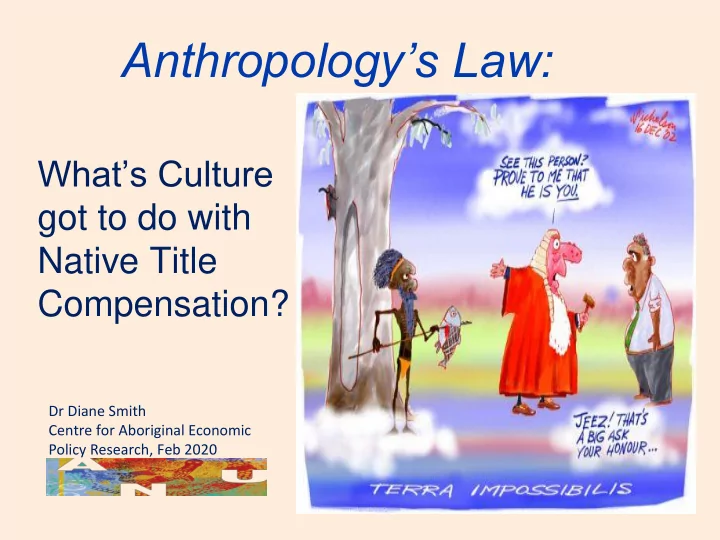
What’s Culture got to do with Native Title Compensation?
Dr Diane Smith Centre for Aboriginal Economic Policy Research, Feb 2020
Anthropologys Law: Whats Culture got to do with Native Title - - PowerPoint PPT Presentation
Anthropologys Law: Whats Culture got to do with Native Title Compensation? Dr Diane Smith Centre for Aboriginal Economic Policy Research, Feb 2020 A Provocation Paper 2 Culture: Anthropologys Law is that complex whole
Dr Diane Smith Centre for Aboriginal Economic Policy Research, Feb 2020
2
“… is that complex whole [not a fragmented bundle] which includes knowledge, belief, art, morals, law, custom, and any
(Aboriginal participant, regional governance workshop)
“… small remote Aboriginal communities [are] cultural museums… they might make people feel good but they leave Indigenous Australians without a viable future … its time to start treating Indigenous Australians like everyone else”
(Senator Amanda Vanstone, ABC Interview 2005)
3
Cultural loss refers to adverse impacts —as a result of damage inflicted on people — on the knowledge, beliefs, activities, capabilities, livelihoods and relationships which are engaged in, and transmitted by, individuals and groups and which reproduce their sense of place, personhood and grouphood. Cultural change may be self or collectively-generated and be naturalised as progress, development or creativity Value — Loss reveals value and preferences. Many types of value = culturally assigned; individually assigned; value assigned by supply and demand; value a collective group assigns; value by institutional fiat. Tangible and Intangible value. Value over time.
4
5
Posed as British “civilised” law versus “palm tree justice” of Indigenous “customary law” (R. Creyke et al
Laying Down the Law (10th ed Butterworth 2018)
Precedents out of date with current anthropology
(C. Bell and M. Asch Challenging Assumptions: The Impact
6
“The self-congratulatory and complacent reign of the legal process” … “[whose] interpretative community reveals a group of mostly white, male, professional and relatively wealthy exponents”
(P. Brest, Standford Law Review 1982)
A Very Dangerous Idea? ……….. Arguably, the culture of the common law itself needs to develop or ‘adjust’ to recognise that the ‘rule of law’ in the field of native title now includes Indigenous laws and principles for addressing the resolution of issues of rights. This means that Indigenous laws’ principles, precedents and rules for determining appropriate compensation for native title extinguishment should have procedural standing as such in courts, tribunals and negotiations.
7
8
Timber Creek: The Monty Pythonesque logic of the High Court:
= “particularly sparse reasoning”; Relying on its own Intuition The “community” as ‘reasonable man’ = “a vehicle for importing discriminatory views into the heart
9
➢ Lack of participatory parity for Indigenous comp laws & principles
➢ Legal ethnocentrism ➢ Invalid conceptualisation of property ➢ Invalid reductionism of categories ➢ The legacy of bundle of rights ➢ Narrow conceptualisation of value ➢ Impoverished understanding of loss ➢ The presumption of benefit and incrementalism ➢ Monetisation – “Just terms or Just Money” (C. Winnett) ➢ Challenges of, and limits to, time ➢ The phantom State ➢ Impacts of the compensation process - distributive spread & equity
10
“I chose cultural anthropology, since it offered the greatest
(Kurt Vonnegut, Palm Sunday: An Autobiographical Collage)
11
Foundation Principle = Participatory parity and standing Monetisation – Include a “Relativity Clause” Beyond monetisation …. Flexible conglomerate packages:
Clause”
Beyond the courts? Part of settlements & frameworks What might a more Holistic approach to value and loss look like?
12
13
14
Compensation for impairment or extinguishment of native title rights and interests remains one of the biggest pieces of unfinished business for Indigenous peoples that must be addressed as a matter of justice and reconciliation.
(Indigenous Social Justice Commissioner, Social Justice and Native Title Report 2016, p. 135)