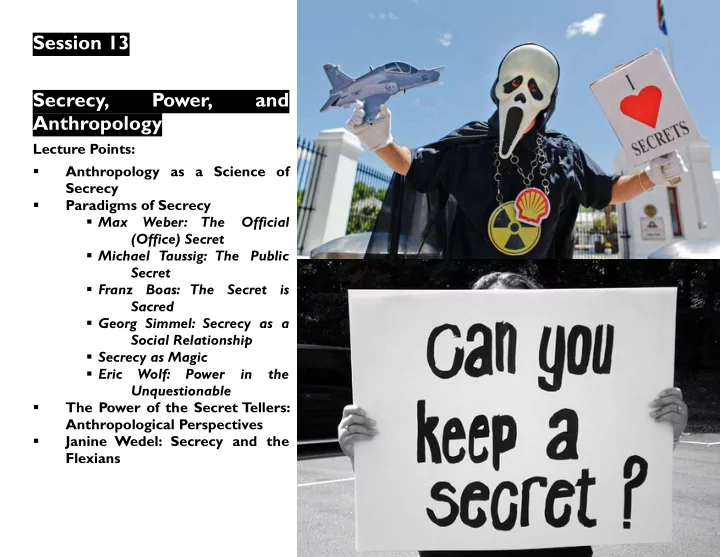
Session 13 Secrecy, Power, and Anthropology Lecture Points: - - PowerPoint PPT Presentation

session 13 secrecy power and anthropology
SMART_READER_LITE
LIVE PREVIEW

Session 13 Secrecy, Power, and Anthropology Lecture Points: - - PowerPoint PPT Presentation

Session 13 Secrecy, Power, and Anthropology Lecture Points: Anthropology as a Science of Secrecy Paradigms of Secrecy Max Weber: The Official (Office) Secret Michael Taussig: The Public Secret Franz Boas: The Secret is


slide-1
SLIDE 1

1

Session 13 Secrecy, Power, and Anthropology

Lecture Points:

  • Anthropology as a Science of

Secrecy

  • Paradigms of Secrecy
  • Max Weber: The

Official (Office) Secret

  • Michael Taussig: The Public

Secret

  • Franz Boas: The Secret is

Sacred

  • Georg Simmel: Secrecy as a

Social Relationship

  • Secrecy as Magic
  • Eric Wolf:

Power in the Unquestionable

  • The Power of the Secret T

ellers: Anthropological Perspectives

  • Janine Wedel: Secrecy and the

Flexians

slide-2
SLIDE 2

2

Information is power? Anthropology as a Science of Secrecy  a secret is worth sharing with everyone  Anthropology and secrecy: secret societies, cults of initiation, shamanic practices, worship, installation of priests, socio-linguistics of secrecy Paradigms of Secrecy  Structural-functionalist approaches (Fulton 1972; Little 1949, 1966; Watkins 1943)  Marxist approaches (La Fontaine 1977; Murphy 1980)  Freudian theories (Ottenberg 1989)  Semiotic approaches (Bellman 1984, p. 183)

slide-3
SLIDE 3

3

Max Weber: The Official (Office) Secret  the “official secret,” as a “specific invention of bureaucracy” (Weber, 1968, p. 992)  Moynihan (1999) “symbolic secrecy”—secrecy that serves no actual purpose other than to advance state power as an end in itself  “bureaucracy naturally welcomes a poorly informed and hence a powerless parliament—at least in so far as ignorance is somehow compatible with the bureaucracy’s own interests” (1968, p. 993). Michael Taussig: The Public Secret  the “(public) secret may…be defined as that which is generally known but cannot be spoken”  “the heterogeneity of the knowledge at stake here, with its knowing what not to know, its strategic absences, its resort to riddle and tone…a Swiss-cheese reality of unexpected shapes…of roller-coaster rides through the carnival grounds of ‘concealment and revelation,’ fuelled by the intensity of the ambivalence of active not-seeing” (Taussig, 1999, p. 50).

slide-4
SLIDE 4

4

 “there is no such thing as a secret”  “to see the secret as secret is to take it at face-value,” rather than a great “as if” without which “the public secret would evaporate” (Taussig, 1999, p. 7). Franz Boas: The Secret is Sacred  Taussig (1999, p. 7): “wherever there is power there is secrecy”  Secrecy as a social practice, a mechanism of social control, inclusion and exclusion, locking out competitors and locking in information as a privilege.  The higher the classification of information, the higher up is the level

  • f authorized speakers in a hierarchic system of control.
slide-5
SLIDE 5

5

Georg Simmel: Secrecy as a Social Relationship  judging the role of the secret not by its contents, its topics, but by the social rules that are employed to manufacture and contain the secret (1950, pp. 331, 335). Secrecy as Magic “I,______, in the Presence of the Mighty Ones, do of my own free will and accord most solemnly swear that I will ever keep secret and never reveal the secrets of the Art…. And may my weapons turn against me if I break this my solemn oath.” –Initiation oath in modern witchcraft, from The Witches’ Way, by Farrar and Farrar (quoted in Luhrmann, 1989, p. 131) “Secrecy also fosters a deferential attitude toward the contents of its secret knowledge. The concealment of magical names, words, images and gestures heightens the value of what has been hidden by implying that its power is too great to be lightly shared. Magicians make much of their moral responsibility in controlling access to magical knowledge” (Luhrmann, 1989, p. 142)

slide-6
SLIDE 6

6

“These secrets are too powerful to share, claim the morally righteous. Maybe so: but by keeping them secret one need never test their strength. To keep a secret creates the sense of the secret’s power without the need for its demonstration” (Luhrmann, 1989, pp. 142-143) “Secrecy fills an essential function in diverting disconfirmation, but the appeal of magic lies in the way it makes its members feel, and its positive psychological help can be considerable. Insofar as magic fails, secrecy masks the failure and perpetuates the illusion. Insofar as magic seems effective, therapeutic secrecy initiates its potency” (Luhrmann, 1989,p. 162) Eric Wolf: Power in the Unquestionable Eric Wolf (1990):  power to shape the arena in which interactions take place  “power that controls the settings in which people may show forth their potentialities and interact with others” (Wolf, 1990, p. 586)

slide-7
SLIDE 7

7

 “Power is implicated in meaning through its role in upholding one version of significance as true, fruitful, or beautiful, against other possibilities that may threaten truth, fruitfulness, or beauty. All cultures, however conceived, carve out significance and try to stabilize it against possible alternatives”  “to make them unquestionable, they are surrounded with sacredness” (Wolf, 1990, p. 593)  “We owe to social anthropology the insight that the arrangements of a society become most visible when they are challenged by crisis” (Wolf, 1990, p. 593)  “Secrecy is about control. It is about the individual possession of knowledge that others do not have, and from the psychological consequences of this privileged possession follow its effects in magical practice. Secrecy elevates the value of the thing concealed” (Luhrmann, 1989,p. 161)

slide-8
SLIDE 8

8

The Power of the Secret T ellers: Anthropological Perspectives

 It is not the content of the secret that matters, but rather the rules governing the telling of the secret. (Don Brenneis, Fred Myers, Michelle Rosaldo, Beryl Bellman). “In a close-knit society, secrecy depends for the most part on convention” (Gable, 1997, p. 227)  a secret is something everybody knows, but agrees not to talk about,

  • r not to talk about except in certain ways (Piot 1993).

 the content of secrets is often known by those who are not supposed to know” (Piot, 1993, p. 357) “The man who talks too much or who does not know how to keep a secret is for the African a being without value” (Zahan, 1979, p. 112, as quoted in Piot, 1993, p. 353).  rules  What defines a secret then is not its content, but who gets to tell it (see Brenneis and Myers 1984; Bellman 1984; Rosaldo 1984; Weiner 1984).

slide-9
SLIDE 9

9

 Who gets to tell it: rules, communal affect (Kasfir 2010; Gable, 1997, fn. 7, p. 230); help to reproduce the local in the face of the onslaught of globalization (De Jong, 2007; Kasfir, 2010).  Kasfir (2010): “In the face of ‘large-scale social formations’ (such as nation-states), small-scale societies must struggle to ‘produce context’ to matter, to be seen and heard and taken account of by the wider world, to enable action”  “ritual practices of secrecy have been able to survive colonial domination and postcolonial nationalism because they produce a sense of locality ‘from below’, as opposed to the calls for national citizenship coming from the government” (Kasfir, 2010)  How the secret gets told: “deep talk” (Bellman 1984: 76, 140; Weiner, 1984; Rosaldo, 1984) rhetorical play, “indirect speech,” as “slow” and “curvy” speech  How information attains the value of being secret (Luhrmann 1989: 161; Rappaport 1979).

slide-10
SLIDE 10

10

Janine Wedel: Secrecy and the Flexians

 insider-outsiders, “flexians” with multiple roles in state, non-state and parastatal organizations such as think tanks, academia, business, the media, and military contracting, with increased power  “privileged access to official information” (2009, pp. 1, 3)  post-Cold War redesign of governing—“the privatization of the state by the state”— “increased authority delegated to private players” which “has enabled them to become guardians of information once resting in the hands of state and international authorities” (Wedel, 2009, p. 4)

slide-11
SLIDE 11

11

References

Adams, Richard N. (1966). “Power and Power Domains.” America Latina, 9: 3-5, 8-11. Adams, Richard N. (1975). Energy and Structure: A Theory of Social Power. Austin: University of Texas Press. Arensberg, Conrad M. (1972). “Culture as Behavior: Structure and Emergence.” Annual Review of Anthropology, 1: 1-26. Bellman, Beryl. (1984). The Language of Secrecy. New Brunswick, NJ: Rutgers University Press. Bendix, Regina. (2003). Sleepers’ Secrets, Actors’ Revelations. Ethnologia Europaea, 33(2), 33-42. Brenneis, Donald, and Fred Myers, eds. (1984). Dangerous Words: Language and Politics in the Pacific. New York: New York University Press. Fulton, Richard. (1972). The Political Structures and Functions of Poro in Kpelle Society. American Anthropologist, 74:1218-1233.

slide-12
SLIDE 12

12

Gable, Eric. (1997). “A Secret Shared: Fieldwork and the Sinister in a West African Village.” Cultural Anthropology, 12 (2) May: 213-233 Goodman, Amy. (2011). Watch: Full Video of WikiLeaks’ Julian Assange & Philosopher Slavoj Žižek with Amy Goodman. Democracy Now! July 5. http://www.democracynow.org/blog/2011/7/5/watch_full_video_

  • f_wikileaks_julian_assange_philosopher_slavoj_iek_with_amy_good

man Horowitz, Morton. (1982). “The History

  • f

the Public/Private Distinction.” University of Pennsylvania Law Review, 130: 1423-1428. Kasfir, Sidney L. (2010). “Review of Masquerades of Modernity: Power and Secrecy in Casamance, Senegal by Ferdinand De Jong. Bloomington: Indiana University Press, 2007.” African Arts, 43 (2). La Fontaine, Jean. (1977). The Power of Rights. Man, 12:421-437. Little, Kenneth. (1949). The Role of the Secret Society in Cultural

  • Socialization. American Anthropologist, 51:199-212.
slide-13
SLIDE 13

13

————— . (1966). The Political Function of the Poro, Part 2. Africa, 36:62-71. Luhrmann, T. M. (1989). “The Magic of Secrecy.” Ethos, 17 (2) Jun: 131-165 Moynihan, Daniel Patrick. (1999). The Science of Secrecy. Delivered at MIT, Cambridge, Massachusetts, March 29. http://www.aaas.org/spp/secrecy/Presents/Moynihan.htm Murphy, William. (1980). Secret Knowledge as Property and Power in Kpelle Society: Elders versus Youth. Africa, 50:193-207. Ottenberg, Simon. (1989). Boyhood Rituals in an African Society. Seattle: University of Washington Press. Piot, Charles D. (1993). “Secrecy, Ambiguity, and the Everyday in Kabre Culture.” American Anthropologist, 95 (2) June: 353-370. Rappaport, Roy A. (1979). Ecology, Meaning, and Religion. Richmond, CA: North Atlantic Books. Rosaldo, Michelle. (1984). “Words that Are Moving: The Social Meanings

  • f Ilongot Verbal Art.” In Dangerous Words: Language and Politics in the
slide-14
SLIDE 14

14

Pacific, D. Brenneis and F. Myers, eds., pp. 131-160. New York: New York University Press. Simmel, Gorg. (1950). The Secret and the Secret Society. In Kurt H. Wolff (ed.), The Sociology of Georg Simmel (pp. 330-344). Glencoe, IL: The Free Press. Singer, Joseph. (1982). “The Legal Rights Debate in Analytical Jurisprudence from Bentham to Hohfeld.” University of Wisconsin Law Review: 975-1059. Stiglitz, Joseph E. (1999). On Liberty, the Right to Know, and Public Discourse: The Role of Transparency in Public Life. Oxford Amnesty Lecture, Oxford, U.K., January 27. http://derechoasaber.org.mx/documentos/pdf0116.pdf Taussig, Michael. (1999). Defacement: Public Secrecy and the Labor of the

  • Negative. Stanford, CA: Stanford University Press.

————— . (2006). Walter Benjamin’s Grave. Chicago: The University of Chicago Press.

slide-15
SLIDE 15

15

Watkins, Mark. (1943). The West African “Bush” School. American Journal

  • f Sociology, 48:666-675.

Weber, Max. (1968). Economy and Society: An Outline of Interpretive

  • Sociology. Gunther Roth and Claus Wittich (Eds.). Berkeley: University
  • f California Press.

Wedel, Janine R. (2009). Shadow Elite: How the World’s New Power Brokers Undermine Democracy, Government, and the Free Market. New York: Basic Books. Weiner, Annette. (1984). “From Words to Objects to Magic: ‘Hard Words’ and the Boundaries of Social Interaction.” In Dangerous Words: Language and Politics in the Pacific, D. Brenneis and F. Myers, eds., pp. 161-191. New York: New York University Press. Wolf, Eric R. (1990). “Distinguished Lecture: Facing Power – Old Insights, New Questions.” American Anthropologist, 92 (3) Sep: 586-596 Zahan, Dominique. (1979). The Religion, Spirituality, and Thought of Traditional Africa. Chicago: University of Chicago Press.