
SLIDE 1
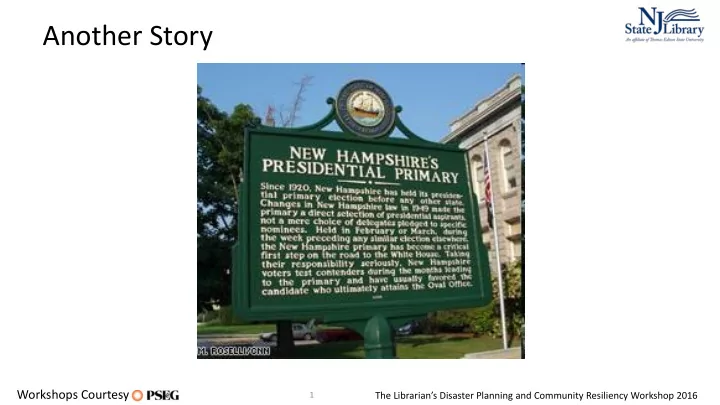
Another Story
1
The Librarian’s Disaster Planning and Community Resiliency Workshop 2016
Workshops Courtesy
Another Story Workshops Courtesy 1 The Librarians Disaster - - PowerPoint PPT Presentation
Another Story Workshops Courtesy 1 The Librarians Disaster Planning and Community Resiliency Workshop 2016 2008 Primary Season Workshops Courtesy 2 The Librarians Disaster Planning and Community Resiliency Workshop 2016 MS NBC Began
1
The Librarian’s Disaster Planning and Community Resiliency Workshop 2016
Workshops Courtesy
2
The Librarian’s Disaster Planning and Community Resiliency Workshop 2016
Workshops Courtesy
3
The Librarian’s Disaster Planning and Community Resiliency Workshop 2016
Workshops Courtesy
4
The Librarian’s Disaster Planning and Community Resiliency Workshop 2016
Workshops Courtesy
5
The Librarian’s Disaster Planning and Community Resiliency Workshop 2016
Workshops Courtesy
6
The Librarian’s Disaster Planning and Community Resiliency Workshop 2016
Workshops Courtesy
7
The Librarian’s Disaster Planning and Community Resiliency Workshop 2016
Workshops Courtesy
8
The Librarian’s Disaster Planning and Community Resiliency Workshop 2016
Workshops Courtesy
9
The Librarian’s Disaster Planning and Community Resiliency Workshop 2016
Workshops Courtesy
Named after Robert T. Stafford this Disaster Relief and Emergency Assistance Act (Stafford Act) is a United States federal law designed to bring an orderly and systemic means of federal natural disaster assistance for state and local governments in carrying out their responsibilities to aid citizens.
10
The Librarian’s Disaster Planning and Community Resiliency Workshop 2016
Workshops Courtesy
11
The Librarian’s Disaster Planning and Community Resiliency Workshop 2016
Workshops Courtesy
Term usually used for Information Technology
Sometimes viewed as representing a reactive mindset Unfair criticism since the focus is on failed equipment.
12
The Librarian’s Disaster Planning and Community Resiliency Workshop 2016
Workshops Courtesy
14
The Librarian’s Disaster Planning and Community Resiliency Workshop 2016
Workshops Courtesy
15
The Librarian’s Disaster Planning and Community Resiliency Workshop 2016
Workshops Courtesy
16
The Librarian’s Disaster Planning and Community Resiliency Workshop 2016
Workshops Courtesy
17
The Librarian’s Disaster Planning and Community Resiliency Workshop 2016
Workshops Courtesy
Focus is on maintaining minimally acceptable levels of operations Requires identification of key processes services, and records Uses 2 metrics to define acceptable “performance” against requirements
How long can you be shutdown?”
How much info can you afford to lose?”
Exceeding either metric is the definition of a disaster!
18
The Librarian’s Disaster Planning and Community Resiliency Workshop 2016
Workshops Courtesy
19
The Librarian’s Disaster Planning and Community Resiliency Workshop 2016
Workshops Courtesy
20
The Librarian’s Disaster Planning and Community Resiliency Workshop 2016
Workshops Courtesy
21
The Librarian’s Disaster Planning and Community Resiliency Workshop 2016
Workshops Courtesy
22
The Librarian’s Disaster Planning and Community Resiliency Workshop 2016
Workshops Courtesy
“You will continue to face risks!”
23
The Librarian’s Disaster Planning and Community Resiliency Workshop 2016
Workshops Courtesy
To create a resilient community society must accept the vital importance of preparedness. This may necessitate the creation
24
The Librarian’s Disaster Planning and Community Resiliency Workshop 2016
Workshops Courtesy
Argument Type How Used
Soft $ Hard $ Obvious Value
Non- Specific Identified Use General Operations
Ubiquitous (None Needed)
Culture Shift
Stage 1 Stage 2 Stage 3 Stage 4
Unclear
Optional New Fad or Trend
Targeted Use
“Killer App” Concept
Operational Integration
Reuse Re-purpose
Embedded Capability
25
The Librarian’s Disaster Planning and Community Resiliency Workshop 2016
Workshops Courtesy
Argument Type How Used
Non- Specific Identified Use General Operations Limited Use Market Penetration Business Tool Multi-functional & Indispensible
Soft $ Hard $ Obvious Value Ubiquitous (None Needed)
26
The Librarian’s Disaster Planning and Community Resiliency Workshop 2016
Workshops Courtesy
Argument Type How Used
Soft $ Hard $ Obvious Value
Non- Specific Identified Use General Operations
Ubiquitous (None Needed)
Entertainment & Education The “Killer App”
: Spreadsheets : Word Processing : Others
The Internet Fabric of Society
27
The Librarian’s Disaster Planning and Community Resiliency Workshop 2016
Workshops Courtesy
Argument Type How Used
Soft $ Hard $ Obvious Value
Non- Specific Identified Use General Operations
Ubiquitous (None Needed) Insurance
Disaster Recovery Continuity of Operations Resiliency
Committed Resources Dedicated Technology Budgeted Line Item Operationally Pervasive Optional Commitment
28
The Librarian’s Disaster Planning and Community Resiliency Workshop 2016
Workshops Courtesy
29
The Librarian’s Disaster Planning and Community Resiliency Workshop 2016
Workshops Courtesy
The works of two authors
Malcolm Gladwell: The Tipping Point Geoffrey A. Moore: Crossing the Chasm
30
The Librarian’s Disaster Planning and Community Resiliency Workshop 2016
Workshops Courtesy
31
The Librarian’s Disaster Planning and Community Resiliency Workshop 2016
Workshops Courtesy
32
The Librarian’s Disaster Planning and Community Resiliency Workshop 2016
Workshops Courtesy
33
The Librarian’s Disaster Planning and Community Resiliency Workshop 2016
Workshops Courtesy
34
The Librarian’s Disaster Planning and Community Resiliency Workshop 2016
Workshops Courtesy
35
The Librarian’s Disaster Planning and Community Resiliency Workshop 2016
Workshops Courtesy
You can be the shock absorber for your community
36
The Librarian’s Disaster Planning and Community Resiliency Workshop 2016
Workshops Courtesy
If a disruptions occurs and its impact on operations is transparent to your clients and other stakeholders!
37
The Librarian’s Disaster Planning and Community Resiliency Workshop 2016
Workshops Courtesy
38
The Librarian’s Disaster Planning and Community Resiliency Workshop 2016
Workshops Courtesy
39
The Librarian’s Disaster Planning and Community Resiliency Workshop 2016
Workshops Courtesy
40
The Librarian’s Disaster Planning and Community Resiliency Workshop 2016
Workshops Courtesy
41
The Librarian’s Disaster Planning and Community Resiliency Workshop 2016
42
The Librarian’s Disaster Planning and Community Resiliency Workshop 2016
Workshops Courtesy
43
The Librarian’s Disaster Planning and Community Resiliency Workshop 2016
Workshops Courtesy
44
The Librarian’s Disaster Planning and Community Resiliency Workshop 2016
Workshops Courtesy
45
The Librarian’s Disaster Planning and Community Resiliency Workshop 2016
Workshops Courtesy
Don Byrne dbyrne@METRIX411.com 603.714.4206
The Librarian’s Disaster Planning and Community Resiliency Workshop 2016
Workshops Courtesy
47
48
The Librarian’s Disaster Planning and Community Resiliency Workshop 2016
Workshops Courtesy
Pre-Planning Phase
49
The Librarian’s Disaster Planning and Community Resiliency Workshop 2016
Workshops Courtesy
50
The Librarian’s Disaster Planning and Community Resiliency Workshop 2016
Workshops Courtesy
51
The Librarian’s Disaster Planning and Community Resiliency Workshop 2016
Workshops Courtesy
event have on your operation?
with natural disasters
are another source of data
52
The Librarian’s Disaster Planning and Community Resiliency Workshop 2016
Workshops Courtesy
Urgent – Avoid if Possible More than $10,000 Important – Take Action Less than $10,000 Of Concern – Address Soon Less than $2,500 Noteworthy – Accept Risk Less than $500 Arbitrary $ Values
53
The Librarian’s Disaster Planning and Community Resiliency Workshop 2016
Workshops Courtesy
These are general values – not necessarily the value for your site.
Objective Probability X Impact = Total
Risk from Flooding 1 2 3 4 5 1 2 3 4 5 ## Risk of Widespread Disease 1 2 3 4 5 1 2 3 4 5 ## Risk from Fire 1 2 3 4 5 1 2 3 4 5 ## Risk of Criminal Activity 1 2 3 4 5 1 2 3 4 5 ##
54
The Librarian’s Disaster Planning and Community Resiliency Workshop 2016
Workshops Courtesy
Probability = Moderate (3) and Impact = High (4)
Risk of a Hurricane 1 2 3 4 5 1 2 3 4 5 12
55
The Librarian’s Disaster Planning and Community Resiliency Workshop 2016
Workshops Courtesy
Risk ALE Risk Appetite Budget Amt. ($)
Hurricane $10,000 25% = $ 2,500 Fire $20,000 5% = $ 1,000 Workplace Violence $ 600 10% = $ 60 Power Outage $ 3,000 20% = $ 600
Total Requested Budget $4,160
56
The Librarian’s Disaster Planning and Community Resiliency Workshop 2016
Workshops Courtesy
Now, adjust the values to match your risk appetite for each risk.
Staff Needs Protect the Facility Preserve Key Assets Ongoing Operations
How will this strategy affect your community service delivery capabilities?
57
The Librarian’s Disaster Planning and Community Resiliency Workshop 2016
Workshops Courtesy
Staff Needs Protect the Facility Preserve Key Assets Ongoing Operations
58
The Librarian’s Disaster Planning and Community Resiliency Workshop 2016
Workshops Courtesy