ANNOUNCEMENTS How does the angle (with respect ot the vertical) - - PowerPoint PPT Presentation

announcements
SMART_READER_LITE
LIVE PREVIEW

ANNOUNCEMENTS How does the angle (with respect ot the vertical) - - PowerPoint PPT Presentation

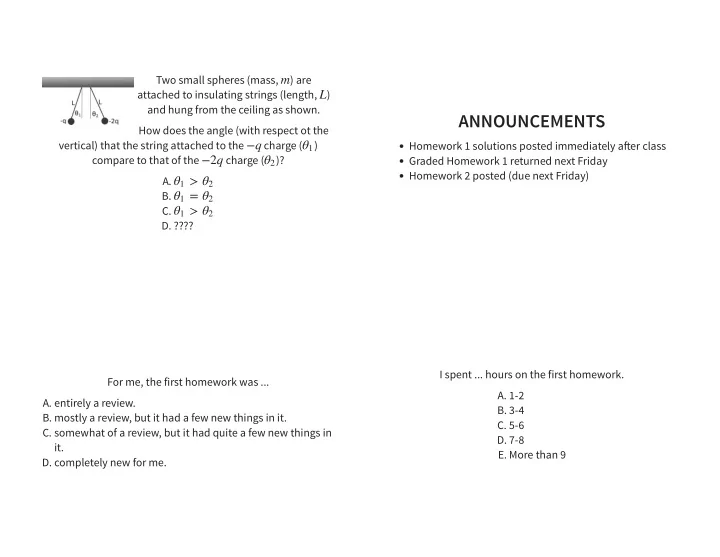
Two small spheres (mass, ) are attached to insulating strings (length, ) and hung from the ceiling as shown. ANNOUNCEMENTS How does the angle (with respect ot the vertical) that the string attached to the charge ( ) Homework 1 solutions


slide-1
SLIDE 1

Two small spheres (mass, ) are attached to insulating strings (length, ) and hung from the ceiling as shown. How does the angle (with respect ot the vertical) that the string attached to the charge ( ) compare to that of the charge ( )? A. B. C.

  • D. ????

ANNOUNCEMENTS

Homework 1 solutions posted immediately aer class Graded Homework 1 returned next Friday Homework 2 posted (due next Friday) For me, the first homework was ...

  • A. entirely a review.
  • B. mostly a review, but it had a few new things in it.
  • C. somewhat of a review, but it had quite a few new things in

it.

  • D. completely new for me.

I spent ... hours on the first homework.

  • A. 1-2
  • B. 3-4
  • C. 5-6
  • D. 7-8
  • E. More than 9
slide-2
SLIDE 2

CLASSICAL ELECTROMAGNETISM

24 orders of magnitude

ELECTROSTATICS

5 charges, q, are arranged in a regular pentagon, as shown. What is the E field at the center?

  • A. Zero
  • B. Non-zero
  • C. Really need trig and a calculator to decide

1 of the 5 charges has been removed, as shown. What’s the E field at the center? A. B.

  • C. 0
  • D. Something entirely different!
  • E. This is a nasty problem which I need more time to solve
slide-3
SLIDE 3

If all the charges live on a line (1-D), use: Draw your own picture. What's ? To find the E-field at P from a thin line (uniform charge density ): What is ? A. B. C. D.

  • E. Something else

, so: A. B. C. D.

  • E. Something else

What do you expect to happen to the field as you get really far from the rod? A. goes to 0. B. begins to look like a point charge. C. goes to .

  • D. More than one of these is true.
  • E. I can't tell what should happen to

.

slide-4
SLIDE 4

Activity: You determine that a particular electrostatics problem cannot be integrated analytically. How do you instruct a computer to do it for you? Work with those around you to come up with a series of instructions (in plain words) to tell the computer to do it. Given the location of the little bit of charge ( ), what is ? A. B. C.

  • D. Something else