PY502, Computational Physics Instructor: Prof. Anders Sandvik - - PowerPoint PPT Presentation

py502 computational physics
SMART_READER_LITE
LIVE PREVIEW

PY502, Computational Physics Instructor: Prof. Anders Sandvik - - PowerPoint PPT Presentation

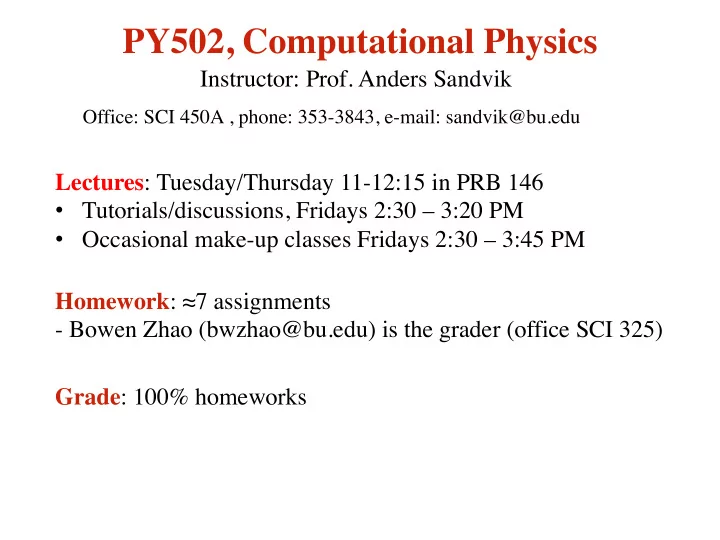
PY502, Computational Physics Instructor: Prof. Anders Sandvik Office: SCI 450A , phone: 353-3843, e-mail: sandvik@bu.edu Lectures : Tuesday/Thursday 11-12:15 in PRB 146 Tutorials/discussions, Fridays 2:30 3:20 PM Occasional make-up


slide-1
SLIDE 1

Homework: ≈7 assignments

  • Bowen Zhao (bwzhao@bu.edu) is the grader (office SCI 325)

Grade: 100% homeworks

PY502, Computational Physics

Instructor: Prof. Anders Sandvik

Office: SCI 450A , phone: 353-3843, e-mail: sandvik@bu.edu

Lectures: Tuesday/Thursday 11-12:15 in PRB 146

  • Tutorials/discussions, Fridays 2:30 – 3:20 PM
  • Occasional make-up classes Fridays 2:30 – 3:45 PM
slide-2
SLIDE 2

Submitting homework

Use e-mail to submit programs: py502@buphy.bu.edu

  • Include the program(s) as attachment(s)!
  • Name your programs: e.g., hwx_lastname.f90

Turn in write-up (hardcopy) report to instructor or grader

Course web site

http://physics.bu.edu/py502

  • Lecture notes
  • Lecture presentations
  • Example program
  • Homework assignments and solutions
  • Messages (“Course News”)

Some discussion/collaboration on homework problems is allowed, but each student has to turn in her/his independently written programs and reports.

slide-3
SLIDE 3

§ Bring your own laptop to class if possible

  • operating system: linux/unix (similar under OSX)
  • install emulator software if you use Windows
  • computer help from Guoan Hu (office PRB 453)

§ Fortran 90 and Julia will be used in lectures § You can possibly use other languages for homeworks § Introduction to Fortran 90 & Julia will be given (~4 lectures) § Extensive background in programming not needed § Some Unix/Linux knowledge assumed (e.g., text editing) § Come to office hours if you need help!

Computers and programming language

slide-4
SLIDE 4

Recommended reading

  • Computational Physics, by J. M. Thijssen
  • Computational Physics, by N. J. Giordano and H. Nakanishi
  • Fortran 90/95 Explained, by M. Metcalf and J. Reid
  • Fortran 90/95 For Scientists and Engineers, by S. Chapman
  • Numerical Recipes, by W. H. Press et al.

(free on-line with codes in many languages: http://www.nr.com/) On-line resources (e.g., Julia); see course web site

Lecture notes

  • Will be posted on the web site ahead of the lectures
  • No additional required text
slide-5
SLIDE 5

What is computational physics?

  • “Scientific computing” in physics
  • Studies of models of physical systems using computers
  • Numerical solutions of equations that cannot be done analytically
  • Direct studies of models to “simulate” a system
  • Most subfields of physics use some computations, e.g.,
  • Dynamics of solar systems, galaxies, etc
  • Studies of mechanical models of earthquakes
  • Fluid dynamics; turbulence
  • Molecular dynamics of gases, fluids
  • Electrostatics and dynamics (Maxwell’s equations)
  • Electronic structure of materials
  • Statistical mechanics of polymers, magnetic systems, etc.
  • Lattice gauge theory (numerical QCD)
  • Some times considered third “branch” of physics
  • Experimental, theoretical, computational
  • Most physicists need to do some computational work
slide-6
SLIDE 6

Topics covered in PY502

  • The Fortran 90/95 and Julia programming language
  • Numerical integration
  • Numerical solution of differential equations
  • classical and quantum mechanics problems
  • Monte Carlo simulations (statistical mechanics)
  • Basic methods for quantum many-body (lattice) systems

Goals

  • Learn the basics of the above techniques
  • Gain proficiency in scientific computing in general
slide-7
SLIDE 7

Teaser: The last topic of the course will combine several

  • f the previous methods we have learned to study:

Quantum Annealing (a paradigm for quantum computing) You will learn what is going on (supposedly…) in machines made by D-wave, Google,….