Announcements CS 188: Artificial Intelligence Spring 2011 Practice - - PDF document

announcements cs 188 artificial intelligence
SMART_READER_LITE
LIVE PREVIEW

Announcements CS 188: Artificial Intelligence Spring 2011 Practice - - PDF document

Announcements CS 188: Artificial Intelligence Spring 2011 Practice Final Out (optional) Similar extra credit system as practice midterm Contest (optional): Advanced Applications: Tomorrow night 11pm deadline for final


slide-1
SLIDE 1

1

CS 188: Artificial Intelligence

Spring 2011

Advanced Applications: Robotics

Pieter Abbeel – UC Berkeley A few slides from Sebastian Thrun, Dan Klein

1

Announcements

§ Practice Final Out (optional)

§ Similar extra credit system as practice midterm

§ Contest (optional):

§ Tomorrow night 11pm deadline for final submission

§ Project 5 Classification is out: due next week Friday

So Far Mostly Foundational Methods

3

Advanced Applications

4

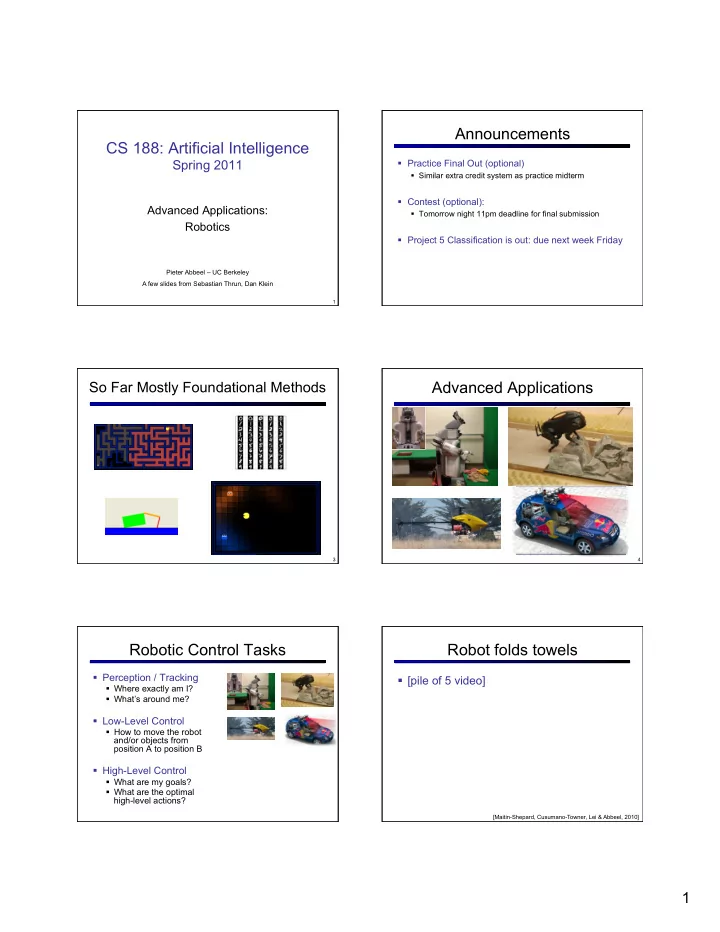
Robotic Control Tasks

§ Perception / Tracking

§ Where exactly am I? § What’s around me?

§ Low-Level Control

§ How to move the robot and/or objects from position A to position B

§ High-Level Control

§ What are my goals? § What are the optimal high-level actions?

Robot folds towels

§ [pile of 5 video]

6

[Maitin-Shepard, Cusumano-Towner, Lei & Abbeel, 2010]

slide-2
SLIDE 2

2

Low-Level Planning

§ Low-level: move from configuration A to configuration B

A Simple Robot Arm

§ Configuration Space

§ What are the natural coordinates for specifying the robot’s configuration? § These are the configuration space coordinates § Can’t necessarily control all degrees of freedom directly

§ Work Space

§ What are the natural coordinates for specifying the effector tip’s position? § These are the work space coordinates

Coordinate Systems

§ Workspace:

§ The world’s (x, y) system § Obstacles specified here

§ Configuration space

§ The robot’s state § Planning happens here § Obstacles can be projected to here

Obstacles in C-Space

§ What / where are the obstacles? § Remaining space is free space

Two-link manipulator

d1 d2

X X Y Y

α2 α1 (x, y)

Example Obstacles in C-Space

slide-3
SLIDE 3

3

Two-link manipulator

§ Demo

http://www-inst.eecs.berkeley.edu/~cs188/fa08/demos/robot.html

Probabilistic Roadmaps

§ Idea: sample random points as nodes in a visibility graph § This gives probabilistic roadmaps

§ Very successful in practice § Lets you add points where you need them § If insufficient points, incomplete

  • r weird paths

Robotic Control Tasks

§ Perception / Tracking

§ Where exactly am I? § What’s around me?

§ Low-Level Control

§ How to move the robot and/or objects from position A to position B

§ High-Level Control

§ What are my goals? § What are the optimal high-level actions?

Perception

18

  • 1. Find a point see in two camera views
  • 2. Find 3D coordinates by finding the intersection of the rays

19 20

slide-4
SLIDE 4

4

21 22 23 24 25 26

slide-5
SLIDE 5

5

27 28 29 30 31 32

slide-6
SLIDE 6

6

33 34 35 36

Motivating Example

n How do we specify a task like this? [demo: autorotate / tictoc]

Autonomous Helicopter Flight

§ Key challenges:

§ Track helicopter position and orientation during flight § Decide on control inputs to send to helicopter

slide-7
SLIDE 7

7

Autonomous Helicopter Setup

On-board inertial measurement unit (IMU) Send out controls to helicopter Position

HMM for Tracking the Helicopter

42

§ State: § Measurements:

§ 3-D coordinates from vision, 3-axis magnetometer, 3-axis gyro, 3-axis accelerometer

§ Transitions (dynamics): [time elapse update]

§ st+1 = f (st, at) + wt

[f encodes helicopter dynamics] [w is a probabilistic noise model]

s = (x, y, z, Á, µ, Ã, ˙ x, ˙ y, ˙ z, ˙ Á, ˙ µ, ˙ Ã)

Helicopter MDP

§ State: § Actions (control inputs):

§ alon : Main rotor longitudinal cyclic pitch control (affects pitch rate) § alat : Main rotor latitudinal cyclic pitch control (affects roll rate) § acoll : Main rotor collective pitch (affects main rotor thrust) § arud : Tail rotor collective pitch (affects tail rotor thrust)

§ Transitions (dynamics):

§ st+1 = f (st, at) + wt

[f encodes helicopter dynamics] [w is a probabilistic noise model]

§ Can we solve the MDP yet?

s = (x, y, z, Á, µ, Ã, ˙ x, ˙ y, ˙ z, ˙ Á, ˙ µ, ˙ Ã)

Problem: What’s the Reward?

§ Rewards for hovering: § Rewards for “Tic-Toc”?

§ Problem: what’s the target trajectory? § Just write it down by hand?

44

[demo: hover] [demo: bad]

Helicopter Apprenticeship?

47

[demo: unaligned]

Probabilistic Alignment using a Bayes’ Net

§ Intended trajectory satisfies dynamics. § Expert trajectory is a noisy observation of one of the hidden states.

§ But we don’t know exactly which one.

Intended trajectory Expert demonstrations Time indices

[Coates, Abbeel & Ng, 2008]

slide-8
SLIDE 8

8

Alignment of Samples

§ Result: inferred sequence is much cleaner!

49

[demo: alignment]

Final Behavior

50

[demo: airshow]

Advanced Applications

51

§ Low-level control problem: moving a foot into a new location à similar search as for moving robot arm § High-level control problem: where should we place the feet?

§ Reward function R(x) = w . f(s) [25 features]

Quadruped

[Kolter, Abbeel & Ng, 2008]

Apprenticeship Learning

§ Goal: learn reward function from expert demonstration § Assume § Get expert demonstrations § Guess initial policy § Repeat:

§ Find w which make the expert better than § Solve MDP for new weights w:

53

Without learning

slide-9
SLIDE 9

9

With learned reward function Advanced Applications

57

Autonomous Vehicles

Autonomous vehicle slides adapted from Sebastian Thrun

§

150 mile off-road robot race across the Mojave desert

§

Natural and manmade hazards

§

No driver, no remote control

§

No dynamic passing

Grand Challenge: Barstow, CA, to Primm, NV

Inside an Autonomous Car

5 Lasers Camera Radar E-stop GPS GPS compass 6 Computers IMU Steering motor Control Screen

1 2 3

Readings: No Obstacles

slide-10
SLIDE 10

10

ΔZ

Readings: Obstacles

Raw Measurements: 12.6% false positives

Obstacle Detection

Trigger if |Zi-Zj| > 15cm for nearby zi, zj

xt+2 xt xt+1 zt+2 zt zt+1

Probabilistic Error Model

GPS IMU GPS IMU GPS IMU

HMM Inference: 0.02% false positives Raw Measurements: 12.6% false positives

HMMs for Detection