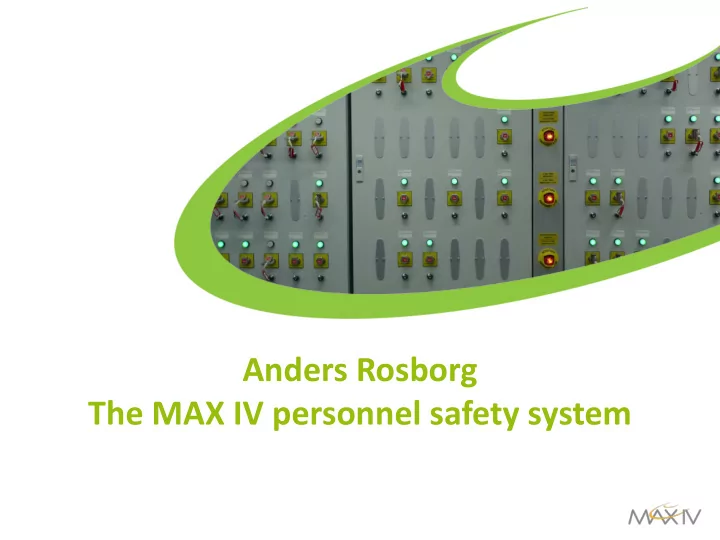
Anders Rosborg The MAX IV personnel safety system Overview PSS - - PowerPoint PPT Presentation
Anders Rosborg The MAX IV personnel safety system Overview PSS areas Control of radiation sources Design principles Searching beamline hutches Searching accelerator areas Top-up The MAX IV personnel safety system /
Overview
- PSS areas
- Control of radiation sources
- Design principles
- Searching beamline hutches
- Searching accelerator areas
- Top-up
The MAX IV personnel safety system / Overview
PSS areas
PSS areas
The MAX IV personnel safety system / PSS areas / PSS areas
Klystron gallery
The MAX IV personnel safety system / PSS areas / Klystron gallery
Gun test
The MAX IV personnel safety system / PSS areas / Gun test
Linear accelerator (linac)
The MAX IV personnel safety system / PSS areas / Linear accelerator (linac)
Short pulse facility (SPF)
The MAX IV personnel safety system / PSS areas / Short pulse facility (SPF)
1.5 GeV ring (R1)
The MAX IV personnel safety system / PSS areas / 1.5 GeV ring
3 GeV ring (R3)
The MAX IV personnel safety system / PSS areas / 3 GeV ring
Cavity test
The MAX IV personnel safety system / PSS areas / Cavity test
SPF beamlines
The MAX IV personnel safety system / PSS areas / SPF beamlines
1.5 GeV ring beamlines
The MAX IV personnel safety system / PSS areas / 1.5 GeV ring beamlines
3 GeV ring soft x-ray beamlines
The MAX IV personnel safety system / PSS areas / 3 GeV ring soft x-ray beamlines
3 GeV ring hard x-ray beamlines
The MAX IV personnel safety system / PSS areas / 3 GeV ring hard x-ray beamlines
Control of radiation sources
Contactors
Contactors are used by the PSS to control the three-phase power to the equipment that accelerate the electrons.
- Modulator contactors
Controls the three-phase power to the modulators powering the electron guns and the linac structures.
- RF transmitter contactors
Controls the three-phase power to the RF transmitters powering the RF cavities in the storage rings.
The MAX IV personnel safety system / Control of radiation sources / Contactors
Electron beam dumps
Electron beam dumps are used by the PSS to control which areas of the facility the electron beams can reach.
- Transfer line to SPF
BC2 beam dump and BC2 magnets determine if the electron beam can reach the SPF.
- Transfer line to 1.5 GeV ring
TR1 beam dumps determine if the electron beam can reach the 1.5 GeV ring.
- Transfer line to 3 GeV ring
TR3 beam dumps determine if the electron beam can reach the 3 GeV ring.
The MAX IV personnel safety system / Control of radiation sources / Electron beam dumps
Photon beam shutters
Photon beam shutters are used by the PSS to control which areas of the facility the photon beams can reach.
- Front-end beam shutters
Two shutters per beamline determine if the photon beam can reach the
- ptics hutch. Heat absorber
monitored but not controlled by PSS.
- Monochromatic beam shutters
At the hard x-ray beamlines, two shutters per beamline determine if the photon beam can reach the experimental hutch. Additional pairs
- f shutters at beamlines with
additional experimental hutches.
The MAX IV personnel safety system / Control of radiation sources / Photon beam shutters
Gun test modulator
The MAX IV personnel safety system / Control of radiation sources / Gun test modulator
Linac modulators (transfer lines closed)
The MAX IV personnel safety system / Control of radiation sources / Linac modulators (transfer lines closed)
Linac modulators (transfer lines closed)
To accommodate access for maintenance
- etc. the transfer line shafts from the linac
to the 1.5 GeV ring and from the linac to the 3 GeV ring are large. A metal gate in each transfer line divide the linac PSS area and the PSS areas of the rings. Radiation from electron losses in the linac can reach the transfer line and the nearby sections in the ring tunnel. There is no access to the top subarea of each ring unless all linac modulator contactors are open.
The MAX IV personnel safety system / Control of radiation sources / Linac modulators (transfer lines closed)
Linac modulators (transfer line to SPF open)
The MAX IV personnel safety system / Control of radiation sources / Linac modulators (transfer line to SPF open)
Linac modulators (transfer line to R1 open)
The MAX IV personnel safety system / Control of radiation sources / Linac modulators (transfer line to R1 open)
Linac modulators (transfer line to R3 open)
The MAX IV personnel safety system / Control of radiation sources / Linac modulators (transfer line to R3 open)
1.5 GeV ring RF transmitters
The MAX IV personnel safety system / Control of radiation sources / 1.5 GeV ring RF transmitters
3 GeV ring RF transmitters
The MAX IV personnel safety system / Control of radiation sources / 3 GeV ring RF transmitters
3 GeV ring RF transmitters
One of the RF cavities in the 3 GeV ring is situated on top of the transfer line from the linac to the 3 GeV ring. Additional lead shielding is mounted below the RF cavity to provide shielding towards the linac PSS area. Access to the linac is allowed even when the RF cavities in the 3 GeV ring are running and when there is a stored electron beam.
The MAX IV personnel safety system / Control of radiation sources / 3 GeV ring RF transmitters
Cavity test RF transmitters
The MAX IV personnel safety system / Control of radiation sources / Cavity test RF transmitters
Front-end beam shutters
The MAX IV personnel safety system / Control of radiation sources / Front-end beam shutters
Monochromatic beam shutters (1st pair)
The MAX IV personnel safety system / Control of radiation sources / Monochromatic beam shutters (1st pair)
Monochromatic beam shutters (2nd pair)
The MAX IV personnel safety system / Control of radiation sources / Monochromatic beam shutters (2nd pair)
Control room keys
Keys in the control room are used to enable the running of different parts of the facility (contactors, electron beam dumps, photon beam shutters). The keys also enable different modes of operation (linac frequency, top-up, I/O tests etc.). During operation of the MAX IV facility, at least one person with the skills to identify and the mandate to address deficiencies in the radiation safety must be physically present at the facility. If no
- ne is present, all keys must be removed.
Emergency stops located in the control room shut down the sources of ionizing radiation at different parts of the facility.
The MAX IV personnel safety system / Control of radiation sources / Control room keys
Control room keys
The MAX IV personnel safety system / Control of radiation sources / Control room keys
Design principles
Design principles
The critical safety functions are designed based on the general design principles of ISO 13849-1 to reach a structure according to category 4 (Cat. 4) and performance level e (PLe). Requires use of well-tried safety principles, components with high mean time to dangerous failure, adequate measures against common cause failures and high diagnostic coverage. PFHD [1/h] = Average probability of dangerous failure per hour
The MAX IV personnel safety system / Design principles / Design principles
PLe PLd 10-8 SIL3 PLc SIL2 PFHD [1/h] High contribution to risk reduction Low contribution to risk reduction 10-6 10-7 PLb PLa SIL1 10-5 10-4
Safety PLCs with distributed I/O nodes
The personnel safety system for the accelerators and beamlines is based on Safety PLCs working in a two processor- architecture with one primary and one partner processor. The safety PLCs communicate over Ethernet/IP with distributed I/O nodes equipped with safe and standard I/O cards to which the PSS components are connected. In total, the radiation safety related PSS consists of 5675 I/O signals, out of which 3077 are safe signals, distributed over 76 I/O nodes and 15 safety PLCs.
The MAX IV personnel safety system / Design principles / Safety PLCs with distributed I/O nodes
PSS division
The MAX IV personnel safety system / Design principles / PSS division
I/O signals
The MAX IV personnel safety system / Design principles / I/O signals
Example of safety function
Opening a linear accelerator main access door during operation causes a section
- f the linear accelerator to shut down.
- Each door is monitored using a two-
channel interlock switch.
- The input and output signals are
handled in instructions in the safe part
- f the PLC code of the safety PLC.
- Three-phase power to each modulator
is controlled by a pair of large contac-
- tors. Each large contactor is controlled
by a small contactor. Mechanically linked positively guided feedback contact on each contactor monitored.
The MAX IV personnel safety system / Design principles / Example of safety function
Example of safety function
Opening a linear accelerator main access door during operation causes a section
- f the linear accelerator to shut down.
- Interlock switch: SensaGuard
PFHD [1/h] = 1.12·10-9
- POINT Guard I/O: 1734-IB8S
PFHD [1/h] = 5.10·10-10 Safety PLC: 1756-L7xS & L7SP PFHD [1/h] = 1.2·10-9 POINT Guard I/O: 1734-OB8S PFHD [1/h] = 5.14·10-10
- Output contactors (365 cycles/year):
PFHD [1/h] = 9.05·10-10 PFHD [1/h] = 4.25·10-9
The MAX IV personnel safety system / Design principles / Example of safety function
PLe PLd 10-8 PLc PFHD [1/h] High contribution to risk reduction Low contribution to risk reduction 10-6 10-7 PLb PLa 10-5 10-4
Searching beamline hutches
Before radiation is allowed in a beamline hutch the hutch must be searched. All doors are monitored during the
- search. The door used to exit the area
can stay open, but is monitored by a light
- curtain. If a door is opened during the
search or if the light curtain detects an
- bject the search is aborted.
Orange warning lights inside and orange information lights outside the hutch flashes during the search and are lit when the search is completed. The search ends with a 30 second warning
- period. During the search and warning
period sirens inside the hutch are active.
The MAX IV personnel safety system / Searching beamline hutches / Searching beamline hutches
Example: HIPPIE optics hutch
The MAX IV personnel safety system / Searching beamline hutches / Example: HIPPIE optics hutch
Example: HIPPIE optics hutch
- 1. If all conditions are in place to start a
search, the search is initiated when the (green) initiate search button is pressed.
- 2. The (blue) search buttons must be
pressed in a specified order within specified time limits. A double press is required at locations with mirrors.
- 3. When the (white) exit during search
buttons is pressed, the light curtain must be passed within 10 seconds and the door closed within an additional 20 seconds.
- 4. The search is completed by pressing
the (yellow) complete search button.
The MAX IV personnel safety system / Searching beamline hutches / Example: HIPPIE optics hutch
1 2A,B 2C,D 3 4
Example: HIPPIE optics hutch
The MAX IV personnel safety system / Searching beamline hutches / Example: HIPPIE optics hutch
Example: HIPPIE optics hutch
The MAX IV personnel safety system / Searching beamline hutches / Example: HIPPIE optics hutch
Example: BALDER experimental hutch
The MAX IV personnel safety system / Searching beamline hutches / Example: BALDER experimental hutch
Example: BALDER experimental hutch
- 1. If all conditions are in place to start a
search, the search is initiated when the (green) initiate search button is pressed.
- 2. The three (blue) search button must
be pressed in a specified order within specified time limits.
- 3. When the (white) exit during search
buttons is pressed, the light curtain must be passed within 10 seconds and the door closed within an additional 20 seconds.
- 4. The search is completed by pressing
the (yellow) complete search button.
The MAX IV personnel safety system / Searching beamline hutches / Example: BALDER experimental hutch
1 2A 2B 2C 4 3
Example: BALDER experimental hutch
The MAX IV personnel safety system / Searching beamline hutches / Example: BALDER experimental hutch
User chicanes
User chicanes are installed at the experimental hutches. The chicanes are monitored by interlock switches. To unlock the chicane, a key button next to the chicane is pressed. As long as the hutch is not searched, the green light is lit and the electromagnetic lock is deactivated during 10 seconds. If the hutch is searched, the red light is lit and the magnet stays active. Both sides of the user chicane can be open at the same time. It is not possible to initiate a search of the hutch unless both sides of the user chicane are closed.
The MAX IV personnel safety system / Searching beamline hutches / User chicanes
Searching accelerator areas
Before radiation is allowed in an accelerator area the area must be searched. The Swedish legislation does not allow for “controlled access” to the areas, hence a full search must always be
- performed. The search procedure has
been designed with this in mind, with search buttons and mirrors strategically placed to ensure that the area can be inspected visually by one person within a reasonable time. In addition, the larger accelerator areas are segmented into subareas that can be searched separately.
The MAX IV personnel safety system / Searching accelerator areas / Searching accelerator areas
Metal gate (closed)
The MAX IV personnel safety system / Searching accelerator areas / Metal gate (closed)
Metal gate (with open door)
The MAX IV personnel safety system / Searching accelerator areas / Metal gate (with open door)
Metal gate (fully open)
The MAX IV personnel safety system / Searching accelerator areas / Metal gate (fully open)
Searching accelerator areas
The search procedure at the accelerator areas is similar to the procedure at the
- beamlines. One difference is that instead
- f a warning period after a search is
completed, the search must be acknow- ledged at one of the main access points. Searches can be performed in up to two different directions (depending on which initiate search button was used) and up to three different exits can be used. After an initial time period, all doors are monitored during the search. If a door is
- pened the search is aborted.
The MAX IV personnel safety system / Searching accelerator areas / Searching accelerator areas
Example: 3 GeV ring subarea #5 (R35)
The MAX IV personnel safety system / Searching accelerator areas / Example: 3 GeV ring subarea #5 (R35)
Example: R35 (search variant 1)
- 1. If all conditions are in place to start a
search, the search is initiated when
- ne of the two (green) initiate search
buttons are pressed.
- 2. The search buttons must be pressed
in a specified order within specified time limits. To guide the person performing the search the button light starts flashing when the button can be pressed. There is a minimum time before a button starts flashing and can be pressed, to encourage walking slowly and doing a thorough
- search. At locations with mirrors, a
double press (minimum 5 seconds between) is required.
The MAX IV personnel safety system / Searching accelerator areas / Example: R35 (search variant 1)
1 2P 2A,B 2C,D 2E,F 2G,H 2I,J 2K,L 2M,N 2O,Q 2R,S 2T,U
Example: R35 (search variant 2)
- 1. If all conditions are in place to start a
search, the search is initiated when
- ne of the two (green) initiate search
buttons are pressed.
- 2. The search buttons must be pressed
in a specified order within specified time limits. To guide the person performing the search the button light starts flashing when the button can be pressed. There is a minimum time before a button starts flashing and can be pressed, to encourage walking slowly and doing a thorough
- search. At locations with mirrors, a
double press (minimum 5 seconds between) is required.
The MAX IV personnel safety system / Searching accelerator areas / Example: R35 (search variant 2)
1 2T,U 2R,S 2P,Q 2N,O 2L,M 2J,K 2E,F 2C,D 2A,B 2H 2G,I
Example: R35 (exit variants)
- 3. There are three different exit
possibilities from R35. When one of the three (white) exit during search buttons is pressed, the monitoring of the nearby door is temporarily
- halted. The door must be opened
within 10 seconds after the button is pressed and closed again within 10 seconds after it was opened.
- 4. The search is completed by pressing
the corresponding (yellow) complete search button within 20 seconds of closing the nearby door.
The MAX IV personnel safety system / Searching accelerator areas / Example: R35 (exit variants)
3 4 3 3 4 4
Example: R35 (acknowledge search)
- 5. The search can be acknowledged at
- ne of the four main access points to
the 3 GeV ring. The search is ack- nowledged by pressing the (yellow) R35 acknowledge search button, pressing “#” on the second passage system card reader, swiping a MAX ID card to the reader and pressing the personal four digit code. Several subareas can be acknowledged at the same time by pressing several acknowledge search buttons before “#” is pressed on the card reader. To acknowledge searches requires a spe- cial authorization in the passage system.
The MAX IV personnel safety system / Searching accelerator areas / Example: R35 (acknowledge search)
5 5 5 5
Example: 3 GeV ring
The MAX IV personnel safety system / Searching accelerator areas / Example: 3 GeV ring
Example: 3 GeV ring
The MAX IV personnel safety system / Searching accelerator areas / Example: 3 GeV ring
Example: 3 GeV ring
The MAX IV personnel safety system / Searching accelerator areas / Example: 3 GeV ring
Example: Transfer line to 3 GeV ring
Template for safety trainings / Example page (Calibri 10 pt / MAX IV dark grey)
Example: 1.5 GeV ring
The MAX IV personnel safety system / Searching accelerator areas / Example: 1.5 GeV ring
Example: 1.5 GeV ring
The MAX IV personnel safety system / Searching accelerator areas / Example: 1.5 GeV ring
Example: Linac
The MAX IV personnel safety system / Searching accelerator areas / Example: Linac
Example: Linac
The MAX IV personnel safety system / Searching accelerator areas / Example: Linac
Top up
Top up
A permanent magnet is installed in each front-end. Any electron beam passing the magnet would be deflected away from the hole in the ratchet end wall. In addition, for top-up to be allowed, the following conditions must be in place:
- Top-up enable key in place
Key located in control room.
- Stored electron beam
One-channel monitoring via DCCT.
- Dipole magnets on
Two-channel monitoring of the current in each power cable.
The MAX IV personnel safety system / Top up / Top up