Positive definite max-QP Recall max-cut max vE(1-v) s.t. 0 v - - PowerPoint PPT Presentation

positive definite max qp
SMART_READER_LITE
LIVE PREVIEW

Positive definite max-QP Recall max-cut max vE(1-v) s.t. 0 v - - PowerPoint PPT Presentation

Positive definite max-QP Recall max-cut max vE(1-v) s.t. 0 v 1 max v(E + kI)(1-v) s.t. 0 v 1 LASSO revisited LASSO objective terms Support vector machines Maximizing margin margin = y i (x i . w - b)


slide-1
SLIDE 1

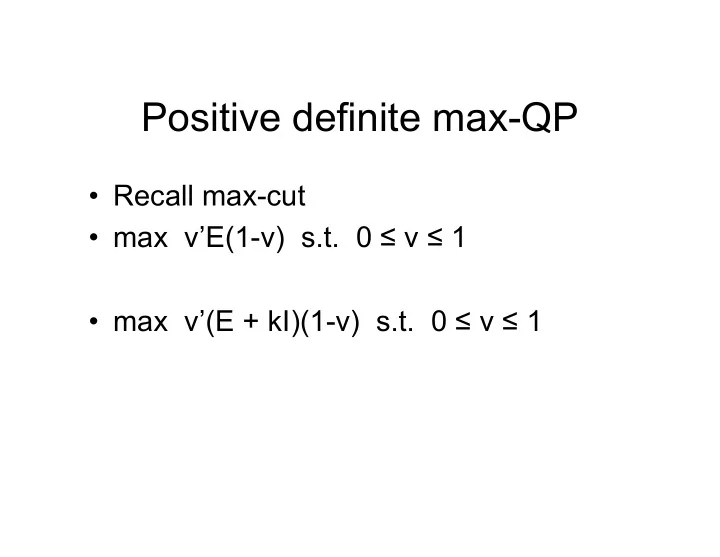
Positive definite max-QP

  • Recall max-cut
  • max v’E(1-v) s.t. 0 ≤ v ≤ 1
  • max v’(E + kI)(1-v) s.t. 0 ≤ v ≤ 1
slide-2
SLIDE 2

LASSO revisited

slide-3
SLIDE 3

LASSO objective terms

slide-4
SLIDE 4

Support vector machines

slide-5
SLIDE 5

Maximizing margin

  • margin = yi (xi . w - b)
  • max

s.t.

slide-6
SLIDE 6

Administrative

  • Submission directories should be present
  • now. /afs/andrew/course/10/725/Submit/your-ID

Check yours!

– e.g., submit a small file “test.txt”

  • We don’t want to hear about problems late on

night before due date…

  • Registration deadline: yesterday

– everyone’s in! – to audit: register + get signed form + turn in to HUB – I still have one signed form

slide-7
SLIDE 7

Duality

slide-8
SLIDE 8

What if we’re lazy

  • A “hard” LP:

min x + y s.t. x + y ≥ 2 x, y ≥ 0

slide-9
SLIDE 9

OK, we got lucky

  • What if it were:

min x + 3y s.t. x + y ≥ 2 x, y ≥ 0

slide-10
SLIDE 10

How general is this?

  • What if it were:

min px + qy s.t. x + y ≥ 2 x, y ≥ 0

slide-11
SLIDE 11

Let’s do it again

  • Note ≤ constraint

min x – 2y s.t. x + y ≥ 2 x, y ≥ 0 x, y ≤ 3

slide-12
SLIDE 12

And again

  • Note = constraint

min x – 2y s.t. x + y ≥ 2 x, y ≥ 0 3x + y = 2

slide-13
SLIDE 13

Summary of LP duality

  • Use multipliers to write combined

constraints

≥ ≤ =

  • Constrain multipliers to give us a bound
  • n objective
  • Optimize to get tightest bound
slide-14
SLIDE 14

The Lagrangian

  • L(a,b,c,x,y) =

[x + y] – [a (x + y – 2) + bx + cy]

  • minx,y maxa,b,c≥0 L(a,b,c,x,y)

min x + y s.t. x + y ≥ 2 x, y ≥ 0

slide-15
SLIDE 15

Lagrangian cont’d

  • L(a,b,c,x,y) =

[x + y] – [a (x + y – 2) + bx + cy]

  • minx,y maxa,b,c≥0 L(a,b,c,x,y)

min x + y s.t. x + y ≥ 2 x, y ≥ 0

slide-16
SLIDE 16

Saddle-point picture

  • min y s.t. y ≥ 2
slide-17
SLIDE 17

Example: max flow

  • Given a directed graph

– edges (i,j) ∈ E – flows fij, capacities cij – source s, terminal t (cts = ∞)

  • max fts s.t.

– positive flow – capacity – flow conservation

slide-18
SLIDE 18

Dual of max flow

slide-19
SLIDE 19

Interpreting dual

slide-20
SLIDE 20

min cut: image segmentation

slide-21
SLIDE 21

What about QP duality?

  • min x2 + y2 s.t.

x + 2y ≥ 2 x, y ≥ 0

  • How can we lower-bound OPT?
slide-22
SLIDE 22

Works at other points too

  • min x2 + y2 s.t.

x + 2y ≥ 2 x, y ≥ 0

  • Try Taylor @ (x, y) = (v, w)
slide-23
SLIDE 23

Example: SVMs

slide-24
SLIDE 24

SVM duality

  • Recall: min

s.t.

  • Taylor bound objective:
  • Generic constraint:
  • To get bound, need:
slide-25
SLIDE 25

SVM dual

  • maxα,v Σi αi – ||v||2/2 s.t.

Σi αiyi = 0 Σi αiyixij = vj for all j αi ≥ 0 for all i

slide-26
SLIDE 26

Perpendicular bisector