SLIDE 1
Ancient Greece --- LANDSCAPE
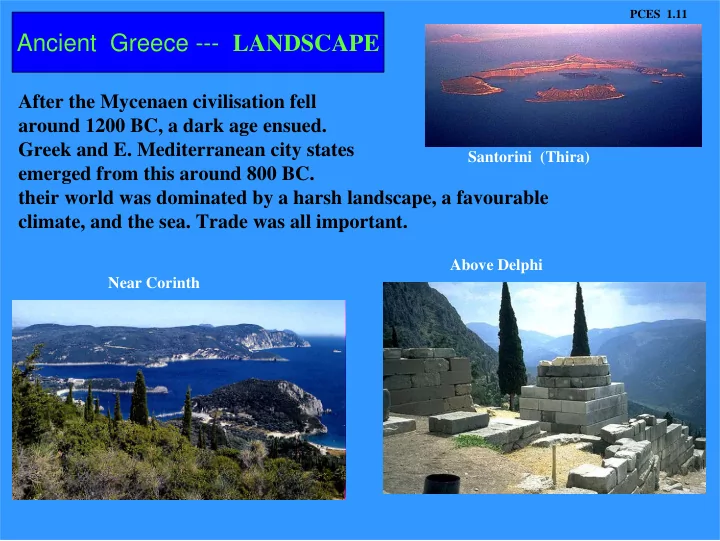
After the Mycenaen civilisation fell around 1200 BC, a dark age ensued. Greek and E. Mediterranean city states emerged from this around 800 BC. their world was dominated by a harsh landscape, a favourable climate, and the sea. Trade was all important.
Santorini (Thira) Near Corinth Above Delphi
PCES 1.11
SLIDE 2
Ancient Mediterranean - HISTORY
PCES 1.12
SLIDE 3
Greek civilisation- ART & Architecture
Acropolis (Athens) Tholos (Delphi) Amphitheatre (Delphi)
Greek architecture, in Dorian and Ionian forms, involved both real engineering expertise, and an appreciation for aesthetics- which was very much tied into both their understanding of mathematics and harmony, and the important role of religion, myths, dramatic theatre, and music.
PCES 1.13
SLIDE 4 Greek civilisation- ART & Architecture
Alexander sarcophagus (c. 305 BC) Ephebe Anticiteria (c. 500 BC) Fighting the Amazons (c. 400 BC)
One of the main problems in research into the life in ancient Greece is that much has been
- lost. Very few bronzes exist (they
were melted down unless hidden
- r lost at sea), pottery is fragile,
etc. There was an evolution in both sculpture and other art forms towards a naturalistic approach as artists learned how to depict motion, and solved many other problems.
PCES 1.14
SLIDE 5
Greek civilisation- ART & Architecture
Venus de Milo Statue of Chrysippus (c 250 BC) Pergamum altar (c. 200 BC)
The themes of Greek art tended to be mythical, although real people were also depicted. There was often extensive relief work on buildings, both interior and exterior. Greek drama and theatre dealt with many themes from the heroic to the tragic or comic, both historical and mythical.
PCES 1.15
SLIDE 6
Greek civilisation- ART & Architecture
Lapiths (c. 250 BC) Death of Laocoon & sons (c. 70 BC)
The themes of Greek art in many ways mirrored themes not only of Greek history and mythology, but also themes that figured in Greek philosophy (next slides) and intellectual life.
PCES 1.16
SLIDE 7 Pre-Socratics: Substances, Elements, etc.
Thales (c. 580 BC) Heraclitus (c. 540-480 BC)
Thales (c. 630-560 BC?): everything is some form of water.
also predicted a solar eclipse (585 BC).
Anaximander (c. 610-546 BC): The earth is an isolated
body in space- he considered it to be drum-shaped. Everything comes from the ineffable but limitless ‘apeiron’,
- r fundamental ‘stuff’ of the universe.
Heraclitus of Ephesus (c. 540-480): Examined the
problem of the apparent change that seems to be universal- considered that this was crucial, and that the world was inherently “dynamic”. This in spite of many things that apparently do not change.
Parmenides (c. 515-450 BC): All matter, etc., is unified
into a single basic “One”, a fundamental substance. Since “nothing” is inexistent, change is illusory.
Empedocles (c. 490-430 BC): There are 4 basic elements
(air, water, earth, fire); this is the ‘pluralist’ approach.
PCES 1.17
SLIDE 8 Pre-Socratics: Mathematics & Form
The Naxian Sphinx (Delphi)
Pythagoras (c. 570-490 BC)
Zeno of Elea (c. 490-440 BC)
The remarkable discoveries in Greek Mathematics really got going with the school started by Pythagoras. Amongst their achievements: (i) early geometry, theory of numbers (eg., Pythagoras theorem, irrational numbers, solids and conics, etc) (ii) Understanding of harmony in music and the relationship to definite fractional relations in pitch- and connection to length of vibrating strings. These ideas were connected with a form of mysticism developed by Pythagoras and pupils, in which mathematical form underlay
- Nature. This has been enormously influential. Pythagoras fused
mystic ideas with logic in a path-breaking way. It is often said that this fusion was also embodied in the fusion of Dionysian and Apollonian traditions, manifested in Delphi. Later followers developed these ideas in novel ways- the best known being Zeno the Eleatic, with his various paradoxes. All of these were intended to refute the pluralists, & show that the world was indivisible, and that motion was impossible. His work was very influential in later mathematics, particularly in ideas on infinitesimals & infinite series.
PCES 1.18
SLIDE 9 Pre-Socratics: Atomists
Democritus (c. 460-359 BC)
Leucippus and then Democritus developed an entirely new idea- that
to resolve the problems posed by Parmenides, one proposes that the world is made of ATOMS. These fundamental entities, which themselves have different shapes and sizes, assemble in many different ways to make all that there is. The void is assumed to exist, and movement is allowed by the existence of empty space between atoms. The atoms were assumed to be indivisible, and their motion and ways of combining were entirely causally determined, with no external agencies operating. The universe began with the condensation of clouds of atoms- Democritus even postulated an infinity of such systems, aggregating in different parts
- f the void. He elaborated a very detailed theory of matter, sensation, and
understood that, eg., from the motion of these atoms one could generate pressure in a gas. These ideas were very modern in 2 ways. First- the style was to advance a hypothesis, even if it left certain problems unresolved (eg., what were the indivisible atoms MADE OF?), and see how far it could be pushed. Second, it anticipated later developments by 2200 yrs. The atomistic ideas were not closely related to the questions being raised by other Greek thinkers, and were largely ignored thereafter by them.
PCES 1.19
SLIDE 10
Pre-Socratics: Medicine
Hippocrates (460-377 BC)
Empirical science in Greek times was most obvious in their medical studies, which led to some understanding of the role of different organs, and of the value of many medicinal plants. Attempts to systematize the understanding (in, eg., the idea of the 4 humours), can be viewed as primitive attempts to go beyond a mere set of recipes for cures. We also got from the Greeks the idea of a “professional code of conduct”. In medicine this came from Hippocrates, in the form of the Hippocratic Oath- still used today. Finally, one can also mention the early beginnings of scientific study of geography, physics, and so on. These really took off with the arrival of Aristotle (to whom we come presently), but Aristotle was synthesizing some of the work of earlier writers. The oldest such science was Astronomy- this goes back to pre-Babylonian times, and was important in many cultures, but could not really develop properly without an adequate understanding of mathematics (see later section).
PCES 1.20