An Overview of GIMPLE Control construct explicated into conditional - - PowerPoint PPT Presentation

an overview of gimple
SMART_READER_LITE
LIVE PREVIEW

An Overview of GIMPLE Control construct explicated into conditional - - PowerPoint PPT Presentation

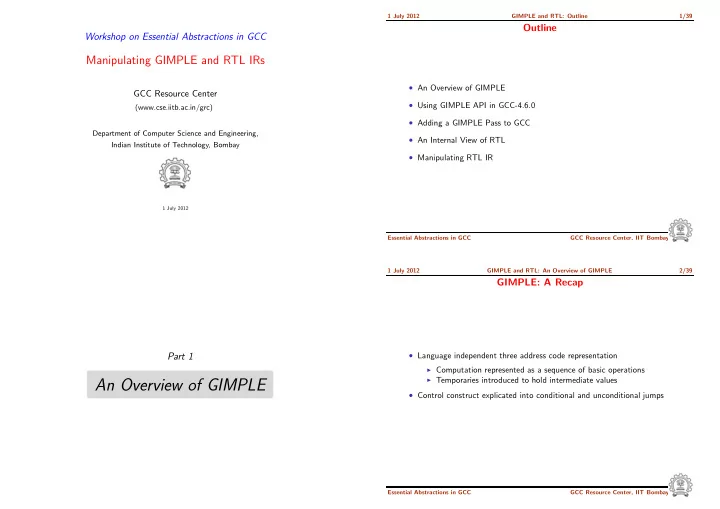
1 July 2012 GIMPLE and RTL: Outline 1/39 Outline Workshop on Essential Abstractions in GCC Manipulating GIMPLE and RTL IRs An Overview of GIMPLE GCC Resource Center Using GIMPLE API in GCC-4.6.0 (www.cse.iitb.ac.in/grc) Adding a


slide-1
SLIDE 1

Workshop on Essential Abstractions in GCC

Manipulating GIMPLE and RTL IRs

GCC Resource Center

(www.cse.iitb.ac.in/grc) Department of Computer Science and Engineering, Indian Institute of Technology, Bombay

1 July 2012

1 July 2012 GIMPLE and RTL: Outline 1/39

Outline

  • An Overview of GIMPLE
  • Using GIMPLE API in GCC-4.6.0
  • Adding a GIMPLE Pass to GCC
  • An Internal View of RTL
  • Manipulating RTL IR

Essential Abstractions in GCC GCC Resource Center, IIT Bombay

Part 1

An Overview of GIMPLE

1 July 2012 GIMPLE and RTL: An Overview of GIMPLE 2/39

GIMPLE: A Recap

  • Language independent three address code representation

◮ Computation represented as a sequence of basic operations ◮ Temporaries introduced to hold intermediate values

  • Control construct explicated into conditional and unconditional jumps

Essential Abstractions in GCC GCC Resource Center, IIT Bombay

slide-2
SLIDE 2

1 July 2012 GIMPLE and RTL: An Overview of GIMPLE 3/39

Motivation Behind GIMPLE

  • Previously, the only common IR was RTL (Register Transfer Language)
  • Drawbacks of RTL for performing high-level optimizations

◮ Low-level IR, more suitable for machine dependent optimizations

(e.g., peephole optimization)

◮ High level information is difficult to extract from RTL (e.g. array

references, data types etc.)

◮ Introduces stack too soon, even if later optimizations do not require it

Essential Abstractions in GCC GCC Resource Center, IIT Bombay 1 July 2012 GIMPLE and RTL: An Overview of GIMPLE 4/39

Why Not Abstract Syntax Trees for Optimization?

  • ASTs contain detailed function information but are not suitable for
  • ptimization because

◮ Lack of a common representation across languages ◮ No single AST shared by all front-ends ◮ So each language would have to have a different implementation of

the same optimizations

◮ Difficult to maintain and upgrade so many optimization frameworks ◮ Structural Complexity ◮ Lots of complexity due to the syntactic constructs of each language ◮ Hierarchical structure and not linear structure

Control flow explication is required

Essential Abstractions in GCC GCC Resource Center, IIT Bombay 1 July 2012 GIMPLE and RTL: An Overview of GIMPLE 5/39

Need for a New IR

  • Earlier versions of GCC would build up trees for a single statement,and

then lower them to RTL before moving on to the next statement

  • For higher level optimizations, entire function needs to be represented in

trees in a language-independent way.

  • Result of this effort - GENERIC and GIMPLE

Essential Abstractions in GCC GCC Resource Center, IIT Bombay 1 July 2012 GIMPLE and RTL: An Overview of GIMPLE 6/39

What is GENERIC?

What?

  • Language independent IR for a complete function in the form of trees
  • Obtained by removing language specific constructs from ASTs
  • All tree codes defined in $(SOURCE)/gcc/tree.def

Why?

  • Each language frontend can have its own AST
  • Once parsing is complete they must emit GENERIC

Essential Abstractions in GCC GCC Resource Center, IIT Bombay

slide-3
SLIDE 3

1 July 2012 GIMPLE and RTL: An Overview of GIMPLE 7/39

What is GIMPLE ?

  • GIMPLE is influenced by SIMPLE IR of McCat compiler
  • But GIMPLE is not same as SIMPLE (GIMPLE supports GOTO)
  • It is a simplified subset of GENERIC

◮ 3 address representation ◮ Control flow lowering ◮ Cleanups and simplification, restricted grammar

  • Benefit : Optimizations become easier

Essential Abstractions in GCC GCC Resource Center, IIT Bombay 1 July 2012 GIMPLE and RTL: An Overview of GIMPLE 8/39

GIMPLE Goals

The Goals of GIMPLE are

  • Lower control flow

Sequenced statements + conditional and unconditional jumps

  • Simplify expressions

Typically one operator and at most two operands

  • Simplify scope

Move local scope to block begin, including temporaries

Essential Abstractions in GCC GCC Resource Center, IIT Bombay 1 July 2012 GIMPLE and RTL: An Overview of GIMPLE 9/39

Tuple Based GIMPLE Representation

  • Earlier implementation of GIMPLE used trees as internal data structure
  • Tree data structure was much more general than was required for three

address statements

  • Now a three address statement is implemented as a tuple
  • These tuples contain the following information

◮ Type of the statement ◮ Result ◮ Operator ◮ Operands

The result and operands are still represented using trees

Essential Abstractions in GCC GCC Resource Center, IIT Bombay 1 July 2012 GIMPLE and RTL: An Overview of GIMPLE 10/39

Observing Internal Form of GIMPLE

test.c.004t.gimple test.c.004t.gimple with compilation option with compilation option

  • fdump-tree-all-raw
  • fdump-tree-all

x = 10; y = 5; D.1954 = x * y; a.0 = a; x = D.1954 + a.0; a.1 = a; D.1957 = a.1 * x; y = y - D.1957; gimple_assign <integer_cst, x, 10, NULL> gimple_assign <integer_cst, y, 5, NULL> gimple_assign <mult_expr, D.1954, x, y> gimple_assign <var_decl, a.0, a, NULL> gimple_assign <plus_expr, x, D.1954, a.0> gimple_assign <var_decl, a.1, a, NULL> gimple_assign <mult_expr, D.1957, a.1, x> gimple_assign <minus_expr, y, y, D.1957>

Essential Abstractions in GCC GCC Resource Center, IIT Bombay

slide-4
SLIDE 4

1 July 2012 GIMPLE and RTL: An Overview of GIMPLE 11/39

Observing Internal Form of GIMPLE

test.c.004t.gimple test.c.004t.gimple with compilation option with compilation option

  • fdump-tree-all-raw
  • fdump-tree-all

if (a < c) goto <D.1953>; else goto <D.1954>; <D.1953>: a = b + c; goto <D.1955>; <D.1954>: a = b - c; <D.1955>: gimple_cond <lt_expr, a,c,<D.1953>, <D.1954>> gimple_label <<D.1953>> gimple_assign <plus_expr, a, b, c> gimple_goto <<D.1955>> gimple_label <<D.1954>> gimple_assign <minus_expr, a, b, c> gimple_label <<D.1955>>

Essential Abstractions in GCC GCC Resource Center, IIT Bombay

Part 2

Manipulating GIMPLE

1 July 2012 GIMPLE and RTL: Manipulating GIMPLE 12/39

Iterating Over GIMPLE Statements

  • A basic block contains a doubly linked-list of GIMPLE statements
  • The statements are represented as GIMPLE tuples, and the operands are

represented by tree data structure

  • Processing of statements can be done through iterators

Essential Abstractions in GCC GCC Resource Center, IIT Bombay 1 July 2012 GIMPLE and RTL: Manipulating GIMPLE 12/39

Iterating Over GIMPLE Statements

  • A basic block contains a doubly linked-list of GIMPLE statements
  • The statements are represented as GIMPLE tuples, and the operands are

represented by tree data structure

  • Processing of statements can be done through iterators

basic_block bb; gimple_stmt_iterator gsi; FOR_EACH_BB (bb) { % for ( gsi=gsi_start_bb (bb); !gsi_end_p (gsi); % gsi_next (&gsi)) find_pointer_assignmentsgsi_stmt (gsi)); }

Essential Abstractions in GCC GCC Resource Center, IIT Bombay

slide-5
SLIDE 5

1 July 2012 GIMPLE and RTL: Manipulating GIMPLE 12/39

Iterating Over GIMPLE Statements

  • A basic block contains a doubly linked-list of GIMPLE statements
  • The statements are represented as GIMPLE tuples, and the operands are

represented by tree data structure

  • Processing of statements can be done through iterators

basic_block bb; gimple_stmt_iterator gsi; FOR_EACH_BB (bb) { % for ( gsi=gsi_start_bb (bb); !gsi_end_p (gsi); % gsi_next (&gsi)) find_pointer_assignmentsgsi_stmt (gsi)); } Basic block iterator

Essential Abstractions in GCC GCC Resource Center, IIT Bombay 1 July 2012 GIMPLE and RTL: Manipulating GIMPLE 12/39

Iterating Over GIMPLE Statements

  • A basic block contains a doubly linked-list of GIMPLE statements
  • The statements are represented as GIMPLE tuples, and the operands are

represented by tree data structure

  • Processing of statements can be done through iterators

basic_block bb; gimple_stmt_iterator gsi; FOR_EACH_BB (bb) { % for ( gsi=gsi_start_bb (bb); !gsi_end_p (gsi); % gsi_next (&gsi)) find_pointer_assignmentsgsi_stmt (gsi)); } GIMPLE statement iterator

Essential Abstractions in GCC GCC Resource Center, IIT Bombay 1 July 2012 GIMPLE and RTL: Manipulating GIMPLE 12/39

Iterating Over GIMPLE Statements

  • A basic block contains a doubly linked-list of GIMPLE statements
  • The statements are represented as GIMPLE tuples, and the operands are

represented by tree data structure

  • Processing of statements can be done through iterators

basic_block bb; gimple_stmt_iterator gsi; FOR_EACH_BB (bb) { % for ( gsi=gsi_start_bb (bb); !gsi_end_p (gsi); % gsi_next (&gsi)) find_pointer_assignmentsgsi_stmt (gsi)); } Get the first statement of bb

Essential Abstractions in GCC GCC Resource Center, IIT Bombay 1 July 2012 GIMPLE and RTL: Manipulating GIMPLE 12/39

Iterating Over GIMPLE Statements

  • A basic block contains a doubly linked-list of GIMPLE statements
  • The statements are represented as GIMPLE tuples, and the operands are

represented by tree data structure

  • Processing of statements can be done through iterators

basic_block bb; gimple_stmt_iterator gsi; FOR_EACH_BB (bb) { % for ( gsi=gsi_start_bb (bb); !gsi_end_p (gsi); % gsi_next (&gsi)) find_pointer_assignmentsgsi_stmt (gsi)); } True if end reached

Essential Abstractions in GCC GCC Resource Center, IIT Bombay

slide-6
SLIDE 6

1 July 2012 GIMPLE and RTL: Manipulating GIMPLE 12/39

Iterating Over GIMPLE Statements

  • A basic block contains a doubly linked-list of GIMPLE statements
  • The statements are represented as GIMPLE tuples, and the operands are

represented by tree data structure

  • Processing of statements can be done through iterators

basic_block bb; gimple_stmt_iterator gsi; FOR_EACH_BB (bb) { % for ( gsi=gsi_start_bb (bb); !gsi_end_p (gsi); % gsi_next (&gsi)) find_pointer_assignmentsgsi_stmt (gsi)); } Advance iterator to the next GIMPLE stmt

Essential Abstractions in GCC GCC Resource Center, IIT Bombay 1 July 2012 GIMPLE and RTL: Manipulating GIMPLE 12/39

Iterating Over GIMPLE Statements

  • A basic block contains a doubly linked-list of GIMPLE statements
  • The statements are represented as GIMPLE tuples, and the operands are

represented by tree data structure

  • Processing of statements can be done through iterators

basic_block bb; gimple_stmt_iterator gsi; FOR_EACH_BB (bb) { % for ( gsi=gsi_start_bb (bb); !gsi_end_p (gsi); % gsi_next (&gsi)) find_pointer_assignmentsgsi_stmt (gsi)); } Return the current statement

Essential Abstractions in GCC GCC Resource Center, IIT Bombay 1 July 2012 GIMPLE and RTL: Manipulating GIMPLE 13/39

Other Useful APIs for Manipulating GIMPLE

Extracting parts of GIMPLE statements:

  • gimple assign lhs: left hand side
  • gimple assign rhs1: left operand of the right hand side
  • gimple assign rhs2: right operand of the right hand side
  • gimple assign rhs code: operator on the right hand side

A complete list can be found in the file gimple.h

Essential Abstractions in GCC GCC Resource Center, IIT Bombay 1 July 2012 GIMPLE and RTL: Manipulating GIMPLE 14/39

Discovering More Information from GIMPLE

  • Discovering local variables
  • Discovering global variables
  • Discovering pointer variables
  • Discovering assignment statements involving pointers

(i.e. either the result or an operand is a pointer variable) The first two are relevant to your lab assignment The other two constitue an example of a complete pass

Essential Abstractions in GCC GCC Resource Center, IIT Bombay

slide-7
SLIDE 7

1 July 2012 GIMPLE and RTL: Manipulating GIMPLE 15/39

Discovering Local Variables in GIMPLE IR

static void gather_local_variables () { tree list = cfun->local_decls; if (!dump_file) return; fprintf(dump_file,"\nLocal variables : "); FOR_EACH_LOCAL_DECL (cfun, u, list) { if (!DECL_ARTIFICIAL (list)) fprintf(dump_file, "%s\n", get_name (list)); list = TREE_CHAIN (list); } }

Essential Abstractions in GCC GCC Resource Center, IIT Bombay 1 July 2012 GIMPLE and RTL: Manipulating GIMPLE 15/39

Discovering Local Variables in GIMPLE IR

static void gather_local_variables () { tree list = cfun->local_decls; if (!dump_file) return; fprintf(dump_file,"\nLocal variables : "); FOR_EACH_LOCAL_DECL (cfun, u, list) { if (!DECL_ARTIFICIAL (list)) fprintf(dump_file, "%s\n", get_name (list)); list = TREE_CHAIN (list); } } List of local variables of the current function

Essential Abstractions in GCC GCC Resource Center, IIT Bombay 1 July 2012 GIMPLE and RTL: Manipulating GIMPLE 15/39

Discovering Local Variables in GIMPLE IR

static void gather_local_variables () { tree list = cfun->local_decls; if (!dump_file) return; fprintf(dump_file,"\nLocal variables : "); FOR_EACH_LOCAL_DECL (cfun, u, list) { if (!DECL_ARTIFICIAL (list)) fprintf(dump_file, "%s\n", get_name (list)); list = TREE_CHAIN (list); } } Local variable iterator

Essential Abstractions in GCC GCC Resource Center, IIT Bombay 1 July 2012 GIMPLE and RTL: Manipulating GIMPLE 15/39

Discovering Local Variables in GIMPLE IR

static void gather_local_variables () { tree list = cfun->local_decls; if (!dump_file) return; fprintf(dump_file,"\nLocal variables : "); FOR_EACH_LOCAL_DECL (cfun, u, list) { if (!DECL_ARTIFICIAL (list)) fprintf(dump_file, "%s\n", get_name (list)); list = TREE_CHAIN (list); } } Exclude variables that do not appear in the source

Essential Abstractions in GCC GCC Resource Center, IIT Bombay

slide-8
SLIDE 8

1 July 2012 GIMPLE and RTL: Manipulating GIMPLE 15/39

Discovering Local Variables in GIMPLE IR

static void gather_local_variables () { tree list = cfun->local_decls; if (!dump_file) return; fprintf(dump_file,"\nLocal variables : "); FOR_EACH_LOCAL_DECL (cfun, u, list) { if (!DECL_ARTIFICIAL (list)) fprintf(dump_file, "%s\n", get_name (list)); list = TREE_CHAIN (list); } } Find the name from the TREE node

Essential Abstractions in GCC GCC Resource Center, IIT Bombay 1 July 2012 GIMPLE and RTL: Manipulating GIMPLE 15/39

Discovering Local Variables in GIMPLE IR

static void gather_local_variables () { tree list = cfun->local_decls; if (!dump_file) return; fprintf(dump_file,"\nLocal variables : "); FOR_EACH_LOCAL_DECL (cfun, u, list) { if (!DECL_ARTIFICIAL (list)) fprintf(dump_file, "%s\n", get_name (list)); list = TREE_CHAIN (list); } } Go to the next item in the list

Essential Abstractions in GCC GCC Resource Center, IIT Bombay 1 July 2012 GIMPLE and RTL: Manipulating GIMPLE 16/39

Discovering Global Variables in GIMPLE IR

static void gather_global_variables () { struct varpool_node *node; if (!dump_file) return; fprintf(dump_file,"\nGlobal variables : "); for (node = varpool_nodes; node; node = node->next) { tree var = node->decl; if (!DECL_ARTIFICIAL(var)) { fprintf(dump_file, get_name(var)); fprintf(dump_file,"\n"); } } }

Essential Abstractions in GCC GCC Resource Center, IIT Bombay 1 July 2012 GIMPLE and RTL: Manipulating GIMPLE 16/39

Discovering Global Variables in GIMPLE IR

static void gather_global_variables () { struct varpool_node *node; if (!dump_file) return; fprintf(dump_file,"\nGlobal variables : "); for (node = varpool_nodes; node; node = node->next) { tree var = node->decl; if (!DECL_ARTIFICIAL(var)) { fprintf(dump_file, get_name(var)); fprintf(dump_file,"\n"); } } } List of global variables of the current function

Essential Abstractions in GCC GCC Resource Center, IIT Bombay

slide-9
SLIDE 9

1 July 2012 GIMPLE and RTL: Manipulating GIMPLE 16/39

Discovering Global Variables in GIMPLE IR

static void gather_global_variables () { struct varpool_node *node; if (!dump_file) return; fprintf(dump_file,"\nGlobal variables : "); for (node = varpool_nodes; node; node = node->next) { tree var = node->decl; if (!DECL_ARTIFICIAL(var)) { fprintf(dump_file, get_name(var)); fprintf(dump_file,"\n"); } } } Exclude variables that do not appear in the source

Essential Abstractions in GCC GCC Resource Center, IIT Bombay 1 July 2012 GIMPLE and RTL: Manipulating GIMPLE 16/39

Discovering Global Variables in GIMPLE IR

static void gather_global_variables () { struct varpool_node *node; if (!dump_file) return; fprintf(dump_file,"\nGlobal variables : "); for (node = varpool_nodes; node; node = node->next) { tree var = node->decl; if (!DECL_ARTIFICIAL(var)) { fprintf(dump_file, get_name(var)); fprintf(dump_file,"\n"); } } } Find the name from the TREE node

Essential Abstractions in GCC GCC Resource Center, IIT Bombay 1 July 2012 GIMPLE and RTL: Manipulating GIMPLE 16/39

Discovering Global Variables in GIMPLE IR

static void gather_global_variables () { struct varpool_node *node; if (!dump_file) return; fprintf(dump_file,"\nGlobal variables : "); for (node = varpool_nodes; node; node = node->next) { tree var = node->decl; if (!DECL_ARTIFICIAL(var)) { fprintf(dump_file, get_name(var)); fprintf(dump_file,"\n"); } } } Go to the next item in the list

Essential Abstractions in GCC GCC Resource Center, IIT Bombay 1 July 2012 GIMPLE and RTL: Manipulating GIMPLE 17/39

Assignment Statements Involving Pointers

int *p, *q; void callme (int); int main () { int a, b; p = &b; callme (a); return 0; } void callme (int a) { a = *(p + 3); q = &a; } main () { int D.1965; int a; int b; p = &b; callme (a); D.1965 = 0; return D.1965; } callme (int a) { int * p.0; int a.1; p.0 = p; a.1 = MEM[(int *)p.0 + 12B]; a = a.1; q = &a; }

Essential Abstractions in GCC GCC Resource Center, IIT Bombay

slide-10
SLIDE 10

1 July 2012 GIMPLE and RTL: Manipulating GIMPLE 18/39

Discovering Pointers in GIMPLE IR

static bool is_pointer_var (tree var) { return is_pointer_type (TREE_TYPE (var)); } static bool is_pointer_type (tree type) { if (POINTER_TYPE_P (type)) return true; if (TREE_CODE (type) == ARRAY_TYPE) return is_pointer_var (TREE_TYPE (type)); /* Return true if it is an aggregate type. */ return AGGREGATE_TYPE_P (type); }

Essential Abstractions in GCC GCC Resource Center, IIT Bombay 1 July 2012 GIMPLE and RTL: Manipulating GIMPLE 18/39

Discovering Pointers in GIMPLE IR

static bool is_pointer_var (tree var) { return is_pointer_type (TREE_TYPE (var)); } static bool is_pointer_type (tree type) { if (POINTER_TYPE_P (type)) return true; if (TREE_CODE (type) == ARRAY_TYPE) return is_pointer_var (TREE_TYPE (type)); /* Return true if it is an aggregate type. */ return AGGREGATE_TYPE_P (type); } Data type of the expression

Essential Abstractions in GCC GCC Resource Center, IIT Bombay 1 July 2012 GIMPLE and RTL: Manipulating GIMPLE 18/39

Discovering Pointers in GIMPLE IR

static bool is_pointer_var (tree var) { return is_pointer_type (TREE_TYPE (var)); } static bool is_pointer_type (tree type) { if (POINTER_TYPE_P (type)) return true; if (TREE_CODE (type) == ARRAY_TYPE) return is_pointer_var (TREE_TYPE (type)); /* Return true if it is an aggregate type. */ return AGGREGATE_TYPE_P (type); } Defines what kind of node it is

Essential Abstractions in GCC GCC Resource Center, IIT Bombay 1 July 2012 GIMPLE and RTL: Manipulating GIMPLE 19/39

Discovering Assignment Statements Involving Pointers

static void find_pointer_assignments (gimple stmt) { if (is_gimple_assign (stmt)) { tree lhsop = gimple_assign_lhs (stmt); tree rhsop1 = gimple_assign_rhs1 (stmt); tree rhsop2 = gimple_assign_rhs2 (stmt); /* Check if either LHS, RHS1 or RHS2 operands can be pointers. */ if ((lhsop && is_pointer_var (lhsop)) || (rhsop1 && is_pointer_var (rhsop1)) || (rhsop2 && is_pointer_var (rhsop2))) { if (dump_file) fprintf (dump_file, "Pointer Statement :"); print_gimple_stmt (dump_file, stmt, 0, 0); num_ptr_stmts++; } } }

Essential Abstractions in GCC GCC Resource Center, IIT Bombay

slide-11
SLIDE 11

1 July 2012 GIMPLE and RTL: Manipulating GIMPLE 19/39

Discovering Assignment Statements Involving Pointers

static void find_pointer_assignments (gimple stmt) { if (is_gimple_assign (stmt)) { tree lhsop = gimple_assign_lhs (stmt); tree rhsop1 = gimple_assign_rhs1 (stmt); tree rhsop2 = gimple_assign_rhs2 (stmt); /* Check if either LHS, RHS1 or RHS2 operands can be pointers. */ if ((lhsop && is_pointer_var (lhsop)) || (rhsop1 && is_pointer_var (rhsop1)) || (rhsop2 && is_pointer_var (rhsop2))) { if (dump_file) fprintf (dump_file, "Pointer Statement :"); print_gimple_stmt (dump_file, stmt, 0, 0); num_ptr_stmts++; } } } Extract the LHS of the assignment statement

Essential Abstractions in GCC GCC Resource Center, IIT Bombay 1 July 2012 GIMPLE and RTL: Manipulating GIMPLE 19/39

Discovering Assignment Statements Involving Pointers

static void find_pointer_assignments (gimple stmt) { if (is_gimple_assign (stmt)) { tree lhsop = gimple_assign_lhs (stmt); tree rhsop1 = gimple_assign_rhs1 (stmt); tree rhsop2 = gimple_assign_rhs2 (stmt); /* Check if either LHS, RHS1 or RHS2 operands can be pointers. */ if ((lhsop && is_pointer_var (lhsop)) || (rhsop1 && is_pointer_var (rhsop1)) || (rhsop2 && is_pointer_var (rhsop2))) { if (dump_file) fprintf (dump_file, "Pointer Statement :"); print_gimple_stmt (dump_file, stmt, 0, 0); num_ptr_stmts++; } } } Extract the first operand of the RHS

Essential Abstractions in GCC GCC Resource Center, IIT Bombay 1 July 2012 GIMPLE and RTL: Manipulating GIMPLE 19/39

Discovering Assignment Statements Involving Pointers

static void find_pointer_assignments (gimple stmt) { if (is_gimple_assign (stmt)) { tree lhsop = gimple_assign_lhs (stmt); tree rhsop1 = gimple_assign_rhs1 (stmt); tree rhsop2 = gimple_assign_rhs2 (stmt); /* Check if either LHS, RHS1 or RHS2 operands can be pointers. */ if ((lhsop && is_pointer_var (lhsop)) || (rhsop1 && is_pointer_var (rhsop1)) || (rhsop2 && is_pointer_var (rhsop2))) { if (dump_file) fprintf (dump_file, "Pointer Statement :"); print_gimple_stmt (dump_file, stmt, 0, 0); num_ptr_stmts++; } } } Extract the second operand of the RHS

Essential Abstractions in GCC GCC Resource Center, IIT Bombay 1 July 2012 GIMPLE and RTL: Manipulating GIMPLE 19/39

Discovering Assignment Statements Involving Pointers

static void find_pointer_assignments (gimple stmt) { if (is_gimple_assign (stmt)) { tree lhsop = gimple_assign_lhs (stmt); tree rhsop1 = gimple_assign_rhs1 (stmt); tree rhsop2 = gimple_assign_rhs2 (stmt); /* Check if either LHS, RHS1 or RHS2 operands can be pointers. */ if ((lhsop && is_pointer_var (lhsop)) || (rhsop1 && is_pointer_var (rhsop1)) || (rhsop2 && is_pointer_var (rhsop2))) { if (dump_file) fprintf (dump_file, "Pointer Statement :"); print_gimple_stmt (dump_file, stmt, 0, 0); num_ptr_stmts++; } } } Pretty print the GIMPLE statement

Essential Abstractions in GCC GCC Resource Center, IIT Bombay

slide-12
SLIDE 12

1 July 2012 GIMPLE and RTL: Manipulating GIMPLE 20/39

Putting it Together at the Intraprocedural Level

static unsigned int intra_gimple_manipulation (void) { basic_block bb; gimple_stmt_iterator gsi; initialize_var_count (); FOR_EACH_BB_FN (bb, cfun) { for (gsi=gsi_start_bb (bb); !gsi_end_p (gsi); gsi_next (&gsi)) find_pointer_assignments (gsi_stmt (gsi)); } print_var_count (); return 0; }

Essential Abstractions in GCC GCC Resource Center, IIT Bombay 1 July 2012 GIMPLE and RTL: Manipulating GIMPLE 20/39

Putting it Together at the Intraprocedural Level

static unsigned int intra_gimple_manipulation (void) { basic_block bb; gimple_stmt_iterator gsi; initialize_var_count (); FOR_EACH_BB_FN (bb, cfun) { for (gsi=gsi_start_bb (bb); !gsi_end_p (gsi); gsi_next (&gsi)) find_pointer_assignments (gsi_stmt (gsi)); } print_var_count (); return 0; } Basic block iterator parameterized with function

Essential Abstractions in GCC GCC Resource Center, IIT Bombay 1 July 2012 GIMPLE and RTL: Manipulating GIMPLE 20/39

Putting it Together at the Intraprocedural Level

static unsigned int intra_gimple_manipulation (void) { basic_block bb; gimple_stmt_iterator gsi; initialize_var_count (); FOR_EACH_BB_FN (bb, cfun) { for (gsi=gsi_start_bb (bb); !gsi_end_p (gsi); gsi_next (&gsi)) find_pointer_assignments (gsi_stmt (gsi)); } print_var_count (); return 0; } Current function (i.e. function being compiled)

Essential Abstractions in GCC GCC Resource Center, IIT Bombay 1 July 2012 GIMPLE and RTL: Manipulating GIMPLE 20/39

Putting it Together at the Intraprocedural Level

static unsigned int intra_gimple_manipulation (void) { basic_block bb; gimple_stmt_iterator gsi; initialize_var_count (); FOR_EACH_BB_FN (bb, cfun) { for (gsi=gsi_start_bb (bb); !gsi_end_p (gsi); gsi_next (&gsi)) find_pointer_assignments (gsi_stmt (gsi)); } print_var_count (); return 0; } GIMPLE statement iterator

Essential Abstractions in GCC GCC Resource Center, IIT Bombay

slide-13
SLIDE 13

1 July 2012 GIMPLE and RTL: Manipulating GIMPLE 21/39

Intraprocedural Analysis Results

main () { ... p = &b; callme (a); D.1965 = 0; return D.1965; } callme (int a) { ... p.0 = p; a.1 = MEM[(int *)p.0 + 12B]; a = a.1; q = &a; } Information collected by intrapro- cedural Analysis pass

  • For main: 1
  • For callme: 2

Why is the pointer in the red state- ment being missed?

Essential Abstractions in GCC GCC Resource Center, IIT Bombay 1 July 2012 GIMPLE and RTL: Manipulating GIMPLE 22/39

Extending our Pass to Interprocedural Level

static unsigned int inter_gimple_manipulation (void) { struct cgraph_node *node; basic_block bb; gimple_stmt_iterator gsi; initialize_var_count (); for (node = cgraph_nodes; node; node=node->next) { /* Nodes without a body, and clone nodes are not interesting. */ if (!gimple_has_body_p (node->decl) || node->clone_of) continue; push_cfun (DECL_STRUCT_FUNCTION (node->decl)); FOR_EACH_BB (bb) { for (gsi=gsi_start_bb (bb); !gsi_end_p (gsi); gsi_next (&gsi)) find_pointer_assignments (gsi_stmt (gsi)); } pop_cfun (); } print_var_count (); return 0; }

Essential Abstractions in GCC GCC Resource Center, IIT Bombay 1 July 2012 GIMPLE and RTL: Manipulating GIMPLE 22/39

Extending our Pass to Interprocedural Level

static unsigned int inter_gimple_manipulation (void) { struct cgraph_node *node; basic_block bb; gimple_stmt_iterator gsi; initialize_var_count (); for (node = cgraph_nodes; node; node=node->next) { /* Nodes without a body, and clone nodes are not interesting. */ if (!gimple_has_body_p (node->decl) || node->clone_of) continue; push_cfun (DECL_STRUCT_FUNCTION (node->decl)); FOR_EACH_BB (bb) { for (gsi=gsi_start_bb (bb); !gsi_end_p (gsi); gsi_next (&gsi)) find_pointer_assignments (gsi_stmt (gsi)); } pop_cfun (); } print_var_count (); return 0; } Iterating over all the callgraph nodes

Essential Abstractions in GCC GCC Resource Center, IIT Bombay 1 July 2012 GIMPLE and RTL: Manipulating GIMPLE 22/39

Extending our Pass to Interprocedural Level

static unsigned int inter_gimple_manipulation (void) { struct cgraph_node *node; basic_block bb; gimple_stmt_iterator gsi; initialize_var_count (); for (node = cgraph_nodes; node; node=node->next) { /* Nodes without a body, and clone nodes are not interesting. */ if (!gimple_has_body_p (node->decl) || node->clone_of) continue; push_cfun (DECL_STRUCT_FUNCTION (node->decl)); FOR_EACH_BB (bb) { for (gsi=gsi_start_bb (bb); !gsi_end_p (gsi); gsi_next (&gsi)) find_pointer_assignments (gsi_stmt (gsi)); } pop_cfun (); } print_var_count (); return 0; } Setting the current function in the context

Essential Abstractions in GCC GCC Resource Center, IIT Bombay

slide-14
SLIDE 14

1 July 2012 GIMPLE and RTL: Manipulating GIMPLE 22/39

Extending our Pass to Interprocedural Level

static unsigned int inter_gimple_manipulation (void) { struct cgraph_node *node; basic_block bb; gimple_stmt_iterator gsi; initialize_var_count (); for (node = cgraph_nodes; node; node=node->next) { /* Nodes without a body, and clone nodes are not interesting. */ if (!gimple_has_body_p (node->decl) || node->clone_of) continue; push_cfun (DECL_STRUCT_FUNCTION (node->decl)); FOR_EACH_BB (bb) { for (gsi=gsi_start_bb (bb); !gsi_end_p (gsi); gsi_next (&gsi)) find_pointer_assignments (gsi_stmt (gsi)); } pop_cfun (); } print_var_count (); return 0; } Basic Block Iterator

Essential Abstractions in GCC GCC Resource Center, IIT Bombay 1 July 2012 GIMPLE and RTL: Manipulating GIMPLE 22/39

Extending our Pass to Interprocedural Level

static unsigned int inter_gimple_manipulation (void) { struct cgraph_node *node; basic_block bb; gimple_stmt_iterator gsi; initialize_var_count (); for (node = cgraph_nodes; node; node=node->next) { /* Nodes without a body, and clone nodes are not interesting. */ if (!gimple_has_body_p (node->decl) || node->clone_of) continue; push_cfun (DECL_STRUCT_FUNCTION (node->decl)); FOR_EACH_BB (bb) { for (gsi=gsi_start_bb (bb); !gsi_end_p (gsi); gsi_next (&gsi)) find_pointer_assignments (gsi_stmt (gsi)); } pop_cfun (); } print_var_count (); return 0; } GIMPLE Statement Iterator

Essential Abstractions in GCC GCC Resource Center, IIT Bombay 1 July 2012 GIMPLE and RTL: Manipulating GIMPLE 22/39

Extending our Pass to Interprocedural Level

static unsigned int inter_gimple_manipulation (void) { struct cgraph_node *node; basic_block bb; gimple_stmt_iterator gsi; initialize_var_count (); for (node = cgraph_nodes; node; node=node->next) { /* Nodes without a body, and clone nodes are not interesting. */ if (!gimple_has_body_p (node->decl) || node->clone_of) continue; push_cfun (DECL_STRUCT_FUNCTION (node->decl)); FOR_EACH_BB (bb) { for (gsi=gsi_start_bb (bb); !gsi_end_p (gsi); gsi_next (&gsi)) find_pointer_assignments (gsi_stmt (gsi)); } pop_cfun (); } print_var_count (); return 0; } Resetting the function context

Essential Abstractions in GCC GCC Resource Center, IIT Bombay 1 July 2012 GIMPLE and RTL: Manipulating GIMPLE 23/39

Interprocedural Results

Number of Pointer Statements = 3 Observation:

  • Information can be collected for all the functions in a single pass
  • Better scope for optimizations

Essential Abstractions in GCC GCC Resource Center, IIT Bombay

slide-15
SLIDE 15

Part 3

An Overview of RTL

1 July 2012 GIMPLE and RTL: An Overview of RTL 24/39

What is RTL ? RTL = Register Transfer Language

Assembly language for an abstract machine with infinite registers

Essential Abstractions in GCC GCC Resource Center, IIT Bombay 1 July 2012 GIMPLE and RTL: An Overview of RTL 25/39

Why RTL?

A lot of work in the back-end depends on RTL. Like,

  • Low level optimizations like loop optimization, loop dependence, common

subexpression elimination, etc

  • Instruction scheduling
  • Register Allocation
  • Register Movement

Essential Abstractions in GCC GCC Resource Center, IIT Bombay 1 July 2012 GIMPLE and RTL: An Overview of RTL 26/39

Why RTL?

For tasks such as those, RTL supports many low level features, like,

  • Register classes
  • Memory addressing modes
  • Word sizes and types
  • Compare and branch instructions
  • Calling Conventions
  • Bitfield operations

Essential Abstractions in GCC GCC Resource Center, IIT Bombay

slide-16
SLIDE 16

1 July 2012 GIMPLE and RTL: An Overview of RTL 27/39

The Dual Role of RTL

  • For specifying machine descriptions

Machine description constructs:

◮ define insn, define expand, match operand

  • For representing program during compilation

IR constructs

◮ insn, jump insn, code label, note, barrier

This lecture focusses on RTL as an IR

Essential Abstractions in GCC GCC Resource Center, IIT Bombay

Part 4

An Internal View of RTL

1 July 2012 GIMPLE and RTL: An Internal View of RTL 28/39

RTL Objects

  • Types of RTL Objects

◮ Expressions ◮ Integers ◮ Wide Integers ◮ Strings ◮ Vectors

  • Internal representation of RTL Expressions

◮ Expressions in RTX are represented as trees ◮ A pointer to the C data structure for RTL is called rtx

Essential Abstractions in GCC GCC Resource Center, IIT Bombay 1 July 2012 GIMPLE and RTL: An Internal View of RTL 29/39

RTX Codes

RTL Expressions are classified into RTX codes :

  • Expression codes are names defined in rtl.def
  • RTX codes are C enumeration constants
  • Expression codes and their meanings are machine-independent
  • Extract the code of a RTX with the macro GET CODE(x)

Essential Abstractions in GCC GCC Resource Center, IIT Bombay

slide-17
SLIDE 17

1 July 2012 GIMPLE and RTL: An Internal View of RTL 30/39

RTL Classes

RTL expressions are divided into few classes, like:

  • RTX UNARY : NEG, NOT, ABS
  • RTX BIN ARITH : MINUS, DIV
  • RTX COMM ARITH : PLUS, MULT
  • RTX OBJ : REG, MEM, SYMBOL REF
  • RTX COMPARE : GE, LT
  • RTX TERNARY : IF THEN ELSE
  • RTX INSN : INSN, JUMP INSN, CALL INSN
  • RTX EXTRA : SET, USE

Essential Abstractions in GCC GCC Resource Center, IIT Bombay 1 July 2012 GIMPLE and RTL: An Internal View of RTL 31/39

RTX Codes

The RTX codes are defined in rtl.def using cpp macro call DEF RTL EXPR, like :

  • DEF RTL EXPR(INSN, "insn", "iuuBieie", RTX INSN)
  • DEF RTL EXPR(SET, "set", "ee", RTX EXTRA)
  • DEF RTL EXPR(PLUS, "plus", "ee", RTX COMM ARITH)
  • DEF RTL EXPR(IF THEN ELSE, "if then else", "eee",

RTX TERNARY) The operands of the macro are :

  • Internal name of the rtx used in C source. It’s a tag in enumeration enum

rtx code

  • name of the rtx in the external ASCII format
  • Format string of the rtx, defined in rtx format[]
  • Class of the rtx

Essential Abstractions in GCC GCC Resource Center, IIT Bombay 1 July 2012 GIMPLE and RTL: An Internal View of RTL 32/39

RTX Formats

DEF RTL EXPR(INSN, "insn", "iuuBieie", RTX INSN)

  • i : Integer
  • u : Integer representing a pointer
  • B : Pointer to basic block
  • e : Expression

Essential Abstractions in GCC GCC Resource Center, IIT Bombay 1 July 2012 GIMPLE and RTL: An Internal View of RTL 33/39

RTL statements

  • RTL statements are instances of type rtx
  • RTL insns contain embedded links
  • Types of RTL insns :

◮ INSN : Normal non-jumping instruction ◮ JUMP INSN : Conditional and unconditional jumps ◮ CALL INSN : Function calls ◮ CODE LABEL: Target label for JUMP INSN ◮ BARRIER : End of control Flow ◮ NOTE : Debugging information

Essential Abstractions in GCC GCC Resource Center, IIT Bombay

slide-18
SLIDE 18

1 July 2012 GIMPLE and RTL: An Internal View of RTL 34/39

Basic RTL APIs

  • XEXP,XINT,XWINT,XSTR

◮ Example: XINT(x,2) accesses the 2nd operand of rtx x as an

integer

◮ Example: XEXP(x,2) accesses the same operand as an expression

  • Any operand can be accessed as any type of RTX object

◮ So operand accessor to be chosen based on the format string of the

containing expression

  • Special macros are available for Vector operands

◮ XVEC(exp,idx) : Access the vector-pointer which is operand

number idx in exp

◮ XVECLEN (exp, idx ) : Access the length (number of elements) in

the vector which is in operand number idx in exp. This value is an int

◮ XVECEXP (exp, idx, eltnum ) : Access element number

“eltnum” in the vector which is in operand number idx in exp. This value is an RTX

Essential Abstractions in GCC GCC Resource Center, IIT Bombay 1 July 2012 GIMPLE and RTL: An Internal View of RTL 35/39

RTL Insns

  • A function’s code is a doubly linked chain of INSN objects
  • Insns are rtxs with special code
  • Each insn contains atleast 3 extra fields :

◮ Unique id of the insn , accessed by INSN UID(i) ◮ PREV INSN(i) accesses the chain pointer to the INSN

preceeding i

◮ NEXT INSN(i) accesses the chain pointer to the INSN

succeeding i

  • The first insn is accessed by using get insns()
  • The last insn is accessed by using get last insn()

Essential Abstractions in GCC GCC Resource Center, IIT Bombay

Part 5

Manipulating RTL IR

1 July 2012 GIMPLE and RTL: Manipulating RTL IR 36/39

Adding an RTL Pass

Similar to adding GIMPLE intraporcedural pass except for the following

  • Use the data structure struct rtl opt pass
  • Replace the first field GIMPLE PASS by RTL PASS

Essential Abstractions in GCC GCC Resource Center, IIT Bombay

slide-19
SLIDE 19

1 July 2012 GIMPLE and RTL: Manipulating RTL IR 37/39

Sample Demo Program

Problem statement : Counting the number of SET objects in a basic block by adding a new RTL pass

  • Add your new pass after pass expand
  • new rtl pass main is the main function of the pass
  • Iterate through different instructions in the doubly linked list of

instructions and for each expression, call eval rtx(insn) for that expression which recurse in the expression tree to find the set statements

Essential Abstractions in GCC GCC Resource Center, IIT Bombay 1 July 2012 GIMPLE and RTL: Manipulating RTL IR 38/39

Sample Demo Program

int new rtl pass main(void){ basic block bb; rtx last,insn,opd1,opd2; int bbno,code,type; count = 0; for (insn=get insns(), last=get last insn(), last=NEXT INSN(last); insn!=last; insn=NEXT INSN(insn)) { int is insn; is insn = INSN P (insn); if(flag dump new rtl pass) print rtl single(dump file,insn); code = GET CODE(insn); if(code==NOTE){ ... } if(is insn) { rtx subexp = XEXP(insn,5); eval rtx(subexp); } } ... }

Essential Abstractions in GCC GCC Resource Center, IIT Bombay 1 July 2012 GIMPLE and RTL: Manipulating RTL IR 39/39

Sample Demo Program

void eval rtx(rtx exp) { rtx temp; int veclen,i, int rt code = GET CODE(exp); switch(rt code) { case SET: if(flag dump new rtl pass){ fprintf(dump file,"\nSet statement %d : \t",count+1); print rtl single(dump file,exp);} count++; break; case PARALLEL: veclen = XVECLEN(exp, 0); for(i = 0; i < veclen; i++) { temp = XVECEXP(exp, 0, i); eval rtx(temp); } break; default: break; } }

Essential Abstractions in GCC GCC Resource Center, IIT Bombay