An introduction to collective motion in biology Fernando Peruani In - - PowerPoint PPT Presentation

an introduction to collective motion in biology
SMART_READER_LITE
LIVE PREVIEW

An introduction to collective motion in biology Fernando Peruani In - - PowerPoint PPT Presentation

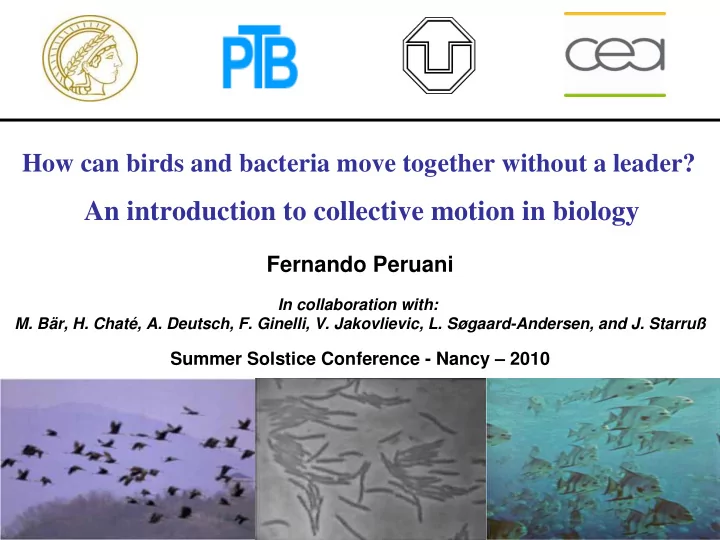
How can birds and bacteria move together without a leader? An introduction to collective motion in biology Fernando Peruani In collaboration with: M. Br, H. Chat, A. Deutsch, F. Ginelli, V. Jakovlievic, L. Sgaard-Andersen, and J. Starru


slide-1
SLIDE 1

Fernando Peruani

How can birds and bacteria move together without a leader?

An introduction to collective motion in biology

Summer Solstice Conference - Nancy – 2010

In collaboration with:

  • M. Bär, H. Chaté, A. Deutsch, F. Ginelli, V. Jakovlievic, L. Søgaard-Andersen, and J. Starruß
slide-2
SLIDE 2

Collective motion on the lattice Motivation: Examples of collective motion in biology Collective motion in a simple model A specific example: collective motion in myxobacteria Symmetries! Summary

slide-3
SLIDE 3

Motivation: Examples of collective motion in biology

Molecular motors bacteria eukaryote cells bird and fish Mammals social insects ~10-6 m ~10-2 m ~10-1 m ~100 m F.Peruani

slide-4
SLIDE 4

Motivation: Examples of collective motion in biology

Molecular motors bacteria eukaryote cells social insects ~10-6 m ~10-2 m

Large-scale patterns of millions of individuals emerge without a central control system! Coherent moving structures that emerge from local rules and short range interactions – i.e., without global knowledge of the system!

F.Peruani

slide-5
SLIDE 5

Motivation: collective motion as a theoretical challenge

Imperfect flow of information leads to defects, and defects set the limit to the size/scale of the patterns we can observe

Some classical results from statistical mechanics:

  • The Kosterlitz-Thouless transition:
  • The Mermin-Wagner theorem:

In equilibrium systems with SU2 symmetry, long-range order out of short-range interactions cannot emerge in 1D or 2D! [Ref.: Peruani, Nicola, Morelli, http://arxiv.org/abs/1003.4253 (2010)] F.Peruani

slide-6
SLIDE 6

Collective motion in a simple model

The Vicsek model

[T. Vicsek et al., Phys. Rev. Lett. 75, 1226 (1995)] Time t Time t+1

Average direction of motion in neighborhood ε

Motion in space Change of the direction of motion Average direction of motion at time t Angular noise !!! F.Peruani

slide-7
SLIDE 7

Collective motion in a simple model

The Vicsek model

Decreasing noise values F.Peruani

slide-8
SLIDE 8

Collective motion in a simple model

The Vicsek model

(noise) F.Peruani

slide-9
SLIDE 9

Collective motion in a simple model

Need of cohesion to sustain a flock in open space

[G. Grégoire and H. Chaté, Phys. Rev. Lett. 92, 025702 (2004)] where, F.Peruani

slide-10
SLIDE 10

Zusman 2007 Reichenbach 1965

Myxococcus xanthus

A specific example: collective motion in myxobacteria

F.Peruani

slide-11
SLIDE 11

2.5µm Myxobacteria (speed = 0.025 to 0.1 µm/s) Cyanobacteria (speed =10 µm/s) Cytophaga-Flavobacterium (speed = 2 to 4 µm/s)

  • Motility engines in M. xanthus:

Type IV pili Slime secretion Focal adhesion points Pelling 05

A specific example: collective motion in myxobacteria

F.Peruani

slide-12
SLIDE 12
  • How do M. xanthus cells communicate?
  • Cell reversal and C-signal:
  • A quorum sensing diffusive mechanism to trigger the life cycle.
  • There is no evidence of a guiding chemotactic signals involved in collective motion.
  • Cells exchange C-signal which controls cell reversal (it requires cell-cell contact).

Internal clock Igoshin & Oster 2003

A specific example: collective motion in myxobacteria

F.Peruani

slide-13
SLIDE 13

(Collective motion and clustering in the wild type during the vegetative growth)

Which mechanism is used by the cells to coordinate their motion?

  • Is there a hidden guiding chemotactic signal?
  • Can slime trail following cause these effects?
  • Is there a cell-density sensing mechanism that controls cell speed causing of

these effects?

  • What is the minimal mechanism that can produce these effects?

A specific example: collective motion in myxobacteria

F.Peruani

slide-14
SLIDE 14

Self-propulsion of bacteria + elongated shape = collective behavior ? What macroscopic effects can we expect in a system of self-propelled rods ?

A specific example: collective motion in myxobacteria

F.Peruani

slide-15
SLIDE 15

We consider the over-damped situation in which we have:

// ⊥ F R R R ~ , ,

// ⊥

are white noises!

( )

( ) ( )        + + + =

⊥ ⊥ ⊥

Inter Inter

F t R F F t R v v ) ( 1 , ) ( 1 ,

//

// // //

ζ ζ

( )

( )

Inter R

M t R dt d

+ =

~ 1

ζ θ

Interactions Self-Propelling force

( ) ( ) ( )

          − − =

β β γ

θ θ γ θ θ 1 ' , ' , , 1 ~ ' , ' , , x x a C x x V

Interactions are due to

  • verlapping of particles :

A simple model for self-propelled rods

[F. Peruani, A. Deutsch, and M. Bär, Phys. Rev. E 74, 030904 (2006)]

A specific example: collective motion in myxobacteria

F.Peruani

slide-16
SLIDE 16
  • Putting the model in the computer- simulations w/ periodic boundary conditions!

A specific example: collective motion in myxobacteria

F.Peruani

slide-17
SLIDE 17

How can we characterize the macroscopic collective behavior

  • f myxobacteria/self-propelled rods?

What can we measure here?

By looking at the clustering properties we can differentiate between individual and collective behavior There is a dramatic change in the clustering properties of the system when either the density or the aspect ratio of the particles is changed!

Peruani, Deutsch, and Bär, PRE (2006)

A specific example: collective motion in myxobacteria

F.Peruani

slide-18
SLIDE 18

The evolution equation for the cluster size distribution

collision kernel fragmentation kernel

A specific example: collective motion in myxobacteria

F.Peruani

slide-19
SLIDE 19

Three types of distributions/phases:

  • Exponential (P<Pc) – [monodisperse phase w/ characteristic cluster size]
  • Power-law (P=Pc) – [at the transition point, scale-free distribution]
  • Peak for large m (P>Pc) – [aggregation phase!]

The system exhibits a phase transition to an aggregation phase

A specific example: collective motion in myxobacteria

In Vicsek model… F.Peruani

slide-20
SLIDE 20

Adventurous mutant:

  • Cells do not reverse
  • Social motility engine – off
  • Advent. motility engine - on

What about collective motion and clustering in real myxobacteria ?

  • Experiments with A+S-Frz- Myxococcus xanthus mutant

A specific example: collective motion in myxobacteria

In collaboration with:

  • M. Bär, A. Deutsch, V. Jakovlievic, L. Søgaard-Andersen, and J. Starruß

F.Peruani

slide-21
SLIDE 21
  • Clustering in the A+S-Frz- mutant
  • Gliding speed = 3.10 ± 0.35 µm/min
  • W=0.7 µm, L=6.3 µm, a=4.4 µm2
  • =8.9 ± 1.95

κ Cell collision leads to alignment: Moving clusters of bacteria are formed:

A specific example: collective motion in myxobacteria

F.Peruani

slide-22
SLIDE 22
  • Comparison: theory and experiments

A specific example: collective motion in myxobacteria

F.Peruani

slide-23
SLIDE 23

parallel - ferromagnetic ||-anti|| - nematic Initial situation Symmetries!

slide-24
SLIDE 24

Same symmetry

Particles move in the direction given by: Update of the moving direction Additive noise Alignment

Symmetries!

A simple model for self-propelled rods (e.g., bacteria)

[F. Peruani, A. Deutsch, and M. Bär, Eur. Phys. J. Special Topics 157, 111 (2008)] F.Peruani

slide-25
SLIDE 25

Symmetries!

F.Peruani

slide-26
SLIDE 26

Symmetries!

The symmetry of the alignment determines the type of macroscopic order

[F. Peruani, A. Deutsch, and M. Bär, Eur. Phys. J. Special Topics 157, 111 (2008)]

  • A mean-field approach to understand collective motion

noise alignment

Ferromagnetic alignment Nematic alignment

Ferro Nema F.Peruani

slide-27
SLIDE 27

Symmetries!

The symmetry of the alignment determines the type of macroscopic order

[F. Peruani, A. Deutsch, and M. Bär, Eur. Phys. J. Special Topics 157, 111 (2008)]

  • A mean-field approach to understand collective motion

noise alignment

Ferromagnetic alignment Nematic alignment

Ferro Nema F.Peruani

slide-28
SLIDE 28

Nematic OP: Ferromagnetic OP: local and global disorder stable band regime no-band

  • rdered

regime

Symmetries!

The symmetry of the alignment plays a crucial role in pattern formation

[F. Ginelli, F. Peruani, M. Bär, and H. Chaté, Phys. Rev. Lett. 104, 184502 (2010)] F.Peruani

slide-29
SLIDE 29

Fraction of the area

  • ccupied by the band

Symmetries!

The symmetry of the alignment plays a crucial role in pattern formation

F.Peruani

slide-30
SLIDE 30

In regime 1:

  • True Long-Range Order (LRO)
  • Giant fluctuations

In regime 3:

  • There is no LRO
  • Unstable macroscopic structures (bands!)

Slope 2/3

Slope 0.8 Mermin Wagner Theorem (for equilibrium syst.) does not allow for LRO!

Symmetries!

F.Peruani

slide-31
SLIDE 31

Symmetries!

The symmetry of the alignment plays a crucial role in pattern formation

F.Peruani

slide-32
SLIDE 32

Collective motion on the lattice

Collective motion in a simple cellular automaton model

[H.J. Bussemaker, A. Deutsch, and E. Geigant, Phys. Rev. Lett. 78, 5018 (1997)] Rules: 1) Migration to next neighbor (according to channel direction) 2) Reorientation (i.e., velocity change) according to the following rule: Where Z defined such that and

Mean local velocity:

F.Peruani

slide-33
SLIDE 33

Collective motion on the lattice

Collective motion in a simple cellular automaton model

[H.J. Bussemaker, A. Deutsch, and E. Geigant, Phys. Rev. Lett. 78, 5018 (1997)] Parameters: L=50, ß=1.5, =0.8 (N ~ 2000) ρ

Mean velocity

Order parameter vs. “noise” Phase diagram

F.Peruani

slide-34
SLIDE 34

Collective motion on the lattice

First- and second order phase transition in a lattice model for swarming

In collaboration with:

  • T. Klauß, A. Deutsch, and A. Voß-Böhme

Possible velocities for a particle:

, , ,

Possible states of a node: 1) Empty 2) Occupied F.Peruani

slide-35
SLIDE 35

Collective motion on the lattice

First- and second order phase transition in a lattice model for swarming

The “stochastic rules”, defined in continuum time: Each particle can perform two actions: 1) Migrate according to its velocity direction 2) Reorient its velocity direction Associated to each action, there is a transition probability (per unit time): 1) Migration according to its velocity direction 2) Reorient its velocity direction

This defines a ferromagnetic alignment rule!

F.Peruani

slide-36
SLIDE 36

Collective motion on the lattice

First- and second order phase transition in a lattice model for swarming

The “stochastic rules”, defined in continuum time: Each particle can perform two actions: 1) Migrate according to its velocity direction 2) Reorient its velocity direction Associated to each action, there is a transition probability (per unit time): 1) Migration according to its velocity direction 2) Reorient its velocity direction

This defines a ferromagnetic alignment rule!

?

F.Peruani

slide-37
SLIDE 37

Collective motion on the lattice

First- and second order phase transition in a lattice model for swarming

The “stochastic rules”, defined in continuum time: Each particle can perform two actions: 1) Migrate according to its velocity direction 2) Reorient its velocity direction Associated to each action, there is a transition probability (per unit time): 1) Migration according to its velocity direction 2) Reorient its velocity direction

This defines a ferromagnetic alignment rule!

?

F.Peruani

slide-38
SLIDE 38

Collective motion on the lattice

First- and second order phase transition in a lattice model for swarming

The “stochastic rules”, defined in continuum time: Each particle can perform two actions: 1) Migrate according to its velocity direction 2) Reorient its velocity direction Associated to each action, there is a transition probability (per unit time): 1) Migration according to its velocity direction 2) Reorient its velocity direction

This defines a ferromagnetic alignment rule!

?

F.Peruani

slide-39
SLIDE 39

Collective motion on the lattice

First- and second order phase transition in a lattice model for swarming

The “stochastic rules”, defined in continuum time: Each particle can perform two actions: 1) Migrate according to its velocity direction 2) Reorient its velocity direction Associated to each action, there is a transition probability (per unit time): 1) Migration according to its velocity direction 2) Reorient its velocity direction

This defines a ferromagnetic alignment rule!

?

F.Peruani

slide-40
SLIDE 40

Collective motion on the lattice

First- and second order phase transition in a lattice model for swarming

Results at “low” density

time

Parameters: L=25, d=0.5, g=1.7, m=100 F.Peruani

slide-41
SLIDE 41

Collective motion on the lattice

First- and second order phase transition in a lattice model for swarming

Results at “low” density (L=50, m=100) g=1.7 g=1.7, d=0.09 F.Peruani

slide-42
SLIDE 42

Collective motion on the lattice

First- and second order phase transition in a lattice model for swarming

Results at “low” density g=1.7 At “low” density the numerical evidence points towards a dynamical first order transition F.Peruani

slide-43
SLIDE 43

Collective motion on the lattice

First- and second order phase transition in a lattice model for swarming

Results at “high” (=full occupancy) density

  • The problem with full occupancy can be mapped to the 4-Potts model
  • The 4-Potts model exhibits a second order phase transition
  • Then, our model exhibits a second order transition at d=1 !

Results at “intermediate” density d=0.7 d=0.7, g=1.1 F.Peruani

slide-44
SLIDE 44
  • Models for collective motion can be either continuum (off-lattice)
  • r discrete (on-lattice)
  • Collective motion models are intrinsically (thermodynamically)

non-equilibrium systems

Summary

F.Peruani

slide-45
SLIDE 45

Summary

  • The symmetry of the interaction determines the kind of order:

either polar or nematic

  • Collective motion can be characterized as a transition to

aggregation (link to pattern formation)

  • Collective motion modeling applies to animal behavior (fish,

birds, sheeps, ants, etc) as well as developmental biology (aggregation patterns in bacteria, tissue formation, cancer, etc)

F.Peruani

slide-46
SLIDE 46

Thanks for you attention!

Some references: FP, Deutsch, and Bär, PRE (2006) FP, Morelli, PRL (2007) FP, Deutsch, and Bär, EPJ-ST (2008) Ginelli, FP, Bär, Chaté, PRL (2010) FP, Nicola, Morelli, arXiv (2010)