An Efficient Algorithm for Partial Order Production Jean Cardinal - - PowerPoint PPT Presentation

an efficient algorithm for partial order production
SMART_READER_LITE
LIVE PREVIEW

An Efficient Algorithm for Partial Order Production Jean Cardinal - - PowerPoint PPT Presentation

An Efficient Algorithm for Partial Order Production Jean Cardinal Samuel Fiorini Gwena el Joret ULB/CS ULB/Math ULB/CS Rapha el Jungers Ian Munro UCL/INMA Waterloo/CS Sorting by Comparisons Input: a set T of size n , totally


slide-1
SLIDE 1

An Efficient Algorithm for Partial Order Production

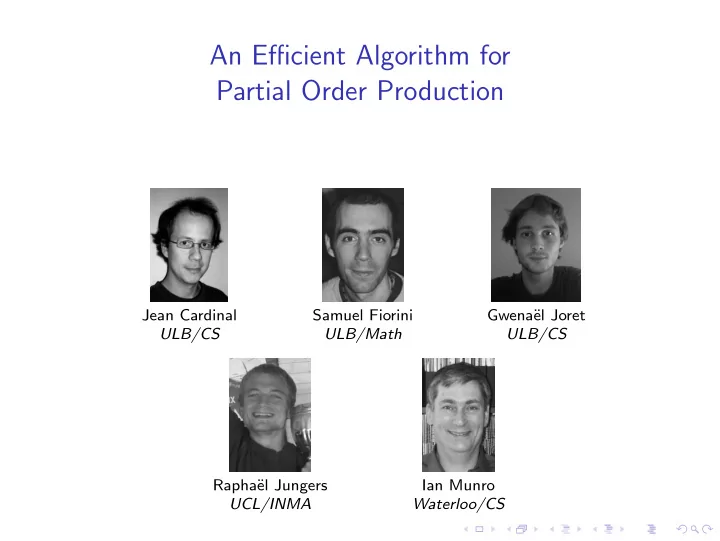
Jean Cardinal ULB/CS Samuel Fiorini ULB/Math Gwena¨ el Joret ULB/CS Rapha¨ el Jungers UCL/INMA Ian Munro Waterloo/CS
slide-2
SLIDE 2

Sorting by Comparisons

Input: a set T of size n, totally ordered by Goal: place the elements of T in a vector v in such a way that v[1] v[2] · · · v[n] after asking a min number of questions of the form “is t t′?”

T v[1] v[2] . . . . . . v[n]

slide-3
SLIDE 3

Sorting by Comparisons

Input: a set T of size n, totally ordered by Goal: place the elements of T in a vector v in such a way that v[1] v[2] · · · v[n] after asking a min number of questions of the form “is t t′?”

v[1] v[2] T v[n] . . . . . .

slide-4
SLIDE 4

Partial Order Production (“Partial Sorting”)

Input: a set T of size n, totally ordered by a partial order on the set of positions [n] := {1, 2, . . . , n} Goal: place the elements of T in a vector v in such a way that v[i] v[j] whenever i j after asking a min number of questions of the form “is t t′?”

v[1] v[2] . . . . . . v[n]

slide-5
SLIDE 5

Particular Cases (1/2)

Heap Construction

  • r

v[7] v[4] v[1] v[1] v[2] v[3] v[4] v[5] v[6] v[7] v[5] v[6] v[3] v[2]

slide-6
SLIDE 6

Particular Cases (2/2)

Multiple Selection

v[r3] v[r2]

1

v[r ]

Find the elements of rank r1, r2, . . . , rk

slide-7
SLIDE 7

Particular Cases (2/2)

Multiple Selection

v[r3] v[r2]

1

v[r ]

Find the elements of rank r1, r2, . . . , rk Target poset P := ([n], ) is a weak order

slide-8
SLIDE 8

Particular Cases (2/2)

Multiple Selection

v[r3] v[r2]

1

v[r ]

Find the elements of rank r1, r2, . . . , rk Target poset P := ([n], ) is a weak order ∃ near-optimal algorithm (Kaligosi, Mehlhorn, Munro and Sanders, 05)

slide-9
SLIDE 9

Worst Case Lower Bounds

Well known fact. For Sorting by Comparisons: worst case #comparisons ≥ lg n!

slide-10
SLIDE 10
  • Fact. (Sch¨
  • nage 76, Aigner 81) For Partial Order Production:

worst case #comparisons ≥ lg n! − lg e(P)

  • =: LB

where e(P) := # linear extensions of P

n!

slide-11
SLIDE 11
  • Fact. (Sch¨
  • nage 76, Aigner 81) For Partial Order Production:

worst case #comparisons ≥ lg n! − lg e(P)

  • =: LB

where e(P) := # linear extensions of P

2 n!

slide-12
SLIDE 12
  • Fact. (Sch¨
  • nage 76, Aigner 81) For Partial Order Production:

worst case #comparisons ≥ lg n! − lg e(P)

  • =: LB

where e(P) := # linear extensions of P

n! 4

slide-13
SLIDE 13
  • Fact. (Sch¨
  • nage 76, Aigner 81) For Partial Order Production:

worst case #comparisons ≥ lg n! − lg e(P)

  • =: LB

where e(P) := # linear extensions of P

n! 8

slide-14
SLIDE 14
  • Fact. (Sch¨
  • nage 76, Aigner 81) For Partial Order Production:

worst case #comparisons ≥ lg n! − lg e(P)

  • =: LB

where e(P) := # linear extensions of P

n! 16

|leaf set| ≤ e(P) = ⇒ #comparisons ≥ lg

n! e(P) = LB

slide-15
SLIDE 15

Problem History

1976 Sch¨

  • nage defined POP problem
slide-16
SLIDE 16

Problem History

1976 Sch¨

  • nage defined POP problem

1981 Aigner studied POP problem

slide-17
SLIDE 17

Problem History

1976 Sch¨

  • nage defined POP problem

1981 Aigner studied POP problem 1985 two surveys: Bollob´ as & Hell, and Saks. Saks conjectured that ∃ algorithm for POP problem s.t. worst case #comparisons = O(LB) + O(n)

slide-18
SLIDE 18

Problem History

1976 Sch¨

  • nage defined POP problem

1981 Aigner studied POP problem 1985 two surveys: Bollob´ as & Hell, and Saks. Saks conjectured that ∃ algorithm for POP problem s.t. worst case #comparisons = O(LB) + O(n) 1989 Yao solved Saks’ conjecture, stated open problems

slide-19
SLIDE 19

Our Result

There exists a O(n3) algorithm for the POP problem s.t. worst case #comparisons = LB + o(LB) + O(n) Improvements over Yao’s algorithm:

◮ overall complexity is polynomial ◮ smaller number of comparisons

slide-20
SLIDE 20

A Simple Plan

  • 1. Extend the target poset P to a weak order W
  • 2. Solve the problem for W using Multiple Selection algorithm

W P

slide-21
SLIDE 21

Key Tool: the Entropy of a Graph

The entropy of G = (V , E) equals: H(G) := min

x∈STAB(G) −1

n

  • v∈V

lg xv where STAB(G) := stable set polytope of G

slide-22
SLIDE 22

Key Tool: the Entropy of a Graph

The entropy of G = (V , E) equals: H(G) := min

x∈STAB(G) −1

n

  • v∈V

lg xv where STAB(G) := stable set polytope of G

◮ Introduced in information theory by J. K¨

  • rner (73)

◮ Graph invariant with lots of applications (mostly in TCS)

◮ bounds for perfect hashing ◮ circuit lower bounds for monotone Boolean functions ◮ sorting under partial information (Kahn and Kim 95) ◮ . . .

slide-23
SLIDE 23
  • Lemma. (Kahn and Kim 95)

−n H(G)

  • =lg Vol(Box)

≤ lg Vol(STAB(G)) ≤ n lg n − lg n! − n H(G)

  • =lg Vol(Simplex)
slide-24
SLIDE 24
  • Lemma. (Kahn and Kim 95)

−n H(G)

  • =lg Vol(Box)

≤ lg Vol(STAB(G)) ≤ n lg n − lg n! − n H(G)

  • =lg Vol(Simplex)
slide-25
SLIDE 25
  • Lemma. (Kahn and Kim 95)

−n H(G)

  • =lg Vol(Box)

≤ lg Vol(STAB(G)) ≤ n lg n − lg n! − n H(G)

  • =lg Vol(Simplex)
slide-26
SLIDE 26

Comparability Graphs and Entropy

G(P) := comparability graph of target poset P H(P) := H(G(P))

P G(P)

  • Lemma. (Stanley 86)

Vol

  • STAB
  • G(P)
  • = e(P)

n! Corollary. n H(P) − n lg e ≤ LB ≤ n H(P)

slide-27
SLIDE 27

Weak Order Extensions → Colorings

Observation. Every weak order extension W of P gives a coloring of G(P) ⇓ Want: “good” coloring of G(P) W extends P = ⇒ STAB

  • G(P)
  • ⊇ STAB
  • G(W )
  • =

⇒ H(P) ≤ H(W ) Intuition. H(W ) should be as small as possible ⇓ The class sizes should be distributed as unevenly as possible

slide-28
SLIDE 28

Greedy Colorings and Greedy Points

For G = perfect graphs

Iteratively remove a maximum stable set from G sequence S1, S2, . . . , Sk of stable sets

◮ Gives greedy coloring (k colors, ith color class = Si) ◮ Also gives greedy point:

˜ x :=

k

  • i=1

|Si| n · χSi ∈ STAB(G)

1/2 1/3 1/6 1/2 1/2 1/3

slide-29
SLIDE 29
  • Theorem. Let G be a perfect graph on n vertices and denote by ˜

g the entropy of an arbitrary greedy point ˜ x ∈ STAB(G). Then ˜ g ≤ 1 1 − δ

  • H(G) + lg 1

δ

  • for all δ > 0, and in particular

˜ g ≤ H(G) + lg H(G) + O(1). Proof idea. Dual fitting, using min-max relation H(G) + H(¯ G) = lg n due to Csisz´ ar, K¨

  • rner, Lov´

asz, Marton and Simonyi (90)

slide-30
SLIDE 30

Colorings → Weak Order Extensions

slide-31
SLIDE 31

Colorings → Weak Order Extensions

slide-32
SLIDE 32

Colorings → Weak Order Extensions

slide-33
SLIDE 33

Colorings → Weak Order Extensions

Weak order extensions of P → colorings of G(P) ← = ⇒ need to “uncross” our greedy colorings

slide-34
SLIDE 34

Uncrossing a Greedy Coloring

D = D(P) := auxiliary network with source s, sink t D = (N(D), A(D))

1 4 5 6 3 2

6− 6+ 5

3+ 2+ 1+

1 3

+

4+ 2− 5− 4 s t

slide-35
SLIDE 35

(H-potential) min −1 n

  • v∈V

lg xv s.t. xv = yv+ − yv− ∀v ∈ V ya

  • yb

∀(a, b) ∈ A(D) ys = yt = 1 Find potential ˜ y for greedy point ˜ x (by DP) We get:

◮ collection of open intervals

yv−, ˜ yv+)

  • v∈V

◮ interval order I extending P, with H(I) close to H(P)

slide-36
SLIDE 36

1/2 1/3 1/6 1/2 1/2 1/3

slide-37
SLIDE 37

1/2 1/3 1/6 1/2 1/2 1/3

1/3 1 1/3 1/2 1/2 5/6 2/3 5/6 1/2 1/2

slide-38
SLIDE 38

1/2 1/3 1/6 1/2 1/2 1/3

1/3 1 1/3 1/2 1/2 5/6 2/3 5/6 1/2 1/2 1/3 1/2 2/3 5/6 1

slide-39
SLIDE 39

1/2 1/3 1/6 1/2 1/2 1/3

1/3 1 1/3 1/2 1/2 5/6 2/3 5/6 1/2 1/2 1/3 1/2 2/3 5/6 1

slide-40
SLIDE 40

Main Steps of our Algorithm

  • 1. P

greedy+DP

֒ → I

  • 2. I

greedy

֒ → W

  • 3. Use Multiple Selection algorithm of Kaligosi et al. on W
  • Theorem. The algorithm above solves the POP problem, in O(n3)

time, after performing at most LB + o(LB) + O(n) comparisons

slide-41
SLIDE 41

Further Result & Open Questions

Tightness result:

◮ Any algorithm reducing the POP problem to Multiple

Selection can be forced to perform LB + Ω(n lg lg n) comparisons for some P with H(P) ≈ 1

2 lg n

Open questions:

◮ Is there an algorithm performing LB + O(n) comparisons? ◮ What about Partial Order Production under Partial

Information?

slide-42
SLIDE 42

Thank You!

P.S.: The paper is available on ArXiv