SLIDE 1
1
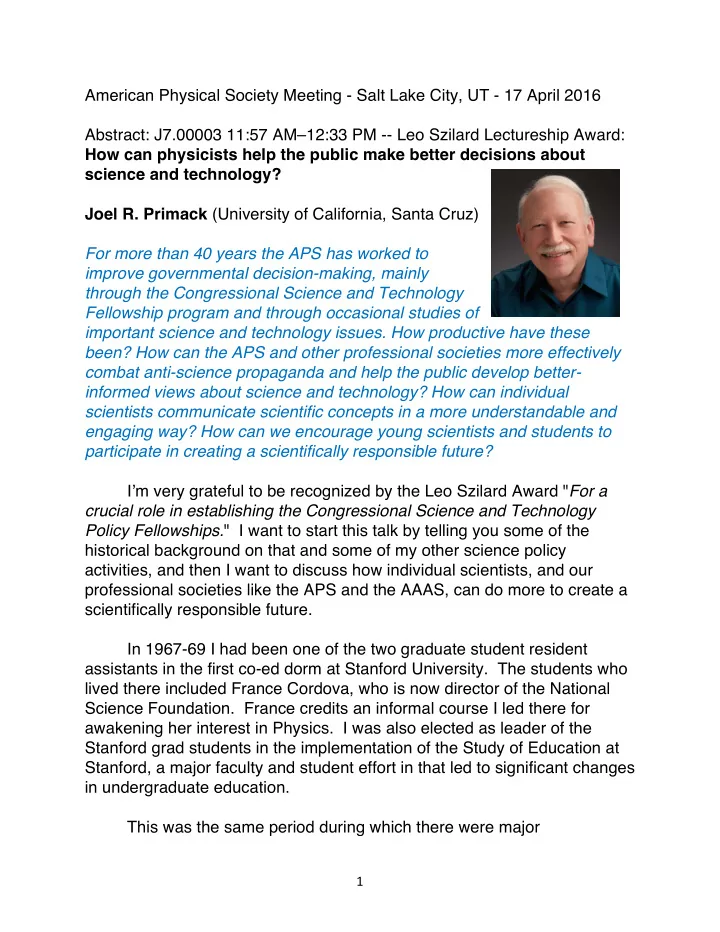
American Physical Society Meeting - Salt Lake City, UT - 17 April 2016 Abstract: J7.00003 11:57 AM–12:33 PM -- Leo Szilard Lectureship Award: How can physicists help the public make better decisions about science and technology? Joel R. Primack (University of California, Santa Cruz) For more than 40 years the APS has worked to improve governmental decision-making, mainly through the Congressional Science and Technology Fellowship program and through occasional studies of important science and technology issues. How productive have these been? How can the APS and other professional societies more effectively combat anti-science propaganda and help the public develop better- informed views about science and technology? How can individual scientists communicate scientific concepts in a more understandable and engaging way? How can we encourage young scientists and students to participate in creating a scientifically responsible future? I’m very grateful to be recognized by the Leo Szilard Award "For a crucial role in establishing the Congressional Science and Technology Policy Fellowships." I want to start this talk by telling you some of the historical background on that and some of my other science policy activities, and then I want to discuss how individual scientists, and our professional societies like the APS and the AAAS, can do more to create a scientifically responsible future. In 1967-69 I had been one of the two graduate student resident assistants in the first co-ed dorm at Stanford University. The students who lived there included France Cordova, who is now director of the National Science Foundation. France credits an informal course I led there for awakening her interest in Physics. I was also elected as leader of the Stanford grad students in the implementation of the Study of Education at Stanford, a major faculty and student effort in that led to significant changes in undergraduate education. This was the same period during which there were major
SLIDE 2 2
demonstrations at Stanford against the Viet Nam war and against military research on campus, including occupation of labs where such research was done. I participated in some of these demonstrations although not the
- ccupations. These actions helped end classified research on campus. I
admired the activism of the students, but I thought that Stanford students should use their brains as well as their bodies to cause social and political
- change. I worked on this mainly with my friends Joyce Kobayashi, who
was elected as a co-president of the Stanford students 1969-70, and Bob Jaffe, who had graduated from Princeton in 1968 and also had Sid Drell as his PhD advisor. We organized ten Stanford classes offered in fall 1969 for credit, taught by grad students as well as Stanford faculty members. The goal of each class was to improve the world as well as to educate the
- participants. We called this program Stanford Workshops on Political and
Social Issues (SWOPSI). In order to have increased flexibility and to secure the cooperation of the Stanford administration, we wrote a proposal to the Ford Foundation, which gave us $40,000; these funds paid for publication
- f the studies resulting from the SWOPSI classes for several years.
SLIDE 3 3
We advertised these SWOPSI classes in a pamphlet that we distributed in the same sign-up process that was used for all the other Stanford classes in those days. As I recall, all the SWOPSI classes attracted goodly numbers of students – and some attracted far more students than we expected. The largest number was for a class on international security, nuclear weapons, and arms control that was co-led by Prof. Wolfgang "Pief" Panofsky, who was then director of the Stanford Linear Accelerator Center and one of the U.S. government's top experts on these issues. More than 100 students wanted to take this class, which is still team-taught at Stanford every year. Ultimately this led to the creation
- f the Stanford Center for International Security and Arms Control (CISAC),
which has become an internationally important center. Bob Jaffe’s and my PhD advisor, Sid Drell, then SLAC deputy director, was also a top Presidential advisor on these issues, and he subsequently co-led this center.
SLIDE 4 4
The Congressional Science and Technology Fellowship program grew out of another of the first SWOPSI courses, which I organized and led with Bob Jaffe, Frank von Hippel, and Martin Perl in 1969-70 [2]. Our workshop was focused on improving U.S. decision-making on science and technology issues. One of our projects was to prepare a questionnaire for Congress, which was distributed by California Senator Alan Cranston and Berkeley Representative Jeffrey Cohelan. Of the several ideas we suggested, the two that were most popular were a science advisory agency for Congress (much like the Office of Technology Assessment, created in 1972), and a program of scientists serving for a year on Congressional staffs. Our workshop wrote an analysis of the Congressional questionnaire, and Frank von Hippel and I wrote a more general report, The Politics of
- Technology. I then set out to try to get our recommendations implemented
SLIDE 5 5
while I began my scientific career. When I was a Harvard Junior Fellow 1970-73, Senior Fellow Ed Purcell was very supportive of these ideas, and as President of the APS in 1970 he got me appointed to relevant committees of APS and AAAS [3]. I sought out other receptive officers of these organizations, and worked with other young activists. Among my important allies in the effort to create the Fellowship program were AAAS Treasurer William T. Golden and Carleton College physics professor Barry
- M. Casper (who was also an early leader of the APS Forum on Physics and
Society). Bill Golden challenged me to give him a list of Senators and Representatives who would like to host a Fellow, and a list of excellent young scientists who were interested in applying for such a program. Although I was initially hesitant to employ the buddy system to do the latter, I did what he asked. The three people that I recruited became members of the first group of AAAS and APS Congressional Science Fellows. Golden responded by writing a personal check to provide initial funding for the AAAS Congressional Fellowship program, and he persuaded the AAAS leadership to support it [4]. APS Executive Secretary Bill Havens was initially hard to convince, but he ultimately became one of the strongest supporters of the Congressional Science Fellowship program – and APS joined with AAAS in initiating the program. Havens was persuaded that it would be a good thing
SLIDE 6 6
for APS to help legitimize activities for physicists other than traditional research in universities and industry. A supportive 1973 Physics Today editorial pointed out that “A modest-size business corporation faced with making million-dollar decisions typically has more specialists in science and technology on its staff than are available to Congressional Committees reaching decisions on billion-dollar questions.” At that time the entire Congressional staff included only two PhD physicists. I had consulted them, among many others including several members of Congress, in designing the program. One of my arguments for establishing the Congressional Fellowship program was that it would give scientists experience and connections that could empower them to succeed in a wide variety of careers. The career paths of the roughly 4000 Congressional Fellows have indeed been
- diverse. Rush Holt went on to serve in the State Department and as
deputy director of the Princeton Plasma Physics Laboratory. From 1999 to 2014 Rush was the Congressman from the New Jersey district that includes Princeton, and he is now the AAAS CEO. Others went on to serve
- n Congressional staffs or in the Executive Branch, and many others are at
universities or laboratories, in industry, on professional society staffs, and at public interest organizations. In addition to the Congressional Fellowship program, during the same period I also helped to organize the Forum on Physics and Society. It was I who suggest the name “Forum” since Bill Havens thought that “Division” should apply only to Physics fields. I also played a major role in starting the APS’s program of studies on public policy issues. On a visit to the Institute for Advanced Study, in addition to giving a seminar about my research with Harvard colleagues Tom Appelquist and Helen Quinn, and with Ben Lee and Sam Treiman, on what we now call the standard model of particle physics, I also gave another seminar about the safety of nuclear power reactors, on which I was working with Henry Kendall (a SLAC and MIT physicist and Union of Concerned Scientists co-founder who later shared the 1990 Nobel Prize in Physics). Freeman Dyson initially disagreed that reactor safety was a concern, but he became interested after he invited me to explain the background during a long walk in the Einstein woods behind the Institute
SLIDE 7 7
for Advanced Study. At a meeting at Los Alamos in 1973 to discuss initiating APS policy studies, Freeman and I drafted the proposal for the first of these studies, on Light Water Reactor Safety, and in 1974 I led the group that obtained funding for this study from NSF director Guyford
- Stever. Among the most ambitious of the subsequent APS studies were
those on Energy Efficiency (1975, 2008), Directed Energy Weapons (1987), and Boost-Phase Missile Defense (2004) [5]. In creating enduring social innovations like SWOPSI, the Congressional Science Fellowship Program, the APS studies, and the also AAAS Science and Human Rights program [6], I have found that the first requirement is that it be “spherically sensible – it has to make sense from everyone’s perspective [7]. The Congressional Fellowship program, for example, benefited the fellows themselves, Congress, their professional societies – as well as their scientific professions and the larger national
- interest. The second requirement is to recruit excellent people. Dick
Scribner, the initial director of the Congressional Science Fellowship Program, played a crucial role in steering the program through its difficult first years – and the Fellows themselves were superb. The final requirement is that initiators like me get out of the way! It is essential that the people who do all the hard work have managerial responsibility and get credit for their successes.
SLIDE 8 8
In 1974, Frank von Hippel and I published a book, Advice and Dissent: Scientists in the Political Arena [8]. Our goal was to improve decisions on technology by improving both advice (from scientists to government) and dissent (political advocacy by scientists and their
- rganizations). We presented many case studies of technological issues –
ABM, SST, cyclamates, persistent pesticides, chemical and biological warfare, nuclear reactor safety. We concluded that insider scientific advisors can tell government officials how to do better what they have already decided to do, but that turning government decisions around usually requires outsider activism. To make such activism effective and help people throughout the country get access to scientific knowledge and expertise, Frank von Hippel and I worked with Senator Ted Kennedy to create the NSF Science for Citizens program, which was signed into law in 1967. The basic premise of the “public interest science” movement was that the solution was providing improved knowledge (for example,
SLIDE 9 9
through studies) and expertise. Several thousand scientists have now become what former President Science Advisor Neal Lane [9] calls “civic scientists.” Democratic decision-making on technological issues certainly improved as a result. But despite all these efforts, the U.S. has continued to have difficulty addressing the crucial technological challenges of our time, including human-caused global climate change and species extinction. Ever since about 1800, the doubling time for human production of carbon dioxide and
- ther industrial waste products has been about 30 years. In the next thirty
years or so, humanity must somehow stop this exponential growth in resource use, and develop a sustainable relationship with the earth. During the past century, the number of people on our planet increased by about a factor of four, but our energy consumption increased by an order of
- magnitude. Worldwide, people emit a ton of carbon a year into the
atmosphere; in the U.S., it’s 10 tons per person per year! [10] Our collective impact on planetary systems is now so great that this growth in resource
SLIDE 10
10
use must slow very quickly, despite the increasing global industrialization as an increasing fraction of the world’s people improve their lives. Unfortunately, most people don’t understand the dangers of exponential growth. Frank and I wrote Advice and Dissent during the Nixon administration, and after President Nixon abolished the Presidential Science Advisory Committee and put scientists like Physicist Richard Garwin on his “enemies list,” we thought things couldn’t get worse. But President Reagan committed many billions of dollars to the Strategic Defense Initiative without critical review – although the APS study on Directed Energy Weapons led by Nobel Laureate Nicholas Bloembergen subsequently showed that these “Star Wars” projects could not succeed without violating the laws of physics. President George W. Bush’s administration chose members of science advisory committees based on who had voted for him, and censored the public statements of government scientists on issues like climate change.
SLIDE 11
11
We did not foresee that the Republican Party would wage a war on science and other independent sources of truth. Among the first things that Newt Gingrich’s Republican Congressional majority did when they came to power in 1995 was to abolish the Office of Technology Assessment and the NSF Science for Citizens Program, and fire the only astronomer who ever headed the Smithsonian Air and Space Museum, Martin Harwitt. The House Science Committee, chaired by Texas representative Lamar Smith, has been given sweeping investigative power by the House leadership and is using it to hassle scientists. And of course Oklahoma Senator James Inhofe, chairman of the Senate Environment Committee, claims that global warming is a “hoax” and said that because “God's still up there”, the “arrogance of people to think that we, human beings, would be able to change what He is doing in the climate is to me outrageous.”
SLIDE 12 12
We also did not appreciate that prominent physicists like Detlev Bronk, National Academy President 1950-1962, would become what historians Naomi Oreskes and Erik Conway called “Merchants of Doubt,” attacking the scientific basis for regulating everything from cigarette smoking to carbon dioxide, claiming that “the science is unsettled so action is premature.” Such efforts unfortunately continue to be successful: Only about one in ten Americans understands that nearly all climate scientists (over 90%) are convinced that human-caused global warming is happening. We also did not foresee that people’s religious and political identities would increasingly determine their views on scientific issues like the existence of climate change – and that in the digital era people increasingly get information from sources, including social media, that confirm their
- prejudices. The problem is not just that the public is not well informed.
SLIDE 13
13
Thus, things have gotten much worse than Frank von Hippel and I foresaw back in 1974. So … What can we do as individual scientists do to improve the situation? And what can professional societies like APS and AAAS do? Let me suggest a few things. First, individual scientists need to become better at explaining our research and also the scientific basis of public policy choices. This is difficult for several reasons. One is because most non-scientists don’t know much about science, and also because scientific discourse is full of facts, theories, and logical arguments – but most non-scientists are not so good at scientific thinking. They are better at dealing with social situations and stories. Let me illustrate this with the Wason selection task:
SLIDE 14
14
Thus we have to become better at presenting science in ways that people can grasp and act on. NY Times columnist Nicholas Kristof’s “Advice on How To Save the World” says that it’s better to focus on one individual person than a multitude: one person’s death is a tragedy, a million is a statistic. Kristof also says that social science research shows it’s far more effective to help people feel good about doing something good than to feel guilty for not doing it. [11] Actor Alan Alda for 14 years hosted the Scientific American Frontiers TV show, constantly challenging the scientists to explain things in a
SLIDE 15 15
compelling way. In 2009 he founded and helps to lead the Alan Alda Center for Communicating Science at Stony Brook University, which is also supported by Brookhaven National Laboratory and Cold Spring Harbor
- Laboratory. Alda and his team (including my daughter, actress and dialect/
communication coach Samara Bay) have been giving workshops for scientists about how to reach audiences by telling memorable stories. They also lead improvisation exercises to help the scientists learn to sense how the audience is responding – and to go with the flow of questions with “yes, and”, the improviser’s motto. Several scientists have also been giving helpful workshops and writing books on communicating science effectively. Randy Olson, a former professor of marine biology turned film-maker, in his 2015 book Houston, we have a narrative, recommends a dialectical scheme for turning science into stories: background, problem, solution, which he summarizes as “And…But…Therefore”. The present era seems to be ripe for student involvement in hopeful
- causes. Scientists at colleges and universities can encourage and help our
SLIDE 16
16
students to organize SWOPSIs – “Science Workshops on Social and Political Issues” to study important issues and help improve the world. When scientists become advocates, they may be perceived by their colleagues and the public as biased. But scientists have a right to express their convictions and work for social change, and these activities need not undercut rigorous commitment to objectivity in research. What can professional scientific societies do? I heard best- selling novelist and screen writer Michael Crichton give an excellent talk about this at the 1999 AAAS meeting in Anaheim [12]. He said, Under the auspices of a distinguished organization—like AAAS—I'd set up a service bureau for reporters. Reporters are harried, and often don't know science. … Establish a source of information to help them, to verify facts, to assist them through thorny issues. Over time, … you can start
SLIDE 17 17
knocking down phony stories, fake statistics, and pointless scares immediately, before they build. And … refer reporters to scientists around the country who can speak clearly to specific issues, who are quotable, and who can eventually emerge as recognizable spokespeople for science in areas of public concern… Convince these scientists that appearing on media isn't an ego trip, but is part of their job, and a service to their profession. Then convince their
- colleagues. Because this pool of scientists will eventually produce media
stars, you need the profession to respect them, instead of making their lives hell. Carl Sagan took incredible flak from colleagues, yet he performed a great service to science…. All this must change. Science has dealt with its disdain of the press by turning media work over to popularizers. But popularizers can't do what needs to be done, because people see they aren't really scientists, they're just well‐informed talkers. You need working scientists with major reputations and major accomplishments to appear regularly on the media, and thus act as human examples, demonstrating by their presence what a scientist is, how a scientist thinks and acts, and explaining what science is about. … Science needs them…. And it doesn't hurt if they're characters: Richard Feynman, with his strip‐tease lunches and pranks and bongo drums, did much to put a human face on physics. I would go further, and have AAAS in collaboration with other professional societies create an online SciTech Policy Review Journal, with authoritative reviews of important topics kept up to date by leading
- experts. A good example of this is the report by the AAAS Climate Science
SLIDE 18 18
Panel, WHAT WE KNOW: The Reality, Risks, and Response to Climate Change, on the web with an introductory video narrated by the President of the American Meteorological Society [13]. Creating videos and using social media to spread the messages is essential to reach a large audience in the modern world, where many people get their news and views from social media. When serious disagreements remain, it is not advisable to paper over the differences. Nancy Abrams and Steve Berry suggested a better approach that they call Scientific Mediation: have experts who disagree write a joint report with the help of a mediator, in which they specify the topics on which they agree and disagree, and explaining why they disagree
- n each of those points to each others’ satisfaction, clarifying what
additional assumptions they are making. These additional assumptions are
- ften not scientific! Fracking and nuclear power might be good topics for
Scientific Mediation. Don’t be discouraged by the tremendous challenges we face. Feynman advised that in choosing projects, we should maximize the product of the (importance)x(probability of success), and it is important not to underestimate the probability of success! Sometimes things work
SLIDE 19 19
Let me tell you how a small group of scientists stopped the Soviet Union from launching nuclear reactors into low-earth orbit. In 1987 Frank von Hippel was working with U.S. and Soviet scientists to try to tamp down the U.S.–U.S.S.R. arms race. Frank introduced me to Roald Sagdeev, then head of the Soviet Space Research Institute and a top advisor to President Gorbachev. The U.S. had orbited the first nuclear power reactor in 1965, and the Soviets subsequently launched dozens of them to power low-flying radar satellites called RORSATs that tracked the U.S. navy. Before reentry, almost all of the RORSATs ejected their 50 kg high- enriched uranium cores to high orbits; but in 1978 one of these Soviet reactors malfunctioned. It came down and spread high radioactivity over a long swath of northern Canada. Meanwhile, some of the U.S. “Star Wars” anti-missile satellites were to be powered by much larger reactors than the Soviet RORSATs. Sagdeev agreed with von Hippel and me that we should propose a ban on future orbiting reactors. Amazingly, the same day that we proposed this at the National Press Club in Washington, a British boys’ school that had been satellite spotting announced that the latest RORSAT was in trouble, and many governments confirmed that, including the Soviet Union [14]. As a result, we were able to bring a lot of pressure – When our delegation met in Moscow in October 1988 with the Soviet deputy foreign minister to emphasize the danger of orbiting reactors producing radioactive contamination and the desirability of avoiding a nuclear reactor arms race, he promised that no more RORSATs would be launched for at least two
- years. In fact none were ever launched again.
SLIDE 20 20
By the way, my contact at the State Department while this was happening was Rush Holt. After his Congressional Science Fellowship, Rush headed the Nuclear and Scientific Division of the Office of Strategic Forces at the State Department. Small world! Sometimes one’s public activities have unexpected benefits. When I was in Washington in 1976 to work with Senator Ted Kennedy to organize hearings and testify on the Science for Citizens bill, the Congressional Science Fellow in Kennedy’s office got me invited to a meeting of President Ford’s Science Advisory Committee that was discussing the proposed “Science Court”. That’s how I met the love of my life, my wife Nancy Ellen
- Abrams. Nancy was then working at the Ford Foundation, and she had
been invited to the Science Advisory Committee meeting in the hopes that Ford would fund a trial of the Science Court. Nancy liked my critique of the Science Court at the meeting, one thing led to another … and we were married the following year. And we subsequently coauthored many articles and two books [15].
SLIDE 21 21
So there are many reasons why scientists and science organizations should work to improve the way our society deals with issues of science and technology! References
- 1. The conference on “Public Interest Science” was held at the Snowbird
Ski Resort in Alta, Utah. The report on the conference by Beverly Rowen is in Bulletin of the American Academy of Arts and Sciences,
- Vol. 27, No. 2 (Nov. 1973), pp. 10-12.
- 2. Jaffe is Morningstar Professor of Physics at M.I.T., and he was chair of
the M.I.T. faculty 1992-95. Perl received the Nobel Prize in Physics in 1995 for the discovery of the tau lepton. von Hippel is Professor of Public and International Affairs and codirector of the Program on Science and Global Security in the Woodrow Wilson School, Princeton
- University. One product of our workshop was an article: Martin Perl, Joel
Primack, and Frank von Hippel, “Public Interest Science – An Overview,” Physics Today, vol. 27, no. 6, pp. 23-31 (June 1974).
- 3. During this period I served on the APS Committee on Problems of
Physics and Society, 1970-71; Forum on Physics and Society Organizing Committee, 1971; APS Nominating Committee, 1971-72;
SLIDE 22 22
Committee on the Future of the APS, 1972; Ad hoc APS-AIP Committee, 1972-73; APS Committee on Summer Studies in Energy, 1973; AIP Committee on Physics and National Problems, 1973-74; and the Forum on Physics and Society Executive Committee, 1974-76. Also
- n the AAAS Youth Council, 1972.
- 4. For more on the early years of the program, including analysis of the
impacts on Congress, the fellows, and their professional societies, see Jeffrey K. Stine, Twenty Years of Science in the Public Interest: A History of the Congressional Science and Engineering Fellowship Program (AAAS, Washington, DC, 1994).
- 5. Some APS reports are at
http://www.aps.org/policy/reports/studies/index.cfm, including those on Reactor Safety, Directed Energy Weapons, and Boost-Phase Missile
- Defense. Reports of the APS Panel on Public Affairs (POPA) are listed
at http://www.aps.org/policy/reports/popa-reports/index.cfm. In addition to helping manage major studies and reports, POPA also does smaller
- studies. I served on POPA 2002-04 and I organized and chaired the
APS special committee that in 2004 wrote a critical APS report on President George W. Bush’s Vision for Space Exploration http://www.aps.org/policy/reports/popa-reports/upload/moon_mars.pdf.
- 6. At the first meeting of the AAAS Committee on Scientific Freedom and
Responsibility in 1976, I pointed out that human rights of scientists were then under attack both in the USSR and in Argentina. This led to my initiating the AAAS program on Science and Human Rights.
- 7. In testifying against the proposed Safeguard anti-ballistic missile
system, physicist Marvin (“Murph”) Goldberger said that it was “spherically senseless. It makes no sense no matter how you look at it.”
- 8. Joel R. Primack and Frank von Hippel, Advice and Dissent: Scientists in
the Political Arena (Basic Books, 1974; New American Library, 1976).
- 9. In his article “Benjamin Franklin, Civic Scientist” (Physics Today,
October 2003), Lane defined a civic scientist as one who uses his or her special scientific knowledge and skills to influence policy and inform the public. 10. The population and carbon dioxide graphs and the cartoon on the
SLIDE 23 23
next page are from Nancy Ellen Abrams and Joel R. Primack, The New Universe and the Human Future (Yale University Press, 2011). 11. Nicholas Kristof’s Advice for Saving the World is at http://www.outsideonline.com/1909636/nicholas-kristofs-advice-saving- world?page=all 12. Michael Crichton, “Ritual Abuse, Hot Air, and Missed Opportunities,” Science 5 March 1999, based on his lecture at the 1999 AAAS Annual Meeting in Anaheim. 13. The website is http://whatweknow.aaas.org/ and the video is at http://whatweknow.aaas.org/consensus-sense/ . 14. William J. Broad, NY Times, May 14, 1988; Kathy Sawyer, Washington Post, May 14, 1988. Steven Aftergood, David W. Hafemeister, Oleg F. Prilutsky, Joel R. Primack, and Stanislav N. Rodionov, Nuclear Power in Space, Scientific American (June 1991). For more details see http://physics.ucsc.edu/~joel/Joel_Primack_and_Space_Nuclear_React
15. Books by Nancy Abrams and me: The View from the Center of the Universe (2006) and The New Universe and the Human Future (2011). See http://new-universe.org and http://www.nancyellenabrams.com/ .