The Effects of The Effects of Marker/ FCFS FCFS Marker/ - - PowerPoint PPT Presentation

the effects of the effects of
SMART_READER_LITE
LIVE PREVIEW

The Effects of The Effects of Marker/ FCFS FCFS Marker/ - - PowerPoint PPT Presentation

The Effects of Active Queue The Effects of Active Queue The UNIVERSITY The UNIVERSITY of of NORTH CAROLINA NORTH CAROLINA Management on Web Performance Management on Web Performance at at CHAPEL HILL CHAPEL HILL The Effects of The Effects


slide-1
SLIDE 1

1 1

The Effects of The Effects of Active Queue Management Active Queue Management

  • n Web Performance
  • n Web Performance

Long Le, Jay Aikat, Kevin Jeffay, and Don Smith Long Le, Jay Aikat, Kevin Jeffay, and Don Smith The The UNIVERSITY UNIVERSITY of

  • f NORTH CAROLINA

NORTH CAROLINA at at CHAPEL HILL CHAPEL HILL

http://www.cs.unc.edu/Research/dirt

SIGCOMM SIGCOMM 2003 2003

2 2

The Effects of Active Queue The Effects of Active Queue Management on Web Performance Management on Web Performance

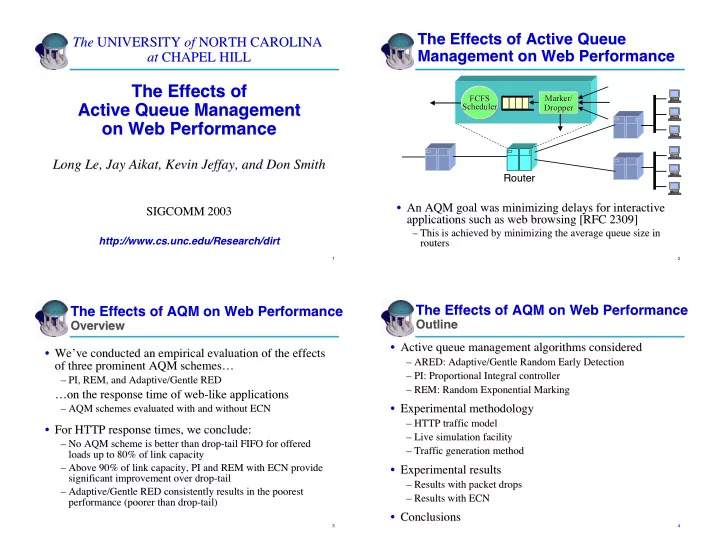
  • An AQM goal was minimizing delays for interactive

An AQM goal was minimizing delays for interactive applications such as web browsing [RFC 2309] applications such as web browsing [RFC 2309]

– – This is achieved by minimizing the average queue size in This is achieved by minimizing the average queue size in routers routers

FCFS FCFS Scheduler Scheduler

Router Router

Marker/ Marker/ Dropper Dropper

3 3

The Effects of AQM on Web Performance The Effects of AQM on Web Performance

Overview Overview

  • We

We’ ’ve conducted an empirical evaluation of the effects ve conducted an empirical evaluation of the effects

  • f three prominent AQM schemes
  • f three prominent AQM schemes…

– – PI, REM, and Adaptive/Gentle RED PI, REM, and Adaptive/Gentle RED

… …on the response time of web-like applications

  • n the response time of web-like applications

– – AQM schemes evaluated with and without ECN AQM schemes evaluated with and without ECN

  • For HTTP response times, we conclude:

For HTTP response times, we conclude:

– – No AQM scheme is better than drop-tail FIFO for offered No AQM scheme is better than drop-tail FIFO for offered loads up to 80% of link capacity loads up to 80% of link capacity – – Above 90% of link capacity, PI and REM with ECN provide Above 90% of link capacity, PI and REM with ECN provide significant improvement over drop-tail significant improvement over drop-tail – – Adaptive/Gentle RED consistently results in the poorest Adaptive/Gentle RED consistently results in the poorest performance (poorer than drop-tail) performance (poorer than drop-tail)

4 4

The Effects of AQM on Web Performance The Effects of AQM on Web Performance

Outline Outline

  • Active queue management algorithms considered

Active queue management algorithms considered

– – ARED: Adaptive/Gentle Random Early Detection ARED: Adaptive/Gentle Random Early Detection – – PI: Proportional Integral controller PI: Proportional Integral controller – – REM: Random Exponential Marking REM: Random Exponential Marking

  • Experimental methodology

Experimental methodology

– – HTTP traffic model HTTP traffic model – – Live simulation facility Live simulation facility – – Traffic generation method Traffic generation method

  • Experimental results

Experimental results

– – Results with packet drops Results with packet drops – – Results with ECN Results with ECN

  • Conclusions

Conclusions

slide-2
SLIDE 2

5 5

AQM Algorithms Considered AQM Algorithms Considered

The original RED Algorithm The original RED Algorithm

Time Time

Max Max queue length queue length Min Min threshold threshold

Mark/Drop Mark/Drop probability probability

No mark/drop No mark/drop Max Max threshold threshold Forced drop Forced drop Probabilistic Probabilistic early mark/drop early mark/drop

Router queue length Router queue length Mark/Drop probability Mark/Drop probability Weighted Weighted Average Average Queue Length Queue Length

100% 100% min minth

th

max maxth

th

max maxp

p

Weighted average queue length Weighted average queue length

6 6

AQM Algorithms Considered AQM Algorithms Considered

Adaptive/Gentle RED (ARED) Adaptive/Gentle RED (ARED)

Time Time

Max Max queue length queue length Forced drop Forced drop Min Min threshold threshold

Mark/Drop Mark/Drop Probability Probability

No mark/drop No mark/drop Max Max threshold threshold Probabilistic Probabilistic early mark/drop early mark/drop

Router queue length Router queue length

2 2× ×Max Max threshold threshold Probabilistic Probabilistic “ “gentle gentle” ” drop drop

Mark/Drop Probability Mark/Drop Probability Weighted Weighted Average Average Queue Queue Length Length

100% 100% min minth

th

2 2× ×max maxth

th

max maxp

p

max maxth

th

7 7

Control Theoretic AQM Control Theoretic AQM

The Proportional Integral (PI) controller The Proportional Integral (PI) controller

  • PI attempts to maintain an explicit target queue length

PI attempts to maintain an explicit target queue length

Time Time Router queue length Router queue length

  • PI samples instantaneous queue length at fixed intervals

PI samples instantaneous queue length at fixed intervals and computes a mark/drop probability at and computes a mark/drop probability at k kth

th

sample: sample:

– p(kT) = a × (q(kT) – qref) – b × (q((k-1)T) - qref) + p((k-1)T) – – a a, , b b, and , and T T depend on link capacity, maximum RTT and the depend on link capacity, maximum RTT and the number of flows at a router number of flows at a router

Target Target Queue Queue Reference Reference

(qref)

8 8

Control Theoretic AQM Control Theoretic AQM

Random Exponential Marking (REM) Random Exponential Marking (REM)

  • REM is similar to PI (though differs in details)

REM is similar to PI (though differs in details)

Time Time Router queue length Router queue length

  • REM mark/drop probability depends on:

REM mark/drop probability depends on:

– – Difference between input and output rate Difference between input and output rate – – Difference between instantaneous queue length and target Difference between instantaneous queue length and target – p(t) = p(t–1) + γ [α (q(t) – qref)) + x(t) – c] – prob(t) = 1 – φ -p(t), φ > 1 a constant

Target Target Queue Queue Reference Reference

(qref)

slide-3
SLIDE 3

9 9

ISP1 ISP1 Browsers/ Browsers/ Servers Servers ISP2 ISP2 Browsers/ Browsers/ Servers Servers

Experimental Methodology Experimental Methodology

Overview Overview

Ethernet Ethernet Switch Switch Ethernet Ethernet Switch Switch

  • Evaluate AQM schemes through

Evaluate AQM schemes through “ “live simulation live simulation” ”

  • Emulate the browsing behavior of a large population of

Emulate the browsing behavior of a large population of users surfing the web in a laboratory users surfing the web in a laboratory testbed testbed

– – Construct a physical network emulating a congested peering Construct a physical network emulating a congested peering link between two ISPs link between two ISPs

ISP 1 Edge ISP 1 Edge Router Router ISP 2 Edge ISP 2 Edge Router Router

– – Generate synthetic HTTP requests and responses but transmit Generate synthetic HTTP requests and responses but transmit

  • ver real TCP/IP stacks, network links, and switches
  • ver real TCP/IP stacks, network links, and switches

… …

Congested Congested Link Link

10 10

Experimental Methodology Experimental Methodology

HTTP traffic generation HTTP traffic generation

  • Synthetic web traffic generated using the UNC HTTP

Synthetic web traffic generated using the UNC HTTP model [SIGMETRICS 2001, MASCOTS 2003] model [SIGMETRICS 2001, MASCOTS 2003]

REQ REQ RESP RESP

User User Server Server

REQ REQ RESP RESP REQ REQ RESP RESP REQ REQ RESP RESP REQ REQ RESP RESP

Time Time

  • Primary random variables:

Primary random variables:

– – Request sizes/Reply sizes Request sizes/Reply sizes – – User think time User think time – – Persistent connection usage Persistent connection usage – – Nbr Nbr of objects per persistent

  • f objects per persistent

connection connection

Response Time Response Time

– – Number of embedded images/page Number of embedded images/page – – Number of parallel connections Number of parallel connections – – Consecutive documents per server Consecutive documents per server – – Number of servers per page Number of servers per page

11 11

Experimental Methodology Experimental Methodology

Testbed Testbed emulating an ISP peering link emulating an ISP peering link

FreeBSD FreeBSD Router Router FreeBSD FreeBSD Router Router

Ethernet Ethernet Switch Switch

ISP1 ISP1 Browsers/ Browsers/ Servers Servers ISP2 ISP2 Browsers/ Browsers/ Servers Servers

100 100 Mbps Mbps Ethernet Ethernet Switch Switch 1 Gbps 1 Gbps 1 Gbps 1 Gbps 100 100 Mbps Mbps 100 100 Mbps Mbps

  • AQM schemes implemented in FreeBSD routers using

AQM schemes implemented in FreeBSD routers using ALTQ kernel extensions ALTQ kernel extensions

10-150 10-150 ms ms RTT RTT

  • End-systems either a traffic generation client or server

End-systems either a traffic generation client or server

– – Use Use dummynet dummynet to provide to provide per-flow per-flow propagation delays propagation delays – – Two-way traffic generated, equal load generated in each Two-way traffic generated, equal load generated in each direction direction … …

12 12

Experimental Methodology Experimental Methodology

1 Gbps network calibration experiments 1 Gbps network calibration experiments

  • Experiments run on a congested 100 Mbps link

Experiments run on a congested 100 Mbps link

  • Primary simulation parameter: Number of simulated

Primary simulation parameter: Number of simulated browsing users browsing users

  • Run calibration experiments on an

Run calibration experiments on an uncongested uncongested 1 1 Gbps Gbps link to relate simulated user populations to average link link to relate simulated user populations to average link utilization utilization

– – (And to ensure offered load linear in the number of simulated (And to ensure offered load linear in the number of simulated users users — — i.e. i.e., that end-systems are not a bottleneck) , that end-systems are not a bottleneck)

Ethernet Ethernet Switch Switch

100 Mbps 100 Mbps (experiments) (experiments)

Ethernet Ethernet Switch Switch 1 1 Gbps Gbps 1 1 Gbps Gbps 100 100 Mbps Mbps 100 100 Mbps Mbps

… …

1 1 Gbps Gbps (calibration) (calibration)

slide-4
SLIDE 4

13 13

Experimental Methodology Experimental Methodology

1 Gbps network calibration experiments 1 Gbps network calibration experiments We run experiments at offered loads

  • f 80%, 90%, 98%, and 105% of the

capacity of the 100 Mbps link We run experiments at offered loads

  • f 80%, 90%, 98%, and 105% of the

capacity of the 100 Mbps link Ex: 98% load means a number of simulated users sufficient to generate 98 Mbps (on average) on the 1 Gbps network Ex: 98% load means a number of simulated users sufficient to generate 98 Mbps (on average) on the 1 Gbps network Generating 98 Mbps of HTTP traffic requires simulating 9,330 users Generating 98 Mbps of HTTP traffic requires simulating 9,330 users

Users Link Throughput (Mbps) 20 40 60 80 100 120 140 160 180 200

14 14

Experimental Methodology Experimental Methodology

Experimental plan Experimental plan

  • Run experiments with ARED, PI, and REM using their

Run experiments with ARED, PI, and REM using their recommended parameter settings at different offered loads recommended parameter settings at different offered loads

drop-tail ARED PI REM 80% 90% 98% 105% loss rate utilization response times completed requests uncongested

  • Compare results with drop-tail FIFO at the same offered

Compare results with drop-tail FIFO at the same offered loads loads… …

– – The The “ “negative negative” ” baselines (the performance to beat) baselines (the performance to beat)

… …and compare with performance on the 1 and compare with performance on the 1 Gbps Gbps network network

– – The The “ “positive positive” ” baseline (the performance to achieve) baseline (the performance to achieve)

  • Redo the experiments with ECN

Redo the experiments with ECN

15 15

Experimental Results Experimental Results

80% Load

80% Load

Performance with packet drops Performance with packet drops 50% of responses… 50% of responses… …complete in 125 ms or less …complete in 125 ms or less

16 16

Experimental Results Experimental Results

80% Load

80% Load

Performance with packet drops Performance with packet drops No benefit to using PI or REM

  • ver drop-tail at 80% load

No benefit to using PI or REM

  • ver drop-tail at 80% load

ARED can actually make things worse ARED can actually make things worse

slide-5
SLIDE 5

17 17

Experimental Results Experimental Results

90% Load

90% Load

Performance with packet drops Performance with packet drops Drop-tail, PI, & REM equivalent for shortest 80% of responses Drop-tail, PI, & REM equivalent for shortest 80% of responses PI with qref = 240 best overall PI with qref = 240 best overall ARED not competitive ARED not competitive

18 18

Experimental Results Experimental Results

98% Load

98% Load

Performance with packet drops Performance with packet drops PI again best but this time with qref = 24 PI again best but this time with qref = 24 Drop-tail & REM largely equivalent Drop-tail & REM largely equivalent

19 19

Performance With Packet Drops Performance With Packet Drops

Summary Summary

  • At offered loads of 80% or below there is no benefit to

At offered loads of 80% or below there is no benefit to employing PI or REM over drop-tail FIFO employing PI or REM over drop-tail FIFO

– – All give comparable response time performance, loss rates, All give comparable response time performance, loss rates, and link utilization and link utilization

  • There is a negative effect to employing ARED (at all

There is a negative effect to employing ARED (at all loads) loads)

– – Our attempts to tune ARED performance were unsuccessful Our attempts to tune ARED performance were unsuccessful

  • At 90% and 98% loads PI outperforms drop-tail and

At 90% and 98% loads PI outperforms drop-tail and REM REM

– – But best parameter settings are load sensitive But best parameter settings are load sensitive

20 20

Experimental Results Experimental Results — — REM REM

Performance with/without ECN at 90% load Performance with/without ECN at 90% load Huge improvement for qref = 240 Huge improvement for qref = 240 REM performance improved with ECN for qref = 24 REM performance improved with ECN for qref = 24

slide-6
SLIDE 6

21 21

Experimental Results Experimental Results — — ARED ARED

Performance with/without ECN at 90% load Performance with/without ECN at 90% load ECN has little impact on ARED performance ECN has little impact on ARED performance

22 22

Experimental Results Experimental Results

90% Load

90% Load

Performance with ECN Performance with ECN PI & REM outperform drop-tail and approximate performance on the uncongested network PI & REM outperform drop-tail and approximate performance on the uncongested network

23 23

Discussion Discussion

  • 1. Why does ARED perform so poorly?
  • 1. Why does ARED perform so poorly?
  • PI and REM measure

PI and REM measure queue length in bytes queue length in bytes

  • By default RED

By default RED measures in packets measures in packets

– – But ARED does have But ARED does have a a “ “byte mode byte mode” ”

ARED Performance w/, w/o ECN at 90% Load

  • Drop/Mark probability in PI/REM biased by packet size

Drop/Mark probability in PI/REM biased by packet size

– – SYNs SYNs and pure and pure ACKs ACKs have a lower drop probability in PI/REM have a lower drop probability in PI/REM

24 24

Discussion Discussion

  • 1. Why does ARED perform so poorly?
  • 1. Why does ARED perform so poorly?
  • ARED bases mark/drop probability on the (weighted)

ARED bases mark/drop probability on the (weighted) average queue length average queue length

  • PI, REM use instantaneous measures of queue length

PI, REM use instantaneous measures of queue length

  • ARED

ARED’ ’s s reliance on the average queue length limits its reliance on the average queue length limits its ability to react effectively in the face of ability to react effectively in the face of bursty bursty traffic traffic

Time Time Router Router queue queue length length Time Time Router Router queue queue length length

Weighted Queue Length (RED) Instantaneous Queue Length (PI/REM)

slide-7
SLIDE 7

25 25

Discussion Discussion

  • 2. Why does ARED not benefit from ECN?
  • 2. Why does ARED not benefit from ECN?
  • ARED drops marked packets when average queue size is

ARED drops marked packets when average queue size is above above max maxth

th

  • This is done to deal with potentially non-responsive flows

This is done to deal with potentially non-responsive flows

  • We believe this policy is a premature optimization

We believe this policy is a premature optimization

Time Time

Max Max queue length queue length Forced drop Forced drop Min Min threshold threshold

Mark/Drop Mark/Drop Probability Probability

No mark/drop No mark/drop Max Max threshold threshold Probabilistic Probabilistic early mark/drop early mark/drop

Router queue length Router queue length

2 2× ×Max Max threshold threshold Probabilistic Probabilistic “ “gentle gentle” ” drop drop

26 26

Discussion Discussion

  • 3. Why does ECN improve REM more than PI?
  • 3. Why does ECN improve REM more than PI?
  • Without ECN REM drops

Without ECN REM drops more packets than PI more packets than PI

  • REM causes more flows to

REM causes more flows to experience multiple losses experience multiple losses within a congestion window within a congestion window

– – Loss recovered through timeout Loss recovered through timeout rather than fast recovery rather than fast recovery

  • In general ECN allows more flows to avoid timeouts

In general ECN allows more flows to avoid timeouts

– – Thus ECN is ameliorating a design flaw in REM Thus ECN is ameliorating a design flaw in REM

  • Future work: Differential congestion notification

Future work: Differential congestion notification

– – Don Don’ ’t signal short flows that can t signal short flows that can’ ’t adapt t adapt

REM Performance w/, w/o ECN at 90% Load

27 27

The Effects of AQM on Web Performance The Effects of AQM on Web Performance Conclusion Conclusion

  • No AQM is better than drop-tail FIFO for offered loads

No AQM is better than drop-tail FIFO for offered loads up to 80% of link capacity up to 80% of link capacity

  • For offered loads of 90% or greater

For offered loads of 90% or greater… …

– – Without ECN, PI results in a modest performance Without ECN, PI results in a modest performance improvement over drop-tail and other AQM schemes improvement over drop-tail and other AQM schemes – – With ECN, both PI and REM provide significant performance With ECN, both PI and REM provide significant performance improvement improvement – – (But is ECN improving PI & REM by ameliorating design (But is ECN improving PI & REM by ameliorating design limitations?) limitations?)

  • ARED consistently results in the poorest response time

ARED consistently results in the poorest response time performance performance

– – Often worse than drop-tail FIFO Often worse than drop-tail FIFO

28 28

The Effects of The Effects of Active Queue Management Active Queue Management

  • n Web Performance
  • n Web Performance

Long Le, Jay Aikat, Kevin Jeffay, and Don Smith Long Le, Jay Aikat, Kevin Jeffay, and Don Smith The The UNIVERSITY UNIVERSITY of

  • f NORTH CAROLINA

NORTH CAROLINA at at CHAPEL HILL CHAPEL HILL

http://www.cs.unc.edu/Research/dirt

SIGCOMM SIGCOMM 2003 2003