Optimal Solitaire Yahtzee Strategies Equipment 5 Dice : values 1 - - PowerPoint PPT Presentation

optimal solitaire yahtzee strategies equipment 5 dice
SMART_READER_LITE
LIVE PREVIEW

Optimal Solitaire Yahtzee Strategies Equipment 5 Dice : values 1 - - PowerPoint PPT Presentation

Optimal Solitaire Yahtzee Strategies Equipment 5 Dice : values 1 through 6 equiprobable 1 Score Card : Tom Verhoeff Category Score Eindhoven University of Technology Aces . . . S Faculty of Math. & Computing Science Twos


slide-1
SLIDE 1

Optimal Solitaire Yahtzee∗ Strategies Tom Verhoeff Eindhoven University of Technology Faculty of Math. & Computing Science Parallel Systems T.Verhoeff@TUE.NL http://wwwpa.win.tue.nl/misc/yahtzee/

*) Yahtzee is a registered trademark of the Milton Bradley Company.

c 1999–2000, Tom Verhoeff (TUE) Yahtzee–1

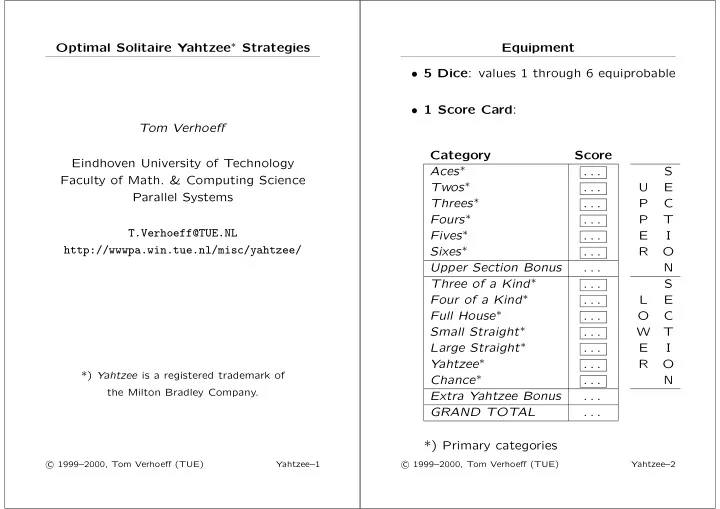
Equipment

  • 5 Dice: values 1 through 6 equiprobable
  • 1 Score Card:

Category Score Aces∗ . . . S Twos∗ . . . U E Threes∗ . . . P C Fours∗ . . . P T Fives∗ . . . E I Sixes∗ . . . R O Upper Section Bonus . . . N Three of a Kind∗ . . . S Four of a Kind∗ . . . L E Full House∗ . . . O C Small Straight∗ . . . W T Large Straight∗ . . . E I Yahtzee∗ . . . R O Chance∗ . . . N Extra Yahtzee Bonus . . . GRAND TOTAL . . . *) Primary categories

c 1999–2000, Tom Verhoeff (TUE) Yahtzee–2

slide-2
SLIDE 2

Playing Rules Take empty score card repeat Roll all dice Keep any ∗ dice, reroll other dice Keep any ∗ dice, reroll other dice Score roll in any ∗ empty primary category until all primary categories scored Calculate GRAND TOTAL for final score Aim: Maximize final score *) Player is free to choose among options

c 1999–2000, Tom Verhoeff (TUE) Yahtzee–3

Scoring Rules Category Condition Score Aces — sum 1s Twos — sum 2s Threes — sum 3s Fours — sum 4s Fives — sum 5s Sixes — sum 6s

  • U. S. Bonus

U.S.Tot ≥ 63 35 once Three of a Kind ≥ 3 equals sum values Four of a Kind ≥ 4 equals sum values Full House 2+3 equals∗ 25 Small Straight ≥ 4 in seq.∗ 30 Large Straight 5 in seq.∗ 40 Yahtzee 5 equals 50 Chance — sum values Extra Y. Bonus 5 equals & 50 at Y. 100 each GRAND TOTAL — sum above *) 5 ys act here as Joker, provided categories ys and Yahtzee have been scored already.

c 1999–2000, Tom Verhoeff (TUE) Yahtzee–4

slide-3
SLIDE 3

Dilemmas

  • First turn, first roll: 1 1 6 6 6

What to do? Keep 6 6 6? Keep all and score 25 in Full House?

  • First turn, second roll: 1 1 3 4 6

What to do?

  • First turn, third roll: 6 6 6 6 1

What to do? Score 24 in Sixes? Score 25 in Four of a Kind?

c 1999–2000, Tom Verhoeff (TUE) Yahtzee–5

Random Play Without Bonuses and Jokers Expected Category Probability Score Aces 1 0.83 Twos 1 1.67 Threes 1 2.50 Fours 1 3.33 Fives 1 4.17 Sixes 1 5.00 Three of a Kind 1656/7776 3.73 Four of a Kind 156/7776 0.35 Full House 300/7776 0.96 Small Straight 1200/7776 4.63 Large Straight 240/7776 1.23 Yahtzee 6/7776 0.04 Chance 1 17.50 GRAND TOTAL 45.95

c 1999–2000, Tom Verhoeff (TUE) Yahtzee–6

slide-4
SLIDE 4

Micro Yahtzee

  • ONE die
  • NO keeping and rerolling
  • TWO primary categories:

Category Score Double value doubled Square value squared TOTAL sum above

  • How to maximize final score?
  • What to do if first roll is 4?

Score 8 in Double? Score 16 in Square?

c 1999–2000, Tom Verhoeff (TUE) Yahtzee–7

Game Tree Turn 1 Turn 2 roll roll choose “choose”

✉ ✜ ✜ ✜ ✜ ✜ ✜ ✜ ✜ ✜ ✜ ✜ ✜ ✜ ✜ ✜

1

✉ ❥ ✚✚✚✚✚✚✚✚✚✚✚ ✚

2

✉ ❥ ✘✘✘✘✘✘✘✘✘✘✘ ✘

3

✉ ❥ ❳❳❳❳❳❳❳❳❳❳❳ ❳

4

✉ ❥ ❩❩❩❩❩❩❩❩❩❩❩ ❩

5

✉ ❥ ❭ ❭ ❭ ❭ ❭ ❭ ❭ ❭ ❭ ❭ ❭ ❭ ❭ ❭ ❭

6

✉ ❥ ✘✘ ✘ ❳❳ ❳ ✘✘ ✘ ❳❳ ❳ ✘✘ ✘ ❳❳ ❳ ✘✘✘✘✘✘✘✘✘✘✘ ✘

Dbl

✉ ❳❳❳❳❳❳❳❳❳❳❳ ❳

Sqr

✉ ✘✘ ✘ ❳❳ ❳ ✘✘ ✘ ❳❳ ❳ ✜ ✜ ✜ ✜ ✜ ✜ ✜ ✜ ✜ ✜ ✜ ✜ ✜ ✜ ✜

1

✉ ❥ ✚✚✚✚✚✚✚✚✚✚✚ ✚

2

✉ ❥ ✘✘✘✘✘✘✘✘✘✘✘ ✘

3

✉ ❥ ❳❳❳❳❳❳❳❳❳❳❳ ❳

4

✉ ❥ ❩❩❩❩❩❩❩❩❩❩❩ ❩

5

✉ ❥ ❭ ❭ ❭ ❭ ❭ ❭ ❭ ❭ ❭ ❭ ❭ ❭ ❭ ❭ ❭

6

✉ ❥ ✜ ✜ ✜ ✚✚ ✚ ✘✘ ✘ ❳❳ ❳ ❩❩ ❩ ❭ ❭ ❭

Sqr

Choice states are circled:

✉ ❥

# Games: 6 · 2 · 6 · 1 = 72 # Deterministic strategies: 26 · 16 = 64

c 1999–2000, Tom Verhoeff (TUE) Yahtzee–8
slide-5
SLIDE 5

Markov Decision Processes (sort of :-)

  • State space S = R ⊎ C

The MDP is always in one state of S.

  • Initial state I with I ∈ S
  • Event sets E.s for s ∈ S

In state s, one event from E.s occurs. Terminate if E.s = ∅.

  • Event probabilities p.s for s ∈ S

Event e ∈ E.s occurs with probability p.s.e.

  • e∈E.s

p.s.e = 1

  • Event scores f.s for s ∈ S

Event e ∈ E.s scores f.s.e.

  • Transition function (juxtaposition)

Event e ∈ E.s leads to next state se.

c 1999–2000, Tom Verhoeff (TUE) Yahtzee–9

Yahtzee as MDP

  • State space S = R ⊎ C

R: roll states; C: choice states.

  • Event sets E.s for s ∈ S

Roll outcomes for s ∈ R. Keep or score choices for s ∈ C.

  • Event scores f.s for s ∈ S

f.s.e = 0 for s ∈ R. f.s.e ≥ 0 for s ∈ C.

  • Transition function

R and C states alternate. Acyclic.

c 1999–2000, Tom Verhoeff (TUE) Yahtzee–10

slide-6
SLIDE 6

Markov Decision Strategies

  • Decision strategy D defines p.s for s ∈ C

Deterministic if p.s.e ∈ { 0, 1 }

  • Game g after state s:

Sequence of successive events starting in s Resulting state sg: s = s, s(eg) = (se)g

  • Set G.s of complete games after s:

G.s = { g | E.sg = ∅ }

  • Score F.s.g of game g after s:

F.s. = F.s.eg = f.s.e + F.se.g

  • Probability P.s.g of game g after s:

P.s. = 1 P.s.eg = p.s.e ∗ P.se.g

c 1999–2000, Tom Verhoeff (TUE) Yahtzee–11

Optimality Criteria

  • Maximize expected final score
  • Minimize variance in final score
  • Maximize probability to beat High Score
  • Maximize probability to beat opponent
  • Maximize minimum final score

c 1999–2000, Tom Verhoeff (TUE) Yahtzee–12

slide-7
SLIDE 7

Optimal Strategies

  • Expected final score ED by strategy D:

ED =

  • g∈G.I

P.I.g ∗ F.I.g

  • Optimal strategy achieves

ˆ E = max

D

ED

  • Conditional expectation after state s:

E.s =

  • g∈G.s

P.s.g ∗ F.s.g

  • Recurrence relations:

E.s =

  • e∈E.s

p.s.e ∗ (f.s.e + E.se) ˆ E.s =

      

  • e∈E.s

p.s.e ∗ ˆ E.se for s ∈ R max

e∈E.s (f.s.e + ˆ

E.se) for s ∈ C

c 1999–2000, Tom Verhoeff (TUE) Yahtzee–13

Recurrence Relation for E For E.s = ∅: E.s =

{ definition of E.s }

  • g∈G.s

P.s.g ∗ F.s.g =

{ g = eh with e ∈ E.s = ∅, h ∈ G.se }

  • e∈E.s
  • h∈G.se

P.s.eh ∗ F.s.eh =

{ recurrences for P.s.eh, F.s.eh }

  • e∈E.s
  • h∈G.se

p.s.e ∗ P.se.h ∗ (f.s.e + F.se.h) =

{ distribution: p.s.e independent of h }

  • e∈E.s

p.s.e ∗

  • h∈G.se

P.se.h ∗ (f.s.e + F.se.h) =

{

  • y∈G.x

P.x.y = 1 }

  • e∈E.s

p.s.e ∗

 f.s.e +

  • h∈G.se

P.se.h ∗ F.se.h

 

=

{ definition of E.se }

  • e∈E.s

p.s.e ∗ (f.s.e + E.se)

c 1999–2000, Tom Verhoeff (TUE) Yahtzee–14

slide-8
SLIDE 8

Yathzee Turn Tree

✉ ✉ ✉ ✉ ✉ ✉ ✉ ✉ ✉ ✉ ✉ ✉ ✉ ✉ ✉ ✉ ✉ ✉ ✉ ❥ ❥ ❥ ❥ ❥ ❥ ❥ ❥ ❥

. . . . . . . . . . . . . . . . . . . . . . . . . . . . . . . . . . . .

✁ ✁ ✁ ✁ ✁ ✁ ✁ ✁ ✁ ✁ ✁ ✁ ✁ ✁ ✁ ✁ ✁ ❆ ❆ ❆ ❆ ❆ ❆ ❆ ❆ ❆ ❆ ❆ ❆ ❆ ❆ ❆ ❆ ❆ ❆ ❅ ❅ ❅ ❅ ❅ ❅ ❅ ❅ ❅ ❅ ❅ ❅ ❅ ❅ ❅ ❅ ❅ ❅ ❅ ❅ ❅ ❅ ❅ ❅ ❅ ❅ ❅ ❅ ❅ ❅ ❅ ❅ ❅ ❅ ❅ ❅ ❅ ❅ ❅ ❅ ❅ ❅ ❅ ❅ ❅ ❅ ❅ ❅ ❅ ❅ ❅ ❅ ❅ ❅

✁ ✁ ✁ ✁ ✁ ✁ ✁ ✁ ✁ ✁ ✁ ✁ ✁ ✁ ❆ ❆ ❆ ❆ ❆ ❆ ❆ ❆ ❆ ❆ ❆ ❆ ❆ ❆ ❆ ❅ ❅ ❅ ❅ ❅ ❅ ❅ ❅ ❅ ❅ ❅ ❅ ❅ ❅ ❅

roll all choose keepers reroll

  • thers

choose keepers reroll

  • thers

choose category # nodes 1 65 6525 6575 657525 657575

c 1999–2000, Tom Verhoeff (TUE) Yahtzee–15

Yahtzee Game Tree

  • # Games:
  • 65 · 75 · 75

· 13! ≈ 1.7 × 10170

  • Probabilities: range from
  • 6−5313

≈ 5.5 × 10−151 to

  • 6−513

≈ 3.8 × 10−50

  • # Strategies:

1010100 ??

c 1999–2000, Tom Verhoeff (TUE) Yahtzee–16

slide-9
SLIDE 9

Reducing the State Space

  • State equivalence relation:

s ∼ t ⇔ F.s = F.t ∧ P.s = P.t Equal future (past ignored)

  • Theorem

For equivalent states s ∼ t: E.s = E.t ˆ E.s = ˆ E.t

  • Reduced game tree:

Merge equivalent states

c 1999–2000, Tom Verhoeff (TUE) Yahtzee–17

Reduced Yathzee Turn Graph

✉ ✉ ✉ ✉ ✉ ✉ ✉ ✉ ✉ ✉ ✉ ✉ ✉ ✉ ✉ ✉ ✉ ✉ ✉ ❥ ❥ ❥ ❥ ❥ ❥ ❥ ❥ ❥

. . . . . . . . . . . . . . . . . . . . . . . . . . . . . . . . . . . .

✁ ✁ ✁ ✁ ✁ ✁ ✁ ✁ ✁ ✁ ✁ ✁ ✁ ✁ ✁ ✁ ✁ ❆ ❆ ❆ ❆ ❆ ❆ ❆ ❆ ❆ ❆ ❆ ❆ ❆ ❆ ❆ ❆ ❆ ❆ ❅ ❅ ❅ ❅ ❅ ❅ ❅ ❅ ❅ ❅ ❅ ❅ ❅ ❅ ❅ ❅ ❅ ❅ ❅ ❅ ❅ ❅ ❅ ❅ ❅ ❅ ❅ ❅ ❅ ❅ ❅ ❅ ❅ ❅ ❅ ❅ ❅ ❅ ❅ ❅ ❅ ❅ ❅ ❅ ❅ ❅ ❅ ❅ ❅ ❅ ❅ ❅ ❅ ❅ ❆ ❆ ❆ ❆ ❆ ❆ ❆ ❆ ❆ ❆ ❆ ❆ ❆ ❆ ❆ ❅ ❅ ❅ ❅ ❅ ❅ ❅ ❅ ❅ ❅ ❅ ❅ ❅ ❅ ❅

✁ ✁ ✁ ✁ ✁ ✁ ✁ ✁ ✁ ✁ ✁ ✁ ✁ ✁

roll all choose keepers reroll

  • thers

choose keepers reroll

  • thers

choose category # nodes 1 252 462 252 462 252

c 1999–2000, Tom Verhoeff (TUE) Yahtzee–18

slide-10
SLIDE 10

Reduced Yahtzee Game States Between turns: 218 · 3 = 786 432

  • Set of unscored primary categories:

213

  • How much needed for Upper Section Bonus:

64 = 26 (0 .. 63)

  • Will 5 equals get Extra Yahtzee Bonus:

2 (false, true) Within turns: 1 + 2 · 462 + 3 · 252 = 1681

  • Roll index:

3 (1 .. 3)

  • Roll versus Choose:

2

  • Rolled dice:

5+6−1 5

  • = 252

Kept dice:

5+7−1 5

  • = 462

c 1999–2000, Tom Verhoeff (TUE) Yahtzee–19

Computational Approach

  • Dynamic programming

Store ˆ E.s to avoid recomputation

  • Two-level

Store ˆ E.s between turns only: Table of 786 432 reals of 8 byte = 6 MB Recompute within turns

  • Self-initializing

Compute required states only: 536 448

c 1999–2000, Tom Verhoeff (TUE) Yahtzee–20

slide-11
SLIDE 11

And now what?

  • Characterize optimal strategies

Exact results versus simulation

  • Compare to other strategies

E.g. random play

  • Investigate effect of rule changes

E.g. 2 or 4 rolls per turn, no Jokers, . . .

  • Optimal Solitaire Yahtzee Player

Submit your game state on WWW and get advice

  • Yahtzee Proficiency Test

Play game on WWW and get analysis

c 1999–2000, Tom Verhoeff (TUE) Yahtzee–21

Approximate Results

  • Numeric Evaluation:

Evalute exact recipe with finite precision Issues: – numeric stability (rounding, cancella- tion) – how many bits precision

  • Simulation:

Take average over a number of instances Issues: – quality of random number generator – how many instances (variance)

c 1999–2000, Tom Verhoeff (TUE) Yahtzee–22

slide-12
SLIDE 12

Dilemmas Resolved

  • First turn, first roll: 1 1 6 6 6

Keep 6 6 6: 265.12 ± 61 Keep all and score 25 in Full House: 253.91 ± 57

  • First turn, second roll: 1 1 3 4 6

Keep 3 4: 245.17 ± 57 Keep 1 1: 245.14 ± 57 Keep 4: 244.96 ± 57 Keep 3: 244.74 ± 57 Keep none: 244.55 ± 57 Keep 6: 244.52 ± 57

  • First turn, third roll: 6 6 6 6 1

Score 24 in Sixes: 268.23 ± 53 Score 25 in Four of a Kind: 260.54 ± 54

c 1999–2000, Tom Verhoeff (TUE) Yahtzee–23

Optimal Strategy Trivia

  • Expected final score:

254.59 ± 60

  • Median final score:

248

  • Best roll in first turn:

y y y y y Score 50 in Yahtzee: 320.84 ± 83

  • Worst first roll in first turn: 1 1 2 3 6

Keep 6: 249.83 ± 58

  • Worst third roll in first turn: 2 3 4 4 6

Score 19 in Chance: 238.96 ± 57

  • Minimum score:

12

c 1999–2000, Tom Verhoeff (TUE) Yahtzee–24

slide-13
SLIDE 13

Final Scores per Category Optimal Solitaire Yahtzee Strategy Category E SD % 0 Aces 1.88 1.22 10.84 Twos 5.28 2.00 1.80 Threes 8.57 2.71 0.95 Fours 12.16 3.29 0.60 Fives 15.69 3.85 0.50 Sixes 19.19 4.64 0.53

  • U. S. Bonus

23.84 16.31 31.88 Three of a Kind 21.66 5.62 3.26 Four of a Kind 13.10 11.07 36.34 Full House 22.59 7.38 9.63 Small Straight 29.46 3.99 1.80 Large Straight 32.71 15.44 18.22 Yahtzee 16.87 23.64 66.26 Chance 22.01 2.54 0.00 Extra Y. Bonus 9.58 34.08 91.76 GRAND TOTAL 254.59 59.61 0.00 Yahtzees Rolled 0.46 0.69 63.24 Jokers Applied 0.04 0.19 96.30

c 1999–2000, Tom Verhoeff (TUE) Yahtzee–25

Final Scores per Category Without Extra Yahtzee Bonus and Jokers Category E SD % 0 Aces 1.82 1.14 9.19 Twos 5.25 1.95 1.31 Threes 8.57 2.65 0.59 Fours 12.19 3.24 0.46 Fives 15.74 3.81 0.40 Sixes 19.29 4.61 0.46

  • U. S. Bonus

24.14 16.19 31.02 Three of a Kind 22.23 5.50 3.44 Four of a Kind 13.04 11.44 39.38 Full House 22.86 6.99 8.54 Small Straight 29.53 3.71 1.55 Large Straight 33.04 15.16 17.40 Yahtzee 15.89 23.28 68.21 Chance 22.26 2.44 0.00 GRAND TOTAL 245.87 39.82 0.00 Yahtzees Rolled 0.41 0.61 64.76 Jokers Applied – – –

c 1999–2000, Tom Verhoeff (TUE) Yahtzee–26

slide-14
SLIDE 14

Distribution of Final Score Optimal Solitaire Yahtzee Strategy Score range % Cum.% 100 – 119 0 % 0 % 120 – 139 0 % 0 % 140 – 159 2 % 2 % 160 – 179 3 % 5 % 180 – 199 9 % 14 % 200 – 219 13 % 27 % 220 – 239 14 % 41 % 240 – 259 20 % 60 % 260 – 279 19 % 80 % 280 – 299 6 % 86 % 300 – 319 5 % 90 % 320 – 339 2 % 92 % 340 – 359 1 % 93 % 360 – 379 1 % 94 % 380 – 399 2 % 96 % 400 – 419 2 % 98 % 420 – 439 1 % 99 % 440 – 459 0 % 99 % 460 – 479 0 % 99 % 480 – 499 0 % 99 %

Results based on simulation of 105 games c 1999–2000, Tom Verhoeff (TUE) Yahtzee–27

Distribution of Final Score Without Extra Yahtzee Bonus and Jokers Score range % Cum.% 100 – 119 0 % 0 % 120 – 139 0 % 0 % 140 – 159 2 % 2 % 160 – 179 3 % 5 % 180 – 199 9 % 14 % 200 – 219 13 % 27 % 220 – 239 14 % 40 % 240 – 259 21 % 61 % 260 – 279 21 % 82 % 280 – 299 8 % 90 % 300 – 319 6 % 97 % 320 – 339 3 % 100 % 340 – 359 0 % 100 %

Results based on simulation of 105 games c 1999–2000, Tom Verhoeff (TUE) Yahtzee–28

slide-15
SLIDE 15

Cumulative Distribution of Final Score Optimal Solitaire Yahtzee Strategy Final score % Games f scoring < f 152 1 % 180 5 % 195 10 % 218 25 % 248 50 % 273 75 % 319 90 % 388 95 % 474 99 % Results based on simulation of 106 games

c 1999–2000, Tom Verhoeff (TUE) Yahtzee–29

Cumulative Distribution of Final Score Without Extra Yahtzee Bonus and Jokers Final score % Games f scoring < f 152 1 % 180 5 % 195 10 % 218 25 % 248 50 % 271 75 % 299 90 % 317 95 % 327 99 % Results based on simulation of 106 games

c 1999–2000, Tom Verhoeff (TUE) Yahtzee–30

slide-16
SLIDE 16

Earliest Scoring per Category Optimal Solitaire Yahtzee Strategy Earliest turn scoring Category Non-Zero Zero Aces 1 2 Twos 1 3 Threes 1 4 Fours 1 5 Fives 1 6 Sixes 1 9 Three of a Kind 1 7 Four of a Kind 2 2 Full House 1 5 Small Straight 1 10 Large Straight 1 7 Yahtzee 1 3 Chance 1 never

c 1999–2000, Tom Verhoeff (TUE) Yahtzee–31

Last Turn Values per Category Without Extra Yahtzee Bonus Category E SD % 0 Aces 2.11 1.10 6.49 Twos 4.21 2.21 6.49 Threes 6.32 3.31 6.49 Fours 8.43 4.42 6.49 Fives 10.53 5.52 6.49 Sixes 12.64 6.62 6.49 Three of a Kind 15.19 10.42 28.76 Four of a Kind 5.61 9.66 72.26 Full House 9.15 12.04 63.39 Small Straight 18.48 14.59 38.40 Large Straight 10.61 17.66 73.47 Yahtzee 2.30 10.48 95.40 Chance 23.33 3.16 0.00

c 1999–2000, Tom Verhoeff (TUE) Yahtzee–32

slide-17
SLIDE 17

Game with Minimum Score Optimal Solitaire Yahtzee Strategy Turn Third Roll Score in Category 1 1 4 4 5 5 1 Aces 2 1 2 3 5 5 2 Twos 3 1 1 2 2 6 Four of a Kind 4 1 2 2 4 6 Yahtzee 5 1 1 2 2 6 Threes 6 1 2 2 3 3 Fours 7 1 2 2 3 3 Fives 8 1 2 2 3 3 Full House 9 1 2 2 3 3 Sixes 10 1 1 2 3 3 Large Straight 11 1 1 2 2 3 9 Chance 12 4 5 5 6 6 Three of a Kind 13 5 6 6 6 6 Small Straight 12 GRAND TOTAL

c 1999–2000, Tom Verhoeff (TUE) Yahtzee–33

Game against Demonic Dice Optimal Solitaire Yahtzee Strategy Turn Roll/Keep Score in Category 1 1 1 2 3 6 1 2 3 5 6 1 2 3 5 6 1 Aces 2 1 1 2 3 6 1 1 1 2 6 1 1 1 3 4 10 Three of a Kind 3 1 1 2 3 6 1 1 1 3 6 1 1 3 5 6 Four of a Kind 4 1 1 1 2 6 1 1 1 2 6 1 2 3 5 5 2 Twos 5 1 1 2 2 6 1 2 2 2 6 2 2 2 4 6 Yahtzee 6 1 2 2 2 2 1 2 2 2 2 1 2 2 2 6 Threes 7 2 3 3 3 3 2 3 3 3 3 2 2 2 2 3 Fours

c 1999–2000, Tom Verhoeff (TUE) Yahtzee–34

slide-18
SLIDE 18

Game against Demonic Dice (cont’d) Turn Roll/Keep Score in Category 8 1 2 2 2 2 2 3 3 3 3 2 2 2 2 3 Fives 9 1 2 2 2 2 1 2 2 2 2 2 2 2 3 4 Full House 10 2 2 5 5 5 2 3 3 3 3 2 2 2 2 3 Sixes 11 2 2 2 6 6 1 2 2 2 2 2 2 2 2 3 Large Straight 12 2 2 2 6 6 1 2 2 2 2 1 1 1 1 2 6 Chance 13 5 6 6 6 6 5 5 6 6 6 5 6 6 6 6 Small Straight 19 GRAND TOTAL

c 1999–2000, Tom Verhoeff (TUE) Yahtzee–35

Remaining Challenges

  • Best strategy to beat given High Score

Approximation via normal distribution and computed mean & variance Optimal premature stopping

  • Best strategy for Group Yahtzee

Approximation

c 1999–2000, Tom Verhoeff (TUE) Yahtzee–36