Alternative fuel technologies and operational models for on-road - - PowerPoint PPT Presentation

alternative fuel technologies and
SMART_READER_LITE
LIVE PREVIEW

Alternative fuel technologies and operational models for on-road - - PowerPoint PPT Presentation

Alternative fuel technologies and operational models for on-road freight Pembina Institute | Transportation and Urban Solutions Maddy Ewing November 4, 2019 Leading Canadas transition to clean energy The Pembina Institute is a non-profit

slide-1
SLIDE 1

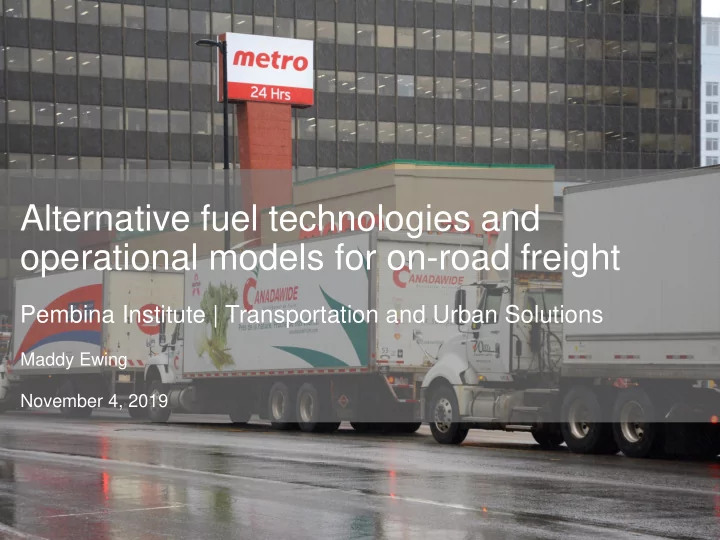
Alternative fuel technologies and

  • perational models for on-road freight

Pembina Institute | Transportation and Urban Solutions

Maddy Ewing November 4, 2019

slide-2
SLIDE 2

2

Leading Canada’s transition to clean energy

The Pembina Institute is a non-profit think-tank that advocates for strong, effective policies to support Canada's clean energy transition.

slide-3
SLIDE 3

3

Context On-road freight

slide-4
SLIDE 4

4

slide-5
SLIDE 5

5

slide-6
SLIDE 6

Trucking is a growing source of GHG emissions in Ontario

6

Source: NRCAN Comprehensive Energy Use Database

slide-7
SLIDE 7

Working towards the decarbonization

  • f Ontario’s freight sector

7

slide-8
SLIDE 8

8

Reducing GHG emissions from freight Technology options and operational practices

slide-9
SLIDE 9

On-road freight is diverse

Varies by:

  • 1. Size
  • 2. Operations
  • 3. Geographic scope
  • 4. Type of goods

moved

9

A need for situation-specific strategies

slide-10
SLIDE 10

On-road freight is diverse

Varies by:

  • 1. Size
  • 2. Operations
  • 3. Geographic scope
  • 4. Type of goods

moved

10

A need for situation-specific strategies

slide-11
SLIDE 11

Different solutions for different realities

11

Long haul Regional Urban Fuel saving devices  Battery electric vehicles  Hydrogen fuel cell vehicles   Renewable natural gas vehicles    Biofuels    Cargo bikes 

slide-12
SLIDE 12

Key barriers to success of low- carbon technologies

12

Availability of refueling infrastructure

Vehicle costs

Fuel costs

Fuel availability

slide-13
SLIDE 13

Operational practices to reduce GHG emissions from freight trucks

13

1.

Maximize amount of goods shipped per vehicle

2.

Reduce empty runs

3.

Reduce distance travelled by truck

4.

Reduce fuel consumption

5.

Perform off-peak deliveries

slide-14
SLIDE 14

14

Last-mile delivery Microhubs and cyclelogistics

slide-15
SLIDE 15

Delivering Last-Mile Solutions

15

https://www.pembina.org/pub/delivering-last-mile-solutions

slide-16
SLIDE 16

16

Alternative

Micro-consolidation +

 electric cargo van  large e-assist cargo bike  small e-assist cargo bike

Business as usual

Suburban consolidation + package car

slide-17
SLIDE 17

Microhubs and cargo bikes are viable and practical in the GTHA

17

Efficient operations

High asset utilization

Cost effective

Lower freight emissions

Photo source: Steve Russell, Toronto Star

slide-18
SLIDE 18

More efficient

18

Total operational time under high congestion, high demand conditions

slide-19
SLIDE 19

Cost effective

19

Average scenario costs under high demand conditions.

slide-20
SLIDE 20

Low-carbon

20

Low demand conditions

24

kg CO2/day

High demand conditions

53

kg CO2/day

Average GHG emission savings

using microhubs and cyclelogistics:

slide-21
SLIDE 21

21

Supporting low-carbon on-road freight Turning ideas into action

slide-22
SLIDE 22

Turning ideas into action

22

Pilot low-carbon technologies and

  • perational models

Develop alternative refueling infrastructure build-out strategies

slide-23
SLIDE 23

Turning ideas into action

23

Explore policies and incentives to support adoption of low-carbon technologies and operations

Launch public/private partnerships

slide-24
SLIDE 24

Urban Delivery Solutions Initiative

24

A network of businesses and

  • rganizations working to modernize

urban freight operations

https://www.pembina.org/UDSI

slide-25
SLIDE 25

Potential benefits of freight decarbonization

25

Climate change mitigation

Improvements to efficiency

Reduced concentrations of local air pollutant emissions

Cost savings

slide-26
SLIDE 26

26

Questions?

Maddy Ewing Analyst, Transportation and Urban Solutions maddye@pembina.org