
SLIDE 1
Alice “Lisa” B. Flowers Ph.D. Director of Conservation Education The Boone and Crockett Club Affiliate Faculty Wildlife Biology University of Montana flowers@boone-crockett.org
EEN Forum June 9, 2009 1
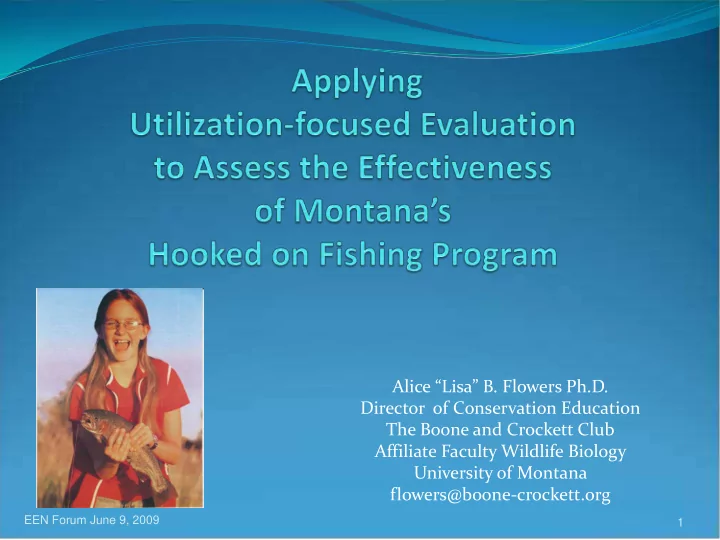
Alice Lisa B. Flowers Ph.D. Director of Conservation Education The - - PowerPoint PPT Presentation
Alice Lisa B. Flowers Ph.D. Director of Conservation Education The Boone and Crockett Club Affiliate Faculty Wildlife Biology University of Montana flowers@boone-crockett.org EEN Forum June 9, 2009 1 HOF Schools EEN Forum June 9,
Alice “Lisa” B. Flowers Ph.D. Director of Conservation Education The Boone and Crockett Club Affiliate Faculty Wildlife Biology University of Montana flowers@boone-crockett.org
EEN Forum June 9, 2009 1
3 EEN Forum June 9, 2009
EEN Forum June 9, 2009 4
EEN Forum June 9, 2009 5
EEN Forum June 9, 2009 6
EEN Forum June 9, 2009 7
EEN Forum June 9, 2009 8
Teachers Students Program Instructors Program Coordinator Designing the Evaluation
(Developing the Evaluation Plan, Piloting and Agreeing on Measurement Methods)
Framing the Questions Implementing the Evaluation Process Use Interpreting the Results Acting on Findings & Recommendations
[1] Process use refers to the effects on those involved in evaluation that extend beyond use of findings, including impacts on the program and
Nov-Dec 2005 May 2006 June 2006 September 2006
HOF Student Survey X
Pre-survey (n=2277)
X
Post- Survey (n=2083)
X
Extended Post-survey (n=194)
NON HOF Student Survey
X Post- Survey (n=229)
X
Extended Post-survey (n=174)
HOF Teacher Survey X (n=114) HOF Instructor Interview X (n=16)
EEN Forum June 9, 2009 9
EEN Forum June 9, 2009 10
Statistical significance difference for knowledge and
No significant difference for attitude and intended
2 – 3 outdoor experiences correlated with positive
EEN Forum June 9, 2009 11
Most teachers thought students
Three major themes emerged from suggestions
“think it would be a valuable addition to the program to
EEN Forum June 9, 2009 12
How do you Judge the Success of HOF?
Good insightful questions from students Expressions of satisfaction when students caught first
fish
Gratifying feedback from students, teachers,
administrators, & parents
Repeat invitations and community support New schools involved in program
EEN Forum June 9, 2009 13
Stakeholder Acceptance of Evaluation Purpose & Process Participatory Approach Personal & Situational High Response Rates Increased Application & Utility of Findings.
EEN Forum June 9, 2009 14
Change (as soon as possible)
Realign program goals and objectives to meet all desired outcomes
Execute (in a reasonable time)
2 to 3 field experiences per class when & where possible Implement program improvements suggested by teachers and
instructors
Reevaluate (2 – 3 years)
Use UFE approach with recommended improvements to the process
Replicate (UFE process)
To evaluate effectiveness of other environmental education programs
EEN Forum June 9, 2009 15
More Time to Conduct Situational Analysis of Overall
Involve more Key Stakeholders in Development of
More Time to Develop and Pilot Instruments Administer all Pre-surveys prior to any Treatment Integrate Observation, Focus Group & Technological
EEN Forum June 9, 2009 16
EEN Forum June 9, 2009 17
To significantly increase desired program outcomes – knowledge, skills, attitudes, and behaviors – for healthier, happier, more engaged children today and for generations to come… who understand & value their connection to the natural world.
EEN Forum June 9, 2009 18
Graduate Committee – University of Montana
Dr. Jack Ward Thomas - Advisor Dr. Daniel Pletscher, Dr. Fletcher Brown, Dr. James Burchfield, Dr. Hal Salwasser.
Professor Rudy Gideon – Math Department University of Montana The Boone and Crockett Club Montana Fish Wildlife & Parks Welder Wildlife Foundation National Fish & Wildlife Foundation NSF – Center for Learning & Teaching in the West All students, teachers, administrators, and HOF instructors involved in my study.
EEN Forum June 9, 2009 19
Thank You! For Additional Information Contact: Lisa B. Flowers flowers@boone-crockett.org talflowrs@3riversdbs.net