Algorithm Analysis Part II Tyler Moore CS 2123, The University of - - PowerPoint PPT Presentation

algorithm analysis
SMART_READER_LITE
LIVE PREVIEW

Algorithm Analysis Part II Tyler Moore CS 2123, The University of - - PowerPoint PPT Presentation

Why it matters Algorithm Analysis Part II Tyler Moore CS 2123, The University of Tulsa Some slides created by or adapted from Dr. Kevin Wayne. For more information see http://www.cs.princeton.edu/~wayne/kleinberg-tardos . Some slides adapted


slide-1
SLIDE 1

Algorithm Analysis

Part II Tyler Moore

CS 2123, The University of Tulsa

Some slides created by or adapted from Dr. Kevin Wayne. For more information see http://www.cs.princeton.edu/~wayne/kleinberg-tardos. Some slides adapted from Dr. Steven Skiena. For more information see http://www.algorist.com

9

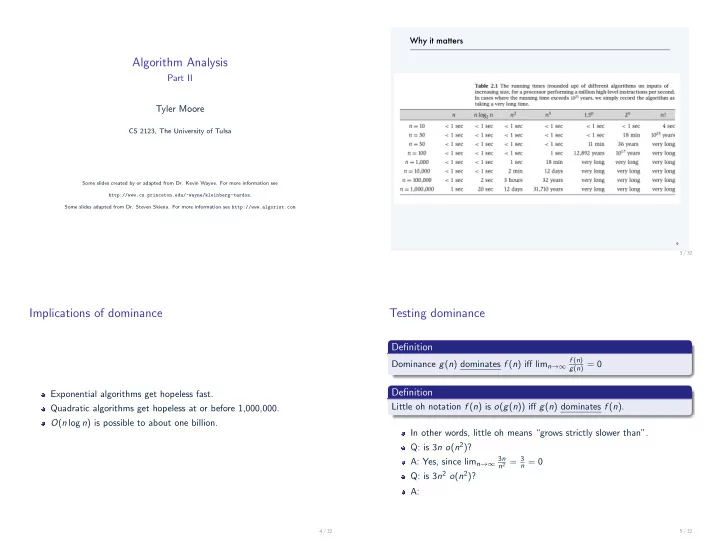
Why it matters

3 / 32

Implications of dominance

Exponential algorithms get hopeless fast. Quadratic algorithms get hopeless at or before 1,000,000. O(n log n) is possible to about one billion.

4 / 32

Testing dominance

Definition

Dominance g(n) dominates f (n) iff limn→∞

f (n) g(n) = 0

Definition

Little oh notation f (n) is o(g(n)) iff g(n) dominates f (n). In other words, little oh means “grows strictly slower than”. Q: is 3n o(n2)? A: Yes, since limn→∞ 3n

n2 = 3 n = 0

Q: is 3n2 o(n2)? A:

5 / 32

slide-2
SLIDE 2

15

Useful facts

  • Proposition. If , then f (n) is Θ(g(n)).
  • Pf. By definition of the limit, there exists n0 such such that for all n ≥ n0

・Thus, f (n) ≤ 2 c g(n) for all n ≥ n0, which implies f (n) is O(g(n)). ・Similarly, f (n) ≥ ½ c g(n) for all n ≥ n0, which implies f (n) is Ω(g(n)).

  • Proposition. If , then f (n) is O(g(n)).

lim

n→∞

f(n) g(n) = c > 0 1 2 c < f(n) g(n) < 2 c lim

n→∞

f(n) g(n) = 0

6 / 32

16

Asymptotic bounds for some common functions

  • Polynomials. Let T(n) = a0 + a1 n + … + ad nd with ad > 0. Then, T(n) is Θ(nd).

Pf.

  • Logarithms. Θ(loga n) is Θ(logb n) for any constants a, b > 0.

Logarithms and polynomials. For every d > 0, log n is O(n d). Exponentials and polynomials. For every r > 1 and every d > 0, nd is O(r n). Pf.

no need to specify base (assuming it is a constant)

lim

n→∞

a0 + a1n + . . . + adnd nd = ad > 0 lim

n→∞

nd rn = 0

7 / 32

Exercises

Using the limit formula and results from earlier slides, answer the following: Q: Is 5n2 + 3n o(n)? A: No, since limn→∞ 5n2+3n

n

= limn→∞ 5n + 3 = ∞ Q: is 3n3 + 5 Θ(n3)? A: Q: is n log n + n2 O(n3)? A:

8 / 32

19

Linear time: O(n)

Linear time. Running time is proportional to input size. Computing the maximum. Compute maximum of n numbers a1, …, an.

max ← a1 for i = 2 to n { if (ai > max) max ← ai }

10 / 32

slide-3
SLIDE 3

20

Linear time: O(n)

  • Merge. Combine two sorted lists A = a1, a2, …, an with B = b1, b2, …, bn into sorted

whole.

  • Claim. Merging two lists of size n takes O(n) time.
  • Pf. After each compare, the length of output list increases by 1.

i = 1, j = 1 while (both lists are nonempty) { if (ai ≤ bj) append ai to output list and increment i else(ai ≤ bj)append bj to output list and increment j } append remainder of nonempty list to output list

11 / 32

21

Linearithmic time: O(n log n)

O(n log n) time. Arises in divide-and-conquer algorithms.

  • Sorting. Mergesort and heapsort are sorting algorithms that perform

O(n log n) compares. Largest empty interval. Given n time-stamps x1, …, xn on which copies of a file arrive at a server, what is largest interval when no copies of file arrive? O(n log n) solution. Sort the time-stamps. Scan the sorted list in order, identifying the maximum gap between successive time-stamps.

12 / 32

22

Quadratic time: O(n2)

  • Ex. Enumerate all pairs of elements.

Closest pair of points. Given a list of n points in the plane (x1, y1), …, (xn, yn), find the pair that is closest. O(n2) solution. Try all pairs of points.

  • Remark. Ω(n2) seems inevitable, but this is just an illusion. [see Chapter 5]

min ← (x1 - x2)2 + (y1 - y2)2 for i = 1 to n { for j = i+1 to n { d ← (xi - xj)2 + (yi - yj)2 if (d < min) min ← d } }

13 / 32

23

Cubic time: O(n3)

Cubic time. Enumerate all triples of elements. Set disjointness. Given n sets S1, …, Sn each of which is a subset of 1, 2, …, n, is there some pair of these which are disjoint? O(n3) solution. For each pair of sets, determine if they are disjoint.

foreach set Si { foreach other set Sj { foreach element p of Si { determine whether p also belongs to Sj } if (no element of Si belongs to Sj) report that Si and Sj are disjoint } }

14 / 32

slide-4
SLIDE 4

24

Polynomial time: O(nk)

Independent set of size k. Given a graph, are there k nodes such that no two are joined by an edge? O(nk) solution. Enumerate all subsets of k nodes.

・Check whether S is an independent set takes O(k2) time. ・Number of k element subsets = ・O(k2 nk / k!) = O(nk).

foreach subset S of k nodes { check whether S in an independent set if (S is an independent set) report S is an independent set } }

poly-time for k=17, but not practical k is a constant

n k

  • = n(n − 1)(n − 2) × · · · × (n − k + 1)

k(k − 1)(k − 2) × · · · × 1 ≤ nk k!

15 / 32

25

Exponential time

Independent set. Given a graph, what is maximum cardinality of an independent set? O(n2 2n) solution. Enumerate all subsets.

S* ← φ foreach subset S of nodes { check whether S in an independent set if (S is largest independent set seen so far) update S* ← S } }

16 / 32

26

Sublinear time

Search in a sorted array. Given a sorted array A of n numbers, is a given number x in the array? O(log n) solution. Binary search.

lo ← 1, hi ← n while (lo ≤ hi) { mid ← (lo + hi) / 2 if (x < A[mid]) hi ← mid - 1 else if (x > A[mid]) lo ← mid + 1 else return yes } return no

17 / 32

Common algorithm dominance classes

Dominance class Example problem types 1 Operations independent of input size (e.g., addition, min(x,y), etc.) log n Binary search n Operating on every element in an array n log n Quicksort, mergesort n2 Operating on every pair of items n3 Operating on every triple of items 2n Enumerating all subsets of n items n! Enumerating all orderings of n items

18 / 32

slide-5
SLIDE 5

Python Algorithm Development Process

1 Think hard about the problem you’re trying to solve. Specify the

expected inputs for which you’d like to provide a solution, and the expected outputs.

2 Describe a method to solve the problem using English and/or

pseudo-code

3 Start coding 1

Development/Debugging phase

2

Testing phase (for correctness)

3

Evaluation phase (performance)

Let’s use the insertion sort as an example of the development process in Python

20 / 32

Debugging in Python

1 Main strategy: run code in the interpreter to get instant feedback on

errors

2 Backup: Generous use of print statements 3 Once code is running in functions: pdb.pm() (Python debugger

post-mortem)

21 / 32

Main strategy: run code in the interpreter

>>> s = [2,7,4,5,9] >>> >>> for i in range(s): ... minidx = i ... for j in range(i,len(s)): ... if s[j]<s[minidx]: ... minidx=i ... s[i],s[minidx]=s[minidx],s[i] ... Traceback (most recent call last): File "<stdin>", line 1, in <module> TypeError: range() integer end argument expected, got list. >>> s [2, 7, 4, 5, 9] >>> range(s) Traceback (most recent call last): File "<stdin>", line 1, in <module> TypeError: range() integer end argument expected, got list. >>> len(s) 5 >>> range(len(s)) [0, 1, 2, 3, 4]

22 / 32

Second strategy: print variables out during execution

>>> for i in range(len(s)): ... minidx = i ... for j in range(i,len(s)): ... print ’list: %s, i: %i, j: %i, minidx: %i’%(s,i,j,minidx) ... if s[j]<s[minidx]: ... print "reassigning minidx %i < %i" %(s[j],s[minidx]) ... minidx=j ... s[i],s[minidx]=s[minidx],s[i] ... list: [2, 7, 4, 5, 9], i: 0, j: 0, minidx: 0 list: [2, 7, 4, 5, 9], i: 0, j: 1, minidx: 0 list: [2, 7, 4, 5, 9], i: 0, j: 2, minidx: 0 list: [2, 7, 4, 5, 9], i: 0, j: 3, minidx: 0 list: [2, 7, 4, 5, 9], i: 0, j: 4, minidx: 0 list: [2, 7, 4, 5, 9], i: 1, j: 1, minidx: 1 list: [2, 7, 4, 5, 9], i: 1, j: 2, minidx: 1 reassigning minidx 4 < 7 list: [2, 4, 7, 5, 9], i: 1, j: 3, minidx: 2 reassigning minidx 5 < 7 list: [2, 5, 7, 4, 9], i: 1, j: 4, minidx: 3 list: [2, 5, 7, 4, 9], i: 2, j: 2, minidx: 2 list: [2, 5, 7, 4, 9], i: 2, j: 3, minidx: 2 reassigning minidx 4 < 7 list: [2, 5, 4, 7, 9], i: 2, j: 4, minidx: 3 list: [2, 5, 4, 7, 9], i: 3, j: 3, minidx: 3 list: [2, 5, 4, 7, 9], i: 3, j: 4, minidx: 3 list: [2, 5, 4, 7, 9], i: 4, j: 4, minidx: 4

23 / 32

slide-6
SLIDE 6

Second strategy: print variables out during execution

>>> for i in range(1,len(s)): ... minidx = i ... for j in range(i+1,len(s)): ... print ’list: %s, i: %i, j: %i, minidx: %i’%(s,i,j,minidx) ... if s[j]<s[minidx]: ... print "reassigning minidx %i < %i" %(s[j],s[minidx]) ... minidx=j ... s[i],s[minidx]=s[minidx],s[i] ... list: [2, 7, 4, 5, 9], i: 1, j: 2, minidx: 1 reassigning minidx 4 < 7 list: [2, 7, 4, 5, 9], i: 1, j: 3, minidx: 2 list: [2, 7, 4, 5, 9], i: 1, j: 4, minidx: 2 list: [2, 4, 7, 5, 9], i: 2, j: 3, minidx: 2 reassigning minidx 5 < 7 list: [2, 4, 7, 5, 9], i: 2, j: 4, minidx: 3 list: [2, 4, 5, 7, 9], i: 3, j: 4, minidx: 3

24 / 32

Third strategy: use Python debugger

Once you’ve gotten rid of the obvious bugs, move the code to a function. But what happens if you start getting run-time errors on different inputs? You can copy code directly into the interpreter Or you can run pdb.pm() to access variables in the environment at the time of the error

25 / 32

After debugging comes testing

While you might view them as synonyms, testing is more systematic checking that algorithms work for a range of inputs, not just the ones that cause obvious bugs Use Python assert command to verify expected behavior

26 / 32

assert in action

>>> s [2, 5, 4, 7, 9] >>> t = list(s) >>> t.sort() >>> >>> assert t == s Traceback (most recent call last): File "<stdin>", line 1, in <module> AssertionError >>> t [2, 4, 5, 7, 9] >>> s [2, 5, 4, 7, 9]

27 / 32

slide-7
SLIDE 7

Using random to generate inputs

>>> import random, timeit >>> l10=range(10) >>> l10 [0, 1, 2, 3, 4, 5, 6, 7, 8, 9] >>> random.shuffle(l10) >>> l10 [4, 2, 0, 3, 8, 1, 9, 7, 6, 5] >>> unsortl10 = list(l10) >>> unsortl10 [4, 2, 0, 3, 8, 1, 9, 7, 6, 5] >>> l10.sort() >>> l10 [0, 1, 2, 3, 4, 5, 6, 7, 8, 9] >>> unsortl10 [4, 2, 0, 3, 8, 1, 9, 7, 6, 5] >>> assert selection_sort(unsortl10) == l10

28 / 32

Using assert on many inputs

#try 10 different shufflings of each list for i in range(10): #try all lists between 1 and 500 elements print ’trying %i time’%(i) for j in range(500): l = range(j) random.shuffle(l) #reorder the list ul = list(l) #make a copy of the unordered list l.sort() #do a known correct sort assert selection_sort(ul) == l #compare sorts

29 / 32

Don’t forget to look for counterexamples

Using assert works when you have a known correct solution to compare against This frequently occurs when you have a known working algorithm, but you are developing a more efficient one While testing lots of random inputs is a good strategy, don’t forget to examine edge cases and potential counterexamples too

30 / 32

Empirically evaluating performance

Once you are confident that your algorithm is correct, you can evaluate its performance empirically Python’s timeit package repeatedly runs code and reports average execution time timeit arguments

1

code to be executed in string form

2

any setup code that needs to be run before executing the code (note: setup code is only run once)

3

parameter ‘number’, which indicates the number of times to run the code (default is 1000000)

31 / 32

slide-8
SLIDE 8

Timeit in action: timing Python’s sort function and our selection sort

#store function in file called sortfun.py import random def sortfun(size): l = range(1000) random.shuffle(l) l.sort() >>> timeit.timeit("sortfun(1000)","from sortfun import sortfun",number=100) 0.0516510009765625 >>> #here is the wrong way to test the built-in sort function ... timeit.timeit("l.sort()","import random; l = range(1000); random.shuffle(l)" ,number=100) 0.0010929107666015625 >>> #let’s compare it to our selection sort >>> timeit.timeit("selection_sort(l)","from selection_sort import selection_sort; import random; l = range(1000); random.shuffle(l)",number=100) 3.0629560947418213

32 / 32