CS 6354: Memory Hierarchy III for ( int i = 0; i < I; ++i) { 5 - - PowerPoint PPT Presentation

cs 6354 memory hierarchy iii
SMART_READER_LITE
LIVE PREVIEW

CS 6354: Memory Hierarchy III for ( int i = 0; i < I; ++i) { 5 - - PowerPoint PPT Presentation

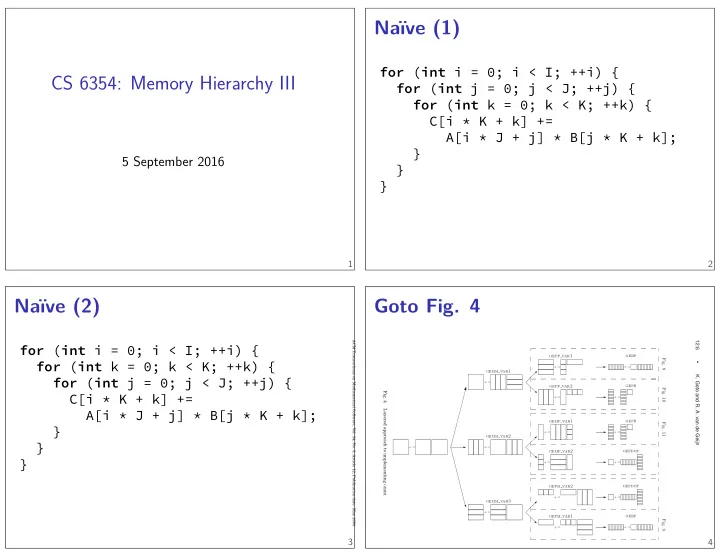
CS 6354: Memory Hierarchy III for ( int i = 0; i < I; ++i) { 5 September 2016 Goto Fig. 4 3 } } } A[i * J + j] * B[j * K + k]; C[i * K + k] += for ( int j = 0; j < J; ++j) { for ( int k = 0; k < K; ++k) { 4 Nave (2) } } }


slide-1
SLIDE 1

CS 6354: Memory Hierarchy III

5 September 2016

1

Naïve (1)

for (int i = 0; i < I; ++i) { for (int j = 0; j < J; ++j) { for (int k = 0; k < K; ++k) { C[i * K + k] += A[i * J + j] * B[j * K + k]; } } }

2

Naïve (2)

for (int i = 0; i < I; ++i) { for (int k = 0; k < K; ++k) { for (int j = 0; j < J; ++j) { C[i * K + k] += A[i * J + j] * B[j * K + k]; } } }

3

Goto Fig. 4

12:6

  • K. Goto and R. A. van de Geijn

+:=

gemm var1

+:=

gepp var1

+:=

gebp

+:=

gepp var2

+:=

✲ ✲

gepb

+:=

gemm var2

+:=

gemp var1

+:=

gepb

+:=

gemp var2

+:=

gepdot

+:=

gemm var3

+:=

gepm var2

+:=

gepdot

+:=

gepm var1

+:=

✲ ✲ ✲

gebp

+:=

  • Fig. 9
  • Fig. 11
  • Fig. 10
  • Fig. 8

✲ ✲ ✲ ✲ ✲

  • Fig. 4.

Layered approach to implementing GEMM.

ACM Transactions on Mathematical Software, Vol. 34, No. 3, Article 12, Publication date: May 2008.

4

slide-2
SLIDE 2

The Inner Loop

  • Fig. 5.

The algorithm that corresponds to the path through Figure 4 that always takes the top branch expressed as a triple-nested loop.

, we focus on that algorithm:

+:=

nr kc mc

king

5

GFLOP/s

m = n = k GFlops 500 1000 1500 2000 1 2 3 4 5 6 7 20 40 60 80 100 Percentage dgemm Kernel Pack A Pack B k (m = n = 2000) GFlops 500 1000 1500 2000 1 2 3 4 5 6 7 20 40 60 80 100 Percentage dgemm Kernel Pack A Pack B

  • Fig. 14.

Pentium4 Prescott (3.6 GHz).

6

Theoretical maximum performance

This CPU: 2 double adds or multiplies per cycle 3.6 GHz: 7.2B adds or multiplies per second = 7.2 Gfmop/s (Giga Floating Point Operation Per Second)

7

Theme: Overlap

Modern CPUs do other things during memory

  • perations

ideal: no added latency

8

slide-3
SLIDE 3

Cache/Register Blocking

minimize data movements … by reordering computation best orders — all computations within ‘block’

9

Load into Cache?

Algorithm: C := gebp(A, B, C )

+:=

nr kc mc Load A into cache (mckc memops) for j = 0, . . . , N − 1 Load Bj into cache (kcnr memops) Load Cj into cache (mcnr memops)

+:=

(Cj := ABj + Cj) Store Cj into memory (mcnr memops) endfor

  • Fig. 7.

Basic implementation of GEBP.

much of the cache as possible and should be roughly square

10

Why packing?

250 x ??? matrix at memory address 300, working on fjrst part:

300 301 302 303 304 305 306 307 308 309 310 311 … 549 550 551 552 553 554 555 556 557 558 559 560 561 … 799 800 801 802 803 804 805 806 807 808 809 810 811 … 1049 1050 1051 1052 1053 1054 1055 1056 1057 1058 1059 1060 1061 … 1299 1300 1301 1302 1303 1304 1305 1306 1307 1308 1309 1310 1311 … 1549

unused parts of cache blocks

irrelevant 310 in same block as 309

confmict misses if close-to-power-of-two

nearby matrix entries map to same set

extra TLB misses

less of relevant matrix in each page

11

The Balanced System

nr ≥ Rcomp 2Rload C = AB

  • verlap loads (at rate Rload) from L2 with

computation enough of C, B (nr) in L1/registers to keep FPU busy

12

slide-4
SLIDE 4

TLB capacities

virtual physical 0x00444 0x007 0x00446 0x01c 0x00448 0x01f 0x0044a 0x024 TLB (cache of page table)

virtual page # page ofgset physical page # page ofgset

virtual (program) address physical (machine) address

reach: page size × # entries = 16K with 4K pages worst case: each entry only useful for 1 byte of data:

e.g. 0x00444ccc 0x00446bbb 0x00448aaa 0x0044a999 0x0044c777 etc.

13

Hierarchical page tables

CR3 32 39 40 47 48 55 56 63 8 16 24 31 15 7 23

... ...

4K memory page Linear address: 64 bit PD entry

... ...

page directory

... ...

PDP entry page-directory- pointer table 64 bit PT entry

... ...

page table

... ...

PML4 entry PML4 table 9 9 40* 9 9 12 sign extended *) 40 bits aligned to a 4-KByte boundary

Diagram: Wikimedia / RokerHRO

14

Large pages (1)

Diagram: Intel 64 and IA-32 Architectures Software Developer’s Manual, Volume 3A

15

Large pages (2)

Diagram: Intel 64 and IA-32 Architectures Software Developer’s Manual, Volume 3A

16

slide-5
SLIDE 5

Data TLB reach on my laptop

4KB pages: 64 pages = 256 KB 2M pages: 32 pages = 64 MB 1GB pages: 4 pages = 4 GB

256 KB — smaller than L3 cache

17

Intuition: why no locality

Amazon recommendation network from Lehmann and Kottler, “Visualizing Large and Clustered Networks”

18

Proof of locality?

19

Preview: Out-of-order

What happens on a cache miss? modern fast CPUs: keep executing instructions …unless value actually needed

20

slide-6
SLIDE 6

Preview: Reorder bufger

holds pending instructions used to make computation appear in-order (more later in the course) key feature here: need to have enough room for every instruction run out-of-order

21

Non-Uniform Memory Access

Some memory closer to one core than another Exists within a socket (single chip)

22

Memory Request Limits

23

Page table overhead

24

slide-7
SLIDE 7

Pointer chasing

void **pointer = /* initialize array */; for (int i = 0; i < MAX_ITER; ++i) { pointer = *pointer; }

25

Preview: SMT

What happens on cache miss? Run a difgerent thread! Needs: extra set of registers Same machinary as out-of-order (more later in the course)

26

Beamer’s theory about SMT

“One thread could generate most of the cache misses sustaining a high efgective MLP while the other thread (unencumbered by cache misses) could execute instructions quickly to increase IPM.” “In practice, the variation between threads is modest…”

27

Conditions

28

slide-8
SLIDE 8

Where to do graph processing?

Extreme: Cray XMT

no data cache 100s of outstanding memory acccesses (“memory-level parallelism”)

29

Homework 1

Example: measure sizes of each data/unifjed cache Benchmark: speed of accessing array of varying size in random order

103 104 105 106 107 101 102 array size (B) cycles/read

30

Note on Paper Reviews (1)

Make it clear where you answer each part

You can copy-and-paste the questions

Only need one signifjcant insight

Better to explain one well (including evidence) than three poorly

Your insight should be a result

What experiments showed, not what experiments were done

31

Note on Paper Reviews (2)

Evidence: not just that there were experiments

What kind of experiments? How big is the efgect?

Weakness/improvement: don’t be afraid

Often the discussion identifjes these for you

32

slide-9
SLIDE 9

Next time

“Performance from architecture: comparing a RISC and CISC with similar hardware organization”

CISC (VAX) v RISC (MIPS) both pipelined microinstructions to implement complex instructions

”The RISC V Instruction Set Manual: Volume I: User-Level ISA”, Chapter 1 (including commentary)

  • nly

motivation (chapter 1 only) for a recent ISA design

33