CS 6354: Memory Hierarchy II Prioritize reads over writes Band- - - PowerPoint PPT Presentation

cs 6354 memory hierarchy ii
SMART_READER_LITE
LIVE PREVIEW

CS 6354: Memory Hierarchy II Prioritize reads over writes Band- - - PowerPoint PPT Presentation

CS 6354: Memory Hierarchy II Prioritize reads over writes Band- width Increase block size N Y Increase cache size N Y Increase associavity N Y Multilevel caches Y Y Hit Virtual-index = Physical Y Pipelined cache accesses Y


slide-1
SLIDE 1

CS 6354: Memory Hierarchy II

31 August 2016

1

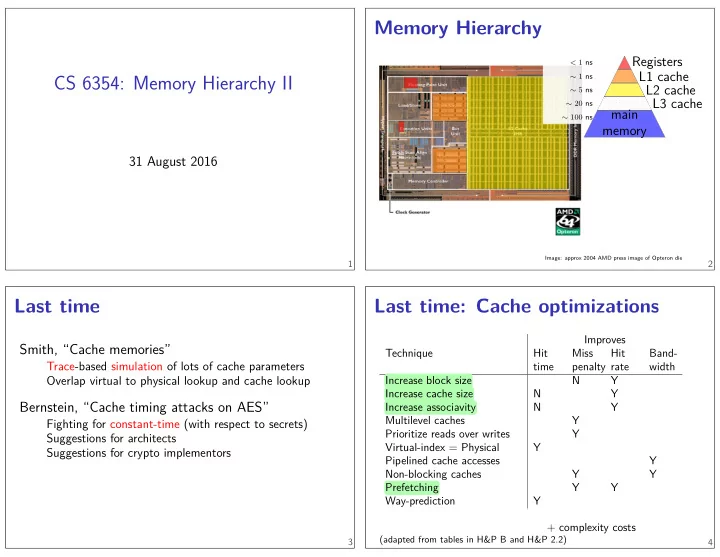
Memory Hierarchy

Registers L1 cache L2 cache L3 cache main memory

< 1 ns ∼ 1 ns ∼ 5 ns ∼ 20 ns ∼ 100 ns

Image: approx 2004 AMD press image of Opteron die

2

Last time

Smith, “Cache memories”

Trace-based simulation of lots of cache parameters Overlap virtual to physical lookup and cache lookup

Bernstein, “Cache timing attacks on AES”

Fighting for constant-time (with respect to secrets) Suggestions for architects Suggestions for crypto implementors

3

Last time: Cache optimizations

Improves Technique Hit time Miss penalty Hit rate Band- width Increase block size N Y Increase cache size N Y Increase associavity N Y Multilevel caches Y Prioritize reads over writes Y Virtual-index = Physical Y Pipelined cache accesses Y Non-blocking caches Y Y Prefetching Y Y Way-prediction Y + complexity costs

(adapted from tables in H&P B and H&P 2.2) 4

slide-2
SLIDE 2

Homework 1

Checkpoint due 12 September Intuition: 32KB much faster than 34KB, then 32KB cache Required for checkpoint:

* For each data or unifjed (data and instruction) cache:

  • The size of that cache
  • The size of blocks (AKA lines) in that cache

* For each data or unifjed TLB:

  • The size (number of entries) of that TLB

* The single-core sequential throughput (read and write)

  • f main memory

* The single-core random throughput (read and write) of main memory

5

Avoiding associativity

tag index ofgset = cache tag calcuation step 1 data bufger execution step 2

6

Way prediction

tag index ofgset select tag cache way 1 cache way 2 tag predict way calcuation step 1 data bufger execution step 2

instruction ptr, …

7

Why not direct-mapped?

Virtual Page # Physical Page # Index of Set? Index of Set? Ofgset

Avoid virtual caches Mitigation: way prediction Difgerent HW speed tradeofgs today?

8

slide-3
SLIDE 3

Victim Caches

V Tag Data 1 0x1000x2000x300AA BBCC DDEE FF V Address Data 1 0x1006 AA BB 1 0x10060x2006AA BBCC DD Access

pattern: 0x1006 0x2006 0x3006 0x2006 0x1006 Direct-mapped Cache Victim Cache

9

Difgerent kinds of memory

0xFFFF FFFF FFFF FFFF 0xFFFF 8000 0000 0000 0x7FFF … 0x0000 0000 0040 0000 Used by OS Virtual memory Stack Memory mappings Writable data Code + Constants Confmict in low-order bits?

10

Old prefetch strategies

Prefetch always Fetch next on miss Tagged prefetch — next on non-prefetch use Common goal: sequential access patterns

11

Sequential access patterns

Examples? Instructions Dense matrix/array math String processing Some database operations

12

slide-4
SLIDE 4

Stream bufgers

hit: shift up miss: clear

13

Multi-way stream bufgers

hit: shift up miss: clear LRU

14

Performance Results

15

Prefetching on recent Intel (1)

From the Intel Optimization Manual on Sandy Bridge: Two hardware prefetchers load data to the L1 DCache:

  • Data cache unit (DCU) prefetcher. This prefetcher … is

triggered by an ascending access to very recently loaded data. …

  • Instruction pointer (IP)-based stride prefetcher. This

prefetcher keeps track of individual load instructions. If a load instruction is detected to have a regular stride, then a prefetch is sent to the next address which is the sum of the current address and the stride. …

16

slide-5
SLIDE 5

Prefetching on recent Intel (2)

From the Intel Optimization Manual on Sandy Bridge: The following two hardware prefetchers fetched data from memory to the L2 cache and last level cache: Spatial Prefetcher: This prefetcher strives to complete every cache line fetched to the L2 cache with the pair line that completes it to a 128-byte aligned chunk. Streamer: This prefetcher monitors read requests from the L1 cache for ascending and descending sequences of

  • addresses. Monitored read requests include … load and store
  • perations and … the [L1] hardware prefetchers, and … code

fetch.

17

Sandy Bridge die

via anandtech (original is Intel press photo??)

18

Within each core

Image: Intel’s Optimization Reference Manual

19

Cook’s Benchmark Categorization

Number of threads Last level cache size Prefetchers Memory bandwidth

20

slide-6
SLIDE 6

Interference between programs

21

Why a shared last-level cache?

22

Sandy Bridge’s cache partitioning

12-way cache

way — ‘column’ of set-associative cache each way is like a direct-mapped cache

Mask for which ways are used to store things on miss

LLC:

Way 1 0.5 MB Way 2 0.5 MB Way 3 0.5 MB Way 4 0.5 MB Way 5 0.5 MB Way 6 0.5 MB Way 7 0.5 MB Way 8 0.5 MB Way 9 0.5 MB Way 10 0.5 MB Way 11 0.5 MB Way 12 0.5 MB

foreground application

mask 1111 1000 0000

background application

mask 0000 0111 1111

23

Page coloring

0101 1111 110110 1111 11 1000 11 0000 0000 …

Physical Page # Index of Set Ofgset cache indices 0x000–0x3FF cache indices 0x400–0x7FF cache indices 0x800–0xBFF cache indices 0xCFF–0xFFF cache (possibly direct-mapped) Page colors: 00, 01, 10, 11

24

slide-7
SLIDE 7

Experiment Design

25

Energy: Race-to-Halt

26

Phases

27

Dynamic partitioning

Dynamic partitioning inputs:

LLC misses over 100 ms, every 100 ms

Thresholds for detecting changes Increase to max allocation — then decrease slowly

28

slide-8
SLIDE 8

Reproducibility

29