Agenda (estimated minutes) Welcome and Project Update (15 min) - - PowerPoint PPT Presentation

agenda estimated minutes
SMART_READER_LITE
LIVE PREVIEW

Agenda (estimated minutes) Welcome and Project Update (15 min) - - PowerPoint PPT Presentation

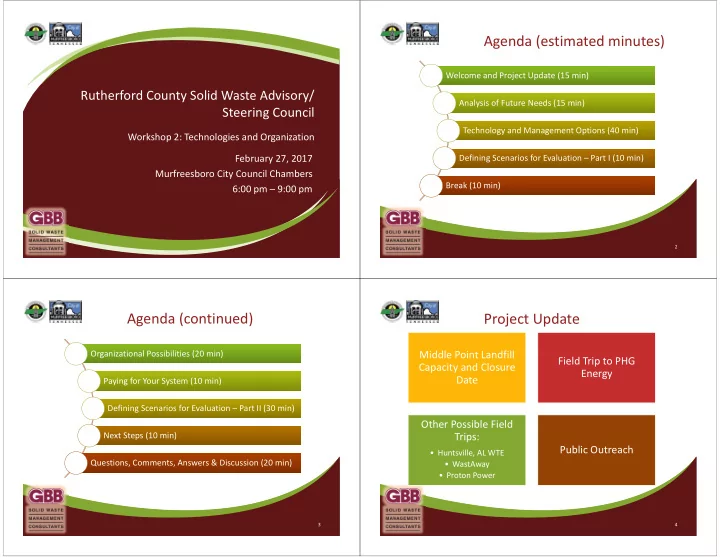
Agenda (estimated minutes) Welcome and Project Update (15 min) Welcome and Project Update (15 min) Rutherford County Solid Waste Advisory/ Analysis of Future Needs (15 min) Analysis of Future Needs (15 min) Steering Council Technology and


slide-1
SLIDE 1

Rutherford County Solid Waste Advisory/ Steering Council

Workshop 2: Technologies and Organization February 27, 2017 Murfreesboro City Council Chambers 6:00 pm – 9:00 pm

Agenda (estimated minutes)

2

Welcome and Project Update (15 min) Welcome and Project Update (15 min) Analysis of Future Needs (15 min) Analysis of Future Needs (15 min) Technology and Management Options (40 min) Technology and Management Options (40 min) Defining Scenarios for Evaluation – Part I (10 min) Defining Scenarios for Evaluation – Part I (10 min) Break (10 min) Break (10 min) Organizational Possibilities (20 min) Organizational Possibilities (20 min) Paying for Your System (10 min) Paying for Your System (10 min) Defining Scenarios for Evaluation – Part II (30 min) Defining Scenarios for Evaluation – Part II (30 min) Next Steps (10 min) Next Steps (10 min) Questions, Comments, Answers & Discussion (20 min) Questions, Comments, Answers & Discussion (20 min)

Agenda (continued)

3

Middle Point Landfill Capacity and Closure Date Field Trip to PHG Energy Other Possible Field Trips:

  • Huntsville, AL WTE
  • WastAway
  • Proton Power

Public Outreach

Project Update

4

slide-2
SLIDE 2

“2016 Estimate of Remaining Life” form estimated the remaining capacity at 11 years (2027) Publicly stated life may be 8 years (2024) Republic’s 2016 Estimate Final Grades (volume) Waste disposal tonnage

  • Historically 3,500 tpd
  • Recently have been taking in more

Items Affecting Capacity TDEC and Republic are in correspondence to define if capacity and closure date Sludge deliveries may cease before garbage TDEC/ Republic

5

Middle Point Landfill

6

Field Trip to PHG Energy

7

Other Possible Field Trips

Huntsville Solid Waste to Energy Facility (Huntsville, AL) https://www.covanta.com/Our‐Facilities/Covanta‐ Huntsville WastAway (Morrison, TN) http://www.wastaway.com/ Proton Power (Lenoir City, TN) http://www.protonpower.com

ANALYSIS OF FUTURE SOLID WASTE MANAGEMENT NEEDS

8

February 27, 2017

slide-3
SLIDE 3

Project population growth for 20 years (FY2015 – FY2035) Calculate the per capita waste disposed for each material Multiply the per capita waste disposed by the following year’s population

9

Waste Projection Methodology

  • 2015 population is 298,612
  • 2030 population estimated to be 420,000
  • Represents a 2.3% compound annual growth rate

Population of Rutherford County

  • 2015 population is 126,118
  • 2035 population estimated to be 228,000
  • Represents a 3.0% compound annual growth rate

Population of City of Murfreesboro

  • 258,000 tons at Middle Point Landfill
  • 21,027 tons at County Class III/IV Landfill

Total waste disposed in FY2015 is 279,027

  • Individuals will generate equal amounts of garbage per

person

Waste disposed per capita does not change

10

Waste Projection Assumptions

11

Rutherford County FY15 Waste and Recycling by Generator

Recycling Center Garbage: 36,765 tons, 13% Recycling Center Recycling: 3,000 tons, 1% Murfreesboro Curbside Garbage: 35,503 tons, 13% C&DD/Brush: 21,027 tons, 7% Private Hauler Garbage: 185,732 tons, 66%

282,027 tons total

12

Estimated FY15 Rutherford County Material Generated

Garbage: 108,511 tons, 38% Single Stream Recycling: 83,331 tons, 30% Organics: 69,157 tons, 25% C&D: 21,027 tons, 7%

282,027 tons total

February 27, 2017

slide-4
SLIDE 4

13

Projection of Rutherford County Waste and Recycling

298,612 374,860 470,576 50,000 100,000 150,000 200,000 250,000 300,000 350,000 400,000 450,000 500,000 County Class III/IV Landfill Disposal Garbage Tons (Murfreesboro only) Recycling Center Recycling Tons (FY2015 estimated) Recycling Center Garbage Tons Private Hauler Garbage Tons County Population 14

Rutherford County FY15 Garbage and Recycling by Recycling Center (approx. 40k tons)

Almaville 7% Bradyville 4% Buchanan 0% Cranor Rd 2% Christiana/Fosterville 1% Eagleville 2% Epps Mill 2% Lascassas 4% Leanna 4% Rock Springs 2% Rock Crusher 7% Rockvale 3% Sand Hill 10% Walter Hill 6% Weakley 17% Hill Yard 28% 15

Map of Recycling Centers

LaVergne Smyrna Murfreesboro Eagleville

PRELIMINARY ANALYSIS OF IDENTIFIED TECHNOLOGY AND MANAGEMENT OPTIONS

16

February 27, 2017

slide-5
SLIDE 5

17

Summary of Current Options

Option Overview No Change Direct Haul/Go It Alone Source Reduction Education, bans, financial penalties Collection System Residential Commercial Recycling centers Landfill Expand Middle Point* New facility in‐County Out of County Transfer Station New facility in‐County Diversion/Processing MRF AD/Composting MWP Energy WTE Advanced Conversion Gasification Pyrolysis

Policy Policy

  • Flow Control
  • Mandatory

Curbside Collection

  • Franchising

Programming Programming

  • Recycling
  • Education/Outreach
  • HHW/HCW

Technology Technology

  • Landfill Gas
  • Fuel

preparation

  • Advanced

Conversion Technology

Policy Drives Programs which are Powered by Technology

18 19

U.S. Waste Management Infrastructure

Technology Number Transfer Stations 3,350 Material Recovery Facilities (MRF) 586 Curbside Recycling Programs 9,000+ Mixed Waste Processing Facilities & Hybrid MRFs 70* Composting 2,300 Anaerobic Digestion 21 WTE 77 Landfills 1,908

*Excludes facilities that solely produce RDF GBB 2016

NO CHANGE/DIRECT HAUL

20

February 27, 2017

slide-6
SLIDE 6

21

Materials Management Facilities within 20 miles of Rutherford County

SOURCE REDUCTION

22

SOURCE REDUCTION

23

Description

  • Education
  • Material bans (e.g.

plastic bags)

  • Financial penalties
  • Grasscycling
  • Backyard composting

Typical Cost

  • First years: $2‐4 per

household per year

  • After 3rd year: $1‐2

per household per year

Impact on Diversion

2‐3%

Implementation

  • Education is key
  • Desire for legislative action is

unknown Risks

  • Can be challenges for

legislation

  • Backyard programs are easier

SOURCE REDUCTION

24

February 27, 2017

slide-7
SLIDE 7

Example: Source Reduction Portland, OR

25

Population: Approx. 600,000 Area: 146 sq. mi Part of Metro Regional Government Portland

  • Statewide Bottle Bill
  • City Plastic bag ban
  • Residential messaging:
  • Waste‐wise holidays
  • Stop junk mail
  • Opt out of phone books
  • Back to school tips
  • Backyard composting
  • Grasscycling

http://www.oregonmetro.gov/tools‐living/garbage‐and‐recycling/reduce‐waste‐home

COLLECTION OPTIONS

26

Description

  • Residential
  • Curbside collection
  • PAYT (variable

rates)

  • Commercial
  • Recycling mandates
  • Recycling Centers
  • Bulky items

Typical Cost

  • Residential: $15‐40

per household per month

  • Commercial: varies
  • Centers: varies

Recycling Improvement Residential: 20‐30% Commercial:25‐35% Centers: 3‐5%

COLLECTION

27

Implementation

  • 1‐2 years to implement
  • Coordinated effort is best
  • Evaluate best mechanism for

working with haulers Risks

  • Possible negative reaction from

private haulers

  • May be too expensive

COLLECTION

28

February 27, 2017

slide-8
SLIDE 8

29

Curbside Collection Options

Compost roll cart with indoor food waste pail Austin, TX Kraft bags for yard waste Montgomery County, MD Roll carts for solid waste, recycling and compost, with additional motor oil and batteries set out Sonoma County, CA

Example: Collection Austin, TX

30

Population: Approx. 900,000 Area: 272 sq. mi

  • Curbside single

stream

  • PAYT
  • Recycle & Reuse

Drop‐Off Center

  • Bulk Collection

http://austintexas.gov/what‐do‐i‐do

LANDFILL OPTIONS

31

Description

  • EPA Subtitle D Landfill
  • Lined
  • Leachate and landfill

gas collection and control

  • Burial of waste under

soil cover

Typical Cost

  • $15‐30/ton

Note: ‘cost’ of landfilling is different than ‘market’ pricing, which will go as high as it can relative to closest alternatives.

Recycling Improvement

N/A

LANDFILLS

32

February 27, 2017

slide-9
SLIDE 9

Implementation

  • Expand Middle Point

(combining County and Middle Point)*

  • New in‐County Landfill
  • Out‐of‐County Landfill

Risks

  • Local Public Concerns
  • Not‐in‐my‐backyard (NIMBY)
  • TDEC Approval
  • Finding a site (if new landfill in‐

County)

33

LANDFILLS Example: Keystone Sanitary Landfill Expansion, Scranton, PA

Source: The Times Tribune, August 2014 http://www.dep.pa.gov/About/Regional/Northeast‐Regional‐ Office/Community%20Information/Pages/Keystone%20Landfill%20Expansion.aspx

35 Name Owner Remaining Life (Years) Driving Distance (Mi) (Truck Route) Gate Rate and/or Contract Rate if it can be determined BFI Middle Point Landfill BFI Waste Systems of Tennessee, Inc. (Republic Services) 11 8.5 $19.50 Cedar Ridge Landfill, Inc. Cedar Ridge Landfill, Inc. 5 58.4 $31.68; $24.50 Dekalb County Landfill DeKalb County Government 1 39.3 $35/ton residential, $40/ton commercial White County Landfill White County Government 2 60.5 $41.25/ton Smith County Landfill Smith County Government 11 57.7 $33/ton household; $33/ton demolition; no charge for residents Bi‐County Balefill Bi‐County Solid Waste Management System 3 95.8 $32/ton; $20/ton West Camden Sanitary Landfill Waste Management, Inc. of Tennessee 25+ 126 $32/ton Decatur Landfill Decatur County 25+ 139 $32/ton out of county Upper Cumberland Landfill Cornell Smith (dba/Upper Cumberland Solid Waste Management, Inc.) 6 88.4 N/A City Of Chattanooga Landfill City of Chattanooga 4 127 $30.50/ton and $24.40 minimum Rhea County Class I Landfill Rhea County Government 15 117 $36.50/ton residential; $38.25 commercial Pickett County Landfill Pickett County Government 34 122 Glasgow Regional Landfill City of Glasgow 75 99.3 $26/ton (9.00 minimum per load) Residential; Contracted Rate $25/ton Morris Farm Sanitary Landfill BFI Waste Systems of Alabama, LLC 50 130 N/A Huntsville Landfill Solid Waste Disposal Authority of the City of Huntsville 45 115 $39.90/Ton MSW; $26.50 C&D/Yard Waste City of Decatur‐Morgan County Sanitary Landfill City of Decatur N/A 127 $26/ton; $100/ton tires Scottsboro Landfill Solid Waste Disposal Authority of the City of Scottsboro N/A 97.4 $38.45/ton residential; $29.64/ton C&D Sand Valley Landfill GEK Inc. (Republic Services) N/A 141 N/A 36

February 27, 2017

slide-10
SLIDE 10

TRANSFER STATION OPTIONS

37

Description

  • Enclosed building for

transferring waste from collection vehicles to larger trailers

  • Reduces hauling

distances and truck wear/tear

  • Likely in‐County

Typical Cost

  • $50‐70/ton
  • $15‐25/ton

cap/operation

  • $15‐25/ton

transportation

  • $20/ton disposal

Recycling Improvement Could pre‐sort bulky waste and recycling 3‐5%

38

TRANSFER STATION

Implementation

  • Could be at existing County

C&D Landfill site

  • Requires coordinated effort to

balance costs Risks

  • Need to have enough flow
  • Takes typically 2+ years to

develop

TRANSFER STATION

39

Example: Transfer Station Lee County, FL

40

Buckingham Campus Transfer Lee County, FL Recycling load

http://www.leegov.com/solidwaste/facilities/rrf

February 27, 2017

slide-11
SLIDE 11

DIVERSION PROCESSING

41 Landfill Residue MSW Organics Materials For Recycling Organics Mixed Waste Processing Refuse Processed Fuel Energy Recovery

  • Oil Refineries
  • Dedicated RE‐Boilers
  • Paper Mills

Food Scraps Power WWTP Composting Anaerobic Digestion Landfill Biogas Residue Soil Amendment Steam Trucks and/or gas grid Biofuel 42

Description

  • MRF
  • AD/Composting
  • Mixed Waste

Processing

  • Refuse Derived

Fuels

  • Mechanical

Biological Treatment

Typical Cost

  • MRF $75‐100/ton
  • Composting $25‐

30/ton

  • AD $45‐65/ton
  • MWP $45‐65/ton

Recycling Improvement

MRF 10‐15% Composting/AD 15‐ 20% MWP 40‐60%

DIVERSION PROCESSING

43

Implementation

  • Requires coordinated effort to

balance costs Risks

  • Need to have enough flow
  • Takes typically 1‐3 years

DIVERSION PROCESSING

44

February 27, 2017

slide-12
SLIDE 12

Ballistic Separator

45

Typical MRF Equipment

Heavy‐Light Air Separator

46

Optical sorting

Typical MRF Equipment

Organics Management

Landfill Residue MSW Organics Organics Mixed Waste Processing Refuse Processed Fuel Energy Recovery

  • Oil Refineries
  • Dedicated RE‐Boilers
  • Paper Mills

Food Scraps Power WWTP Composting Anaerobic Digestion Landfill Biogas Residue Soil Amendment Steam Trucks and/or gas grid Biofuel 47

AD Feedstocks

48

Sources for Organic Materials

Grocers Restaurants and Cafeterias Urban Farms Food Processing Industries Curbside Collections

Source: Seattle Public Utilities Source: Getty Images

February 27, 2017

slide-13
SLIDE 13

Mixed Waste Processing

49 Landfill Residue MSW Organics Materials For Recycling Organics Mixed Waste Processing Refuse Processed Fuel Energy Recovery

  • Oil Refineries
  • Dedicated RE‐Boilers
  • Paper Mills

Food Scraps Power WWTP Composting Anaerobic Digestion Landfill Biogas Residue Soil Amendment Steam Trucks and/or gas grid Biofuel

Mechanical Biological Treatment (MBT)

Mechanical‐ Biological Treatment Plant (MBT) Products: Recyclables Compost Biogas/ Electricity RDF/EF Mechanical (grinding, screening, recyclables separation, palletizing) Biological (bio‐drying, aerobic composting, anaerobic digestion) Mixed MSW Source Separated Organics Source Separated Recyclables MSW source Over 330 MBT facilities in

  • peration throughout Europe

50

Example: MBT Berkeley County, WV

  • Front end sorting of MSW to remove high

value recyclables

  • Remaining material is processed by mixed

waste composting to create Solid Recovered Fuel (SRF)

Uses High Efficiency Mechanical Biological Treatment (HEBioT) Process

  • EPA approved alternative to coal to

reduce emissions

SRF marketed to cement kilns valued at ~$30/ton

51

http://entsorgawv.com/

TRADITIONAL WTE

52

February 27, 2017

slide-14
SLIDE 14

Waste to Energy

Landfill Residue MSW Organics Materials For Recycling Organics Mixed Waste Processing Refuse Processed Fuel Energy Recovery

  • Oil Refineries
  • Dedicated RE‐Boilers
  • Paper Mills

Food Scraps Power WWTP Composting Anaerobic Digestion Landfill Biogas Residue Soil Amendment Steam Trucks and/or gas grid Biofuel 53

Description

  • Combustion/mass

burn

  • Products: steam,

power, hot water, and/or chilled water; also metals, aggregates, and ADC

  • Processes MSW,

biosolids, special wastes

Typical Cost

  • $90‐150/ton (before

electricity revenues)

Recycling Improvement

Recovered metals on the backend

TRADITIONAL WTE

54

Implementation

  • It works!
  • Well

demonstrated

  • Financeable
  • Advanced

emissions controls Risks

  • Political will
  • Perceived to be

polluting

  • Perceived to

compete with recycling

  • Electricity prices

low

  • Expensive

Trends

  • Pre‐processing for

fuel preparation and recycling

  • Ash processing for

recycling

TRADITIONAL WTE

55

Example: WTE Solid Waste Authority of Palm Beach County, FL

  • 3,000 TPD Mass Burn facility

(1,040,000 TPY)

  • Babcock & Wilcox
  • 130 MW renewable power;

enough for over 86,000 houses

  • $668 million construction price
  • $20.5 million first year O&M cost
  • Advanced emissions controls,

ferrous and non‐ferrous metals recovery

56 Source: SWA of Palm Beach County

http://www.leegov.com/solidwaste/facilities/rrf/wte

February 27, 2017

slide-15
SLIDE 15

Example: WTE Durham York Energy Centre Ontario, Canada

57

https://www.durhamyorkwaste.ca

  • Operated by Covanta
  • 140,000 tonnes of garbage/year
  • Thermal mass burn with Martin GmbH stoker grate

combustion technology

  • Advanced air pollution controls and monitoring
  • Net electrical energy generation of approximately 14 MW
  • Recovery of ferrous and non‐ferrous metals
  • Zero wastewater discharge

ADVANCED CONVERSION TECHNOLOGIES

58

Description

  • Gasification: converts

carbonaceous materials into carbon monoxide, hydrogen and carbon dioxide, no combustion

  • Pyrolysis: plastics to
  • il, no oxygen

Typical Cost

  • ???????? (not

enough commercial data)

Recycling Improvement

Can take additional materials (waste plastics, etc.) compared to WTE

ADVANCED CONVERSION TECHNOLOGIES

59 60

ADVANCED CONVERSION TECHNOLOGIES

Implementation

  • Can produce multiple products
  • Reduced air emissions
  • Perceived more compatible

with recycling Risks

  • Political will
  • Perceived to be polluting
  • Gasification not demonstrated

commercially in US with MSW

February 27, 2017

slide-16
SLIDE 16
  • 330 TPD refuse derived fuel
  • 10 million gallons/year of ethanol
  • Produces cellulosic methanol,

ethanol (planned for 2017), syngas, and chemical intermediates

  • Edmonton Waste Management

Centre:

– Refuse Derived Fuel Facility – Enerkem Waste‐to‐Biofuels Facility – Advanced Energy Research Facility

61

Example: Advanced Conversion Enerkem Waste‐to‐Biofuels Facility, Alberta, CA

Source: SWANA Northern Lights 2013, Bud Latta, Processing and Disposal Waste Management Services, City of Edmonton

http://enerkem.com/facilities/enerkem‐alberta‐biofuels/

Alternative Risks/Liability Risk Summary

Processing for Recyclables and Fuel Proven commercial technology Low Composting Proven commercial technology Low Mass Burn Combustion Proven commercial technology Low RDF Combustion Proven technology; limited U.S. commercial experience Moderate to Low Anaerobic Digestion Proven technology; limited U.S. commercial experience Moderate to Low Pyrolysis and Gasification Previous failures at scale; no operating experience with large ‐scale operations in the U.S.; full‐scale demonstrations nearing operation High

Conversion Technologies have Different Risk Profiles

Source: Gershman, Brickner & Bratton, Inc. 2017

62

Option Overview Cost/Impact Ranking No Change Direct Haul/Go It Alone Source Reduction Direct messaging $ Collection System Residential Commercial Community partners $$  Landfill Expand Middle Point New facility in‐county $$ Transfer Station New facility out‐of‐county Expand Middle Point New facility in‐county $$$  Diversion Processing MRF AD/Composting MWP $$$  Energy WTE $$$$  Advanced Energy Gasification Pyrolysis $$$$ 

63

Summary of Current Options

DEFINING SCENARIOS FOR EVALUATION (PART 1)

64

February 27, 2017

slide-17
SLIDE 17

65

Exercise

BREAK (10 MIN)

66

ORGANIZATIONAL POSSIBILITIES

67 68

No Action/Go it Alone Rutherford County Management Murfreesboro‐ Rutherford County Authority Regional Authority

Options

February 27, 2017

slide-18
SLIDE 18

No Action / Go it Alone

69

Description

County, municipalities and private carters manage own waste collected Solid waste direct hauled to nearest and/or negotiated facilities

Benefits

Low level of investment No inter‐governmental agreements needed

Challenges

Less efficient No economy of scale Retail pricing

Rutherford County Management

70

Description

County takes primary responsibility for solid waste management planning, implementation, and reporting Municipalities may have inter‐local agreements to participate in County system Could include public‐private partnerships

Benefits

Local control Some economy of scale Negotiated pricing

Challenges

Additional County staff needed (2‐3 people) Inter‐governmental agreements needed Change from current practice May limit the technology options

Example: Lee County, FL

71

Population: Approx. 700,000 Area: 1,212 sq. mi 6 municipalities(cities, towns, village) Unincorporated areas Services

  • WTE
  • Landfill
  • Collection

(unincorporated)

  • HCW
  • MRF
  • C&D Processing
  • Composting
  • Tire Recycling

Tonnages

  • MSW 542k tpy
  • Hort (yard

waste) 119k tpy

  • C&D 88k tpy
  • Recycling 86k

tpy

  • Sludge 64k tpy

Board/Staff

  • 5 elected County

Commissioners

  • 102 full time

employees

  • 17 temporary

laborers

72

Example: Lee County, FL

February 27, 2017

slide-19
SLIDE 19

Budget

  • Operating $76

million

  • Annual debt

service $9.1 million Revenues

  • Tipping Fees

($38/ton)

  • Assessments

($196/yr average)

  • Franchise Fees

($1.8 million)

  • Sales of recyclables

73

Example: Lee County, FL

Murfreesboro‐Rutherford County Authority

74

Description

Independent solid waste authority Could include other municipalities (Smyrna, Eagleville, LaVergne) Created pursuant to TN Solid Waste Authority Act of 1991 (Title 68, Chapter 211, Part 9)

Benefits

Operates independently of elected officials (somewhat outside of politics) Independent revenue, debt and expenses Provides services on behalf of its member communities Some economy of scale and negotiated pricing

Challenges

Administration needed (3‐4 people) Offices needed (could co‐locate within County and/or municipal offices) Possible perception of new fees or taxes

Example: Pollution Control Financing Authority of Warren County, NJ

75

Population: Approx. 109,000 Area: 363 sq. mi 22 municipalities(cities, towns, townships) No unincorporated areas Services

  • Landfill
  • WTE partner
  • Convenience Center
  • Recycling Markets

Tonnages

  • MSW (WTE) 200k

tpy

  • Ash, Bulky (Landfill)

100k tpy Board/Staff 5 Board members appointed by County 11 staff

Example: Pollution Control Financing Authority of Warren County, NJ

76

February 27, 2017

slide-20
SLIDE 20

Budget

  • Operating $7.3 million
  • Capital $1.3 million

Revenues

  • Tipping Fees ($40‐

$96/ton)

  • Grants
  • Sales of recyclables

Example: Pollution Control Financing Authority of Warren County, NJ

77

Regional Authority

78

Description

Independent solid waste authority Could include other counties municipalities Created pursuant to TN Solid Waste Authority Act of 1991 (Title 68, Chapter 211, Part 9)

Benefits

Operates independently of elected officials (somewhat outside of politics) Independent revenue, debt and expenses Provides services on behalf of its member communities Economy of scale and negotiated pricing

Challenges

Administration needed (3‐4 + people) Offices needed (could co‐locate within County and/or municipal offices) Possible perception of new fees or taxes

Middle Tennessee Solid Waste “Crunch”

Bi‐County Solid Waste Board, which is comprised of Montgomery and Stewart Counties northwest of Nashville along the Kentucky border

  • They have stopped accepting waste from City of Franklin
  • They may or may not have a “landfill crisis”

Franklin County is part of the Interlocal Solid Waste Authority with Lincoln, Moore, & Bedford Counties and City of Tullahoma

  • Their 5‐year SW plan says they are interested in waste to

energy because they currently haul from a TS to Middle Point which is closing.

Nashville Metro wants Zero Waste to Landfill within 30 years

  • In 2015, just over 1 million tons of waste was generated

in Davidson County and sent to MSW or C&D landfills.

Middle Tennessee is going through a growing pain beyond Rutherford County and Murfreesboro

Middle Tennessee Solid Waste “Crunch”

  • The northern border with Kentucky to the southern

borders with Alabama and Georgia is about 150 road miles

  • Almost any place in Middle Tennessee is within long‐

hauling distance of almost any other place within it

Location, Location, Location

  • Counties are courting WTE in the northern part of Middle

Tennessee

  • Rutherford Co. and Murfreesboro would be midway between

that theoretical site and the WTE in Huntsville

  • Two WTE plants 160 miles apart might be anchors for making all
  • f the Middle Tennessee Grand Division Zero Waste to Landfill

Solid waste managers looking at options February 27, 2017

slide-21
SLIDE 21

Example: Three Rivers Solid Waste Management Authority, SC

81 Source: Waste360; Rutherford County Solid Waste

Population: Approx. 374,000 Area: 5,329 sq. mi 9 counties

Services

  • Planning
  • Landfill
  • Transfer Stations –

(County Responsible) (6)

  • Waste Tires
  • White Goods

Tonnages

  • 255,000 tons

Board/Staff

9 Board Directors 25 staff

82

Example: Three Rivers Solid Waste Management Authority, SC

Budget

  • $7.5 operating million

Revenues

  • Tipping Fees $22/ton
  • Landfill Gas to Electricity

Sales

83 Source: Waste360; Rutherford County Solid Waste

Example: Three Rivers Solid Waste Management Authority, SC

PAYING FOR YOUR SYSTEM

84

February 27, 2017 February 27, 2017

slide-22
SLIDE 22

Revenues should cover the costs of the system Revenues should include reliable sources that do not depend entirely on the amount of material disposed Revenues should equitably distribute costs among residents and businesses Fees must be affordable

85

Revenue Objectives

86

General Fund (Taxes) Tipping Fees System Benefit Charges / Assessments Sales of Commodities

  • r Energy

Host Community Fees License Fees Franchise Fees Impact Fees

Options

87

General Fund (Taxes)

Broad distribution of system costs Does not depend on the amount of waste generated

Tipping Fees

Gate fees (no contract) Contract based fees (may depend on waste quantity and credit worthiness May be different by waste type

System Benefit Charges / Assessments

Residential fee based on dwelling type (sing family, multi‐family) Commercial fee based on business type (NAICS code) and size (sq. footage) Fee based on incorporated or unincorporated areas (depending on service)

Sales of Commodities

  • r Energy

Recyclables Compost/Biogas Refuse derived fuel (RDF) Electricity

Options

88

Host Community Fees

Private or publicly owned waste facility payments to community (similar to current fees)

License Fees

Fees charged to license private haulers to provide waste collection services in the County

Franchise Fees

If decision to franchise collection in the County, a fee the selected franchise hauler pays (typically a % of gross revenue – 5 to 20%) for the right to provide collection services

Impact Fees

Fee based on new construction (square footage or cubic yards of C&D debris generated) Fee charged when Certificate of Occupancy is issued

Options

February 27, 2017

slide-23
SLIDE 23

DEFINING SCENARIOS FOR EVALUATION (PART 2)

89 90

Discussion and Deliberation

  • n Potential System Scenarios

NEXT STEPS

91

Laying the Foundation of a Successful Project

92

Develop and articulate an integrated strategy Clearly define project

  • bjectives and
  • pportunities

Develop internal economic and risk profile Clearly define roles and responsibilities Knowledgeable and trustworthy advisor

February 27, 2017

slide-24
SLIDE 24
  • Workshop 1
  • Workshop 2
  • Workshop 3

Workshops

  • Media Outreach
  • Community

Outreach

  • Public Meetings

Public Involvement Process

  • Develop draft

Strategic Plan

  • Review Process
  • Finalize Plan

Planning Document

  • Execute Chosen

Scenario

Implementation

Overview of the Planning Process

93

Workshop 2:

  • Options for organization of a countywide or regional

authority

  • Detailed analysis of future recycling and solid waste

management needs

  • Determine technology and management options

Workshop 3:

  • Determine scenarios for analysis in Strategic Plan
  • Finalize content/TOC for Strategic Plan

Workshops

94 Today Dec 2017 Feb Mar Apr May Workshop #1

December 2016 Workshop #2 February 2017 Workshop #3 April 2017 First Draft of Plan May 2017 Review Draft of Plan June 2017 Final Plan August 2017 12/12/2016 April 2017 Workshops January 2017 May 2017 Public Outreach May 2017 Development of Strategic Plan

June July August September

August 2017

Proposed Schedule

95

QUESTIONS, COMMENTS, ANSWERS & DISCUSSION

96

February 27, 2017