African Art, CA. 1000-1800 This week I decided to look at In - - PowerPoint PPT Presentation

african art ca 1000 1800
SMART_READER_LITE
LIVE PREVIEW

African Art, CA. 1000-1800 This week I decided to look at In - - PowerPoint PPT Presentation

African Art, CA. 1000-1800 This week I decided to look at In Africa, art helps define and create culture. It is integrated within African life African art. While I wouldnt say and thought, and was not created solely for display until the


slide-1
SLIDE 1

African Art, CA. 1000-1800

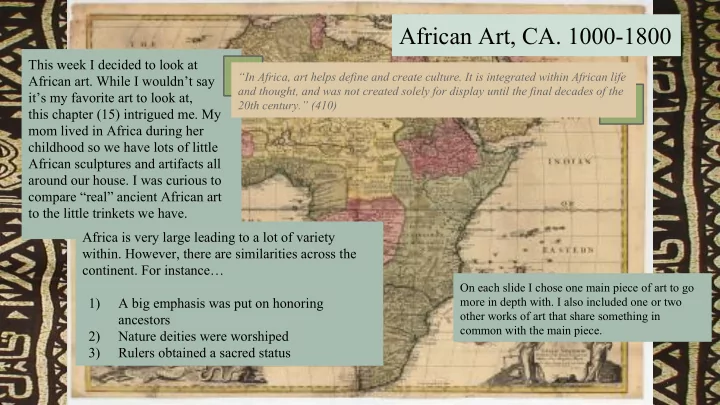
This week I decided to look at African art. While I wouldn’t say it’s my favorite art to look at, this chapter (15) intrigued me. My mom lived in Africa during her childhood so we have lots of little African sculptures and artifacts all around our house. I was curious to compare “real” ancient African art to the little trinkets we have.

“In Africa, art helps define and create culture. It is integrated within African life and thought, and was not created solely for display until the final decades of the 20th century.” (410)

Africa is very large leading to a lot of variety

  • within. However, there are similarities across the
  • continent. For instance…

1) A big emphasis was put on honoring ancestors 2) Nature deities were worshiped 3) Rulers obtained a sacred status

On each slide I chose one main piece of art to go more in depth with. I also included one or two

  • ther works of art that share something in

common with the main piece.

slide-2
SLIDE 2

King

Ife, Nigeria, 11th to 12th century, Zinc brass

Also significant is that this piece of art, along with a lot of other African art, features an abnormally large head. This was because Yoruba (a group of people in Benin and Nigeria) believed the head was “the locus of wisdom, destiny, and the essence of being.” (415) Lastly, this statue is also significant in the fact that it was made to serve in rituals based on sacred kingship. Rulers’ sacred nature was

  • ften emphasized in Africa.

Heads and the Sacred Nature of Kings in African Art

Altar to the Hand and Arm (left) and Master of the Symbolic Execution (right) also features proportions that emphasize the size of the head. Altar to the Hand and Arm also shows the sacred nature rulers possessed. The king is larger than the surrounding figures, animals are being sacrificed to him, and this altar’s purpose was to make sacrifices to the king’s power and accomplishment. This is a sculpture

  • f a king. Setting it

apart from other African art, the modeling shows idealized

  • naturalism. It is

“idealized” because there are no blemishes or signs

  • f age. It is

“naturalism” because the face is quite realistic, almost to the level

  • f portraiture.
slide-3
SLIDE 3

Running woman

rock painting, from Tassili, Algeria, 6000-4000 BCE

This piece was found in Apollo 11 cave and is

  • ne of the earliest

known works of art. It has a significant amount

  • f detail for the time

and was superimposed

  • ver other figures, a

common occurrence in African art. The woman wears ceremonial attire and also has dotted marks all up her arms, legs, and

  • torso. This sort of body

painting was very common for rituals. The Head from Lydenburg is another example of body-decoration in African art. People would purposefully create scars on their flesh to create patterns. This head displays these scarification marks. Body-Decoration in African Art

slide-4
SLIDE 4

Walls and tower, Great Enclosure, Great Zimbabwe

Zimbabwe, 14th century

Architecture and Ancestors in African Art

The Beta Medhane Alem church from Ethiopia is another example of African architecture.

The Great Zimbabwe (left and top) is an example of African architecture. It had large towers and walls (up to 30ft) and served as a royal residence. Commoners would live in the surrounding area. It also may have been a granary. The Bird with crocodile image on top of stone monolith (right) was found at an ancestral shrine of a king’s wife at Great Zimbabwe. Ancestors were very important in African

  • culture. The bird possibly symbolizes the wife’s ancestors, who were believed to

communicate between sky and earth. Another possibility is that the bird, along with crocodile, symbolizes previous rulers who were messengers between the living and the

  • dead. The crocodile’s eyes and the chevron patterns also represent different ancestors.
slide-5
SLIDE 5

Ivory belt mask of a Queen Mother

Benin, Nigeria, mid-16th century. Ivory and iron.

European Influence and Deities in African Art

This mask was worn around the waist of a Benin

  • king. It shows Idia, the mother of Oba Esigie (by

whom the mask was commissioned). Its crown is made up of Portuguese heads and

  • mudfish. Portuguese heads are also around the

neck. The mudfish symbolize the god of the sea, wealth, and creativity, Olokun. Worship of nature deities was common in African culture. The Portuguese heads reference the relationship the Benin had with Portugal. They often traded with each other. The Master of the Symbolic Execution also references Portugal. In the 15th-16th centuries, Portuguese explorers would commision Sapi (West-coast) artists. This is one of those pieces made for Portugal. It was also influenced by European design in the fact that it has a spherical container resting on a pedestal, geometric patterns, and shirts and hats that were common in Europe.