Units of Energy Unit Term Recalculation J Joule 1000 J = 1000 - - PowerPoint PPT Presentation

units of energy
SMART_READER_LITE
LIVE PREVIEW

Units of Energy Unit Term Recalculation J Joule 1000 J = 1000 - - PowerPoint PPT Presentation

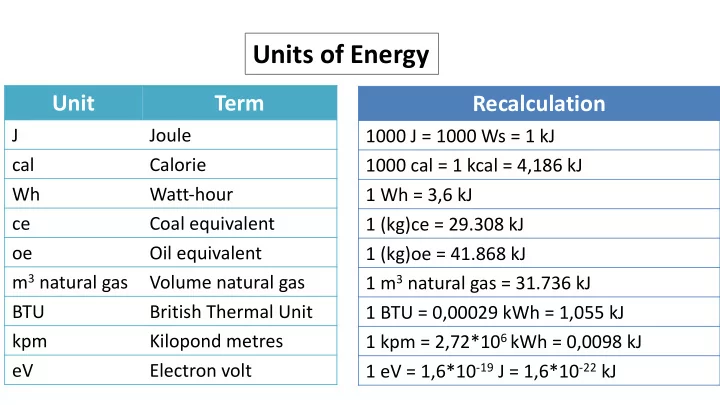
Units of Energy Unit Term Recalculation J Joule 1000 J = 1000 Ws = 1 kJ cal Calorie 1000 cal = 1 kcal = 4,186 kJ Wh Watt-hour 1 Wh = 3,6 kJ ce Coal equivalent 1 (kg)ce = 29.308 kJ oe Oil equivalent 1 (kg)oe = 41.868 kJ m 3 natural


slide-1
SLIDE 1

Unit Term

J Joule cal Calorie Wh Watt-hour ce Coal equivalent

  • e

Oil equivalent m3 natural gas Volume natural gas BTU British Thermal Unit kpm Kilopond metres eV Electron volt

Recalculation

1000 J = 1000 Ws = 1 kJ 1000 cal = 1 kcal = 4,186 kJ 1 Wh = 3,6 kJ 1 (kg)ce = 29.308 kJ 1 (kg)oe = 41.868 kJ 1 m3 natural gas = 31.736 kJ 1 BTU = 0,00029 kWh = 1,055 kJ 1 kpm = 2,72*106 kWh = 0,0098 kJ 1 eV = 1,6*10-19 J = 1,6*10-22 kJ

Units of Energy

slide-2
SLIDE 2

Final Energy Consumption (EU28, 2016)

25% 33% 42%

total 1.110.000 ktoe

Processing Industries

Non-metallic minerals Food, beverages Iron and Steel Pulp and paper Chemical Machinery

Transport

Rail Road Aviation Navigation

Services and Other

Commerical services Public services Residential Agriculture Forestry Fishing

Source: https://ec.europa.eu/eurostat/documents/3217494/9172750/KS-EN-18-001-EN-N.pdf/474c2308-002a-40cd-87b6-9364209bf936

slide-3
SLIDE 3

Share of Total Renewable Energies: 17,1 % (EU28, 2016)

Source: http://www.aebiom.org/about-bioenergy/basic-facts/what-is-the-eu-28-bioenergy-consumption/

Electrical power Heating and Cooling

29,6 % renewable power 7,1 % renewable fuel 18 % renewable heating, cooling

Transport Fuel

renewable renewable renewable

slide-4
SLIDE 4

Share of Bio-Energies: 10,2 % (EU28, 2015)

Source: http://www.aebiom.org/about-bioenergy/basic-facts/what-is-the-eu-28-bioenergy-consumption/

Electrical power Heating and Cooling

6 % bio-based power 15.300 ktoe 6 % bio-based fuel 16.400 ktoe 16 % bio-based heating, cooling 82.900 ktoe

Transport Fuel

  • ther

renewable

bio-based bio-based bio-based

slide-5
SLIDE 5

Source of Bio-Energies (EU28, 2015, incl. imports)

Source: http://www.aebiom.org/about-bioenergy/basic-facts/what-is-the-eu-28-bioenergy-consumption/

Rapeseed oil 37% Recycled

  • veg. oil

13% Palm oil 11% Animal fats 7% Soy bean oil 6% Sun flower

  • il

2% Corn 7% Wheat 7% Sugar 6% Other 4%

Biofuel

Crop, Food industry waste, Manure 75% Landfill 17% Sewage sludge 8%

Biogas

Agricultural crop Wood Woody biomass Waste Agricultural residuals Landfill Sludge

Ligno- cellulose 75% Commercial and municipal waste 7% Other 18%

Heat and Power

slide-6
SLIDE 6

EU-Biomass: Volume and Utilization (2015)

Source: https://ec.europa.eu/jrc/en/science-update/biomass-production-supply-uses-and-flows-european-union

EU- Agri- culture

EU- Forestry, Fisheries Algae Import 0% 20% 40% 60% 80% 100%

total 1000 Mt dry matter EU Biomass Supply

Food and Feed Other

0% 20% 40% 60% 80% 100%

Biomaterials Bioenergy

EU Biomass Utilization

slide-7
SLIDE 7

Sustainable Potential for Bioenergy Feedstock

Agricultural residues 35% Non-forest woody residues 28% Manure 12% Energy crop 5% Lignocellulosic waste 5% Forest small diameter stemwood 5% Forest residue 7% Sewage 2% Used cooking

  • il

1% Landfill gas 0%

Mtoe

Source: https://www.transportenvironment.org/sites/te/files/publications/Potential%20and%20Implications%20of%20using%20biomass%20BRE%202015.pdf

Sustainable Bioenergy Scenarios 2030

(Mtoe) BRE Building Research Establishment 152,2 Greenpeace energy revolution scenario for EU27 154,0 EU 2050 roadmap reference scenario 162,8 Commission 2030 impact assessment reference scenario 178,0 Commission 2030 impact assessment HGG40/EE/RES30 scenario 192,0

slide-8
SLIDE 8

Conclusions and Policy Recommendations

  • Adopt an EU-wide limit on the amount of bioenergy
  • Exclude high-risk biomass sources such as biomass from protected areas
  • Limit the extraction of agricultural and forest residues to safe levels
  • Ensure that biomass doesn‘t displace other existing uses for energy
  • Ensure affected communities‘ Free Prior and Informed Consent
  • Introduce a minimum efficiency threshold
  • Increase investments of renewable energies other than bioenergy

Source: https://www.transportenvironment.org/sites/te/files/publications/Potential%20and%20Implications%20of%20using%20biomass%20BRE%202015.pdf