
SLIDE 1
Advertising The Dream
The “Great American Desert” In The Late 19th Century
Advertising The Dream The Great American Desert In The Late 19 th - - PowerPoint PPT Presentation
Advertising The Dream The Great American Desert In The Late 19 th Century Homestead Act Of 1862 160 Acres Of Free Land If You Were A U.S. Citizens Or Had Declared Your Intention And To Become A Citizen Built A Home And
The “Great American Desert” In The Late 19th Century
If…
And
To Become A Citizen
And
Land For 5 Years
Then
Homesteader!!
Created The Union
Pacific Railroad Company
Authorized The
Construction Of A Transcontinental Railroad
Provided Millions Of
Acres In Land Grants To Railroads
Many Feared The Population Of The U.S. Was Not Sufficient To Sustain The Agricultural And Industrial Designs Of The West Railroad Men Lobbied To Create A Strategy To Pursue Immigrants And Wanted Government Support
So…
Established: The Federal Commissioner Of Immigration Created: The Superintendent Of Immigration For New York City Provided: Information To Immigrants About Opportunities
Companies To Provide Transportation
First Objective Of Promoters
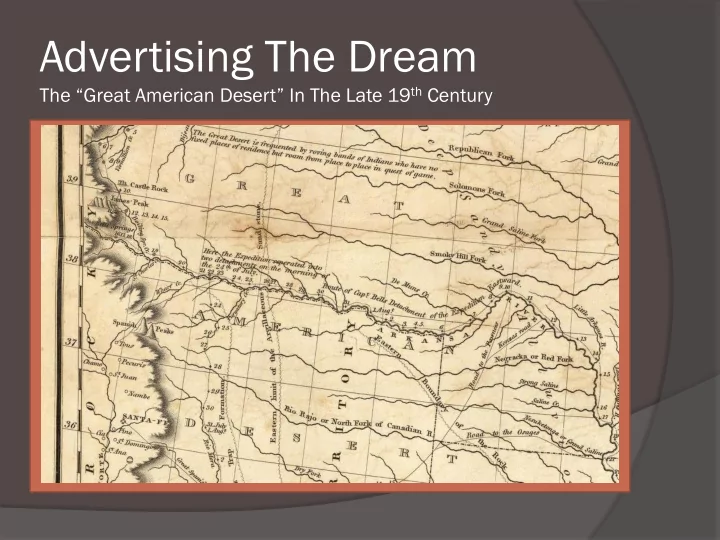
Overcome The Stigma Attached To The Geography
Coined the term
“Great American Desert” in 1820 while
funded expedition
Claimed the area was:
“almost wholly unfit for cultivation, and of course uninhabitable by people depending upon agriculture for subsistence”
Introduction To A Popular Book Titled The English Family Robinson By Captain Mayne Reid,1852
Listed the “Great American Desert” as
Reminded By A Soft Gentle Breeze From The South, That Winter Is Gone”
Cool, Refreshing Breeze, Which Makes Even The Hottest Days And Nights Pleasant And Delightful”
Into The Air That Would Then Fall Back To Earth As Rain
Created Air Currents, Resulting In Electrical Atmospheric Conditions That Produced Rain
“Immigration has almost
ceased, and the present unsettled condition of Europe, tending to a general war on that continent, should invite, on our part, the adoption of the most liberal policy, which will induce the immigrant to seek a home here.”
Congressman John Potter, Head of the Committee for Public Lands, 1862.
“ „Serfs’ were beaten both at work and at home for the merest
Every farmer had first to do his dues at the manor house, whether with his team or on foot. Only then could he work his
needs at home was of any use. If one did not appear as
busy cooking he would throw a pail of water on the fire, or in winter would carry off the windows or the doors.”
Excerpt: Jan Slomka, From Serfdom to Self-Government: Memoirs of a Polish Village Mayor, 1842-1927 trans. William John Rose, (London: Minerva Publishing Co.), 1941.
Alsace-Lorraine after annexation in Franco-Prussian War
English Germans Scandinavians
Missouri, Kansas, and Texas Railroad (English and Scottish) Santa Fe Railroad (Germans) Great Northern Railroad (Scandinavians)
The 8th Wonder Of The World Transatlantic Telegraph Completed In 1866
Railroads Often Employed “Trusted” Individuals Such As Clergy gy, Doctor
Profess ssio iona nals From The Country They Were Targeting To Write About The Opportunities Available In America
Population Data Suggests A Large Influx Of
Immigrants To The Great Plains
Foreign Born Population 1860 Foreign Born Population 1880
5000 10000 15000 20000 25000
Dakotas: Foreign Born 34% Wyoming: Foreign Born 39% Montana: Foreign Born 39%
1860 Total Poulation 1870 Total Population Foreign Born Population In 1870
50000 100000 150000 200000 250000 300000 350000 400000 Nebraska: Foreign Born 25% Kansas: Foreign Born 13%
Chart Title
1860 Total Population 1870 Total Population Foreign Born Population in 1870
Native Born 402,481 Foreign Born 94,528 1870
And Transatlantic Telegraph
Support
European Countries
Marketing To Specific Groups
Focused Advertising On Groups Most Likely To Come To The United States, Spending Large Amounts Of Money Restricted Land Ownership, Social, Economic, And Political Barriers Ability To Communicate Across Long Distances The Homestead Act, Pacific Railway Act, An Act To Encourage Immigration
Annual Budgets Dedicated To Marketing In Foreign Countries Union Pacific (1871) $300,000 (equivalent to over $5.4 million today) The Burlington Railroad (1872) $500,000 (equivalent to over $9 million today)