Advances in Allergy/Immunology 2014 Nothing to declare Katherine - - PDF document

advances in allergy immunology 2014
SMART_READER_LITE
LIVE PREVIEW

Advances in Allergy/Immunology 2014 Nothing to declare Katherine - - PDF document

10/14/2014 Advances in Allergy/Immunology 2014 Nothing to declare Katherine Gundling, MD, FACP Professor University of California, San Francisco Manifestations of Allergy! Order of Presentation Itching of the eyes, nose, Rhinitis throat


slide-1
SLIDE 1

10/14/2014 1

Advances in Allergy/Immunology 2014

Katherine Gundling, MD, FACP Professor University of California, San Francisco

Nothing to declare

Order of Presentation

Respiratory allergy update Influenza Vaccination Anti‐IgE for urticaria

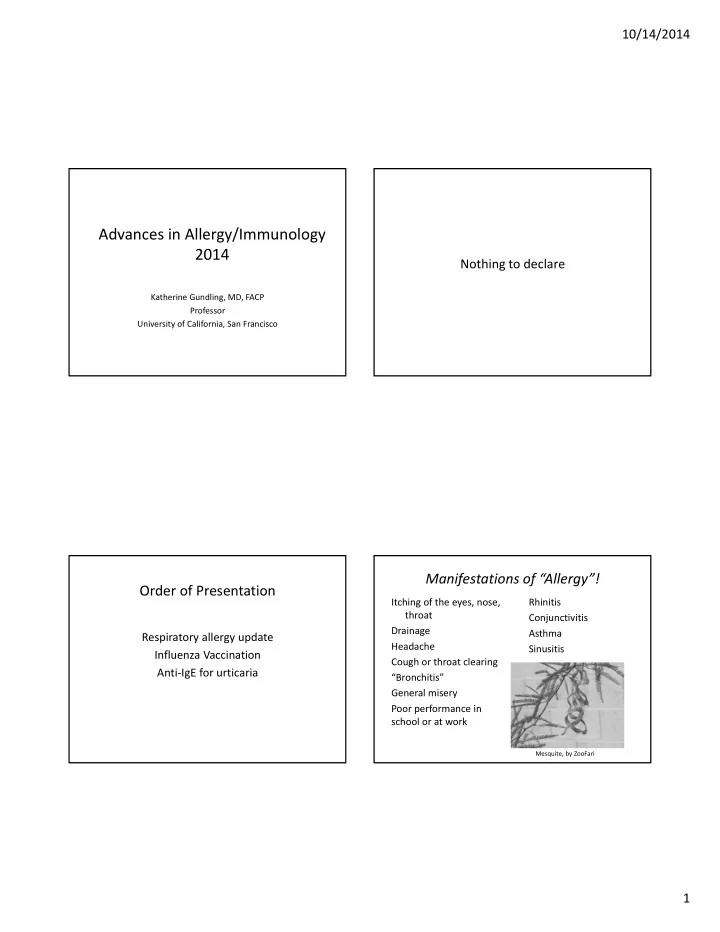
Manifestations of “Allergy”!

Rhinitis Conjunctivitis Asthma Sinusitis Itching of the eyes, nose, throat Drainage Headache Cough or throat clearing “Bronchitis” General misery Poor performance in school or at work

Mesquite, by ZooFari

slide-2
SLIDE 2

10/14/2014 2 Allergic Rhinitis/Asthma/Conjunctivitis

Inhaled Allergens Categories of Management options:

  • 1. Maximal preventive measures
  • 2. Treatment of symptoms
  • 3. Retraining of the immune system

Allergic Rhinitis/Asthma/Conjunctivitis

Inhaled Allergens Categories of Management options:

  • 1. Maximal preventive measures
  • 2. Treatment of symptoms
  • 3. Retraining of the immune system
  • 2. Treatment of Symptoms

Saline (rarely, budesonide) irrigation Oral antihistamines (multiple) Nasal sprays

Corticosteroids (multiple) Antihistamines (azelastine) Decongestants (oxymetazoline) Mast cell stabilizers (cromolyn sodium) Anticholinergics (ipratropium) Clinical pearl: best for treating DRAINAGE

  • 2. Treatment of Symptoms

Leukotriene inhibitors

Receptor blockers (montelukast, zafirlukast) Production inhibitors (zileuton)

Inhaled agents

Corticosteroids (multiple) Corticosteroid/LABA (multiple) Anticholinergics (ipratropium/tiotropium) Mast cell stabilizers (cromolyn sodium)

Various OTC agents and remedies Oral corticosteroids/antibiotics as a last resort

slide-3
SLIDE 3

10/14/2014 3 New developments in OTC medication status

The first nasal corticosteroid to go OTC: Triamcinolone acetonide (Nasacort) Clinical Pearl: Correct technique for use of nasal spray ‐‐‐‐‐‐‐‐‐‐‐‐‐‐‐‐‐‐‐‐‐‐‐‐‐‐‐‐‐‐‐‐‐‐‐‐‐‐‐‐‐‐‐‐‐‐‐‐‐‐‐‐‐‐‐‐‐‐‐‐‐‐‐‐‐‐‐ Ketotifen eye drops are now OTC (Zaditor, Alaway)

  • antihistamine/mast cell stabilizer

‐‐‐‐‐‐‐‐‐‐‐‐‐‐‐‐‐‐‐‐‐‐‐‐‐‐‐‐‐‐‐‐‐‐‐‐‐‐‐‐‐‐‐‐‐‐‐‐‐‐‐‐‐‐‐‐‐‐‐‐‐‐ Montelukast (Singulair) is NOT going OTC any time soon.

What to do if your patient’s quality of life is still not satisfactory? Allergic Rhinitis/Asthma/Conjunctivitis

Inhaled Allergens Categories of Management options:

  • 1. Maximal preventive measures
  • 2. Treatment of symptoms
  • 3. Retraining of the immune system

Testing for specific inhalant allergens

Serum specific IgE testing (examples)

  • Dermatophagoides farinae; Dermatophagoides

pteronyssinus (dust mites)

  • Cat
  • Cedar/cypress
  • Oak, birch, sycamore, elm
  • Rye grass
  • Ragweed, English plantain
  • Alternaria
  • Aspergillus
slide-4
SLIDE 4

10/14/2014 4 Testing for Specific Allergens

Prick skin testing/intradermal testing

Photo by: Gundling

  • 1. Maximal Preventive Measures

Personalized counseling avoidance measures: Dust mite cleaning Humidity control Air filtration improvement (HEPA filters) Pollen/mold spore count awareness Mold remediation (indoor and out) Others

Which allergen is most associated with death due to severe asthma?

  • A. Alternaria
  • B. Cat
  • C. Dust mites
  • D. Rye grass

Which allergen is most associated with death due to severe asthma?

  • A. Alternaria
  • B. Cat
  • C. Dust mites
  • D. Rye grass

cdc.gov

slide-5
SLIDE 5

10/14/2014 5 Allergic Rhinitis/Asthma/Conjunctivitis

Inhaled Allergens Categories of Management options:

  • 1. Maximal preventive measures
  • 2. Treatment of symptoms
  • 3. Retraining of the immune system
  • 3. Retraining of the Immune System

Allergen Immunotherapy‐ subcutaneous “SCIT” Generally works very well Very time consuming Requires injections every 1‐4 weeks Associated risks

New kid on the block! Oral or “sublingual” allergen immunotherapy

Sublingual Immunotherapy

SLIT‐tablets

– Rapidly dissolving tablet held under the tongue until dissolved – Self‐administered, once daily

SLIT‐drops

– Extract of allergen held under the tongue, then swallowed – Self‐administered, once daily

2014 – New FDA Approvals

Five grass sublingual tablet

– Oralair by Stallergenes (approved for ages 10‐65)

Timothy grass tablet

– Grastek by Merck (approved for ages 5‐65)

Short ragweed tablet

– Ragwitek by Merck (approved for ages 18‐65)

(Existing off‐label use of some drops for the past several years)

slide-6
SLIDE 6

10/14/2014 6 Advantages of SLIT

Can be self‐administered at home (for the most part) Probably safer than SCIT

Disadvantages of SLIT

Limited kinds of antigens (allergens)

May not work quite as well as SCIT Long‐term benefit of SCIT is better known

Mechanism of Action

Picture by K Gundling Public domain: NCI

Mechanism of Action

Gut‐associated lymphoid tissue (GALT)

Tonsils/lymphoid tissue of the posterior pharynx Peyer’s patches throughout the small intestine

Lymphoid organs (mesenteric lymph nodes, spleen and liver) Gut mucosal immune system TRIES to tolerate non‐pathogens.

Mechanism of Action

Changes to both humoral and cellular immunity

Antigen uptake by mucosal dendritic cells Presentation to T cells in the draining lymph nodes

Activation of T regulatory cells

Upregulation of IL‐10 Increasing levels of specific IgG4

Downregulation of mucosal mast cells/effector cells Blunting of seasonal increases of specific IgE Increased CD8+ T cells

slide-7
SLIDE 7

10/14/2014 7 Adverse effects/contraindications of SLIT

  • >/= 5% experience itching/pain of the oropharynx
  • Cough
  • Risk of systemic reactions
  • Not for pts with severe, uncontrolled asthma
  • Prescribe epinephrine and train in appropriate use

Approved for use in Europe in 2008 and authorized in 31 countries More than 20 million doses have been given to more than 110,000 pts. ‐‐‐‐‐‐‐‐‐‐‐‐‐‐‐‐‐‐‐‐‐‐‐‐‐‐‐‐‐‐‐‐‐‐‐‐‐‐‐‐‐‐‐‐‐‐‐‐‐‐‐‐‐‐‐‐‐‐‐‐‐‐‐‐‐‐‐‐‐‐‐‐‐‐‐

Influenza vaccination

“Doctor, I am allergic to eggs. Can I receive the flu vaccine?”

  • A. Just give the vaccine
  • B. Allergy skin test to hen’s egg
  • C. Allergy skin test to the vaccine
  • D. Give a test dose
  • E. Avoid completely

Influenza vaccination

“Doctor, I am allergic to eggs. Can I receive the flu vaccine?”

  • A. Just give the vaccine
  • B. Allergy skin test to hen’s egg
  • C. Allergy skin test to the vaccine
  • D. Give a test dose
  • E. Avoid completely

But wait……..

slide-8
SLIDE 8

10/14/2014 8

What is the best approach to administration of the influenza vaccine in patients who are allergic to hen’s egg?

Influenza

294,128 hospitalizations 23,609 deaths

Much of this morbidity and mortality can be prevented with vaccination.

Estimates of deaths associated with seasonal influenza—US, 1976‐2007. MMWR 2010; 59:1057‐62. Thompson, et al. Influenza associated hospitalizations in the US. JAMA 2004;292:1333‐ 40

Egg Allergy

Prevalence 0.5‐2% in small children; lower in adults 5‐20% of US citizens receive the influenza vaccination‐ (about 15‐60 million vaccines annually)

Photo by Andrei

Ovalbumin content of vaccines

(Inactivated, trivalent)

Name Manufacturer Content Afluria CSL Limited <1.0 mcg/0.5mL Fluarix GlaxoSmithKline 0.05 Flucelvax Novartis Vaccines Not in package insert FluLaval ID Biomedical Corp <0.3 Fluvirin Novartis Vaccines <1.0 Fluzone Sanofi Pasteur Not in package insert

slide-9
SLIDE 9

10/14/2014 9 Vaccination reactions in egg allergic patients

7 published studies 1600 patients with egg allergy

0‐6.3% involve reactions confined to the skin 0‐4.8% involve mild respiratory or GI symptoms No hypotension No need for epinephrine

3,640 patients with reported egg allergy in an adjuvanted H1N1 vaccine:

– 1.2% had skin reactions – 0.7% had respiratory reactions, including 2 that were given epinephrine (authors concluded these reactions were not anaphylaxis)

Studies with non egg‐allergic controls:

Similar rates of reactions

185 patients with a history of anaphylaxis or severe reaction to egg ingestion, vaccinated with TIV:

– 119 received a divided dose – 66 received a single dose – No serious reactions

Howe LE, et al. Safe administration of seasonal influenza vaccine to children with egg allergy of all severities. Ann Allergy Asthma Immunol 2011; 106:446‐7 Webb L, et al. Single‐dose influenza vaccination of patients with egg allergy in a multicenter study. JACI 2011; 128:218‐9

As of 2 years ago… Recommendations for Influenza Vaccination in the Egg Allergic Patient : Type of reaction…

HIVES ONLY:

  • k to administer vaccine in a primary care setting

POSSIBLE SYSTEMIC REACTION: refer to A/I office for work‐up of the egg allergy administration in a setting prepared for anaphylaxis

slide-10
SLIDE 10

10/14/2014 10

Fall armyworm Public domain‐ US govt

As of 11 months ago….. “Flublok”

Recombinant hemagglutinin proteins produced in an insect cell line.

“Flucelvax”

Prepared from virus propagated in cell culture

These vaccines use no egg protein

The CDC’s revised position: The trivalent influenza vaccination is contraindicated in patients with, “History of severe allergic reaction to any component of the vaccine, including egg protein, or after a previous dose of any influenza vaccine.” CDC recommendation this past year: RIV for patients with egg allergy

http://www.cdc.gov/mmwr/preview/mmwrhtml/rr6207a1. htm?s_cid=rr6207a1_w#Fig2

The main advantage of the RIV is that it can be PRODUCED QUICKLY

slide-11
SLIDE 11

10/14/2014 11 Most recently…..

More data from the AAAAI Practice Parameters: …supports the safe use of TIV in egg allergic individuals. “For egg‐allergic patients 18 years of age and

  • lder, either egg‐based or egg‐free influenza

vaccination can be used.” “Special precautions beyond those used for any vaccine are not needed.”

Updated Practice Parameters for the

American Academy of Allergy, Asthma and Immunology ‐www.aaaai.org/practice‐resources/Statements‐and‐ Practice‐Parameters/Practice‐parameters‐and‐other‐ guidelines‐page.aspx ‐Additional Evidence‐Based Guidelines and Resources ‐“Update on Egg Allergy and Influenza Vaccine” ‐Ann Allergy Asthma Immunol 111 (2013) 301‐302 ‐‐‐‐‐‐‐‐‐‐‐‐‐‐‐‐‐‐‐‐‐‐‐‐‐‐‐‐‐‐‐‐‐‐‐‐‐‐‐‐‐‐‐‐‐‐‐‐‐‐‐‐‐‐‐‐‐‐‐‐‐‐‐‐‐‐‐‐‐‐‐

Image: K. Gundling

Urticaria Acute urticaria is frequently due to allergy Chronic urticaria (>6 weeks) is very seldom due to allergy. Think “autoimmune” etiology

slide-12
SLIDE 12

10/14/2014 12

Mast cell Degranulation

Image: Wikipedia

Mechanism of chronic urticaria:

Not fully elucidated, but IgG antibodies probably trigger degranulation of mast cells and basophils by attaching to:

  • IgE
  • Fc epsilon RI (cell receptor)
  • Fc epsilon RII (cell receptor)

Kapan, AP. Chronic urticaria: pathogenesis and treatment. J All Clin Immunol 2004; 114(3):465‐74

News Flash!

  • Omalizumab (Xolair), previously approved for

for severe asthma, is now approved for use in chronic urticaria

  • Significant improvement after just 1‐2 doses in

60‐70% of patients.

Summary

  • The first nasal corticosteroid spray has gone
  • tc.
  • Oral/sublingual allergen IT is now approved

for use in the US.

  • Two new influenza vaccines are made without

eggs.

  • Chronic urticaria can be well‐treated with
  • malizumab