Allergy and Immunology Pearls for Clinical Practice No discussion of - - PDF document

allergy and immunology
SMART_READER_LITE
LIVE PREVIEW

Allergy and Immunology Pearls for Clinical Practice No discussion of - - PDF document

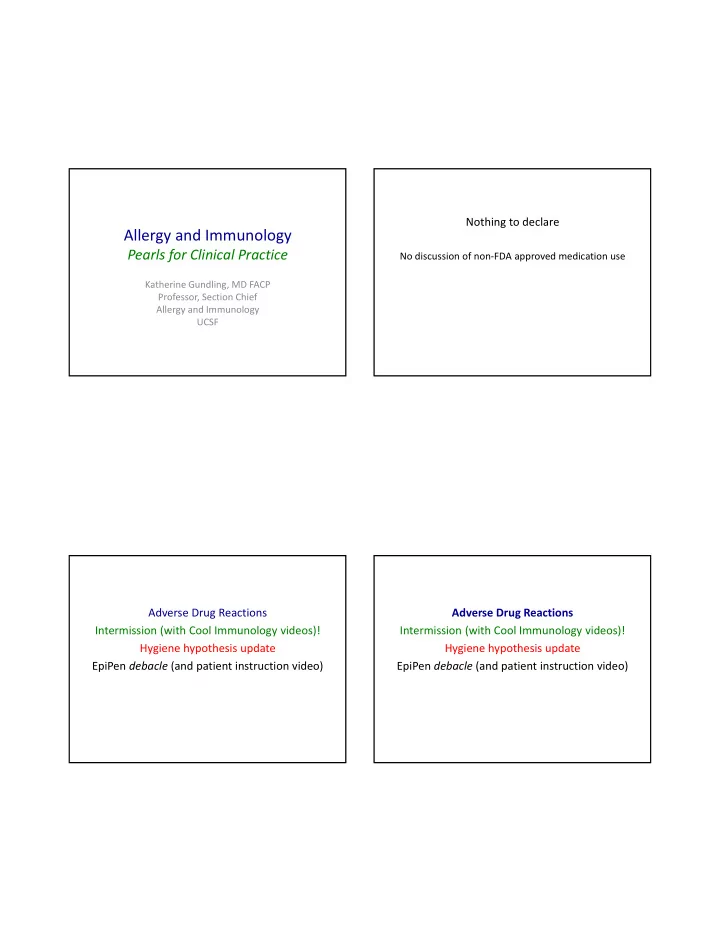
Nothing to declare Allergy and Immunology Pearls for Clinical Practice No discussion of non FDA approved medication use Katherine Gundling, MD FACP Professor, Section Chief Allergy and Immunology UCSF Adverse Drug Reactions Adverse Drug


slide-1
SLIDE 1

Allergy and Immunology

Pearls for Clinical Practice

Katherine Gundling, MD FACP Professor, Section Chief Allergy and Immunology UCSF

Nothing to declare

No discussion of non‐FDA approved medication use

Adverse Drug Reactions Intermission (with Cool Immunology videos)! Hygiene hypothesis update EpiPen debacle (and patient instruction video) Adverse Drug Reactions Intermission (with Cool Immunology videos)! Hygiene hypothesis update EpiPen debacle (and patient instruction video)

slide-2
SLIDE 2

Adverse Drug Reactions are more common in women than men

Ann Allergy Asthma Immunol. 2013 Dec;111(6):452‐7

“Adverse drug reaction” (ADR) = any unwanted reaction to a medication “Drug allergy” = ADR that results from a specific immunologic response to a medication

The true incidence of Adverse Drug Reactions is unknown: ADRs: 3‐6% of hospital admissions 10‐15% of hospitalized patients Drug allergy 1‐2% of hospital admissions 3‐5% of hospitalized patients

Br J Clin Pharmacol 2011; 71:684‐700

slide-3
SLIDE 3

Perioperative Anaphylaxis

Reactions can be severe or fatal The incidence of perioperative anaphylaxis is the same in boys and girls but more common in women than men.

Perioperative Anaphylaxis

Exposure to many agents occurs during a short time period:

– Antibiotics – Neuromuscular blocking agents – Propofol – Latex – Chlorhexidine – Dyes – Opioids – Blood transfusions – Benzodiazepines – Others

Perioperative Anaphylaxis

Exposure to many agents occurs during a short time period:

– Antibiotics – Neuromuscular blocking agents – Propofol – Latex – Chlorhexidine – Dyes – Opioids – Blood transfusions – Benzodiazepines – Others “3/4 of anaphylactic reactions to neuromuscular blocking agents occur in women, …..

suggesting that cross‐reactions with ammonium compounds in makeup and other personal care products could be responsible.” “Skin testing is unlikely to be useful in selecting the safest alternative for subsequent surgery because of the unknown predictive value.”

Anaphylaxis Practice Parameters Lieberman P et al. Ann Allergy Immunol 115 (2015) 341‐384

slide-4
SLIDE 4

IgE mediated reaction “Immediate (Type 1) hypersensitivity” Or…..Non‐IgE mediated reaction “Direct Mast Cell Degranulation”

Perioperative Anaphylaxis

  • Exposure to many agents occurs during a short

time period:

– Antibiotics – Neuromuscular blocking agents – Propofol – Latex – Chlorhexidine – Dyes – Opioids – Blood transfusions

Commercial products that contain chlorhexidine (to name a few):

  • Antiseptic mouthwashes
  • Antiseptic sore throat lozenges and sprays
  • Antiseptic toothpastes
  • Topical eczema creams
  • Acne creams
  • Antiseptic powders such as athletes foot powder
  • Antiseptic creams
  • Antiseptic wipes
slide-5
SLIDE 5

More chlorhexidine containing products

  • Antiseptic dressings
  • Skin washes/cleansers
  • Topical disinfectants
  • Bladder washouts
  • Eye drops
  • Contact lens solution
  • Anesthetic gels for catheterization
  • Some creams and sprays (such as nasal sprays)

include chlorhexidine as a preservative

  • Some sunscreens
  • Central venous catheters

More chlorhexidine containing products

  • Antiseptic dressings
  • Skin washes/cleansers
  • Topical disinfectants
  • Bladder washouts
  • Eye drops
  • Contact lens solution
  • Anesthetic gels for catheterization
  • Some creams and sprays (such as nasal sprays)

include chlorhexidine as a preservative

  • Some sunscreens
  • Central venous catheters

Chlorhexidine allergy

If your patient develops a rash upon exposure to chlorhexidine, consider avoiding its use during the perioperative period. ****Chlorhexidine is embedded in some central line catheters**** The predictive value of skin testing to chlorhexidine is unknown

No matter what the cause of perioperative anaphylaxis, obtain a serum tryptase level:

  • within 1‐2 hours of the event, and
  • at baseline (a couple of weeks later ok)

Elevated acute tryptase levels supports mast cell degranulation as a proximate cause of the event Elevated baseline tryptase supports an underlying mast cell activation disorder

Clinical Pearl

slide-6
SLIDE 6

A patient with a previous allergic reaction to which agent is most likely to experience a drug allergic reaction to furosemide?

  • A. Acetazolamide
  • B. Atenolol
  • C. Penicillin
  • D. Trimethoprim‐sulfamethoxazole

Reactions to sulfonamide non‐antibiotics are likely due to predispostion to allergic reactions, not due to cross‐reactivity with sulfonamide antibiotics!

On the sulfonamide molecule it is the arylamine component that is most allergenic, hence the vast majority of patients who react to arylamine sulfonamides will not react to non‐arylamine sulfonamides.

Partial list of sulfonamide medications

Arylamine Sulfonamides – Sulfamethoxazole – Sulfadiazine – Sulfacetamide – Sulfasalazine

  • Sulfonamide antiretrovirals

– Amprenavir – Fosampranavir Non‐arylamine Sulfonamides Carbonic anhydrase inhibitors Sulfonylureas Loop diuretics Thiazide diuretics Anti‐inflammatory Others

From the package insert for furosemide, noted 11/1/16: “patients allergic to sulfonamides may also be allergic to furosemide.” Updated recommendations: “The weight of evidence suggests that withholding non‐antibacterial sulfonamides from patients with prior reactions to antibacterial sulfonamides or

  • ther non‐antibacterial sulfonamides is not

clinically justified.”

N Engl J Med 349;17 Am J Health‐Syst Pharm 70:1483‐94

slide-7
SLIDE 7

The Drug Allergy Practice Parameters from the AAAAI state:

“There is no evidence to suggest allergic cross‐ reactivity between sulfonamide antibiotics and nonantibiotic sulfonamides.”

AAAAI.org Drug Allergy: An Updated Practice Paramenter

Clinical Pearls

The term “sulfa” allergy should be dropped!

  • Endeavor to determine and report the exact medication

to which a reaction occurred.

  • When that information is not available, inquire as to the

condition that was being treated, and document the information.

Hot off the presses… The risk of adverse pregnancy outcomes after first trimester exposure to H1 antihistamines: A systematic review and meta‐analysis. Offers reassurance about the use of H1 antihistamines during early pregnancy.

Etwel F, Faught L et al. Drug Safety Nov 2016

Intermission

2 cool videos of the immune system in action!

slide-8
SLIDE 8

NIH video Cytotoxic T cells on Patrol

How can one “boost” the immune system?

Everything Grandma told you is true….

Get a good night’s sleep Eat a variety of foods, including fruits and vegetables Moderate (not severe or couch potato type) exercise Laugh with your friends Listen to some good music

Adverse Drug Reactions Intermission (with Cool Immunology videos)! Hygiene hypothesis update EpiPen debacle (and patient instruction video)

slide-9
SLIDE 9

Which of the following early exposures is most associated with the prevention of atopic disease (atopic dermatitis, food allergy, allergic rhinitis, asthma)?

  • A. Barn animals
  • B. An older brother
  • C. A household dog
  • D. Dust mites in the pillow

Answer: A Barn animals

Early exposure to barn animals is strongly associated with less atopy Exposure to pets from infancy might also be helpful, as are older siblings Exposure to dust mites is associated with increased atopic conditions

Von Mutius E. Proc Am Thorac Soc 2007; Vol 4 pp 212-216

Farming, Bavarian Style

Current Opinion Immunology 2016,42:41‐47

slide-10
SLIDE 10

Prevention of atopic conditions

Clear:

  • Infants should be breast fed
  • Early exposure to animals (especially barn

animals) and older siblings is preventative

  • Allergen immunotherapy can prevent the

development of new sensitization and asthma Gathering data: – Influence of food/microbiome of the gut and airways – Role of early exposures to pollution, infections, medications – Whether an “at risk” infant should be exposed to small amounts of common food allergens (will have better answers next year…)

JACI 122:114‐8

Adverse Drug Reactions Intermission (with Cool Immunology videos)! Hygiene hypothesis EpiPen debacle (and patient instruction video)

https://www.youtube.com/watch?v=i6K2_kVmr3E

slide-11
SLIDE 11