Advanced Camera Control From Introduction to: M. Haigh-Hutchinson, - - PDF document

advanced camera control
SMART_READER_LITE
LIVE PREVIEW

Advanced Camera Control From Introduction to: M. Haigh-Hutchinson, - - PDF document

3/31/2016 Note: if you dont notice camera, then it is working well! An ideal virtual camera system, regardless of genre, is notable by the lack of attention given to it by the viewer Advanced Camera Control From Introduction to: M.


slide-1
SLIDE 1

3/31/2016 1

Advanced Camera Control

IMGD 4000

Original source: Phil Wilkins (Sony Playstation Entertainment). “Designing and Implementing a Dynamic Camera System”, Game Developer's Conference, San Francisco, CA, USA, 2008.

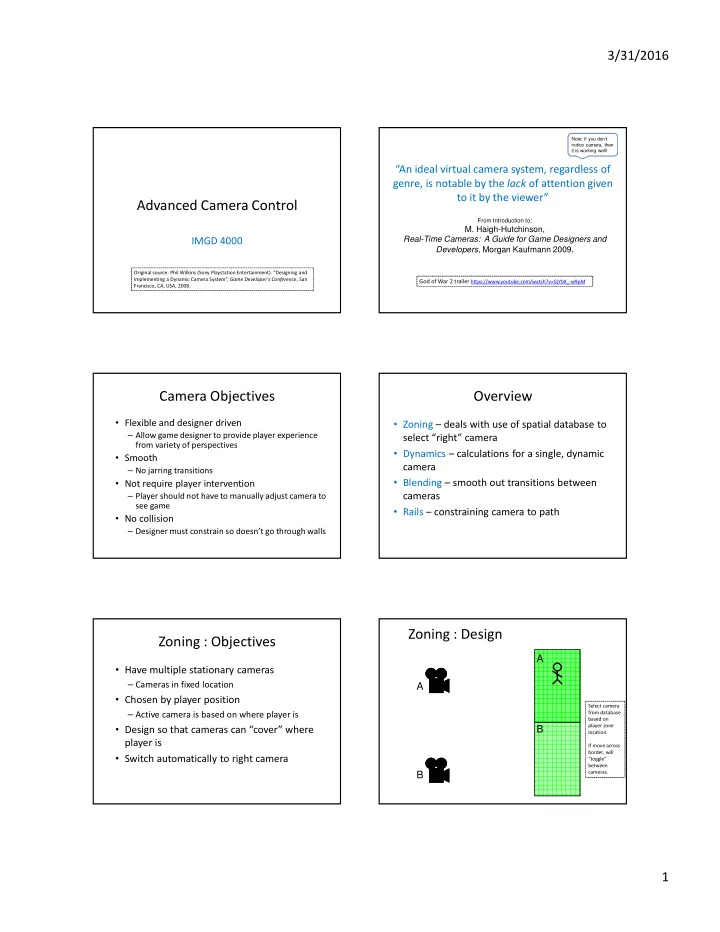
“An ideal virtual camera system, regardless of genre, is notable by the lack of attention given to it by the viewer”

From Introduction to:

  • M. Haigh-Hutchinson,

Real-Time Cameras: A Guide for Game Designers and Developers, Morgan Kaufmann 2009.

God of War 2 trailer https://www.youtube.com/watch?v=GjYbK_-w9pM

Note: if you don’t notice camera, then it is working well!

Camera Objectives

  • Flexible and designer driven

– Allow game designer to provide player experience from variety of perspectives

  • Smooth

– No jarring transitions

  • Not require player intervention

– Player should not have to manually adjust camera to see game

  • No collision

– Designer must constrain so doesn’t go through walls

Overview

  • Zoning – deals with use of spatial database to

select “right” camera

  • Dynamics – calculations for a single, dynamic

camera

  • Blending – smooth out transitions between

cameras

  • Rails – constraining camera to path

Zoning : Objectives

  • Have multiple stationary cameras

– Cameras in fixed location

  • Chosen by player position

– Active camera is based on where player is

  • Design so that cameras can “cover” where

player is

  • Switch automatically to right camera

A B A B

Zoning : Design

Select camera from database based on player zone location. If move across border, will “toggle” between cameras.

slide-2
SLIDE 2

3/31/2016 2

Zoning : Design

A A B B

Non-

  • verlapping

zones. Switch to camera when player ENTERS zone. Provides hysteresis. But may not “cover” all areas well

Zoning : Design

A A B B

Alternative is

  • verlapping

zones . When enter

  • verlap, switch

to new camera

Camera B Camera C Camera A

A C B

Zoning : Implementation

Each frame, query spatial DB and get cameras. Assume unordered (don’t want assumption about underlying db)

Camera C Camera A

A C B A B C

Zoning : Implementation

If simply switch to new camera, will toggle between A and C every frame.

  • Submission List

– List of all cameras that were submitted last frame – Used to distinguish newly submitted cameras from old ones – New cameras inserted at top

  • So, effectively sorted by age

Zoning : Implementation

B C A

A C B A B C Query Result Submission List

A C B

Zoning : Implementation

  • In this example,

player moves from A, to C, to B.

  • If then to just C, top

entry would change.

slide-3
SLIDE 3

3/31/2016 3

Camera A Priority 1 Camera B Priority 2 A B

Zoning : Implementation

Provide priority for more important (higher priority) camera when

  • verlapped.

B C A

A C B A B C Query Result Submission List

A C B

Priority 2 2 1

Zoning : Implementation Zoning Implementation

  • Submission List (with priorities)

– Insert and delete entries to match query results – Unless query result was empty – Sorted by priority – Then by age – Top entry is active camera

Outline

  • Zoning

(done)

  • Dynamics

(next)

  • Blending
  • Rails

Dynamics : Objectives

  • Camera impacts 3 properties of avatar as it

appears on screen

– Position – where camera is focused impacts where on screen avatar appears (e.g., center? bottom right?) – Size – how far away camera is impacts how big avatar appears (e.g., takes up full screen, takes up tiny portion) – Angle – angle of camera from avatar orientation impacts what representation avatar has (e.g., profile? top-down?)

Dynamics : Design

Define “safe zone” (rectangle)

  • n screen where player

avatar will be.

  • Make these resolution

independent (represent screen, not pixels) Note, can be “point” if player always there. When avatar oustide of zone, move camera. How?

slide-4
SLIDE 4

3/31/2016 4

Dynamics : Design

  • Player position and viewing angle depend upon angle between

camera and player

  • Specify angle viewing player from as fixed value
  • But result will be camera moves around lots (background

moves) can be disconcerting

Dynamics : Design

  • Instead, calculate angle relative

camera location (black lines)

  • Only move camera if angle greater

than constraints (blue lines) Camera will move less

  • This is like “high water mark” and

“low water mark” in algorithms

5 metres

Dynamics : Design

Control size of player on screen, by controlling distance from camera to player. Similar to angle, often don’t want as fixed value (see next slide).

Minimum Maximum

Dynamics : Design

Camera never gets too far from, or too close to, player. Allow designer to set range of valid distances for camera.

Dynamics : Implementation

Target Position Distance to Target Plane Angle to Target Angle to World

SUMMARY: Let designer control: position of player on screen angle looking (orientation of camera) size (distance from camera)

Outline

  • Zoning

(done)

  • Dynamics

(done)

  • Blending

(next)

  • Rails
slide-5
SLIDE 5

3/31/2016 5

Blending : Overview

  • Blending – smooth out transitions between

cameras

  • Three aspects:

– Timers – track and update each blend – Ease – controls the smoothness of blend – Blend Space – defines what a blend between two cameras does

Timers : Design

A A B B

When start new camera, don’t immediately cut to it, but blend into it over fixed period of time.

Timers : Design

A A B B A+B

  • Don’t actually blend

pixels

  • Rather, create third

camera from varying proportions of other two cameras

  • Moves from first

camera to second

  • Position and
  • rientation

determined by blend

  • f two cameras
  • Driven by timer

(started when new camera activated)

Timers : Implementation

  • Timer List

– Entry is camera fading in – New timers inserted at top – Camera can have multiple timers in list

  • This happens if player moves quickly between

cameras

– First-In, First-Out (FIFO) – When timer completes, all timers below it are removed B

A C B A B C

Submission List

C A

Timer List

C 1/3 A 1/1 B 2/4

Timers : Implementation

In this example, player moves from A, to C, to B and back to C.

?

Zone A: list empty, start camera A Zone C: starts new timer, camera is blend of A and C Zone B: start new timer, camera is blend of A,B and C Camera C’s timer done, so drop camera A Back to Zone B: start new C timer top (C in list twice) Camera B’s timer completes, drop C timer below Camera C’s timer completes, drop B below At C 100%

C 1/3

Timer List

B 3/4 C 3/3 3/4 3/4 B + 1/4 C 1/3 C + 2/3 (3/4 B + 1/4 C) 1/3 1/2 B + 1/2 C

Timers : Implementation

Start at bottom (oldest). Blend in new camera (higher

  • n list) based on timer fraction.
slide-6
SLIDE 6

3/31/2016 6

Ease : Design

  • Using as-is, get simple linear blend

(see sharp corners in picture)

  • When use to blend cameras, see

jerk when starts to move and stops Can be ugly

  • Want what animators call “ease”

Feed linear blend into spline

Ease : Implementation

  • Hermite Spline

– Used to smoothly interpolate between key- points (e.g., camera A to camera B)

  • Fixed endpoints at P1 & P2
  • Controllable tangents
  • ease = [0 , 1]

– 0 means no ease (linear) – 1 means full ease

  • Ease-in from P1 tangent, and Ease-out from

P2 tangent

http://cubic.org/docs/hermite.htm

B 3/4 C 3/3 3/4 Ease (3/4, ease, C.easeIn, B.easeOut)

Ease : Implementation

Apply Ease() when calculate blend factor between two cameras ease from 0 to 1 easeIn from old camera (C) easeOut from new camera (B)

Blend Space : Design

If blend positions along straight line, will get “zoom” effect. Instead, blend along arc, fixed distance from player.

Outline

  • Zoning

(done)

  • Dynamics

(done)

  • Blending

(done)

  • Rails

(next)

Rails : Objectives

Want camera on a track idea borrowed from film industry. Construct rails, put camera on little cart (a “Dolly”).

slide-7
SLIDE 7

3/31/2016 7

Rails : Design

  • Rail can be curve (e.g., spline – numeric

function compose of polynomials)

  • Dolly is point on spline

Rails : Design

Only move Dolly by enough to keep player within constraints defined by camera. Player is free to move within constraints, but when Player moves outside, Dolly moves to compensate as best it can.

2.0 2.0

Dolly Position

Rails : Implementation

  • Player is 2 units outside, so

weight at p0 is 2.

  • Move dolly to p1, weight is 0

since inside constraints.

  • Between p1 and p2, weight

stays 0.

  • At p3, again 2 units outside,

weight is 2. Use constraints to calculate weight at given point on spline. Using weighting function, find nearest minima to previous position of Dolly. Dolly Position

Rails : Implementation

  • Guess which direction

player moved

  • Take step in that direction
  • If weight at new position is

lower, then try another step.

  • If weight is higher, turn

around and go back ½ as much

  • If below certain threshold,

then stop.

  • In general, may be

difficult to find minima Classic hill climbing

Rails : Implementation

  • Can experiment with weights

– Distance from Player to Dolly

  • Classic drag/push camera down corridor

– Amount Boss obscures Player – Number of minor characters out of frame – …

  • Also, can combine Dolly technique with

earlier ones

Other Stuff (not Discussed)

  • Dealing with multiple targets

– Framing fights, using multiple targets

  • Dynamic target definition, and calculation

– Target changes, fade to different targets

  • Overriding cameras at arbitrary points to

focus on dynamic areas of interest

– Different camera “states”

  • Physical post effects like shake and sway

God of War 2 trailer https://www.youtube.com/watch?v=GjYbK_-w9pM What techniques can you identify?