
SLIDE 1
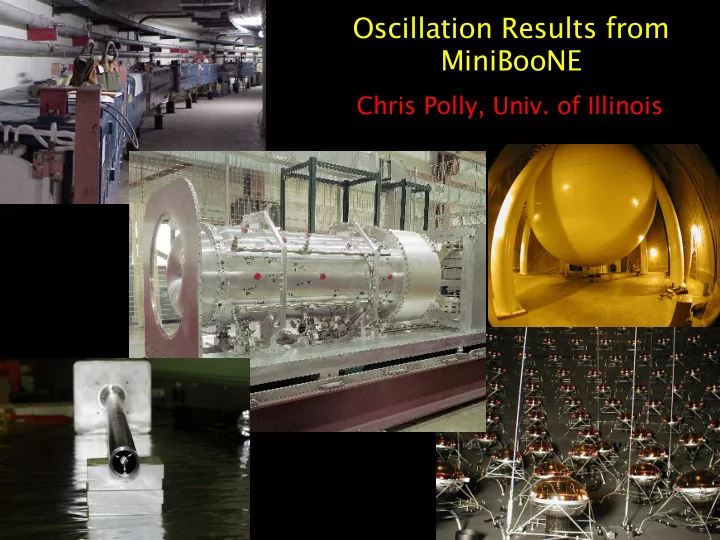
Oscillation Results from Oscillation Results from MiniBooNE MiniBooNE
Chris Polly, Univ. of Illinois Chris Polly, Univ. of Illinois
Oscillation Results from Oscillation Results from MiniBooNE - - PowerPoint PPT Presentation
Oscillation Results from Oscillation Results from MiniBooNE MiniBooNE Chris Polly, Univ. of Illinois Chris Polly, Univ. of Illinois Long history of solving data-driven mysteries Starting with the original mystery of the continuous nature of
Oscillation Results from Oscillation Results from MiniBooNE MiniBooNE
Chris Polly, Univ. of Illinois Chris Polly, Univ. of Illinois
2 Lake Louise Winter Institute, 20 Feb 2009
Long ν history of solving data-driven mysteries
Starting with the original mystery of the continuous nature of the β decay spectrum
Detective Pauli
✰ And so the neutrino was 'discovered'!
“Dear Radioactive Ladies and Gentlemen, ...as a desperate remedy to save the principle
propose the idea of a neutral particle of spin half” W. Pauli 1929 “I have done something very bad today by proposing a particle that cannot be detected; it is something no theorist should ever do.” W. Pauli 1929
3 Lake Louise Winter Institute, 20 Feb 2009
Starting in the 1960's solar ν mystery arises
The sun is fueled by fusion reactions
Neutrinos are produced copiously
✰ Ray Davis sets out to measure
solar ν's for the first time.
4 Lake Louise Winter Institute, 20 Feb 2009
Ray Davis' Experiment at Homestake
Used a large vat of dry cleaning solution to look for Argon from inverse beta decay Remained mired in controversy for 30
experiment correct? Could it be new physics, e.g. Pontecorvo's oscillations?
✰ Found 1/3 of the νe from sun
compared to Bahcall's prediction!
5 Lake Louise Winter Institute, 20 Feb 2009
Pontecorvo first to point out possible ν mixing
“At present this is highly speculative-
there is no experimental evidence for neutrino oscillations...” D.J. Griffiths (1995), Introduction to Quantum Mechanics
νe νµ ντ Ue1 Ue2 Ue3 Uµ1 Uµ2 Uµ3 Uτ1 Uτ2 Uτ3 = ν1 ν2 ν3
Pab=sin
22sin 21.27m 2 L
E
Back in 1957, Pontecorvo pointed out that if ν's have mass, then it could be the case that the mass eigenstates were not identical to the weak Sounds a little far-fetched, but similar to kaon mixing where it was already known that the weak and strong (mass) eigenstates differed Neutrino mixing is a direct result:
✰ By measuring the mixing, the mass
differences of the neutrino can be inferred!
Bruno Pontecorvo
6 Lake Louise Winter Institute, 20 Feb 2009
Definitive proof via systematically different expts
SNO: Definitive proof of solar mixing Measured same disappearance signal as Davis Also measured NC total xsec consistent with Bahcall's expected total ν flux Kamland: Confirmation of the physics
Confirms anti-νe behave like νe
✰ Latest results, including
3rd phase of SNO, see Ryan Martin talk, this conference!
7 Lake Louise Winter Institute, 20 Feb 2009
Similarly compelling story in atmospheric sector
hep-ex/0404034 hep-ex/0404034
Super-K: New mixing found in atmospheric νµ found 1/2 as the upward νµ as downward Δm23
2 ̴ 210-3 eV2, sin2(2θ23) ~ 1.0K2K: Confirms Super-K accelerator vs. cosmic source much smaller L, confirms L/E invariance MINOS: Entering the precision era OPERA: Looking to confirm νµ -> ντ
Super-K Data Minos Data
✰ Emulsion from OPERA, see talk by
Guillame Lutter, this conference!
8 Lake Louise Winter Institute, 20 Feb 2009
neutrino mixing (mass→weak) UPMNS =
Ue1 Ue2 Ue3 Uµ1 Uµ2 Uµ3 Uτ1 Uτ2 Uτ3
0.8 0.5 <0.2 0.4 0.6 0.7 0.4 0.6 0.7
=
So where do we stand with many mysteries solved?
Now know neutrinos have mass and weak /mass eigenstates differ SM has a much richer ν sector Source of CLFV in SM
BR(µ→eγ) < 10-52 BR(µΝ→eΝ) < 10-54
9 Lake Louise Winter Institute, 20 Feb 2009
Vud Vus Vub Vcd Vcs Vcb Vtd Vts Vtb
VCKM = quark mixing (strong/mass→weak)
0.974 0.225 0.004 0.226 0.973 0.041 0.009 0.041 0.999
=
(PDG 2008)
neutrino mixing (mass→weak) UPMNS =
Ue1 Ue2 Ue3 Uµ1 Uµ2 Uµ3 Uτ1 Uτ2 Uτ3
0.8 0.5 <0.2 0.4 0.6 0.7 0.4 0.6 0.7
=
So where do we stand with many mysteries solved?
Now know neutrinos have mass and weak /mass eigenstates differ SM has a much richer ν sector Why is the PMNS matrix so different from CKM?
✰ MORE MYSTERIES!!!
Source of CLFV in SM
BR(µ→eγ) < 10-52 BR(µΝ→eΝ) < 10-54
10 Lake Louise Winter Institute, 20 Feb 2009
Open questions from the mixing matrix... ν3 ν2 ν1 ∆m 2
atm~ 2.4x10 –3 eV 2
∆m 2
sol~ 8x10 –5 eV 2
At 1st order mixing is tribimaximal, why? What is causing the PMNS symmetry? How big is the Ue3 component? Zero if consistent with tribimaximal. Is there still enough room for CP violation in the ν sector for leptogenesis? Unitarity?
neutrino mixing (mass→weak) UPMNS =
Ue1 Ue2 Ue3 Uµ1 Uµ2 Uµ3 Uτ1 Uτ2 Uτ3
2/3 1/3 1/3 1/2 1/6 1/2
√ √ √ √ √ √ √ √
0.8 0.5 <0.2 0.4 0.6 0.7 0.4 0.6 0.7
≈ UTBM = =
11 Lake Louise Winter Institute, 20 Feb 2009
Why is the ν mass so small? What is the absolute mass scale? Is the hierarchy normal or inverted? Are ν's Dirac or Majorana? Are there right-handed partners? Sterile neutrinos at any mass scale?
Even more basic questions...
Shamelessly stolen from Scientific American
✰ Many experiments/theories out there
seeking answers right now. Too many to discuss and still have time for MiniBooNE.
12 Lake Louise Winter Institute, 20 Feb 2009
They say the sun is gonna grow someday. It's gonna get real close and burn us all up... ...I can't promise you tomorrow. No
You can beg and steal and borrow. It won't save you from the sky.
Tomorrow (lyrics)
Let m e see a show of hands.
Tell me the truth now . What happens if neutrinos hav e mass?
I can't tell you about tom orrow. I'm as lost as yesterday. In between your joy and sorrow, I suggest you have your say: Here's to the little things...
So many questions, even Bob Seger is curious!!
13 Lake Louise Winter Institute, 20 Feb 2009
A more recent mystery...LSND
hep-ex/0404034
— —
LSND looked for νe appearing in a νµ beam Signature: Cerenkov light from e+ (CC) Scintillation light from nuclear recoil Delayed n-capture (2.2 MeV)
14 Lake Louise Winter Institute, 20 Feb 2009
Picture of LSND photomultipliers (used later in MB)
hep-ex/0404034
15 Lake Louise Winter Institute, 20 Feb 2009
MiniBooNE's motivation...LSND
— —
LSND found an excess of νe in νµ beam Signature: Cerenkov light from e+ with delayed n-capture (2.2 MeV) Excess: 87.9 ± 22.4 ± 6.0 (3.8σ) Under a 2ν mixing hypothesis:
16 Lake Louise Winter Institute, 20 Feb 2009
MiniBooNE's motivation...LSND
Other experiments, i.e. Karmen and Bugey, have ruled out portions of the LSND signal MiniBooNE was designed to cover the entire LSND allowed region
— —
LSND found an excess of νe in νµ beam Signature: Cerenkov light from e+ with delayed n-capture (2.2 MeV) Excess: 87.9 ± 22.4 ± 6.0 (3.8σ) Under a 2ν mixing hypothesis:
17 Lake Louise Winter Institute, 20 Feb 2009
Interpreting the LSND signal νe νµ ντ ν3 ν2 ν1 ∆m 2
atm~ 2.4x10 –3 eV 2
∆m 2
sol~ 8x10 –5 eV 2 The other two measured mixings fit conveniently into a 3-neutrino model With ∆m13
2 = ∆m12 2 + ∆m23 2, the LSND∆m2 ~ 1 eV2 does not fit 'Simplest' explanation...a 4th neutrino
18 Lake Louise Winter Institute, 20 Feb 2009
Interpreting the LSND signal νe νµ ντ ν3 ν2 ν1 ∆m 2
atm~ 2.4x10 –3 eV 2
∆m 2
sol~ 8x10 –5 eV 2 The other two measured mixings fit conveniently into a 3-neutrino model With ∆m13
2 = ∆m12 2 + ∆m23 2, the LSND∆m2 ~ 1 eV2 does not fit 'Simplest' explanation...a 4th neutrino Width of the Z implies 2.994 + 0.012 light neutrino flavors Requires 4th neutrino to be 'sterile' or an even more exotic solution
Sterile neutrinos hep-ph/0305255 Neutrino decay hep-ph/0602083 Lorentz/CPT violation PRD(2006)105009 Extra dimensions hep-ph/0504096
19 Lake Louise Winter Institute, 20 Feb 2009
The MiniBooNE Collaboration
Part 1: Recap of the analysis method and '07 νe result Part 2: Analysis updates, emphasis on νe-like excess at low energy Part 3: New results from anti-ν run (including νµ disappearance)
~80 physicists from ~18 institutions
OUTLINE
20 Lake Louise Winter Institute, 20 Feb 2009
The MiniBooNE design strategy...must make νµ
Start with 8 GeV proton beam from FNAL Booster Add a 174 kA pulsed horn to gain a needed x 6 Requires running ν (not anti-ν like LSND) to get flux Pions decay to ν with Eν in the 0.8 GeV range Place detector to preserve LSND L/E: MiniBooNE: (0.5 km) / (0.8 GeV) LSND: (0.03 km) / (0.05 GeV) Detect ν interactions in 800T pure mineral oil detector
1280 8” PMTs provide 10% coverage of fiducial volume 240 8” PMTs provide active veto in outer radial shell
dirt (~500 m) target and horn (174 kA) + - K+ K0
✶ ✶
+
✶
decay region (50 m) detector
FNAL booster (8 GeV protons)
21 Lake Louise Winter Institute, 20 Feb 2009
Key points about the signal
LSND oscillation probability is < 0.3% After cuts, MiniBooNE has to be able to find ~300 νe CCQE interactions in a sea of ~150,000 νµ CCQE Intrinsic νe background
Actual νe produced in the beamline from muons and kaons Irreducible at the event level E spectrum differs from signal
Mis-identified events
νµ CCQE easy to identify, i.e. 2 “subevents” instead of 1. However, lots of them. Neutral-current (NC) π0 and radiative ∆ are more rare, but harder to separate Can be reduced with better PID
Effectively, MiniBooNE is a ratio meas. with the νµ constraining flux X cross-section
Signal Background Background
22 Lake Louise Winter Institute, 20 Feb 2009
Analysis Chain: Flux Prediction
23 Lake Louise Winter Institute, 20 Feb 2009 HARP collaboration, hep-ex/0702024
Meson production at the target
Kaons: Pions:
MiniBooNE members joined the HARP collaboration 8 GeV proton beam 5% λ Beryllium target Data were fit to Sanford-Wang parameterization for '07 analysis Kaon data taken on multiple targets in 10-24 GeV range Fit to world data using Feynman scaling 30% overall uncertainty assessed
24 Lake Louise Winter Institute, 20 Feb 2009
µ → e νµ νe K→ π e νe
Final neutrino flux estimation
Flux intersecting MB detector (not cross-section weighted) Intrinsic contamination νe /νµ = 0.5% µ+ → e+ νµ νe (52%) K+ → π0 e+ νe (29%) K0 → π e νe (14%) Other (5%) Wrong-sign νµ content: 6%
25 Lake Louise Winter Institute, 20 Feb 2009
Analysis Chain: X-Section Model
26 Lake Louise Winter Institute, 20 Feb 2009
Nuance Monte Carlo
Comprehensive generator, covers entire Eν range Predicts rates and kinematics of specific ν interactions from input flux Expected interaction rates in MiniBooNE (before cuts) shown below Based on world data, νµ CC shown below right νµ CC World data Input flux
27 Lake Louise Winter Institute, 20 Feb 2009
Nuance Monte Carlo
Comprehensive generator, covers entire Eν range Predicts rates and kinematics of specific ν interactions from input flux Expected interaction rates in MiniBooNE (before cuts) shown below Based on world data, νµ CC shown below right Also tuned on internal data νµ CC World data Input flux
28 Lake Louise Winter Institute, 20 Feb 2009
data/MC~1 across all angle vs.energy after fit
Tuning Nuance on internal νµ CCQE data
Poor agreement in Q2 From Q2 fits to MB νµ CCQE data extract: MA
eff -- effective axial massκ -- Pauli Blocking parameter
Beautiful agreement after Q2 fit, even in 2D Ability to make these 2D plots is unique due to MiniBooNE's high statistics
Before correction After correction
MB, PRL 100, 032310 (2008)
Lake Louise Winter Institute, 20 Feb 2009
NC π⁰ important background 97% pure π⁰ sample (mainly Δ→Nπ⁰) Measure rate as function
Default MC underpredicts rate at low momentum Δ→Nγ also constrained
Tuning Nuance on internal NC π0 data
Invariant mass distributions in momentum bins
MB, Phys Lett B. 664, 41 (2008)
30 Lake Louise Winter Institute, 20 Feb 2009
Analysis Chain: Track-Based Likelihood Reconstruction and Particle ID
31 Lake Louise Winter Institute, 20 Feb 2009
TBL Analysis: Separating e from µ
, E t,x,y,z
light
data MC
Analysis pre-cuts
Only 1 subevent Veto hits < 6 Tank hits > 200 Radius < 500 cm
νµ CCQE events (2 subevent)
Event is a collection of PMT-level info (q,t,x) Form sophisticated Q and T pdfs, and fit for 7 track parameters under 2 hypotheses
The track is due to an electron The track is coming from a muon
32 Lake Louise Winter Institute, 20 Feb 2009
Separating e from π0
E1,1,1 t,x,y,z
light
s1 s2 E2,2,2 blind
Extend fit to include two e-like tracks Very tenacious fit...8 minutes per event Nearly 500k CPU hours used
33 Lake Louise Winter Institute, 20 Feb 2009
TBL Analysis: Expected event totals
shower
dirt
escapes shower
dirt 17 Δ→Nγ 20 νe
K94 νe
μ132 π⁰ 62
475 MeV – 1250 MeV
33 total 358 LSND best-fit νμ→νe 126
34 Lake Louise Winter Institute, 20 Feb 2009
dirt 17 Δ→Nγ 20 νe
K94 νe
μ132 π⁰ 62
475 MeV – 1250 MeV
33 total 358 LSND best-fit νμ→νe 126
In situ background constraints: NC π0
Reconstruct majority of π0 events Error due to extrapolation uncertainty into kinematic region where 1 γ is missed due to kinematics or escaping the tank Overall < 7% error on NC π0 bkgs
MB, Phys Lett B. 664, 41 (2008)
35 Lake Louise Winter Institute, 20 Feb 2009
dirt 17 Δ→Nγ 20 νe
K94 νe
μ132 π⁰ 62
475 MeV – 1250 MeV
33 total 358 LSND best-fit νμ→νe 126
In situ background constraints: Δ→Nγ
About 80% of our NC π0 events come from resonant ∆ production Constrain Δ→Nγ by measuring the resonant NC π0 rate, apply known branching fraction to Nγ, including nuclear corrections
MB, PRL 100, 032310 (2008)
36 Lake Louise Winter Institute, 20 Feb 2009
dirt 17 Δ→Nγ 20 νe
K94 νe
μ132 π⁰ 62
475 MeV – 1250 MeV
33 total 358 LSND best-fit νμ→νe 126
In situ background constraints: Dirt
Come from ν events int. in surrounding dirt Pileup at high radius and low E Fit dirt-enhanced sample to extract dirt event rate with 10% uncertainty
37 Lake Louise Winter Institute, 20 Feb 2009
dirt 17 Δ→Nγ 20 νe
K94 νe
μ132 π⁰ 62
475 MeV – 1250 MeV
33 total 358 LSND best-fit νμ→νe 126
In situ background constraints: Muon νe
Intrinsic νe from µ+ originate from same π+ as the νµ CCQE sample Measuring νµ CCQE channel constrains intrinsic νe from π+
38 Lake Louise Winter Institute, 20 Feb 2009
In situ background constraints: Kaon νe
At high energy, νµ flux is dominated by kaon production at the target Measuring νµ CCQE at high energy constrains kaon production, and thus intrinsic νe from K+
dirt 17 Δ→Nγ 20 νe
K94 νe
μ132 π⁰ 62
475 MeV – 1250 MeV
33 total 358 LSND best-fit νμ→νe 126
39 Lake Louise Winter Institute, 20 Feb 2009
In situ background constraints
✰ In the end, every major source of background
can be internally constrained by MB at various levels. dirt 17 Δ→Nγ 20 νe
K94 νe
μ132 π⁰ 62
475 MeV – 1250 MeV
33 total 358 LSND best-fit νμ→νe 126
40 Lake Louise Winter Institute, 20 Feb 2009
2007 Data/fit result after unblinding...
No sign of an excess in the analysis region (where the LSND signal should have highest significance for the 2ν mixing hypothesis) Visible excess at low E
What does it all mean? There are a few possibilities...
Some problem with LSND, e.g. mis-estimated background? Difference between neutrinos and antineutrinos? The physics causing the excess in LSND doesn't scale with L/E?
41 Lake Louise Winter Institute, 20 Feb 2009
Part 2: Exploring the Low E Excess
42 Lake Louise Winter Institute, 20 Feb 2009
The low E excess has fueled much speculation...
Commonplace SM, but odd Beyond the SM
Muon bremsstrahlung (Bodek, 0709.4004) Anomaly-mediated γ (Harvey, Hill, Hill, 0708.1281) New gauge boson (Nelson, Walsh,0711.1363) Easy to study in MB with much larger stats from events with a Michel tag Proved negligible with MB data in 0710.3897 Still under study, nuc. effects neglected, δgω Has to contribute...how much? Can accommodate LSND and MiniBooNE Firm prediction for anti- neutrinos
43 Lake Louise Winter Institute, 20 Feb 2009
Extending the analysis to lower energies
Original excess quoted in initial
475-1250 MeV, 22 ± 40, 0.6σ 300-475 MeV, 96 ± 26, 3.7σ In summer 2007 extended analysis down to 200 MeV 200-300 MeV, 92 ± 37, 2.5σ Combined significance with proper systematic correlations 200-475 MeV, 188 ± 54, 3.5σ
44 Lake Louise Winter Institute, 20 Feb 2009
Extending the analysis to lower energies
Original excess quoted in initial
475-1250 MeV, 22 ± 40, 0.6σ 300-475 MeV, 96 ± 26, 3.7σ In summer 2007 extended analysis down to 200 MeV 200-300 MeV, 92 ± 37, 2.5σ Combined significance with proper systematic correlations 200-475 MeV, 188 ± 54, 3.5σ
Since this result a comprehensive (> 1 year) review of bkgs/errors with an emphasis at low E was performed...detailed updates to follow
45 Lake Louise Winter Institute, 20 Feb 2009
Updates with minimal impact
With the νe appearance result published and the unexpected excess at low E, we decided to go back and perform a comprehensive re-analysis of all aspects of the analysis
General review of all aspects Add improvements that had been put on hold Emphasis on the low E region
Improvements that had no measurable impact:
Better pion flux determination using spline fit to HARP data instead of Sanford-Wang parameterization Flux errors calculated subject to HARP error matrix Implemented MB in situ measure of resonant/coherent pion production Completely independent re-analysis of π0 backgrounds Complete combinatorial treatment of ∆−>Νγ branching ratio allowing for pion re-interactions in struck nucleus Added 15% more newly-acquired ν data
46 Lake Louise Winter Institute, 20 Feb 2009
Hadronic bkgs/errors in ν interactions
Charged π − C elastic scattering
Found π± elastic scattering to be nearly absent in GCALOR Possibility that NC π± have more scattering ⇒ making Cerenkov ring look more e-like
Radiative π− capture
π− capture is in GCALOR, but missing radiative branching fraction (<2%, ~100MeV gamma)
π± induced ∆->Nγ in mineral oil
Abs/cex allowed in GCALOR, but radiative γ branch missing Not as dangerous as in struck nucleus, since π propagates for some time and can give multiple rings
ADDITIONAL HADRONIC PROCESSES:
✰ None of these processes contributed a
significant number of bkg events
47 Lake Louise Winter Institute, 20 Feb 2009
Hadronic bkgs/errors in ν interactions
Photonuclear interactions
Absent in GEANT3 Can delete a γ in a NC pi0 interactions, thus creating a single e-like ring 40,000 NC pi0 interactions Well-known cross-section, in fact in GEANT4 which allowed for cross-check Uncertainties enter via final states
Only missing hadronic process found to contribute significantly
ADDITIONAL HADRONIC PROCESSES:
Z ∆ p,n p,n π0 νµ νµ
p ,n p, n
0 , 0 γ γ
48 Lake Louise Winter Institute, 20 Feb 2009
Hadronic bkgs/errors in ν interactions
ADDITIONAL HADRONIC PROCESSES:
Photonuke bottom line:
Additional p0 mis-id due to all modified hadronic processes (dominated by PN)
Additional systematic error negligible relative to other errors
νe-like backgrounds Eν (QE)
49 Lake Louise Winter Institute, 20 Feb 2009
Additional cut to remove dirt events
Dirt backgrounds tend to come from γ that sneak through the veto and convert in tank ⇒ pile up at high radius Don't carry full ν energy ⇒ pile up at low visible energy Define R-to-wall cut, distance back to wall along reconstructed track direction Apply 2d cut as shown
shower
dirt
Evis
RED: CCQE Nue BLACK: Background
R-to-wall distance [cm]
50 Lake Louise Winter Institute, 20 Feb 2009
Additional cut to remove dirt events
Dirt cut bottom line: Removes ~85% of the dirt backgrounds at low energy
No DIRT cuts With DIRT Cuts
51 Lake Louise Winter Institute, 20 Feb 2009
Full update: Impact on oscillation analysis
Limit (this work) Limit (April 07)
✰ Little impact on primary oscillation analysis!
52 Lake Louise Winter Institute, 20 Feb 2009
Full update: Compare update stages
Divided into 4 major rows based on energy range Columns separate analysis updates
Original All update except new data and dirt cut Add new data Add new dirt cut
FINAL
Original (April 07) Updated Analysis Add New Data Add Dirt Cut
53 Lake Louise Winter Institute, 20 Feb 2009
Full update: Compare update stages
In 475-1250 MeV, excess is small/stable through all updates In 200-475 MeV, excess significance reduced due to additional hadronic bkgs, compensated by reduction in dirt background Original 3.7σ excess in 300-475 remains a 3.4σ effect after a comprehensive review
FINAL
Original (April 07) Updated Analysis Add New Data Add Dirt Cut
54 Lake Louise Winter Institute, 20 Feb 2009
Full update: Compare update stages
In 475-1250 MeV, excess is small/stable through all updates In 200-475 MeV, excess significance reduced due to additional hadronic bkgs, compensated by reduction in dirt background Original 3.7σ excess in 300-475 remains a 3.4σ effect after a comprehensive review
FINAL
Original (April 07) Updated Analysis Add New Data Add Dirt Cut
55 Lake Louise Winter Institute, 20 Feb 2009
Full update: Compare update stages
In 475-1250 MeV, excess is small/stable through all updates In 200-475 MeV, excess significance reduced due to additional hadronic bkgs, compensated by reduction in dirt background Original 3.7σ excess in 300-475 remains a 3.4σ effect after a comprehensive review
FINAL
Original (April 07) Updated Analysis Add New Data Add Dirt Cut
56 Lake Louise Winter Institute, 20 Feb 2009
Part 3: New antineutrino results
57 Lake Louise Winter Institute, 20 Feb 2009
Anti-neutrino analysis...rates down
Simple matter of switching horn polarity Analysis for anti-neutrinos nearly identical to neutrino mode Biggest problem: Overall reduction in rate
events all channels 895k CC quasielastic 375k NC elastic 165k 200k 33k 53k 30k 39k ν channel CC π+ CC π0 NC π0 NC π+/- CC/NC DIS, multi-π
6.6x10²⁰ POT ν mode 3.4x10²⁰ POT ν mode
all channels 83k CC quasielastic 37k NC elastic 16k 14k 2.6k 7.6k 2.8k 2.9k ν channel CC π− CC π0 NC π0 NC π+/- CC/NC DIS, multi-π
With about half of the POT delivered in nubar mode, the overall number
Check part of LSND phase space with an antineutrino beam Useful comparison of low E anomalous region Cross-section measurements (very relevant for T2K)
58 Lake Louise Winter Institute, 20 Feb 2009
Rate down partially due to cross-section
DIS Single Pion
QE TOTAL νµ CC total cross section world data νµ CC total cross section world data
59 Lake Louise Winter Institute, 20 Feb 2009
Rate also down due to π −/π+ flux
Overall flux is also down Second complication: Wrong-sign component is much larger 6% anti-νµ in ν beam...18% νµ in anti-νµ beam WS component further amplified to 30% in nubar mode due to xsec
ν mode flux (focus π+) ν mode flux (focus π-)
60 Lake Louise Winter Institute, 20 Feb 2009
Projected sensitivity (90% CL) to anti-ν oscillation
Important point, only anti-ν are assumed to oscillate in this analysis Already know WS component νµ do not oscillate from ν mode result (at least above 475 MeV) Due to low E excess in neutrino mode, analysis is performed with and without 475 MeV cut in Eν(QE) Cover > half of LSND 90% CL
61 Lake Louise Winter Institute, 20 Feb 2009
Recently unblinded anti-ν data...NEW RESULTS
Unblinded Nov, first presented in Dec, some interesting observations... Backgrounds actually very similar Role of stat error can be seen in blue errors plotted on data, especially relative to systematic errors in black plotted on MC Good agreement...even at low energy
ν mode 6.6e20 POT ν mode 3.4e20 POT
62 Lake Louise Winter Institute, 20 Feb 2009
Comparing limits and sensitivities to 2ν mixing
Fit prefers to add some signal making limit curve shift to right relative to sensitivity. Nearly all of LSND and the null hypothesis included at 90% CL
ν mode 6.6e20 POT ν mode 3.4e20 POT
63 Lake Louise Winter Institute, 20 Feb 2009
Data-MC prediction versus energy (nubar)
Counting exp. only has a 3.2 event excess above 475 MeV, where LSND's best fit would predict 12.6 events However, fit performed with a systematic covariance matrix that allows some normalization freedom χ2 minimized by putting in a small signal that better matches shape of wiggle
Fit Range 17 20.2 18.2 14 17.9 15.9 dof χ2(null) χ2(LSND) > 200 MeV > 475 MeV
✰ LSND best fit parameters
slightly preferred over null!
64 Lake Louise Winter Institute, 20 Feb 2009
Event excesses in various regions
Simple exercise, if the low E excess had scaled with total bkg, how many events should we have seen in anti-ν mode?
200-475, should have observed 19 events on top of 61.5 bkg With stat error only that means 2.4 σ downward fluctuation Not quite right, need fully correlated systematic analysis, compare various bkg hypotheses
65 Lake Louise Winter Institute, 20 Feb 2009
Initial study of low E compatibility
Main idea: Ignore what we think we know about various backgrounds and ask how compatible the low E region is under various signal/bkg hypothesis All correlated systematic errors have to be handled properly
Work in progress, but final result has to be bracketed between 100% corr. and uncorr.
Examples:
Low E Kaons: If the excess at low E was due to misestimating the kaon production in the beam, then nubar mode should also see an excess. Axial anomaly falls under first row ν-scaled most compatible, but this is really just a statement that there is only 30% νµ in the anti-νµ beam
66 Lake Louise Winter Institute, 20 Feb 2009
PRELIMINARY
data limit for 90%CL,3σ 5σ
A word on νµ disappearance? NEW RESULTS
Harder than νe appearance since you have to dead reckon flux and cross-section Also know νµ rate is 30% (1.5σ) larger than expectation (before MA fits) Solution: perform a shape only fit to a 2ν mixing hypothesis Resulting limits shown below...will greatly improve with SciBooNE near detector data
ν mode 5.6e20 POT ν mode 3.4e20 POT
67 Lake Louise Winter Institute, 20 Feb 2009
MiniBooNE Conclusions: ν mode
A comprehensive review of all bkgs and errors completed (emphasis at low E)
No change to the analysis above 475 MeV Excess at low E energy reduced but still >3.0σ significant
Assuming ν behave like anti-ν, L/E invariant models for LSND are ruled out, including simple
68 Lake Louise Winter Institute, 20 Feb 2009
MiniBooNE Conclusions: anti-ν mode
No statistical significant excess above 475
Shape of data-mc prefers a small signal LSND best fit slightly preferred over null Both LSND best fit and null within 90% CL Need more data
LSND alive and well with regard to anti-n result
69 Lake Louise Winter Institute, 20 Feb 2009
MiniBooNE Conclusions: ν vs. anti-ν
Very curious that there is no sign of excess at low E in anti-ν data Excess in visible E in plots on right ν mode excess is 6σ statistically significant (3σ with systematics) Many conventional possibilities, e.g. missed bkgs, axial anomaly, low E kaon production, ruled out Has ramifications for T2K T2K uses same energy n beam Looks for νe appearance If θ13 nonzero, will want to compare ν to anti-ν running for CP violation
70 Lake Louise Winter Institute, 20 Feb 2009
Looking forward....
MiniBooNE
Will increase anti-ν mode stats by 50% by shutdown, 5e20 POT Proposal in to PAC last week to double nubar stats to 1e21 POT
change in program planning or Booster upgrades
SciBooNE
Finished with 1e20 POT in both ν and anti-ν mode
low E analysis, reconstruction typically limited to >500 MeV
MicroBooNE
Valuable liquid Ar R&D to be constructed in 8 GeV ν beam
Projected Luminosity at MiniBooNE
OscSNS
MB-like near/far detectors at Oak Ridge Relative to LSND
71 Lake Louise Winter Institute, 20 Feb 2009
Extra slides
72 Lake Louise Winter Institute, 20 Feb 2009
Calibration sources span various energies
73 Lake Louise Winter Institute, 20 Feb 2009
Optical Model
74 Lake Louise Winter Institute, 20 Feb 2009
Light propagation in the detector
Optical model is very complex
Cerenkov, scintillation, fluorescence PMT Q/t response Scattering, reflection, prepulses
Overall, about 40 non-trivial parameters Started with benchtop measurements, refined via in situ tuning. Data/MC agreement critical (esp. for Boosted Decision Tree)
Michel electron t distribution
75 Lake Louise Winter Institute, 20 Feb 2009
Tuning the optical model
Refining the OM: Basic idea
Define n-dimensional hypercube (n~40) of allowed underlying parameter ranges Throw random darts (~100,000) in that space and run 5-10k MC Michel samples Compute a χ2 for an ensemble of topology-based variables Shrink allowed parameter space down to a remaining hyper-ellipse
Decay e- from cosmic muons are a great calibration source
Electrons, like the signal E<50 MeV, fast to simulate Uniformly populate all R
76 Lake Louise Winter Institute, 20 Feb 2009
Tuning the optical model
Benefits are two-fold
Center of ellipse defines improved OM Extent of ellipse defines systematic error
and fits (much more CPU intensive) to extract errors
Decay e- from cosmic muons are a great calibration source
Electrons, like the signal E<50 MeV, fast to simulate Uniformly populate all R
77 Lake Louise Winter Institute, 20 Feb 2009
Breaking the UVF/scintillation degeneracy
Important due to degeneracy in original OM
Ability of Cerenkov in UV region to absorb and re-emit in visible was not well- measured Means that isotropic, late light in Michel e- could either be due to UV Cerenkov light fluorescence or due to direct excitation due to charged-particle passage
In general, tried to avoid tuning OM with neutrino sampes One exception...NC elastic
NC elastic not a significant bkg to signal Sub-Cerenkov p provides direct measure of scintillation amplitude
78 Lake Louise Winter Institute, 20 Feb 2009
Final step in tuning the optical model
With the scintillation amplitude fixed from the NC elastic data...could now tune the UVF parameters with the Michels Look at the fraction of light on the tank wall behind the Cerenkov cone as a function of corrected time Adjusted UVF amplitudes to get amount of isotropic light correct
79 Lake Louise Winter Institute, 20 Feb 2009
Impact of OM tuning on ν samples
6 variables below used in Fisher discriminant to isolate νµ CCQE Various stages of tuning shown on left (red Nov05, blue May06). Final OM shown on right.
80 Lake Louise Winter Institute, 20 Feb 2009
Laser timing distributions (old and new PMTs)
81 Lake Louise Winter Institute, 20 Feb 2009
Full update: Background event breakdown
Above 475 MeV still dominated by intrinsic νe At low E transitions to NC π0 and ∆->Nγ dominated bkgs
82 Lake Louise Winter Institute, 20 Feb 2009
Update #1: Treatment of π flux errors
Fit HARP/E910 data to SW parameterization. Use SW fit as central value (CV) MC Use covariance matrix governing SW parameters in χ2 fit to assess error Problem: poor χ2 due to SW parameterization not fully describing data at HARP's precision Old Sol'n: inflate HARP error until χ2 accept. Turns HARP's ~7% error into ~15%
OLD METHOD:
xsec (mb) vs pπ (GeV)
HARP data/errs SW fit new method
81% of ν flux crossing MB covered by HARP
83 Lake Louise Winter Institute, 20 Feb 2009
Update #1: Treatment of π flux errors
Fit HARP/E910 data to SW parameterization. Use SW fit as central value (CV) MC Use covariance matrix governing SW parameters in χ2 fit to assess error Problem: poor χ2 due to SW parameterization not fully describing data at HARP's precision Old Sol'n: inflate HARP error until χ2 accept. Turns HARP's ~7% error into ~15% Sounds dumb, but... Getting a good 2-dim parameterization in (pπ,θ) not as easy as you might think More importantly, in the νe appearance analysis the π flux is heavily constrained from the in situ νµ measurement
OLD METHOD:
xsec (mb) vs pπ (GeV)
HARP data/errs SW fit new method
84 Lake Louise Winter Institute, 20 Feb 2009
Update #1: Treatment of π flux errors
NEW METHOD:
xsec (mb) vs pπ (GeV)
HARP data/errs SW fit new method
Forget SW, use HARP data and fit with spline interpolation Vary HARP data with their own covariance matrix to produce flux systematic error Update #1 bottom line: No impact on νe appearance
Largest diff at low pπ ,not much ν flux hitting det, further deweighted by cross-sections Still have additional 5% in errors coming from horn modeling + secondary interactions Errors outside of HARP measurement region actually larger by taking covariance about old SW as 1σ error
85 Lake Louise Winter Institute, 20 Feb 2009
Parent π kinematics -> make νe-like bkgs
86 Lake Louise Winter Institute, 20 Feb 2009
Update #2: Improved π0/radiative ∆ analysis
Complete re-extraction of π0 weights
Independent code, improved unsmearing technique, 11 bins, consistent with old result Fit over 9 bins in pπ to smooth reweighting function
Z ∆ p,n p,n π0 νµ νµ
p ,n p, n
0 , 0 ν
87 Lake Louise Winter Institute, 20 Feb 2009
Full update: Visible energy distribution
Visible energy interesting to look at in case excess is not really due to νe CCQE Can see excess is more consistent with νµ mis-ID than intrinsic νe. Excess piles up below 400 MeV, analysis threshold set at 140 MeV Evis
88 Lake Louise Winter Institute, 20 Feb 2009
Full update: Q2 and cos θ
Excess events plotted versus Q2 and cos θ...hope was that shapes would favor a particular explanation. χ2 are from a shape only fit, internal constraints on absolute production ignored
No smoking gun Most favored is expected excess shape from anti-νe, but would require MC prediction off by x 65 NC π0 next most-favored, but measured to better than 10%
Process 13.46 2.18 2.0 16.86 4.46 2.7 14.58 8.72 2.4 10.11 2.44 65.4 χ2(cos θ)/9 DF χ2(Q2)/6 DF
NC π0 ∆ → N γ νe C → e- X νe C → e+ X
89 Lake Louise Winter Institute, 20 Feb 2009
Update #2: Improved π0/radiative ∆ analysis
Applied in situ measurement of the coherent/resonant production rate
Coherent event kinematics more forward Coherent fraction reduced by 35% (from RS)
Improvements to ∆->Nγ bkg prediction
Coh/res π0 fraction measured more accurately, ∆−>Νγ rate tied to res π0 Old analysis, π created in struck nucleus not allowed to reinteract to make new ∆ Complete combinatorial derivation based on branching ratios (Γγ, Γπ0) and the pion escape probability (ε) Error on ∆->Nγ bkg increased from 9 to 12%
Update #2 bottom line: Overall, produces a small change in νe appearance bkgs
p , n p ,n
0 , 0Z ∆ p,n p,n π0 νµ νµ C Z C νµ νµ π0
90 Lake Louise Winter Institute, 20 Feb 2009
Hadronic bkgs/errors in ν interactions
Mainly due to charged π absorption and charge exchange in the mineral oil, analogous to the same processes in the struck nucleus Use GEANT3 MC with GCALOR instead of GFLUKA default better π abs/cex handling (error=max{Ashery error,Ashery-GCALOR}) better neutron scattering Cross-check: Accounting for cex/abs differences GCALOR & GFLUKA give same result for νe appearance bkgs
OLD HADRONIC PROCESSES/ERRORS:
91 Lake Louise Winter Institute, 20 Feb 2009
Update #4: Additional cut to remove dirt events
Consistency-check: look at radial distribution after dirt cut applied
Uniform excess throughout tank
R [cm] R [cm]
92 Lake Louise Winter Institute, 20 Feb 2009
Update #5: New data
Extra 0.83E20 POT during combined MiniBooNE/SciBooNE ν running
νe-like events per POT evenly distributed throughout duration of run
Update #5 bottom line: νe-like event rate slightly higher for new data, but perfectly acceptable
93 Lake Louise Winter Institute, 20 Feb 2009
Full update: Extend 2ν fit to low E
Eν>475 MeV Eν>200 MeV Null fit χ2 (prob.): 9.1(91%) 22.0(28%) Best fit χ2 (prob.): 7.2(93%) 18.3(37%) Adding 3 bins to fit causes chi^2 to increase by 11 (expected 3) Can see the problem...the best 2ν fit that can be found does not describe the low E excess.
94 Lake Louise Winter Institute, 20 Feb 2009
Background event breakdown nubar mode
95 Lake Louise Winter Institute, 20 Feb 2009
Data-MC prediction versus energy (nubar)
Best fit is not very different from LSND oscillations, easily within large error bars.
96 Lake Louise Winter Institute, 20 Feb 2009
Systematic error comparison
97 Lake Louise Winter Institute, 20 Feb 2009
Chi2 values