Addressing Urban Poverty in sub-Saharan Africa: An Overview of the - - PowerPoint PPT Presentation

addressing urban poverty in sub saharan africa an
SMART_READER_LITE
LIVE PREVIEW

Addressing Urban Poverty in sub-Saharan Africa: An Overview of the - - PowerPoint PPT Presentation

Addressing Urban Poverty in sub-Saharan Africa: An Overview of the Millennium Cities Initiative Accra, Ghana July 2011 The Millennium Cities Initiative (MCI) A project of The Earth Institute at Columbia University, Millennium Cities

slide-1
SLIDE 1

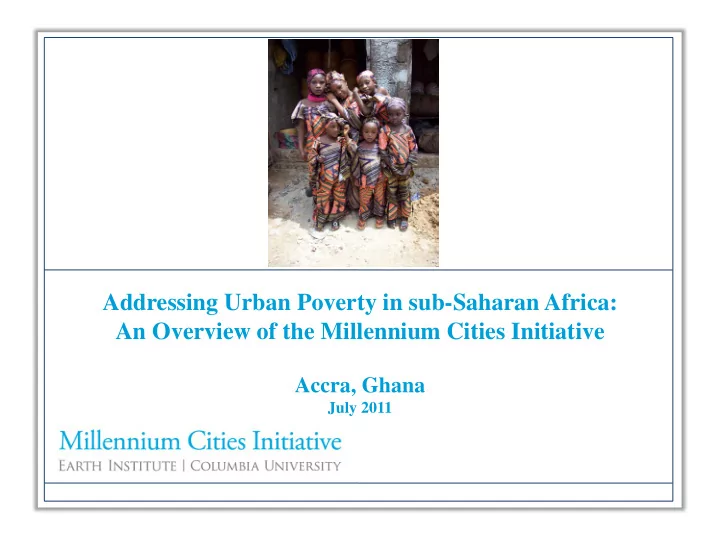
Addressing Urban Poverty in sub-Saharan Africa: An Overview of the Millennium Cities Initiative

Accra, Ghana

July 2011

slide-2
SLIDE 2

The Millennium Cities Initiative (MCI)

A project of The Earth Institute at Columbia University, Millennium Cities Initiative was founded in 2006 by world-renowned development economist Jeffrey D. Sachs as the urban complement to the Millennium Villages Project, which aims to eradicate extreme poverty in rural sub- Saharan Africa.

slide-3
SLIDE 3

MCI Works Together with Underserved Cities across sub-Saharan Africa

Country

  • Ethiopia
  • Ghana
  • Ghana
  • Kenya
  • Malawi
  • Mali
  • Mali
  • Nigeria
  • Nigeria
  • Senegal
  • Tanzania
  • Mali
  • Rwanda
  • Uganda

Millennium Cities

  • Mekelle
  • Accra
  • Kumasi
  • Kisumu
  • Blantyre
  • Bamako
  • Segou
  • Akure
  • Kaduna
  • Louga
  • Tabora
  • Timbuktu*
  • Kigali*
  • Mbarara*

3

*Future Cities

slide-4
SLIDE 4

MCI Works in Two Arenas

Social Sector Investment/Business Development

4

slide-5
SLIDE 5

Investment Sector: Research and Analysis

  • Research and analysis of

investment opportunities and constraints, with emphasis on farm-to- market

  • Targeting of potential

investors

  • Focus on investment

promotion and capacity- building

5

slide-6
SLIDE 6

Social Sector: Research and Analysis

MCI conducts needs assessments and costing analyses in public health, gender, education and water/sanitation and

  • ther follow-on research,

to help the cities determine how far they still need to go to attain the MDGs

6

slide-7
SLIDE 7

MCI Builds Comprehensive Development Strategies for the Cities

  • Consultative stakeholder

meetings to determine and rank top development priorities

  • Working closely with municipal

government to design a fitting city development strategy and advocate for its implementation

  • Seeking partners to fill gaps in

attaining the MDGs through interventions and investment

7

slide-8
SLIDE 8

MCI Interventions to Improve Access to Education

  • School2School partnership

programs (IT, Girls’ Clubs, literacy, STEM subjects, joint research)

  • Early childhood education

program and training

  • Teacher trainings in literacy,

science, math, technology and higher education

  • Advocating for programs to

help raise the quality of primary school instruction/completion rates

8

slide-9
SLIDE 9

MCI Interventions to Improve Public Health

  • Trainings for medical professionals in

such areas as maternal and neonatal health; emergency medicine; infectious diseases; HIV/AIDS and nutrition; heart disease, lifestyle and diabetes; and accident and trauma care

  • Baseline maternal and neonatal mortality

surveys

  • Neonatal survival study, two neonatal

resuscitation units, a fully-equipped emergency room

  • Surgical interventions and rotations
  • Hospital inventory and supply chain

management support

  • Donations of medicines and equipment

9

slide-10
SLIDE 10

MCI Interventions to Help Women and Girls

  • Fistula repair and other

medical missions

  • Girls’ Clubs
  • Private latrines and feminine

pads, to keep girls in school

  • Medical and layperson

trainings to improve maternal and child survival

  • NGO partnerships to support

job training, enterprise development and microfinance

  • pportunities

10

slide-11
SLIDE 11

MCI Interventions to Improve Water/Sanitation, Housing and Other Social Infrastructure

  • Research regarding the quality of

and context for public health, public service delivery and the environment

  • Infrastructure improvements to

deliver reliable access to safe drinking water, sound sanitation and cleaner, more efficient energy and transport systems

  • Training and workshops on

sanitation and hygiene

  • Urban planning and urban design

work in Accra, Ghana, to address some of the city’s most pressing challenges

11

slide-12
SLIDE 12
slide-13
SLIDE 13

Accra: Building the MDGs in 3 Dimensions

A multidisciplinary Earth Institute team addressing planning, infrastructure, environmental and public health challenges in Ghana’s vibrant capital

  • Using GIS mapping to enable regional planning, government-community

communication & preparedness and adaptation for impacts of climate change

  • Advising re. sustainable water and sanitation systems, including liquid waste

management

  • Envisioning sustainable development for several large underserved

neighborhoods (“sub-metros”), in close consultation with local communities

  • Focus on MDG-based interventions (incl. those pioneered by MCI in Kumasi)
  • Working collaboratively with other development partners
  • Developing workable, sustainable urban models for Africa
  • Using knowledge to address similar challenges in other large sub-Saharan cities

13

slide-14
SLIDE 14

Economical and Ecological Urban Development:

An Implementable tool-kit for Accra

Urban Design Spring Studio 2011

GSAPP at Columbia University

slide-15
SLIDE 15

M.O.D.

Market Oriented Development

Location: Ga Mashie Issues Addressed:

  • market upgrades
  • local industry/commerce
  • community services

Physical Interventions:

  • London Market Renovation
  • New Community Center
  • Commercial Street Development
  • Salaga Market Renovation
  • New Fish Market and Processing Center

Key Concepts

  • Building Renovation
  • modular system
  • preserve existing facade
  • Additional Infrastructure
  • refrigeration
  • rain collection
  • solar power
  • public toilets
  • Related Programs
  • computer center
  • job training
  • health center
  • daycare
slide-16
SLIDE 16

London Market Renovation

slide-17
SLIDE 17

Ga Mashie Community Center

slide-18
SLIDE 18

Ga Mashie Commercial District

slide-19
SLIDE 19

WE GROW

Participatory Development

Location: Ga Mashie Issues Addressed:

  • housing upgrades and overcrowding
  • lack of water supply
  • lack of proper sanitation facilities
  • income generation

Physical Interventions:

  • Compound Housing Reconstruction
  • Neighborhood Service Cluster

Key Concepts

  • Building Structure
  • natural ventilation
  • locally made sandcrete structure
  • communal and private space
  • preserve family shrine
  • Additional Infrastructure
  • public composting toilets
  • public water tanks
  • public waste collection and sorting
  • shared production space
  • Related Programs
  • microfinancing
  • shared community savings
slide-20
SLIDE 20

Ga Mashie Housing Reconstruction

slide-21
SLIDE 21

Ga Mashie Neighborhood Service Cluster

slide-22
SLIDE 22

Strategy to Insure no Displacement

slide-23
SLIDE 23

MCI Thrives on Its Family of Partnerships

National Governments

23

Regional Governments

Municipal Governments United Nations Columbia University Key Partners

Ethiopia, Ghana, Kenya, Malawi, Mali, Nigeria, Senegal, Tanzania Tigray Region, Ethiopia; Segou and Bamako Districts, Mali; Kaduna and Akure States, Nigeria; Commune of Louga, Senegal Mekelle, Ethiopia; Kumasi, Ghana; Kisumu, Kenya; Blantyre, Malawi; Bamako, Mali; Segou, Mali; Akure, Nigeria; Kaduna, Nigeria; Louga, Senegal UNDP; UNDP MDG Support Team to the Poverty Unit; UN Environment Programme, Agenda 21; UN-HABITAT; UNICEF; UNIDO

Columbia University Medical Center: Depts of Anesthesiology, Disease Pathology and Surgery; The Earth Clinic; Graduate School of Architecture, Preservation & Planning; Mailman School of Public Health; Millennium Villages Project; School of International and Public Affairs; School of Engineering and Applied Sciences; Teachers College; Urban Design Lab; Vale Columbia Center on International Investment.

The American Academy of Pediatrics; The American College of Surgeons; The African Community Development Foundation (London, UK); Africaverein; Alston Bird LLP; AmeriCares; Baltimore Community Foundation; Ben Gurion University (Israel); Ms. Nancy Best; Boulder, Colorado, Sister Cities Project (partner to Kisumu, Kenya); Charles and Elizabeth Bowlus; Carter, Ledyard & Milburn LLP; Center for National Health Development in Ethiopia (Addis Ababa, Ethiopia); Cities Alliance; Cordaid (Dutch NGO); Cravath, Swain & Moore LLP; CyberSmart!; DLA Piper ; Doc to Dock; Mr. Douglas Durst; The Economist Intelligence UnitGovernment of Finland; The Bill and Melinda Gates Foundation; Government of France, Agence Francaise de Développement; Government of Germany, German Technical Cooperation (GTZ); Government of Israel, Office of International Cooperation (MASHAV), Ministry of Foreign Affairs ; Government of the Netherlands, SNV Netherlands Development Organization; Himalayan Cataract Project; Ingenieurs du Monde; Ms. Ann Kaplan; Kinkaid School (Houston, TX); KPMG; The Lemmon Foundation; Los Gatos High School (Los Gatos, California); MDG Centre, East and Southern Africa (Nairobi, Kenya); MDG Centre, West and Central Africa (Bamako, Mali); Millennium Promise (New York); Millennium Promise Japan (Tokyo); Mount Carmel Training Center (Haifa, Israel); New York City Lab Middle and High Schools; One World Youth Project; Physicians for Peace; The Sackler Institute (Tel Aviv, Israel); Save the Children Ghana; Sidwell Friends School (Washington, DC); Stevens Institute of Technology; Surgeons OverSeas; Tides Foundation; Wilmer Cutler Pickering Hale and Dorr LLP; Gregory and Jacquelyn Zehner.

slide-24
SLIDE 24

Achieving the MDGs

24

To learn more about MCI, visit our website: www.mci.ei.columbia.edu

slide-25
SLIDE 25

Thank you!

25