
SLIDE 1
Credit: Innovation Africa
1
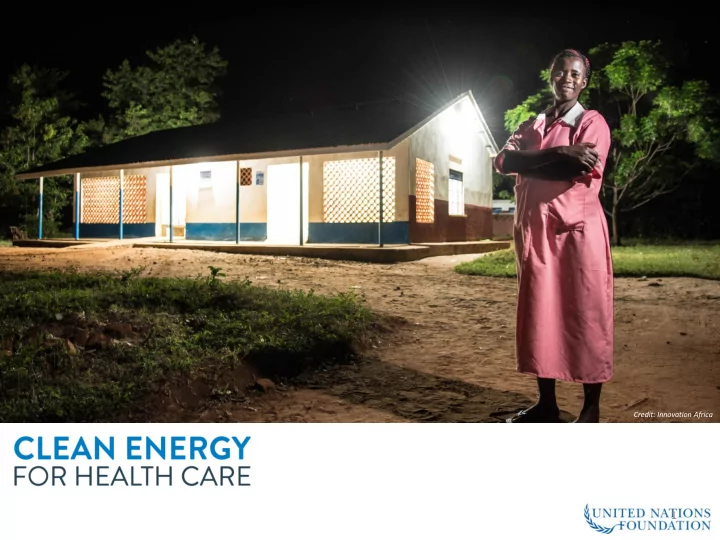
1 Despite recent progress, quality of health care in sub-Saharan - - PowerPoint PPT Presentation
Credit: Innovation Africa 1 Despite recent progress, quality of health care in sub-Saharan Africa remains a challenge 59% 72% 50% births attended by skilled child immunization health facilities lack health staff coverage (DPT-3) basic
Credit: Innovation Africa
1
health facilities lack basic water services
births attended by skilled health staff
child immunization coverage (DPT-3)
sub-Saharan Africans say they have access to high- quality health care
Source: WASH in health care facilities: Global baseline report 2019, WHO & UNICEF, 2019 Source: WHO Source: WHO & UNICEF
women die during pregnancy or childbirth each year
Source: Gallup World Poll
sub-Saharan Africans without access to timely, affordable, safe surgeries
Source: The Lancet Commission on Global Surgery Source: WHO
2
Additional investment required to meet SDG 3
Billions of $ (2014)
Source: Financing transformative health systems towards achievement of the health Sustainable Development Goals: a model for projected resource needs in 67 low- income and middle-income countries, Lancet Global Health, 2017
Infrastructure
3
Credit: UNDP Zambia/Slingshot Credit: UNDP Zimbabwe /Slingshot Credit: UN Foundation Credit: UNDP Zambia/Slingshot Credit: UN Foundation Credit: UNDP Zimbabwe /Slingshot Credit: UN Foundation Credit: New York Times Credit: MSF-East Africa Credit: UN Foundation Credit: Jake Lyell Credit: WASH in Health Care Facilities
4
Credit: We Care Solar
5
Access deficit
Million people
Source: Energy Access Outlook 2017: From Poverty to Prosperity, International Energy Agency, 2017
6
Source of electricity for rural health facilities
%
Ethiopia Kenya
challenge.
electricity from off-grid solar products.
areas have no access to grid electricity.
main source of electricity.
17% 68%
1% 7% 14% 8% 9% 2% 59% 16% 0% 20% 40% 60% 80% 100% Kenya (rural) Ethiopia (rural) No electricity Solar lighting system Solar PV system Generator National grid n=125 n=63
Source: Energy Sector Management Assistance Program
7
16% 26% 59% 48% 25% 26% 0% 20% 40% 60% 80% 100% Kenya (rural) Ethiopia (rural) Tier 0 Tier 1 Tier 2 Tier 3 Tier 4 Tier 5 No power
MTF Tier distribution among grid-connected rural health facilities
%
n=39 n=20
Ethiopia Kenya
Main issues with the grid electricity
fluctuations Main issues with the grid electricity
more than 2 hours of interruptions per week.
Source: Energy Sector Management Assistance Program
24-hr power
8
Availability of medical equipment in rural health facilities
%
Source: Energy Sector Management Assistance Program
9
Electrification rate
%
People without access
Million people
Source: Energy Access Outlook 2017: From Poverty to Prosperity, International Energy Agency, 2017
10
Facility-based delivery trends in Africa
% of all births taking place within a facility
0% 10% 20% 30% 40% 50% 60% 70% 80% 90% 100% 2000 2002 2004 2006 2008 2010 2012 2014 2016 2018 2020 Ghana Benin Chad
Uganda Tanzania Rwanda Namibia Lesotho
Source: Demographic and Health Surveys Program
11
Solar prices
$/W
Source: Bloomberg New Energy Finance
PV module prices have declined 93% in the last decade
12
Solar Kiosks
Portable Solutions Mini-grids Facility-wide ‘Micro-grids’ Stand-alone Solutions Tier 1 Tier 2 Tier 3 Tier 4 Tier 5 Level of Access Higher Lower
13
Source: Energy Access Outlook 2017: From Poverty to Prosperity, International Energy Agency, 2017
New connections On-grid Mini-grid Off-grid
14
Energy Efficient Medical Equipment
Comparative Costs of Stand- alone Power Equipped with…
Simulation of rural Kenyan facility @ 8.6kWh/day
15-25% savings
Capital Expense Operating Expense
Source: Access to Modern Energy Services for Health Facilities in Resource-Constrained Settings World Health Organization & World Bank, 2015
Conventional Medical Equipment
15
Credit: REUTERS/Philimon Bulawayo
16
Credit: UNDP Zambia/Slingshot
Credit: UNDP / Karin Schermbrucker for Slingshot
17