Activities proposed during the dog-assisted program . Encounter - - PowerPoint PPT Presentation

activities proposed during the dog assisted program
SMART_READER_LITE
LIVE PREVIEW

Activities proposed during the dog-assisted program . Encounter - - PowerPoint PPT Presentation

D EVELOPMENT OF A D OG -A SSISTED A CTIVITY P ROGRAM IN A P RIMARY S CHOOL TO IMPROVE WELLBEING AND SOCIAL INTERACTION AMONG PEERS Cinzia Correale, Marta Borgi, Lara Crescimbene, Francesca Cirulli The main aims of our educational intervention were:


slide-1
SLIDE 1

DEVELOPMENT OF A DOG-ASSISTED ACTIVITY PROGRAM IN A PRIMARY SCHOOL TO IMPROVE WELLBEING AND SOCIAL INTERACTION AMONG PEERS

Cinzia Correale, Marta Borgi, Lara Crescimbene, Francesca Cirulli

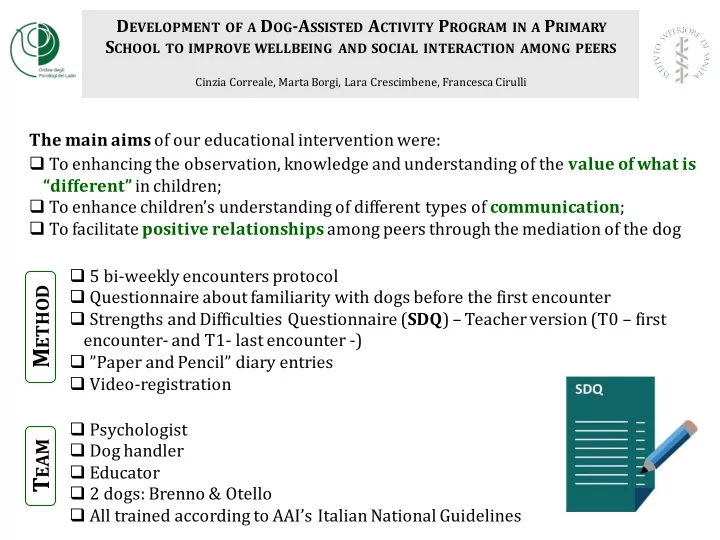
The main aims of our educational intervention were: q To enhancing the observation, knowledge and understanding of the value of what is “different” in children; q To enhance children’s understanding of different types of communication; q To facilitate positive relationships among peers through the mediation of the dog q 5 bi-weekly encounters protocol q Questionnaire about familiarity with dogs before the first encounter q Strengths and Difficulties Questionnaire (SDQ) – Teacher version (T0 – first encounter- and T1- last encounter -) q ”Paper and Pencil” diary entries q Video-registration q Psychologist q Dog handler q Educator q 2 dogs: Brenno & Otello q All trained according to AAI’s Italian National Guidelines

METHOD TEAM

slide-2
SLIDE 2

Encounter Goal Activities 1st encounter: “Evolution: from wolf to dog” Observation, knowledge and understanding of the value of what is "different” Group session: watching movies and images on the topic of evolution of the wolf and the domestication of the dog. 2nd encounter: “Exploring the world through the sense of smell” Putting oneself in someone's shoes, experience a different point of view Playing with dogs: blindfolded searching activities by using the sense of smell 3rd encounter: “A thousand ways to communicate” Use of nonverbal communication, understanding the importance of emotions in communication Team work: observation of dog behaviors and their categorization (emotional categories: happiness, sadness, insecurity, etc) 4th encounter: “How to play” Use the dog as a mediator of the relationship with peers to promote a positive interaction Team work: creation of fairy tales with dogs as main characters (narrative about a conflict to be solved) 5th encounter: “Please, take care

  • f me!”

Through the dog, children can experience their own interpretation of the parental role and what “taking care of

  • thers” means

Team work: drawing T

  • shirts to be

given as a goodbye gift to the dogs “Brenno” and “Otello”

Activities proposed during the dog-assisted program.

slide-3
SLIDE 3

All children rated as having difficulties at T0 (n=3) increased (abnormal) Total Difficulties scores at T1. The use of the SDQ questionnaire appears to have allowed teachers to become more aware of some behavioral problems that had been previously underestimated, as well as specific strengths characterizing some of the children.

RESULTS AND DISCUSSION

These observations may represent a first step that might encourage the application of dog-assisted programs to target specific behavioral/relational problems and to promote social integration in educational contexts, informing feasibility in the design of larger studies and suggesting assessment tools (i.e., SDQ).

CORRESPONDENCE

  • DR. CINZIA CORREALE – ORDINE DEGLI PSICOLOGI DEL LAZIO (ITALY)

networkiaa@ordinepsicologilazio.it REFERENCE CORREALE C, CRESCIMBENE L, BORGI M, CIRULLI F (2017) DEVELOPMENT OF A DOG-ASSISTED ACTIVITY PROGRAM IN AN

ELEMENTARY CLASSROOM. VET SCI 4(4):62.