SLIDE 1
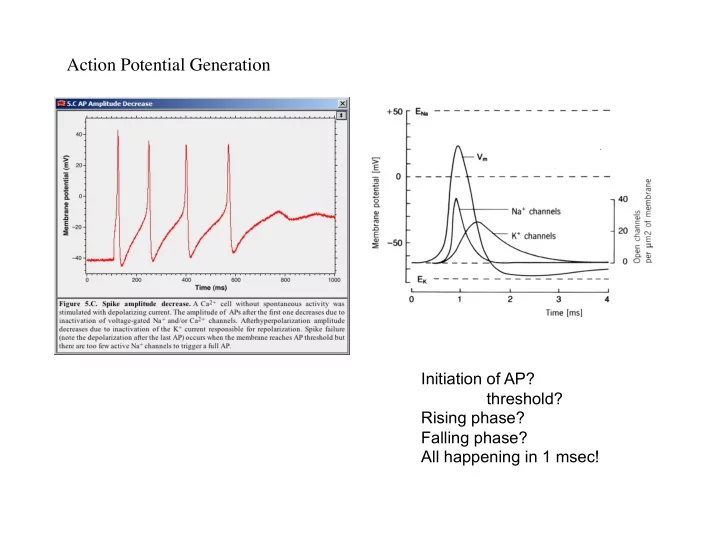
Initiation of AP? threshold? Rising phase? Falling phase? All happening in 1 msec!
Action Potential Generation
SLIDE 2
Current across membrane Im = I Rm + ICm Examples of passive voltages Initiating AP?? AP spread ahead Receptor potentials Synaptic potentials
SLIDE 3
Typical values 0.01 to 1.0 mm. Experimental measurement of space constant
SLIDE 4
Evolution of fast signal conduction
Reduce internal resistance to current flow Increase membrane resistance to leak current flow
SLIDE 5 Lambda and tau interact to determine speed and amplitude
- f voltage change ahead of AP
Tau 1-20 ms
SLIDE 6
Initiation Na vs K Na wins Threshold- dynamic Again Na vs K Fall- K
SLIDE 7
Traveling AP- unmyelinated nerve Local current flowing ahead of AP initiates next AP What happens first?- Spreading charge depolarizes Cm. 1 ms!
SLIDE 8
Also: Cs in series add reciprocally Traveling AP- myelinated nerve Comparison of traveling AP
SLIDE 9
Repolarization at Nodes of Ranvier by fast tau for repolarization unmyelinated nerve resting g= 0.2-1 mS/cm2, tau 1-20 ms myelinated nodes resting g= 40 mS/cm, tau= 100S! Traveling AP- myelinated nerve
SLIDE 10
AP conduction velocity: Squid giant axon vs. myelinated nerve
19 m/s = 43 mph 500 micron
Alpha motor neuron: 120 m/s = 268 mph 8.6 microns Unmelyinated C pain fibers: 2m/s = 4 mph 1.5 micron Same as 10 micron Frog myelinated fiber!!
Squid Mammal
Nerves
SLIDE 11
Refractory periods
SLIDE 12
Why doesn’t the AP go backwards?
SLIDE 13
Vr stable Vth unstable Vpeak could be stable but conductances are time and V sensitive I/V curve explanation for AP
SLIDE 14
Refractory periods D- gK>>>gNa C- gNa recovering, but no AP B- smaller AP A- full AP Notice threshold change
C,D A B
SLIDE 15
Add Ca to the equation Calcium APs
SLIDE 16
Examples of calcium APs
SLIDE 17
Na vs. Ca AP
SLIDE 18
Calcium current contributing to APs
SLIDE 19
Calcium current inactivation
SLIDE 20
Ca-activated K current
SLIDE 21
Na AP vs. Heart AP
SLIDE 22
Cardiac AP currents