SLIDE 1
Master Informatique - Université Paris-Sud (c) 2011-2017, Michel Beaudouin-Lafon mbl@lri.fr 1
Psychology 101
Action – Perception – Cognition Michel Beaudouin-Lafon Université Paris-Sud mbl@lri.fr
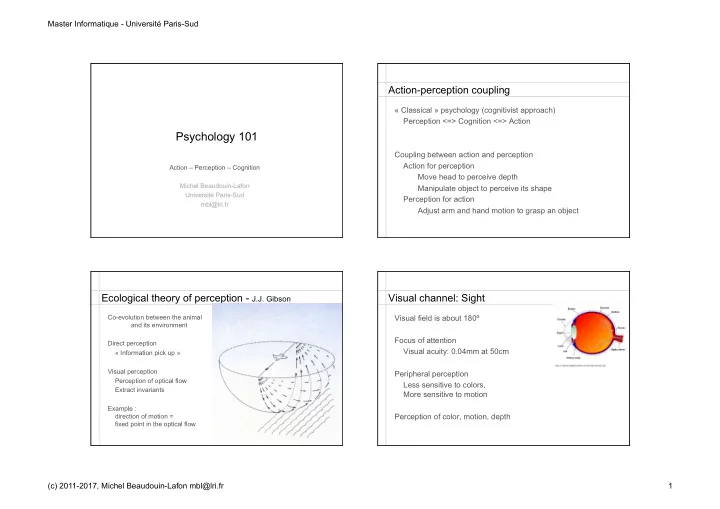
Action-perception coupling
« Classical » psychology (cognitivist approach) Perception <=> Cognition <=> Action Coupling between action and perception Action for perception Move head to perceive depth Manipulate object to perceive its shape Perception for action Adjust arm and hand motion to grasp an object
Ecological theory of perception - J.J. Gibson
Co-evolution between the animal and its environment Direct perception « Information pick up » Visual perception Perception of optical flow Extract invariants Example : direction of motion = fixed point in the optical flow
Visual channel: Sight
Visual field is about 180º Focus of attention Visual acuity: 0.04mm at 50cm Peripheral perception Less sensitive to colors, More sensitive to motion Perception of color, motion, depth
SLIDE 2
Master Informatique - Université Paris-Sud (c) 2011-2017, Michel Beaudouin-Lafon mbl@lri.fr 2
Held & Hein (1963) Kitten Carousel
The role of experience in perceptual-motor devlopment Self-produced movement and concurrent visual feedback are essential for the development of visually guided behavior
Depth illusion: Ames room The Monkey Business Illusion
Watch this video: https://www.youtube.com/watch?v=IGQmdoK_ZfY
Change blindness
We do not always notice changes in visual stimuli, even when the change is dramatic Attention is selective: notifications can go unnoticed
SLIDE 3
Master Informatique - Université Paris-Sud (c) 2011-2017, Michel Beaudouin-Lafon mbl@lri.fr 3
Auditory channel: Hearing
Very large sensitivity range Hearing without listening « Cocktail-party » effect Masking effects Distance between sources Distance between peak frequences Localizing a source Correlation with visual localisation
Auditory illusion: Sheppard-Risset tones
A sound that (seems to) always go down Audio equivalent to Escher’s stairs or fountain
Haptic channel: TPK
Touch: 6 types of sensors Hot, Cold, Pain Pressure, Touch (2 sensitivities)
Haptic channel: TPK
Touch Proprioception Configuration of one’s body in space, used to perceive, e.g., the shape of an object
SLIDE 4
Master Informatique - Université Paris-Sud (c) 2011-2017, Michel Beaudouin-Lafon mbl@lri.fr 4
Haptic channel: TPK
Touch Proprioception Kinesthesia Tension of one’s muscles, used to assess the weight or resistance of an object
Vestibular sense
Sense of balance: relative orientation in space Located in the inner ear Multimodal perception: visual, kinesthetic, vestibular Discrepancies cause
Motor system
Control body movements Locomotion Physical action Gesturing, hand movements Voice
Motor system
Control body movements Kinematic chain: articulated arrangement of the limbs to combine large amplitude and precise movements
SLIDE 5
Master Informatique - Université Paris-Sud (c) 2011-2017, Michel Beaudouin-Lafon mbl@lri.fr 5
Motor system
Control body movements Kinematic chain Bi-manual control (Yves Guiard) Non dominant hand: sets the context Dominant hand: acts within that context
Motor system
Control body movements Kinematic chain Bi-manual control (Yves Guiard) Application to a drawing interface: Toolglasses
Toolglasses and Magic Lenses, Bier et al., SIGGRAPH 1993
Motor system
Controlling a gesture: target pointing Fitts’ law MT= a + b log(1 + D/W)
MT, movement time D, distance to target W, width of target a, b, empirically determined constants
Scale invariant: pointing a target twice as large at a distance twice as long takes the same time
Functions of the gestural channel (Claude Cadoz)
Epistemic: acquire information Ergotic: transform through physical action Semiotic: emit information
SLIDE 6 Master Informatique - Université Paris-Sud (c) 2011-2017, Michel Beaudouin-Lafon mbl@lri.fr 6
Memory and learning
Short-term memory Working memory Low capacity (7 ± 2) Short-lived (10-30s) Long-term memory Infinite capacity Unlimited duration Associative access Repetition reinforces memory and learning
Different types of memory
http://www.human-memory.net/types.html
Action theory - Don Norman
Evaluation Interpretation Perception Intention
Execution System Goal Evaluation distance Execution distance
Plans and Situated Action (Suchman)
Humans do not always act according to a pre-made plan Action is situated The plan is revised / adapted according to the local situation Example: empty printer
- add paper
- print to another printer
- give up printing
SLIDE 7
Master Informatique - Université Paris-Sud (c) 2011-2017, Michel Beaudouin-Lafon mbl@lri.fr 7
Problem solving
Strategies in case of error Mental models Mental representations that help us reason and solve problems goal current state expected state starting state undo repair continue