NEW DIRECTIONS IN CONSERVATION PSYCHOLOGY WEBINAR SERIES Why Study - - PowerPoint PPT Presentation

new directions in conservation psychology webinar series
SMART_READER_LITE
LIVE PREVIEW

NEW DIRECTIONS IN CONSERVATION PSYCHOLOGY WEBINAR SERIES Why Study - - PowerPoint PPT Presentation

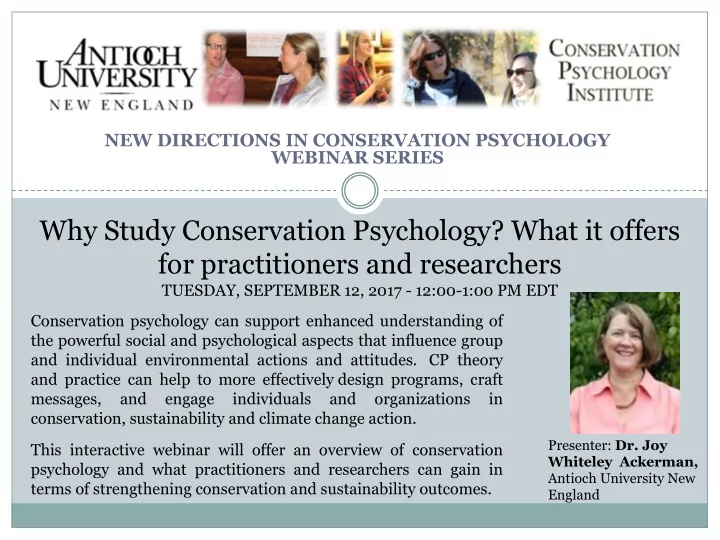
NEW DIRECTIONS IN CONSERVATION PSYCHOLOGY WEBINAR SERIES Why Study Conservation Psychology? What it offers for practitioners and researchers TUESDAY, SEPTEMBER 12, 2017 - 12:00-1:00 PM EDT Conservation psychology can support enhanced


slide-1
SLIDE 1

NEW DIRECTIONS IN CONSERVATION PSYCHOLOGY WEBINAR SERIES

Why Study Conservation Psychology? What it offers for practitioners and researchers

TUESDAY, SEPTEMBER 12, 2017 - 12:00-1:00 PM EDT Conservation psychology can support enhanced understanding of the powerful social and psychological aspects that influence group and individual environmental actions and attitudes. CP theory and practice can help to more effectively design programs, craft messages, and engage individuals and

  • rganizations

in conservation, sustainability and climate change action. This interactive webinar will offer an overview of conservation psychology and what practitioners and researchers can gain in terms of strengthening conservation and sustainability outcomes.

Presenter: Dr. Joy Whiteley Ackerman, Antioch University New England

slide-2
SLIDE 2

NEW DIRECTIONS IN CONSERVATION PSYCHOLOGY WEBINAR SERIES

Why Study Conservation Psychology? What it offers for practitioners and researchers

TUESDAY, SEPTEMBER 12, 2017 - 12:00-1:00 PM EDT Webinar Logistics

  • Everyone should be connected via Audio Broadcast upon entering the webinar – You do

not need to call in and you are automatically muted

  • The presentation will be recorded and posted to the Antioch web site within a week
  • Please submit any questions you have for the presenter in the Q& A section
  • If you are having trouble with any aspect of the broadcast, use the Chat section to

message the Host directly

slide-3
SLIDE 3

NEW DIRECTIONS IN CONSERVATION PSYCHOLOGY WEBINAR SERIES

Why Study Conservation Psychology? What it offers for practitioners and researchers

TUESDAY, SEPTEMBER 12, 2017 - 12:00-1:00 PM EST

  • Overview & Introductions
  • Abigail Abrash Walton, PhD
  • Presentation
  • Joy Whiteley Ackerman, PhD
  • Audience Questions

Moderator: Dr. Abigail Abrash Walton, Antioch University New England

slide-4
SLIDE 4

NEW DIRECTIONS IN CONSERVATION PSYCHOLOGY WEBINAR SERIES

Building the Capacity of Conservation Professionals to Predict Behavior

TUESDAY, OCTOBER 17, 2017 - 12:00-1:00 PM EDT Conservation professionals are becoming increasingly cognizant of their need to better predict human behavior as it relates to environmental conservation. This presentation will explain the five psychological indicators that predict 34% of variation in a professional’s capacity to apply new skills effectively after a training: meaningful ownership, effective autonomy, explicit need, group efficacy, and self-regulated knowledge. Additionally, the presenter will discuss why these indicators are critical to the long-term success of conservation professionals.

Presenter: Kayla Cranston, Ph.D.

slide-5
SLIDE 5

Why Study Conservation Psychology?

An OVERVIEW

Context Definition Development Network Approaches Application Reiteration Your Questions!

slide-6
SLIDE 6

Conservation Social Sciences are

“diverse traditions of using

social science to understand and improve conservation policy, practice and

  • utcomes.”

Also referred to as

  • environmental social science
  • human dimensions of natural

resource management

  • social-ecology systems research

Bennett et al 2017

ZOOM OUT

slide-7
SLIDE 7

Conservation Psychology is

“the scientific study of the reciprocal relationships between humans and the rest of nature, with a particular focus on how to encourage conservation

  • f the natural world.”

Saunders, 2003

ZOOM IN

slide-8
SLIDE 8

Like Conservation Biology

Conservation Psychology is an Interdisciplinary, Mission Oriented* Field of Study

*improving conservation outcomes

slide-9
SLIDE 9

Conservation Psychology is also

  • a network of

researchers and practitioners

  • an iterative approach to

identifying research questions

Conservation Psychology Institute Participants June 2016

slide-10
SLIDE 10

Areas of Study

  • Conservation Behavior
  • Nature Care and

Connection

  • Effective Environmental

Communication

slide-11
SLIDE 11

Approaches

  • Theoretical

Developing Conceptual Models

  • Applied

Identifying Effective Strategies

  • Evaluative

Measuring Success

slide-12
SLIDE 12

Scales or Levels

  • Individual
  • Group
  • Society
slide-13
SLIDE 13

Application

Previous Webinars: April 2017 Kim Langmaid: Walking Mountains Science

Center & Amy Weidensaul: Audubon Society

Upcoming Webinars: Practitioner-Oriented Publications

Influencing Conservation Action: What Research Says About Environmental Literacy, Behavior and Conservation Results (National Audubon Society, EETAP, US Fish & Wildlife Service, NAAEE). Common Cause for Nature: Finding Values and Frames in the Conservation Sector (Public Interest Research Centre) Climate Communications and Behavior Change: A Guide for Practitioners (cooldavis.org)

slide-14
SLIDE 14

Why Study People?

Because human behavior is at the root of our most pressing environmental challenges Because your work - no matter where or what it is - will involve you with people and society Because you want to engage and communicate effectively with your clients, students, and audiences Because making a difference means leveraging social and individual change

slide-15
SLIDE 15

Reference List

Bennett,Nathan J. et al. 2017. Conservation social science: Understanding and integrating human dimensions to improve conservation. Journal of Biological Conservation 205:93-108. http://dx.doi.org/10.1016/j.biocon.2016.10.006 Saunders, Carol. 2003. The Emerging Field of Conservation Psychology . Human Ecology Review. 10 (2):p. 137-149. De Young, Raymond. 2013. Environmental Psychology Overview. In: Huffman, A.

  • H. and Klein, S., editors. Green Organizations: Driving Change with IO
  • Psychology. New York (NY): Routledge. p. 17-33.

Clayton, S and Saunders, C. 2012.Introduction: Environmental and Conservation

  • Psychology. In: Clayton, S. The Oxford Handbook of Environmental and

Conservation Psychology. New York (NY): Oxford University Press. p. 1-8.