Happiness Reconsidered: A Perspective on Psychology (and Economics?) - - PDF document

happiness reconsidered
SMART_READER_LITE
LIVE PREVIEW

Happiness Reconsidered: A Perspective on Psychology (and Economics?) - - PDF document

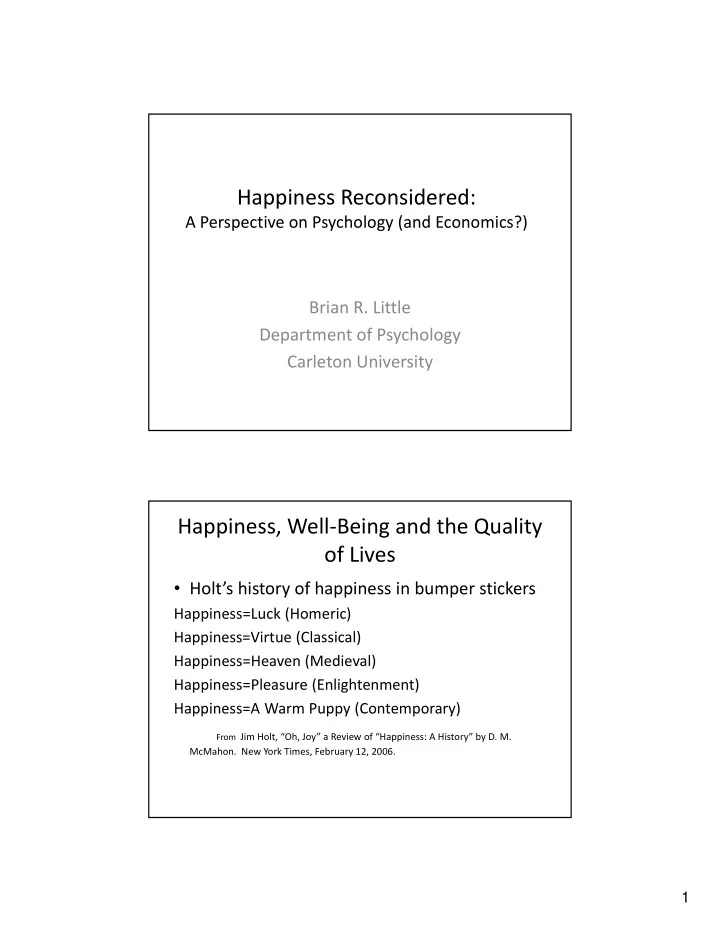
Happiness Reconsidered: A Perspective on Psychology (and Economics?) A Perspective on Psychology (and Economics?) Brian R. Little Department of Psychology Carleton University Happiness, Well Being and the Quality of Lives Holts history


slide-1
SLIDE 1

1

Happiness Reconsidered:

A Perspective on Psychology (and Economics?) A Perspective on Psychology (and Economics?)

Brian R. Little Department of Psychology Carleton University

Happiness, Well‐Being and the Quality

  • f Lives
  • Holt’s history of happiness in bumper stickers

Happiness=Luck (Homeric) Happiness=Virtue (Classical) Happiness=Heaven (Medieval) Happiness=Pleasure (Enlightenment) Happiness=A Warm Puppy (Contemporary) Happiness A Warm Puppy (Contemporary)

From Jim Holt, “Oh, Joy” a Review of “Happiness: A History” by D. M.

  • McMahon. New York Times, February 12, 2006.
slide-2
SLIDE 2

2

  • Complexity of the good:

– Eudaimonic and hedonic well‐being: contemporary debate about whether they are distinct – Flourishing includes happiness, physical vitality and accomplishments: Statistical analyses confirm bli l ti hi hi ll d

  • blique relations among hierarchically arranged

components

  • When we measure aspects of flourishing how

d h l t t lit ? do such measures relate to personality?

  • Heckman’s 2009 challenge: what are the “non‐

cognitive” characteristics that mediate human development (e.g. progressing through the school system)? y )

– Two ways personality psychologists answer the challenge: Traits (e.g. Big Five) and Personal action constructs (PAC units) (e.g. personal projects).

slide-3
SLIDE 3

3

Big Five Traits and Flourishing

  • Openness to Experience
  • Conscientiousness
  • Extraversion
  • Agreeableness
  • Neuroticism
  • Openness to Experience

– Linked to creativity, innovation: importance of fact that creative individuals open to both positive and negative emotion – Myth of the creative hero – Regional variation: very high in western U.S.

slide-4
SLIDE 4

4

  • Conscientiousness

– Excellent predictor of successful outcomes in workplace and in health – One exception? Jazz musicians

  • Extraversion

– Need stimulation to reach optimal arousal levels (implications for caffeine consumption and crime rates – Lower risk aversion – U.S. state with the highest extraversion?

  • North Dakota (the Fargo factor?)
slide-5
SLIDE 5

5

  • Agreeableness

– Relation to commons dilemmas. Highly agreeable individuals more sensitive to commons. Highly extraverted individuals are less sensitive. – Individuals low in agreeableness at much greater risk for health problems, particularly di l bl cardiovascular problems

  • Neuroticism

– High levels of neuroticism much greater risk aversion (low threshold for detecting punishment cues). Especially so in neurotic introverts – Stability (low N) associated with greater resiliency

slide-6
SLIDE 6

6

Personal Action and Flourishing

  • Personal Projects:

– Extended sets of personally salient action in context – They can be measured through a suite of assessment devices (PPA) – Human well‐being arises from the sustainable pursuit of core personal projects

  • Not so much the “pursuit of happiness” as “the

happiness of pursuit”

  • Sustainable pursuit of core projects involves

– Internal, regulatory skills and resources – External, social ecological skills and resources (including economic factors) – Optimal development is based on an accurate reading of eco‐system resources and constraints

  • The positive tilt debate.
slide-7
SLIDE 7

7

A Social Ecological Model of Well Being

  • Person Attributes: Stable, Mutable
  • Contextual Attributes: Stable, Mutable
  • Personal Projects
  • Quality of Life (Optimal Functioning)

– Health, happiness, SBW, sustainable human development, “hard indicators”

Examples of the Content of Personal Projects

“l ” t d

  • Get my pilot’s license

tti t b d

  • “loose” ten pounds
  • be a better Druid
  • repair my guilt
  • repair my quilt
  • maybe apologizing to
  • getting a water bed
  • going to Colorado
  • going to the Bahamas
  • getting out of debt

y p g g my brother

slide-8
SLIDE 8

8

  • become more

extraverted

  • Continue to “grow” as a

person and find extraverted

  • come to terms with my

stance on religion and its relevance in my life

  • build a cabin in the

woods person and find contentment in everyday life

  • letting my fingernails

grow woods

  • spending at least 1/2

hour a day with pet

  • Singing with friends

itti b k d hour a day with pet budgie

  • Get my cat house‐

trained

  • Be sensitive to my

incontinent mother

  • sitting back and

enjoying the music

  • playing with my dog
  • hugging my friends
  • try to be more easy

incontinent mother going

slide-9
SLIDE 9

9

  • Move to Las Vegas

G t j b

  • Tell my sister to get rid
  • f her sickening
  • Get a job
  • f her sickening

boyfriend

  • Think before saying

something stupid

  • Give a talk to Carleton

economics department economics department

  • Don’t give too many

examples of personal projects

slide-10
SLIDE 10

10

Assessment Modules for Personal Projects Analysis

  • Elicitation Module: What’s Up?
  • Appraisal Module: How’s it Going?
slide-11
SLIDE 11

11

  • Three Contextual Modules:

– Primary context: Laddering Hows and Whys – Secondary context: Cross‐Impact Matrix – Tertiary context: Joint Cross‐Impact Matrix

Five Factor Model of Project Appraisals and Well Being

j i j lf id i

  • Project Meaning: e.g. enjoyment, self‐identity
  • Project Structure: e.g. initiation, control
  • Project Community: e.g. visibility, support
  • Project Efficacy: e.g. progress, competence
  • Project Stress: e.g. stress, difficulty

j g , y

slide-12
SLIDE 12

12

Projects Highest in Self‐Identity for Adolescents

  • Sports 8.14
  • Boy/girlfriend 8 45
  • Reading

6.15

  • Estate

6 04

  • Boy/girlfriend 8.45
  • Sex

8.63

  • Spiritual 8.85
  • Community 9.75
  • Estate

6.04

  • Academic

5.65

  • Anti‐School

4.80

Intrapersonal Projects: A Paradox?

  • Intrapersonal projects and depressive affect
  • Intrapersonal projects and creativity
  • The origin of the self‐change project
slide-13
SLIDE 13

13

Examples of Ad hoc Dimensions and Eco‐Settings Studied

  • Self identity: Voices in the classroom
  • Age you feel: Voices of mid‐life men
  • Studies of the elderly: Some surprising

findings?

  • “South East Asian Immigrants” and “language

difficulties” difficulties”

  • Pregnancy, entrepreneurs and “emotional

support”

  • Facilitation of built environment on access to
  • utdoor projects
  • Gender, connection and agency
  • Projects in Portugal: saudade and jubilation
slide-14
SLIDE 14

14

Conclusions and Caveats

  • Optimal functioning comprises the sustainable

it f j t i t l l t pursuit of core projects: internal regulatory skills and social ecological skills and affordances

  • Be careful about explicitly focusing on

“happiness projects” pp p j

  • Fortuity and the unexpected good

Happiness is Engagement

slide-15
SLIDE 15

15