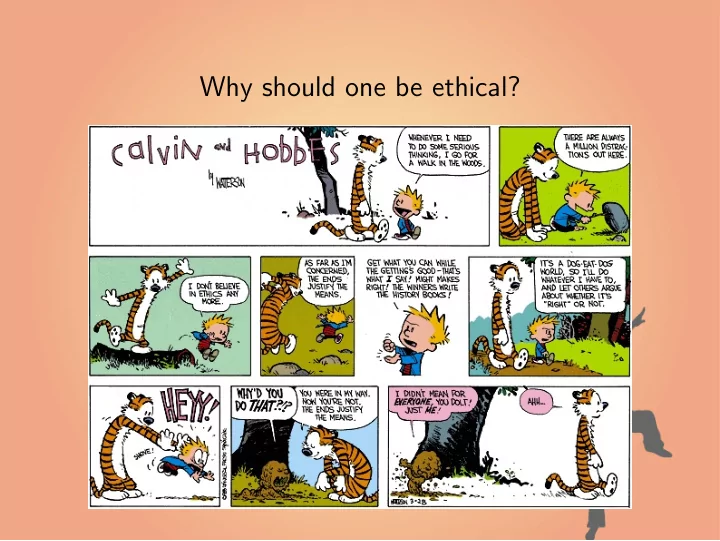
SLIDE 1
Why should one be ethical?
SLIDE 2
The Ring of Gyges
◮ What would you do if you could turn invisible at will? ◮ Plato’s Republic is one of the most important defenses of
ethics of all time
◮ In the Republic, Socrates debates with a number of people
(chiefly Glaucon) on why we should act justly.
◮ According to Socrates (Plato), it is always better to be just
than unjust, regardless of outcomes (even if you are thought to be the most unjust person in the world.
◮ According to Glaucon, justice has merely intstrumental value
as a means to an end.
SLIDE 3
The Ring of Gyges
◮ According Glaucon, we only agree to be just in order to avoid
a worse outcome
◮ The best thing for you is to be able to be unjust to people,
while not having anyone be unjust to you.
◮ The worst thing for you is to suffer injustice while not being
able to inflict injustice on anyone else
◮ The badness of the latter much outweighs the goodness of the
former.
◮ In order to avoid the horrible situation in which everyone else
takes advantage of us, we agree to form societies with laws which force people to be just.
◮ In effect, we give up our right to be unjust in order to secure
that no one will be unjust with us.
◮ His ultimate proof of this is the Ring of Gyges Example
SLIDE 4
The Ring of Gyges
◮ The Ring of Gyges was a mythical ring which would allow the
wearer to turn invisible when the ring was turned inward
◮ Glaucon’s Challenge: Who among us would really still act
justly all the time if they had the Ring of Gyges
◮ If in fact everyone would do wrong things if they could get
away with it (which presumably they could with the Ring of Gyges) then we in fact only follow the laws in order to avoid injustice, not because we think they are actually good.
◮ Socrates thinks that one should still be just even with the
Ring of Gyges. That is, he thinks that even if there were no consequences for being immoral, being moral is still better than being immoral.
SLIDE 5
Why Live Ethically
◮ You might recall that this section of the class is labeled “How
should we live?”
◮ I can’t claim that we have looked or will look at all the
relevant existential questions included in that question
◮ Instead, we are looking at the classic answer to that
question−one should live ethically.
◮ Two questions arise to that answer−What is ethical? Why
should we be ethical?
◮ The first question is answered by normative ethics; it gives us
general rules how to live ethically
◮ The second question is what we turn to now: Why should we
be ethical?
SLIDE 6
Why Live Ethically
◮ Why be ethical? ◮ One way to think about this question is, why should a person
with the Ring of Gyges still be ethical?
◮ Another way to think about it is to consider two other
positions in ethics:
◮ Egoism claims that the right thing to do is whatever is best
for oneself; each individual should be entirely self-centered.
◮ Nihilism claims that there is no such thing as right or wrong.
There are personal preferences, and that is it. I may not prefer murder, and if a bunch of us with that preference get together we may make a solemn promise to prevent murder (a law), but there is nothing correct or incorrect about our preferences; they are just the preferences we happen to have. For nihilism, it is not even right or wrong to do what benefits yourself, it is just stuff you do.
◮ Some nihilists will make various claims to make sense of our
moral language; we can think of “charity is good” as meaning” “I like charity” and “bullying is bad” as “I dislike bullying.
SLIDE 7 Why Live Ethically
◮ While egoism and nihilism are distinct positions, in practice
they amount to the same thing.
◮ In practice, each position amounts to individuals doing
whatever they can to advance their aims by all means necessary.
◮ The questions of ethical foundations can be helpfully
rephrased as a number of different questions:
◮ What are we to say to the ethical egoist and nihilist? ◮ Why shouldn’t they just do whatever their impulses and desires
tell them to do?
◮ If they can get away with it (Ring of Gyges), why shouldn’t
they steal and kill and rape and whatever else they desire to do?
◮ To put it in more realistic terms, why shouldn’t you just go out
partying every night of the week, have sex with anything that moves, cheat your way through college, and use your (or your family’s) connections to land a high paying job after college?
SLIDE 8 Why Live Ethically
◮ The questions of ethical foundations can be helpfully
rephrased as a number of different questions:
◮ What are we to say to the ethical egoist and nihilist? ◮ Why shouldn’t they just do whatever their impulses and desires
tell them to do?
◮ If they can get away with it (Ring of Gyges), why shouldn’t
they steal and kill and rape and whatever else they desire to do?
◮ To put it in more realistic terms, why shouldn’t you just go out
partying every night of the week, have sex with anything that moves, cheat your way through college, and use your (or your family’s) connections to land a high paying job after college?
◮ Many people respond that the main reason not to is that you
would get caught and get in legal trouble, which is precisely what is so brilliant about Plato’s Ring of Gyges example−it asks what you would do if you knew you would get away with
- it. The Ring of Gyges is supposed to remove the legal answer
from the equation so we can just look at the ethics.
SLIDE 9
Mill’s Answer
◮ The utilitarian says that one should do the action that results
in the greatest amount of pleasure for the greatest number of people.
◮ Why should the egoist/nihilist care? ◮ The answer seems to be “because this is what is most
valuable.” We value pleasure, so the action that in fact maximizes pleasure is in fact the most valuable action.
◮ So what can the utilitarian say if the egoist/nihilist responds
“why should I do the most valuable thing?”
SLIDE 10
Mill’s Answer
◮ The utilitarian might try to appeal to the egoist by saying that
this is in fact what will work out best for him/her in the long run (if everyone tries to maximize pleasure for everyone), but we really can’t be sure of this.
◮ Examples like the trolley cases (and more grotesque examples)
show that utilitarian ethics could be very bad for me personally.
◮ If I am an egoist, I don’t care if my being tortured to death
saves a billion people, I don’t want to be tortured to death!
SLIDE 11
Mill’s Answer
◮ The best way for the utilitarian to respond is to say that “the
good” is just what should be pursued.
◮ The utilitarian is merely showing that maximizing pleasure is
“the good;”
◮ We just know independently that, whatever the good is, we
should pursue it.
◮ While this is not a particularly compelling or motivating
answer, it’s not fair to say that the utilitarian has no answer−many people have thought it was just obvious that we should pursue the good, whatever that turns out to be.
◮ Nonetheless, it is worrisome that the utilitarian has nothing
particular to say to the egoist who just wants to take advantage of people.
SLIDE 12
Kant’s Answer
◮ Deontological ethics says that one should act on principles
which she wishes to be universalized; that no one should make an exception of themselves.
◮ The egoist and nihilist specifically want to make special rules
for themselves so that they can get everything they want for themselves.
◮ Kant’s response is based on the nature of what he calls
autonomy.
SLIDE 13
Kant’s Answer
◮ We are autonomous when we are in control of ourselves,
exercising our free will.
◮ Autonomy seems like a desirable thing; if we are not
autonomous, we just kinda do things without those things actually being guided by our rationality and desires.
◮ However, Kant argues, we are only autonomous when we are
following the categorical imperative.
◮ Roughly, to make an exception of ourselves is to be irrational. ◮ If I think that I should cheat others, but others should not
cheat me, then I am contradicting myself. I am telling myself to do something that I don’t think should be done, which is just to be irrational.
◮ If I am acting irrationally rather than on principles, then I am
not autonomous.
SLIDE 14
Kant’s Answer
◮ To put the point another way, I have to be acting for reasons
in order to be acting rationally (or freely).
◮ Reasons, by their very nature, are things that we think are
true.
◮ If I think it is true that I should A, but I think it is false that
someone else should A, then I think the same thing is both true and false and am being irrational.
◮ Where this ultimately leaves us is that Kant can say that the
egoist and nihilist are irrational and thereby non-autonomous.
◮ Suppose the egoist responds, “thats ok, I like being irrational
because it makes me happy!” What else can Kant say? Has he said enough?
SLIDE 15
Aristotle’s Answer
◮ Virtue ethics holds that there is a condition of life called
“eudaimonia” or “happiness.”
◮ This is not so much of a feeling, like pleasure or boredom, but
more like a state of being, like healthy or weak.
◮ Happiness is the state of living life well. ◮ This only makes sense if there is a standard of what counts as
living life well.
◮ We consider someone healthy when all their organs and other
physical parts are functioning properly, when their heart is pumping blood well, when their stomach is properly digesting food, etc.
◮ Virtues allow things to fulfill their function better. ◮ Virtues for living bodies would be things like self-healing,
disposal of waste, efficient energy absorption
SLIDE 16 Aristotle’s Answer
◮ Likewise, we consider someone a good basketball player if they
can shoot accurately, handle the ball well, get rebounds, block shots, steal the ball, and whatever else goes into playing the game well.
◮ The proper function of a basketball player is to play basketball
well, and he/she fulfills his/her function well if he/she has certain virtues such as dexterity, agility, speed, athleticism, etc.
◮ Everything has a proper function (scissors, horses,
manufactures, etc.)
◮ For Aristotle, the function of humans is something unique to
them; since the unique characteristic of humans is the ability to reason, he says that the function of a human is “the activity of the soul in accordance with reason.”
◮ The classic “virtues” (courage, justice, temperance, prudence,
generosity, compassion, etc.) are things that allow us to fulfill
- ur function well−Without developing virtues we cannot live
well the life of reason.
SLIDE 17
Aristotle’s Answer
◮ Aristotle thus gives slightly different answers to the egoist and
nihilist.
◮ To the nihilist he says that there is in fact one proper way to
live (the way that fulfills our function).
◮ To the egoist, he says that given what living well consists in,
it requires virtue. He would think of the egoist as someone who says, “to be healthy you should eat whatever you are craving at the moment.” They have just not grasped what is necessary for happiness.
SLIDE 18
Plato’s Answer
◮ Recall that in the Republic Socrates is defending that justice
is so much better than injustice, that the just person who is thought completely unjust will be happier than the unjust person who is thought completely just.
◮ His arguments for this thesis generally start with an analogy
between parts of the soul and something else (for instance, parts of the city, or various animals, or a charioteer and horses).
◮ What is common to all the various analogies is that there are
three parts of the the soul: appetite, spirit, and reason.
SLIDE 19 Plato’s Answer
◮ What is common to all the various analogies is that there are
three parts of the the soul: appetite, spirit, and reason.
◮ The appetite is our basic desires (money, comfort,
satisfaction) etc. All it really does is form desires for basic things; Socrates thinks that if we are using it well it will form
- nly necessary and good desires (e.g. desires for healthy
sustaining food, rather than desires for gallons of ice cream).
◮ The spirit is your heart/ your passions. It is the part of the
soul responsible for emotions. Using it well will result in emotions which are appropriate to any given situation.
◮ Reason is your head; it desires truth and wisdom. Used
properly, it keeps everything in accord with truth.
SLIDE 20 Plato’s Answer
◮ Socrates argument against the egoist, that it is always better
to be just than unjust, is psychological in nature.
◮ When we are being just (or virtuous), we are letting reason
use the spirit to control the appetites (so the head is in charge
◮ When we are unjust, we feed and strengthen our appetites
while we starve our reason (so the stomach is in charge of the head). Socrates thinks it is clearly a happier life when reason is in control.
◮ When reason is in control, we are free to pursue what reason
desires and we in fact gain most of what we desire.
◮ On the other hand, if our appetites control us, then we will be
enslaved to the least human part of us.
SLIDE 21
Plato’s Answer
◮ Socrates argument against the egoist, that it is always better
to be just than unjust, is psychological in nature.
◮ Worse than this, appetites grow the more they are fed, so if
we continue to give the appetite control, it eventually will desire more than it can possibly get.
◮ This means that the egoist who just does whatever she desires
will end up with many more unfulfillable desires than the virtuous person.
◮ Assuming that happiness at least partially depends on being
able to do what we want to do, then the just life is happier than the unjust life.
SLIDE 22 Formalizing Plato’s Answer
- 1. Being vicious strengthens the appetite part of the soul while weakening
the rational part of the soul.
- 2. Being virtuous strengthens the rational part of the soul while weakening
the appetite part of the soul.
- 3. When the appetite is strengthened it desires more than it did before
- 4. Being vicious makes us desire more than we did before (1, 3)
- 5. There is a point at which not all desires can be fulfilled
- 6. Being vicious will lead us to a point at which not all our desires can be
fulfilled (4, 5)
- 7. We are more free when we are more able to choose from a variety of
- ptions
- 8. The rational part of the soul is able to choose from various options
- 9. The appetite part of the soul always chooses what it immediately desires
- 10. We are more free when we are virtuous than when we are vicious (1, 2, 7,
8, 9)
- 11. The appetite is the least human part of us
- 12. The more we are vicious, the more we are enslaved by the least human
part of us (1, 11)
- 13. The vicious person will be less free, less human, and have more frustrated
desires than the virtuous person (6, 10, 12)
- 14. Freedom, humanness, and fulfilled desires are necessary for full happiness
- 15. Therefore, the virtuous person is always more happy than the vicious
person (13, 14)
SLIDE 23 The Religious Answer
◮ From very early in human history, humans have said that they
should do good so that they may be blessed by the god(s).
◮ According to this way of thinking, the egoist and nihilist are
foolish because they do not understand that there is a divine law by which they will be punished, in this life or the next.
◮ A lot of religions have particular normative ethics in the form
- f doing what the sacred text tells you to do.
◮ If the sacred text tells us what God wants, then if we are being
good to please God, we should do what the sacred text says.
◮ However, there is a very famous problem for this position−the
Euthyphro dilemma.
SLIDE 24
The Religious Answer
◮ The Euthyphro dilemma can be stated as a question:
Are things good because God says they are good, or does God say they are good because they are good?
◮ If they are good because God says they are good, then ethics
seems arbitrary−what if tomorrow God decides that murder is good and feeding the poor is bad; do we really want to say that it would then be good to kill people and bad to feed the poor?
◮ If God says they are good because they are good, then God is
merely recognizing goodness−things are right or wrong independently of God. Perhaps God is very skilled at recognizing good and evil, so sacred texts could still be good for telling us the answers on things, but ethics no more depends on God than gravity depends on physicists.
◮ Both options seem bad, so how might the defender of the
religious answer respond?
SLIDE 25
Horn 1: Ethics are Arbitrary
◮ Søren Kierkegaard was a Danish philosopher of the early 19th
century who defended the position that right and wrong depend entirely on what God declares to be right and wrong.
◮ His prime example that he used to illustrate this was the
biblical story of Abraham and Isaac. Picking up the story in Genesis 22, we read: Some time later God tested Abraham. He said to him, “Abraham!” “Here I am,” he replied. Then God said, “Take your son, your only son, whom you loveIsaacand go to the region of Moriah. Sacrifice him there as a burnt offering on a mountain I will show you.” Early the next morning Abraham got up and loaded his donkey. He took with him two of his servants and his son Isaac. When he had cut enough wood for the burnt offering, he set out for the place God had told him about.
SLIDE 26 Horn 1: Ethics are Arbitrary
◮ On the third day Abraham looked up and saw the place in the
- distance. He said to his servants, “Stay here with the donkey
while I and the boy go over there. We will worship and then we will come back to you.” Abraham took the wood for the burnt offering and placed it on his son Isaac, and he himself carried the fire and the knife. As the two of them went on together, Isaac spoke up and said to his father Abraham, “Father?” “Yes, my son?” Abraham replied. “The fire and wood are here,” Isaac said, “but where is the lamb for the burnt offering?” Abraham answered, “God himself will provide the lamb for the burnt offering, my son.” And the two of them went on together. When they reached the place God had told him about, Abraham built an altar there and arranged the wood on it. He bound his son Isaac and laid him
- n the altar, on top of the wood.
SLIDE 27 Horn 1: Ethics are Arbitrary
◮ Then he reached out his hand and took the knife to slay his
- son. But the angel of the Lord called out to him from heaven,
“Abraham! Abraham!” “Here I am,” he replied. “Do not lay a hand on the boy,” he said. “Do not do anything to him. Now I know that you fear God, because you have not withheld from me your son, your only son.” Abraham looked up and there in a thicket he saw a ram caught by its horns. He went over and took the ram and sacrificed it as a burnt offering instead of his son. So Abraham called that place The Lord Will Provide. And to this day it is said, “On the mountain of the Lord it will be provided.”
SLIDE 28 Horn 1: Ethics are Arbitrary
◮ Should Abraham have done that? ◮ Did God have the right to command murder? Should a
religious person today kill someone if God commanded them?
◮ According to Kierkegaard, the only faith worth having is a
faith that can ask us to do otherwise irrational things. If we were not willing to receive ridiculous commands, like killing your son or marching around a wall, then we don’t really have
- faith. Sure ethics could seem somewhat arbitrary if you could
be told murder used to be wrong but now is right, but on the
- ther hand, if you think God is good, why not think that all
his judgments are good?
SLIDE 29
Horn 2: God is the Enforcer
◮ Suppose, on the other hand, that God says things are good
because they are good.
◮ This means there is an ethical standard independent of God to
which God himself is subject.
◮ If this is the case, in what way can we still say that God is
relevant to ethics (particularly relevant to the egoist and nihilist)?
◮ One thing that could be said is that God might tell us what is
right and wrong in sacred texts. While this is relevant, it is not relevant to the egoist and nihilist other than informing them that they is factually wrong in their beliefs.
SLIDE 30
Horn 2: God is the Enforcer
◮ What is more relevant is if God acts as a divine law enforcer.
Many religions believe in some sort of karmic system where God(s) punish evil and reward good, in this life or the next.
◮ If this is the case, the rational egoist should do good and
avoid evil out of self-interest; if she continues to do evil, she is just really bad at trying to achieve her aims of happiness.
◮ Does this actually motivate people? Should it? ◮ Do we see these punishment and rewards in this life? ◮ Should we like a God that acts like this? ◮ Is God then a grown-up version of Santa Claus?
SLIDE 31
Splitting the Horns: God’s character
◮ Some philosophers have tried to find a third option by saying
that morality depends on God (so it is not a higher standard), but it is not arbitrary or changing because it depends on his unchanging character (not his will).
◮ Good is whatever is like the character of God, and bad is
whatever is unlike the character of God.
◮ Assuming God’s character is not changing or arbitrary, ethics
will not be changing or arbitrary.
SLIDE 32 Splitting the Horns: God’s character
◮ Suppose this is a legitimate 3rd option, so what? If saying
“action A is good,” means the same thing as “action A is in line with God’s character,” why does this matter to the egoist
◮ For one thing, they are now both factually wrong. The nihilist
is wrong because there is in fact a good and a bad; the egoist is most likely wrong because it is unlikely that what is in one’s selfish interest is always in line with God’s character (consider the fact that sometimes lying will be in one’s self-interest, and sometimes telling the truth will be in one’s self-interest).
◮ Beyond this it seems a bit like the utilitarian answer. If it is
just analytically true that “one ought to seek the good,” then they ought to live in line with this, but it is hard to see how this will matter to them.
◮ The one potential advantage this system has over the
utilitarian system is that God could still be a law enforcer−rewarding those who do good and punishing those who do evil.
SLIDE 33
The Religious Answer
This still leaves open a lot of questions:
◮ How could we know what the character of God is like? ◮ Which of the many religious traditions (if any) gives us the
right normative ethics?
◮ What if God’s character seems really bad to us (such as with
the wars and plagues of the old testament)?
◮ Should we like a God that polices the world in this way?