
SLIDE 1
ACRYLIC
Gabriela Mesquita
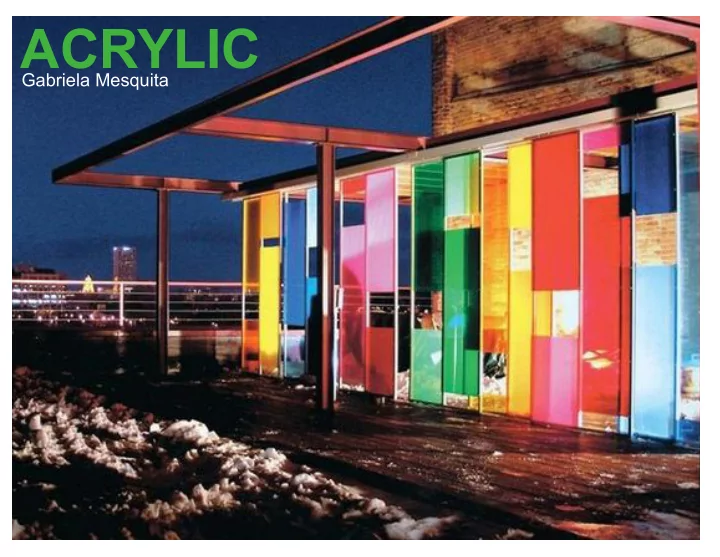
ACRYLIC Gabriela Mesquita what is ACRYLIC ? Acrylic plastic : family - - PowerPoint PPT Presentation
ACRYLIC Gabriela Mesquita what is ACRYLIC ? Acrylic plastic : family of synthetic (man-made) plastic materials containing one or more derivatives of acrylic acid Most common acrylic plastic= polymethyl methacrylate (PMMA) sold as Plexiglas,
Gabriela Mesquita
Acrylic plastic: family of synthetic (man-made)
plastic materials containing one or more derivatives of acrylic acid
Most common acrylic plastic=polymethyl methacrylate
(PMMA)
sold as Plexiglas, Lucite, Perspex, and Crystallite
PMMA is a tough, highly transparent, and light thermoplastic
material with excellent chemical and weathering resistance; good alternative for glass colorfast and non-yellowing good structural and thermal properties, dimensionally stable can be colored, molded, cut, drilled, and formed can become brittle and tends to scratch more than glass
Location: UK Pavilion at Shanghai Expo Date: 2010 Designer: Heatherwick Studio
Each acrylic strand contains a seed in its
185 miles of the site. Inspired by crops blowing in the wind, the rods are free to sway gently with the wind.
polymerization process to turn methyl methacrylate into polymethyl methacrylate (PMMA) discovered by German chemists Fittig and Paul acrylic plastic was fjrst produced brought to market by Rohm and Haas Company
All acrylics are constructed from petroleum distillates that are reacted to give acrylic acid.
Methyl methacrylate is basic molecule from which acrylic plastic is formed. Acrylic plastic forms
when methyl methacrylate is reacted with a catalyst (usually organic peroxide). Like other plastics, they are polymers, meaning they are made up of many molecules, or parts, linked together like a chain Acrylic can be formed in fmat sheets (most common), rods and tubes, or into a molding powder. PMMA can be joined using cyanoacrylate cement (superglue), with heat (welding), or by using
solvents such as di- or trichloromethane to dissolve the plastic at the joint, which then fuses and sets,
forming an almost invisible weld.
First applications were in World
War II when it was used for
submarine periscopes as well as airplane windows, turrets, and canopies. Ideal for applications such as
skylights, automobile taillights,
nails, paint, security barriers, medical devices, and LCD screens.
Due to clarity, also often used for windows, tanks, and
enclosures around exhibits.
In interior spaces, can be used for furniture, decorative vases,
trays, or walls.
PMMA is a thermoplastic, meaning it has
higher impact strength, is easier to process, and is more adaptable to complex designs. It is able to soften when heated and hardens as it cools.
Manufacturing involves highly toxic substances and produces toxic fumes Recent legislation requires polymerization process to be done in closed environment and that fumes be cleaned, captured, or neutralized before discharge to the atmosphere
Not easily recycled- a group 7 plastic and is not collected for recycling in most communities Not readily biodegradable
Large pieces can be reformed into other useful objects if not severely damaged Does not contain or release BPA and is not toxic in solid form
Average annual increase in rate of consumption: 10% Future annual growth rate of 5% is predicted Continual innovate use of acrylic plastic in design and
art installations Lucite International currently in the process of
developing a plant that will use the Alpha process, which is a cheaper, greener way of making methyl methacrylate
https://en.wikipedia.org/wiki/Poly(methyl_ methacrylate) https://en.wikipedia.org/wiki/Wilhelm_Rudolph_ Fittig http://www.madehow.com/Volume-2/Acrylic- Plastic.html https://www.creativemechanisms.com/blog/ injection-mold-3d-print-cnc-acrylic-plastic-pmma http://sumitomo-chem.com.sg/pmma/science- lesson-4-acrylic-plastic-made/ https://www.ingenia.org.uk/Ingenia/ Articles/3ab65b97-7930-452a-b3a3- bbd5147f41a4