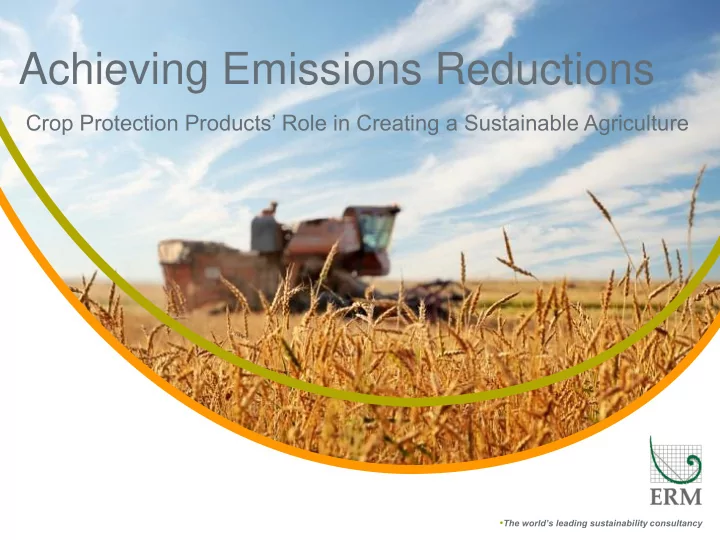
Achieving Emissions Reductions Crop Protection Products Role in - - PowerPoint PPT Presentation

achieving emissions reductions
SMART_READER_LITE
LIVE PREVIEW

Achieving Emissions Reductions Crop Protection Products Role in - - PowerPoint PPT Presentation

Achieving Emissions Reductions Crop Protection Products Role in Creating a Sustainable Agriculture Insert then choose Picture select your picture. Right click your picture and Send to back. The worlds leading


slide-1
SLIDE 1
  • “Insert” then choose “Picture” – select your picture.

Right click your picture and “Send to back”.

  • The world’s leading sustainability consultancy

Achieving Emissions Reductions

Crop Protection Products’ Role in Creating a Sustainable Agriculture

  • The world’s leading sustainability consultancy
slide-2
SLIDE 2

Delivering sustainable solutions in a more competitive world

The threat from climate change

Source: World Economic Forum, Global Risks 2012

slide-3
SLIDE 3

Delivering sustainable solutions in a more competitive world

What will happen to agricultural greenhouse gas emissions as we address the increasing global demand for crops?

slide-4
SLIDE 4

Delivering sustainable solutions in a more competitive world

Feeding the World

According to the United Nations, by 2050

  • the world’s population is

expected to reach 8.9

billion 1

  • food production must

increase by 70% to meet

this growing demand 2

  • And adapt to climate

change itself

  • In 2005, agriculture

accounted for 10%- 12% of total global

anthropogenic GHG emissions 3

1 United Nations (2004), Department of Economic and Social Affairs/ Population Division, World Population to 2300 2 United Nation Food and Agricultural Organization (FAO) 3 Smith P, et al (2007) Agriculture. Climate Change 2007: Mitigation Contribution of Working Group III to the Fourth Assessment Report of the Intergovernmental Panel on Climate Change

slide-5
SLIDE 5

Delivering sustainable solutions in a more competitive world

What is Life Cycle Assessment & Carbon Footprinting?

  • LCA is a technique for assessing the environmental aspects and potential impacts

associated with a product or service

  • by compiling an inventory of inputs and outputs; evaluating the potential

environmental impacts; and interpreting the results of the inventory analysis (ISO 14040, 2006)

  • A product carbon footprint is a streamlined version of an LCA
  • focuses on greenhouse gases only,
  • reported as a single figure, carbon dioxide equivalents (CO2)

EMISSIONS eg N2O from soil, CH4 from manure growing

  • f crop

Use & Disposal Production food products/ biofuels harvesting

raw materials eg seeds, fertilisers, crop protection

INPUTS eg energy, water cradle to gate cradle to grave

slide-6
SLIDE 6

Delivering sustainable solutions in a more competitive world

What activities contribute the most to the total greenhouse gas emissions associated with crop production?

slide-7
SLIDE 7

Delivering sustainable solutions in a more competitive world

GHG Emissions Associated with Maize Growing

61% 31% 6% 1% 1%

Crop protection products Fertiliser production Fertiliser application Energy and fuels Other inputs

  • Key contributor to GHG emissions of maize

growing is the production of and N2O emissions associated with the application of fertilisers

  • Higher yields are achieved through nutrient

application, ie a balance to be created between yield and GHG emissions

  • Crop protection does not contribute

significantly, accounting for 1% of the total

Figure does not include for land use change

slide-8
SLIDE 8

Delivering sustainable solutions in a more competitive world

Carbon Footprint of the Cultivation of Cotton

34% 18% 44% 4% 1%

Crop protection products Fertiliser production Fertiliser application Energy and fuels Other inputs

  • Key contributors to the GHG emissions

associated with cotton production are energy and fertilizer production and application

  • Again, a direct link between yield and

GHG emissions

  • Crop protection does not contribute

significantly, accounting for 4% of the total

slide-9
SLIDE 9

Delivering sustainable solutions in a more competitive world

Industry Life Cycle Thinking Initiatives

  • Building a better understanding of the climate change impacts of and

benefits with crop protection products in the context of agricultural production

  • Collaborate to calculate the average GHG emissions associated with CPP in
  • rder to meet demand for information and support further understanding of

the GHG impacts of agriculture

The average GHG emissions associated with the production of CPP is calculated to be 5.5 kg CO2e per litre of finished product This is based on a collaborative project between CropLife and the main producers and builds on company own information covering the ‘cradle-to- gate’ aspects of CPP production

slide-10
SLIDE 10

Delivering sustainable solutions in a more competitive world

Monitoring progress towards meeting needs

  • Striking the right balance - between increasing yield and GHG emissions
  • And understanding how to achieve this
  • understanding the climate change impacts per tonne crop produced
  • Including monitoring progress
  • how key factors interlink to achieve improved yield
  • at a level that provides the best insight
  • model farms / pilots?
  • natural level?
  • regional level?
  • all of the above

farming practices nutrients

crop protection

irrigation temperature seeds

farm machinery

harvesting techniques

IMPROVED YIELD

slide-11
SLIDE 11

Delivering sustainable solutions in a more competitive world

Final Remarks

  • With growing populations and limited global land available for crop growing,

yield gain is the focus area

  • Crop protection products play a key part in this
  • …and in adapting to climate change, their role may become even more

important

  • Focus for the crop protection sector is to avoid crop loss at minimal GHG

emissions

  • which means lower GHG emissions per quantity of crop produced
  • …not necessarily per quantity of CPP
slide-12
SLIDE 12

Delivering sustainable solutions in a more competitive world

About ERM

ERM is a leading global provider of environmental, health, safety, risk and social consulting services in influential

  • assignments. For over 40 years we have been working with clients around the world and in diverse industry sectors to

help them to understand and manage their impacts. Over 4,00 employees in 40 countries across the globe. Over the past five years we have worked for approximately 60% of the Global Fortune 500.

Simon Aumônier Principal Partner simon.aumonier@erm.com

Contact details: