
SLIDE 1
18TH INTERNATIONAL CONFERENCE ON COMPOSITE MATERIALS
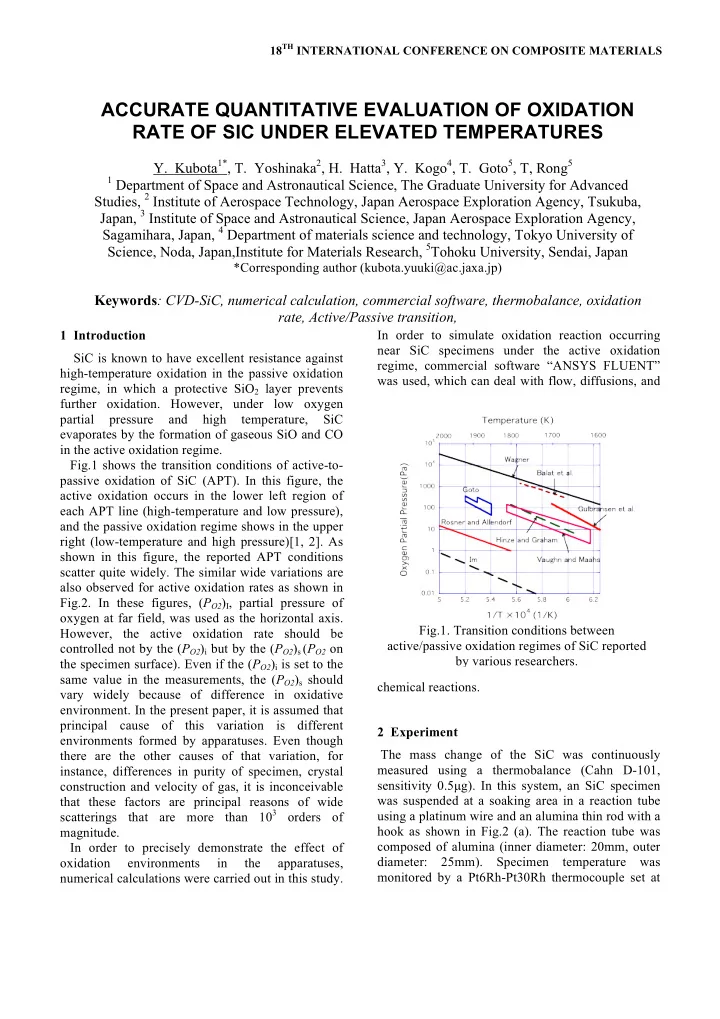
1 Introduction SiC is known to have excellent resistance against high-temperature oxidation in the passive oxidation regime, in which a protective SiO2 layer prevents further oxidation. However, under low oxygen partial pressure and high temperature, SiC evaporates by the formation of gaseous SiO and CO in the active oxidation regime. Fig.1 shows the transition conditions of active-to- passive oxidation of SiC (APT). In this figure, the active oxidation occurs in the lower left region of each APT line (high-temperature and low pressure), and the passive oxidation regime shows in the upper right (low-temperature and high pressure)[1, 2]. As shown in this figure, the reported APT conditions scatter quite widely. The similar wide variations are also observed for active oxidation rates as shown in Fig.2. In these figures, (PO2)I, partial pressure of
- xygen at far field, was used as the horizontal axis.
However, the active oxidation rate should be controlled not by the (PO2)i but by the (PO2)s (PO2 on the specimen surface). Even if the (PO2)i is set to the same value in the measurements, the (PO2)s should vary widely because of difference in oxidative
- environment. In the present paper, it is assumed that
principal cause of this variation is different environments formed by apparatuses. Even though there are the other causes of that variation, for instance, differences in purity of specimen, crystal construction and velocity of gas, it is inconceivable that these factors are principal reasons of wide scatterings that are more than 103 orders of magnitude. In order to precisely demonstrate the effect of
- xidation
environments in the apparatuses, numerical calculations were carried out in this study. In order to simulate oxidation reaction occurring near SiC specimens under the active oxidation regime, commercial software “ANSYS FLUENT” was used, which can deal with flow, diffusions, and chemical reactions. 2 Experiment The mass change of the SiC was continuously measured using a thermobalance (Cahn D-101, sensitivity 0.5µg). In this system, an SiC specimen was suspended at a soaking area in a reaction tube using a platinum wire and an alumina thin rod with a hook as shown in Fig.2 (a). The reaction tube was composed of alumina (inner diameter: 20mm, outer diameter: 25mm). Specimen temperature was monitored by a Pt6Rh-Pt30Rh thermocouple set at
ACCURATE QUANTITATIVE EVALUATION OF OXIDATION RATE OF SIC UNDER ELEVATED TEMPERATURES
- Y. Kubota1*, T. Yoshinaka2, H. Hatta3, Y. Kogo4, T. Goto5, T, Rong5