TC80 Total Chlorine Analyzer Introduction to Chlorine Chlorine, Cl - - PowerPoint PPT Presentation

tc80 total chlorine analyzer introduction to chlorine
SMART_READER_LITE
LIVE PREVIEW

TC80 Total Chlorine Analyzer Introduction to Chlorine Chlorine, Cl - - PowerPoint PPT Presentation

TC80 Total Chlorine Analyzer Introduction to Chlorine Chlorine, Cl 2 , is a Diatomic Gaseous Element It is a strong oxidizer (wants electrons) The High Oxidation Potential makes it an efficient Sanitizer and Disinfectant. When


slide-1
SLIDE 1

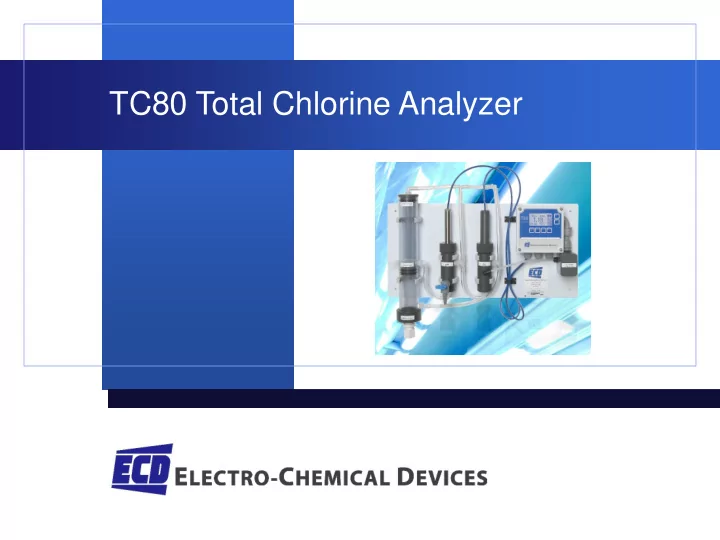
TC80 Total Chlorine Analyzer

slide-2
SLIDE 2

Introduction to Chlorine

 Chlorine, Cl2, is a Diatomic Gaseous Element  It is a strong oxidizer (wants electrons)  The High Oxidation Potential makes it an efficient Sanitizer and Disinfectant.  When combined with water it hydrolyzes to form hypochlorous acid and hypochlorite ion, depending on the pH.

HOCl

OCl-

slide-3
SLIDE 3

What is Total Chlorine?

 Total Chlorine is defined as the sum of the Free Chlorine and Combined Chlorine in the sample.  Combined Chlorine is formed by the reaction of Free Chlorine with Organic Compounds, Ammonia

  • r other nitrogen compounds.

 Two of the most common forms

  • f Combined Chlorine are

Monochloroamine (MCA) Dichloroamine (DCA)  Total Chlorine is typically a regulatory measurement in wastewater to satisfy discharge requirements.

slide-4
SLIDE 4

How is Chlorine Measured?

 DPD Method (N, N-diethyl-p- phenylenediamine sulfate)  One of the most widely used testing methods for Free and Total Chlorine  Forms a pink color with an intensity proportional to the chlorine concentration  The testing can be automated

  • r handheld measuring the

intensity of the color formed  FAS-DPD testing (pink to clear with addition of thiosulfate drops)  DPD is not specific for chlorine it responds to most oxidizers

slide-5
SLIDE 5

How is Chlorine Measured?

 Amperometric Analyzers

Measure current between two polarized electrodes

No Reagents are needed

 ECD Chlorine Analyzers

FC80 Free Chlorine

TC80 Total Chlorine

 Panel Mounted Plumb and Play design

1. Constant Head Flow Controller 2. pH Sensor in Flow Cell with sample port 3. Chlorine Sensor in Flow Cell 4. T80 Analyzer 5. Spray Cleaner solenoid

slide-6
SLIDE 6

How do they Work?

 The instrument applies a fixed voltage across the sensor referenced to the 316SS counter electrode.  This polarization voltage generates a polarization current in the sensor.  The current consumes all

  • xidants in the sensor and the

sensor stabilizes at the “zero point current.”  The initial polarization takes about 60 minutes.  The Chlorine sensor is now ready to use.

slide-7
SLIDE 7

Total Chlorine Sensor

 Amperometric Design

  • Externally polarized by the

analyzer

  • Gold Cathode
  • Silver-Silver Halide Anode
  • 316 SS Counter Electrode
  • Digital communication

 Replaceable Micro Porous Teflon Membrane  Refillable Potassium Iodide Gel Electrolyte  PVC outer body

slide-8
SLIDE 8

Total Chlorine Sensors

 The Micro Porous membrane allows all oxidizers to pass through.  When an oxidizer diffuses through the membrane it oxidizes the iodide to iodine, reducing the Chlorine compound to Chloride  Iodine is then reduced at the cathode back to iodide.  Silver is oxidized off the anode in response to the chloride and iodide ions.  The current flow from the

  • xidation and reduction reactions

is proportional to the Total Chlorine concentration. Potassium Iodide (KI) KI plus Chlorine yields Iodine

slide-9
SLIDE 9

Measurement Influences: Flow

Flow Sensitivity

  • The Chlorine sensors

consume chlorine depleting the area around the sensing tip

  • Flow replenishes the

chlorine supply

  • Constant flow is

required for a stable measurement

  • Low flow = Low reading
  • Chlorine readings are

unchanged with flow rates above 0.5 ft./sec

20 40 60 80 100 10 20 30 % Theoretica l output Flow rate, gal/hr

Flow dependence

slide-10
SLIDE 10

Constant Head Flow Controller

The Constant Head Flow Controller (CHFC) eliminates the need for Pressure Regulators and Rotameters to control the flow by the sensor.

 CHFC has ¼” ports  No small orifices to clog

The unique overflow design maintains a constant flow at the sensor with incoming variations between 8 and 80 gal/hr.

slide-11
SLIDE 11

Influences: pH Total Chlorine

 The Total chlorine concentration is not affected by the pH of the solution.  The Total Chlorine sensor is affected by the pH of the solution, about -5% per pH unit  The Total Chlorine concentration does not change with changes in pH but the

  • utput of the sensor increases

as the pH gets lower.  The sensor’s equilibration time to pH changes is typically 3-5 minutes, T90 < 30 seconds

50 100 150 200 5 10 15 % Output with pH8 = 100% pH

TCA output vs. pH value

slide-12
SLIDE 12

pH Sensor or Reagents?

 pH influences the output of the Total Chlorine sensor  The pH must be controlled by adding reagents, typically acetic acid (vinegar) or  The pH must be measured and used to calculate the interaction

slide-13
SLIDE 13

Measurement Influences: Temperature

 Temperature Sensitivity

  • Output increases with

temperature, 4-6 % per C°

  • Primarily due to the

increased permeability of the membrane at higher temperatures

  • Output decreases with

cooling.  The TC80 Sensor has built in temperature compensation.  The TC80 Sensor outputs a Temperature Compensated reading.

10 20 30 40 50 20 40 60 mV/ppm Cl2 Temperature C°

Temperature Dependence, 4%/C°

slide-14
SLIDE 14

Measurement Influences: Coating

 Iron and Manganese precipitate from some waters after chlorination  Bio-Films grow on most surfaces when little to No chlorine is present  Mud and silt can settle

  • ut from some sample

waters  Regular cleaning is necessary

Manually with a squirt bottle and rag or

Automatically with the Spray Cleaning option

Period and duration controlled solenoid with 40+ psi water or air back flushes the system

slide-15
SLIDE 15

Maintenance

 All Analytical Instrumentation requires regular Maintenance  Weekly DPD verification of grab sample

The Handheld HCA1 Photometric meter is an easy to use accurate grab sampling device

 Verify pH is correct weekly, standardize the reading if more then 0.2 pH off  Visually inspect for sedimentation or fouling in lines

slide-16
SLIDE 16

Maintenance

 TC80 replace electrolyte every 4-6 months and membrane cap yearly  pH electrode replacement every 6- 12 months depending

  • n water quality.
slide-17
SLIDE 17

Meet EPA Requirements?

 YES !!!!  METHOD 334.0: DETERMINATION OF RESIDUAL CHLORINE IN DRINKING WATER USING AN ON-LINE CHLORINE ANALYZER

This method is for the analysis of residual chlorine (free or total) in drinking water. It is primarily intended to be used by drinking water utilities for compliance with daily monitoring

  • requirements. This method allows the

use of any type of on-line chlorine analyzer (e.g., amperometric, DPD, etc.) for compliance monitoring when used in conjunction with a grab sample reference method that is approved for drinking water compliance monitoring. This method is intended to be used when chlorine residuals (free or total) are in the range of 0.2 mg/L to 4 mg/L.

slide-18
SLIDE 18

Electro-Chemical Devices

Thank You,

Go to www.ecdanalytical.com for Data Sheets/ Instruction Manuals/ Presentations/ Press Release Packages For over 40 years Electro-Chemical Devices has been a recognized leader in process control instrumentation: Liquid Analytical Analyzers, Controllers, Transmitters, Sensors and Electrodes. Electro-Chemical Devices Phone: +1-714-695-0051 1500 North Kellogg Dr : +1-800-729-1333 Anaheim, CA Fax: +1-714-695-0057 www.ecdanalytical.com email: sales@ecdi.com