Accret Ac etion ion of of gas aseou eous clumps ps fr from - - PowerPoint PPT Presentation

accret ac etion ion of of gas aseou eous clumps ps fr
SMART_READER_LITE
LIVE PREVIEW

Accret Ac etion ion of of gas aseou eous clumps ps fr from - - PowerPoint PPT Presentation

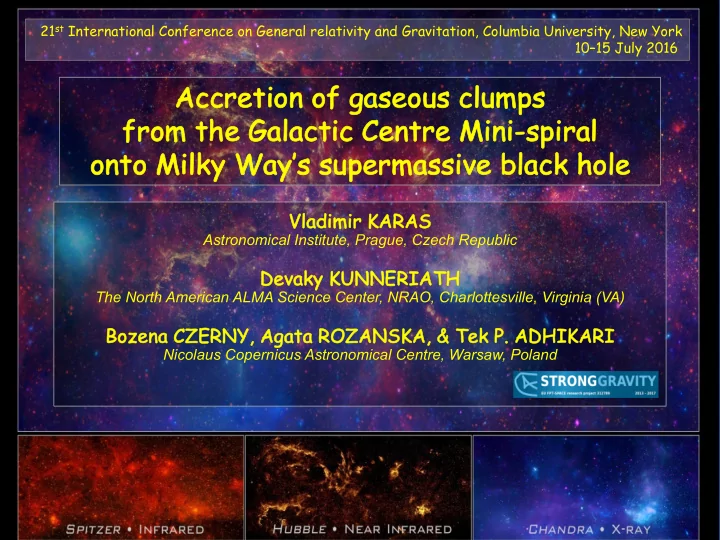
21 st International Conference on General relativity and Gravitation, Columbia University, New York 1015 July 2016 Accret Ac etion ion of of gas aseou eous clumps ps fr from om the e Gal alac actic ic Cen entre e Min Mini-sp


slide-1
SLIDE 1

Ac Accret etion ion of

  • f gas

aseou eous clumps ps fr from

  • m the

e Gal alac actic ic Cen entre e Min Mini-sp spiral

  • n
  • nto
  • Mi

Milky Wa Way’s s su superma massi ssive black ck hole

Vl Vlad adimir KA KARAS

Astronomical Institute, Prague, Czech Republic

De Devaky KUNNER ERIATH

The North American ALMA Science Center, NRAO, Charlottesville, Virginia (VA)

Bo Boze zena CZER ERNY, Ag Agata RO ROZANSKA, & & Te Tek P.

  • P. ADHIKARI

Nicolaus Copernicus Astronomical Centre, Warsaw, Poland

21st International Conference on General relativity and Gravitation, Columbia University, New York 10–15 July 2016

slide-2
SLIDE 2
slide-3
SLIDE 3

Ar Artis ist’s s pict cture of a galact ctic c nu nucl cleus: s: st stars s passi ssing ng through gase seous s env nvironme nment nt

SM SMBH NS NSC gas gas an and d du dust st

3

slide-4
SLIDE 4

Koyama et al. (1996) Sunyaev et al. (1993)

Sg Sgr A* A* past ast ac activity

fr from

  • m its

pr present X-ra ray e emis issio ion

4

slide-5
SLIDE 5

Ponti et al. (2010)

5

slide-6
SLIDE 6

Ry Ryu et al.

  • l. (2013)

Ca Capelli et t al. . (2012) 2012)

Pa Past st a activity o y of S Sgr A* A* – de decay of the X-ra ray ligh ghtcurve urve

6

slide-7
SLIDE 7
  • T. Krichbaum 1998

X-ray: NASA/CXC/UCLA (Li et al. 2013) Radio: NRAO/VLA

Region

  • n of
  • f interest:

Th The Mi Mini-sp spiral

7

slide-8
SLIDE 8

Left: radio 1.3mm (Kunneriath et al. 2012) Right: MIR 8.6 µm (Sabha et al. 2012)

Co Cold phase (gas 3-21x104 cm-3, 5000- 13000 K, and dust ~300 K) Ho Hot phase (fully ionised gas, ne=18 cm-3, Te=3.5 keV at 1.5’’)

Region

  • n of
  • f interest:

Th The Mi Mini-sp spiral

8

slide-9
SLIDE 9

El Elementary accretion

  • n events from
  • m in

infallin ing clou

  • uds

(Zdziarski et al. 2009)

‘Standard’ thin disk accretion: dM/dt|(R) ~ 6pR1/2 d(R1/2 nS) / dR

(Lynden-Bell & Pringle 1974)

Superposition of elementary events: dM/dt|(0) ~ t-5/3 / tvisc

9

slide-10
SLIDE 10

(Czerny et al. 2013)

Multiple accretion

  • n events

Past activity of

  • f Sg

Sgr A* A*

10

slide-11
SLIDE 11

11

…to study accretion driven by the thermal instability (TI)

slide-12
SLIDE 12
  • Fi

Field (1965) – Radiatively heated plasma can be thermally unstable (cooler, dense matter coexists with hot medium in pressure equilibrium) lF = mean thermal conduction / total heating per volume à (10-7T7/2 / Htot)1/2 Clumps of size < lF ev evaporate

Triggering the accretion

  • n events:

the hermal instability in in a two-ph phase mediu dium

  • Ba

Barai et al (2012 12) – Two-phase medium forms spontaneously. Ionization parameter: Ξ = Prad / Pgas à (Lcentral + Lstars) / (PgascR2)

  • Mo

Moscibrodzka et al l (201 2013) 3): filaments break into cloudlets Cooling time: tcool ~ E / Ltot , Ltot ~ n2T1/2

12

Colder clumps form filaments à they become accreted faster à en enhanced ed accret retion ra rate

slide-13
SLIDE 13

Method

  • d and parameters

Cloudy photoionisation code to model the ISM in the GC

  • calculate instability curves log(T) vs. log(Ξ) for different

luminosity states of Sgr A*,

  • include the influence of dust grains on the onset of TI
  • include the influence of stellar radiation and winds.

We consider

  • clouds: different density and different distance
  • accretion mode: Mdot ~ m x 10-9 Msun yr-1

13

slide-14
SLIDE 14

Th Thermal l inst stabili lity – different states of

  • f luminos
  • sity

(distance R=0.008pc from the center)

ß Stable à ß Stable à ß Unstable à log(Lbol [erg/s]) = 37.57, 38.33, 39.06, 39.76, 40.61, 41.33

14

slide-15
SLIDE 15

Thermal instability for

  • r different states of
  • f luminos
  • sity

(R=0 =0.008pc)

log(Lbol [erg/s]) = 37.57, 38.33, 39.06, 39.76, 40.61, 41.33

15

slide-16
SLIDE 16

Influence of

  • f dust: suppression
  • n of
  • f instability

Without dust The Mini-spiral contains dust (200–300K; Cotera et al. 1999). (Treated by an option in Cloudy.)

16

With dust: suppresing the instability

slide-17
SLIDE 17

Size of

  • f clou
  • uds
  • Four different curves: bolometric luminosity Lbol
  • Radius of the yellow circles: Field length lF
  • Mass of clouds Mc in units of Earth mass

Thermal conduction limits the smallest size

  • f the clouds

(Rozanska et al. 2014).

17

slide-18
SLIDE 18

Instability strips for

  • r two-ph

phase mediu dium wit ithin in Bon

  • ndi flow
  • w

nout = 18 cm-3 nout = 1 cm-3

18

slide-19
SLIDE 19

The rol

  • le of
  • f stellar radiation
  • n and wind (mechanical heating)

Sg Sgr A* A* NSC M6 M60-UC UCD1

19

slide-20
SLIDE 20

S-cur curves of f Thermal Instability: Te Tempera rature re vs vs. . Ionisat sation pa parameter

On Only th the centr tral so sourc rce of f ir irradia iatio ion + I + Including t the st stellar r ra radiation by by 6 6 My Myr SED ED

à à

20

+ I + Including t the st stellar r mechanical he heating by by winds

slide-21
SLIDE 21

Co Concl nclusi sions ns

  • Current level of luminosity of Sgr A* not enough to

drive the thermal instability

  • For luminosity > 1039 erg/s at distance ~ 0.008–0.2 pc,

the thermal instability operates, cold clumps can accrete

  • Cooling time-scales are long (~ hundreds years)
  • Typical cloud size of 1014-15 cm, mass of ~10 MEarth
  • Influence of dust is small

Th Thank y you!

21

slide-22
SLIDE 22

Discussion

  • n slides:

Tw Two-ph phase mediu dium in in Bon

  • ndi flow
  • w arou
  • und Sg

Sgr A* A*

Bondi accretion operates up to ~ 0.1pc from Sgr A*

22

slide-23
SLIDE 23

Thermal instability for

  • r different states of
  • f luminos
  • sity

(R=0 =0.2pc)

log(Lbol [erg/s]) = 37.57, 38.33, 39.06, 39.76, 40.61, 41.33

23

slide-24
SLIDE 24

Molinari et al. (2011), Marin et al. (2014)

Past activity of Sgr A* – predictions for X-ray polarimetry

24

slide-25
SLIDE 25

Marin et al. (2015)

Past activity of Sgr A* – predictions for X-ray polarimetry

25

slide-26
SLIDE 26

Marin et al. (2015)

Past activity of Sgr A* – predictions for X-ray polarimetry

26

slide-27
SLIDE 27

HKL composite NIR image GC group, University of Cologne

Introduction

27