
SLIDE 1
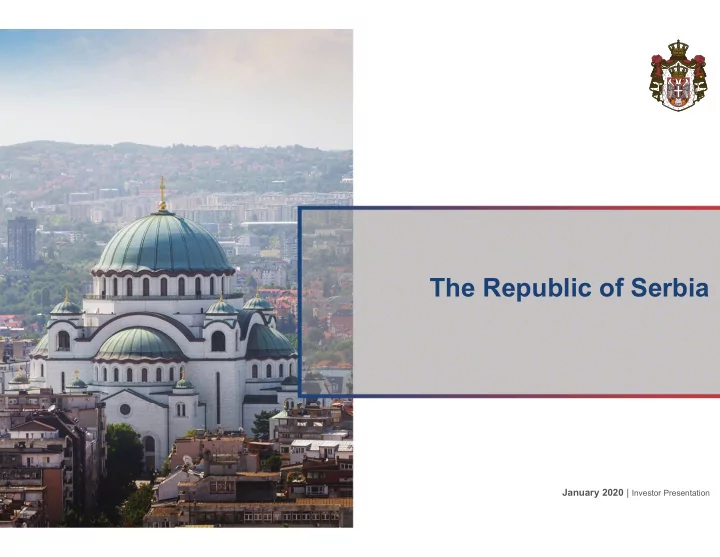
The Republic of Serbia
January 2020 | Investor Presentation
The Republic of Serbia January 2020 | Investor Presentation Table of - - PowerPoint PPT Presentation
The Republic of Serbia January 2020 | Investor Presentation Table of Contents 1. Serbia Overview & Highlights 2 2. Strong Macroeconomic Indicators 5 3. Robust External Position 9 4. Sound Fiscal Performance 14 5. Public Debt 16 6.
January 2020 | Investor Presentation
2
5
9
14
16
23
Serbia is building a foundation for increased economic competitiveness and expansion on the back of significant reforms. Prudent macroeconomic targets and negotiations with Europe anchor economic and fiscal policy
Serbia at a Glance Capital Belgrade Official Language Serbian Population (2011) 7.2 million Nominal GDP1
(2018, EUR million)
42,855 GDP per Capita1
(2018, EUR)
6,137 Form of Government Parliamentary Republic Upcoming Regular Parliamentary Election April / May 2020 Currency Serbian Dinar (RSD) FX EUR/RSD (January 8th, 2020) 117.54 Main Economic Sectors2 Industry (25.4%); Trade, transport and tourism (20.2%); Agriculture (7.7%); ICT3 (5.8%); Construction (5.4%); Other (35.5%) Credit Ratings Moody’s: Ba3 (Positive); S&P:BB+ (Positive); Fitch: BB+ (Stable) EU Accession Status Latest Conference ended December 2019: 18
negotiations, 2 are provisionally closed
EU Non-EU
Source: Statistical Office of the Republic of Serbia, National Bank of Serbia, European Council, Bloomberg Markets Note: 1Recalculated by the Ministry of Finance using average exchange rate for 2018 (118.2716 RSD/EUR), 2Measured as % of Total Gross Value Added (GVA) in 2018, 3ICT – Information and Communication Technology
2
Integration with European Union remains key strategic objective; EU accession process, together with IMF and WB programmes, set the pace for comprehensive structural reforms Strong GDP growth of 4.4%1, strongest in 10 years, driven by robust investment and growing local demand and reflecting improving domestic and external confidence. GDP projection for 2019 revised upward from 3.5% to 4%. Fiscal surplus achieved in 2017, 2018 first time since 2005. Favourable trend continues in Q1-Q3 2019 with a surplus of 0.9% of GDP and 0.2% end of the year. Inflation kept firmly in check, moving around 2% on average in the last five years, supported by preserved relative exchange rate stability; NPL ratio reduced sharply
1 Full Year 2018, 2 MNC: Multinational Company, 3 CAD: Current Account Deficit, 4 December 2019
Top investment destination for MNCs2; Net FDI inflow reached EUR 3.1 billion in October 2019, and fully covered the CAD3 for 4th year in a row Public debt to GDP ratio decreased by almost 20 percentage points since 2015; now down to 52%4 of projected GDP and expected to fall further as growth continues and primary surplus is sustained
3
Serbia’s economic transformation has been recognised in improving credit ratings and outlooks. Fitch and S&P upgraded Serbia during 2019, Moody’s awarded a positive outlook in 2019
consolidation and stable macroeconomic position, Outlook Stable
public finances, Outlook Stable
consolidation and improving external balances, Outlook Stable
the government’s fiscal consolidation plan and improvement in external balances
deteriorating public finances, Outlook Stable
Positive Outlook Negative Outlook
consolidation and stable macroeconomic position, Outlook Positive
performance, Outlook Stable
to the fiscal outturn exceeding expectations
reflecting reduced risk to the country's fiscal consolidation and structural reform program
monetary stability amidst external pressures, Outlook Negative
momentum and political stability, Outlook Stable
representing improving debt metrics and robust economic growth outlook
consolidation and structural reforms, Outlook Stable
representing the government’s commitment to structural reforms and fiscal consolidation
BB+ BB B+ BB- B B-
1 2 3 4 5 6
2007 2009 2011 2013 2015 2017 2019
Fitch
BB+ BB B+ BB- B B- Ba1 Ba2 B1 Ba3 B2 B3
1 2 3 4 5 6
2007 2009 2011 2013 2015 2017 2019
Moody's
Next publication: March 2020 Next publication: Јune 2020 Next publication: June 2020
Source: S&P, Fitch, Moody’s
4
1 2 3 4 5 6
2007 2009 2011 2013 2015 2017 2019
S&P
Implementation of wide-ranging structural reforms, improvement in the domestic investment climate and EU accession process have created a foundation for healthy, long-term growth
The Global Competitiveness Index Improvement across Key Governance Indicators Forty five places gain in the World Bank Doing Business Index
Source: Global Competitiveness Report Source: World Bank Worldwide Governance Indictors
93 91 59 47 43 48 44
0.1 0.2 0.3 0.4 0.5 0.6 0.7 0.8 0.9 12014 2015 2016 2017 2018 2019 2020 Rank of 189
with EU standards, creating a more effective and efficient public sector that facilitates private investment and delivers quality services to businesses and citizens
and policymaking credibility deepens. They are better positioned to promote inclusive economic growth and prosperity Regulatory convergence fosters institutional strengthening
Source: World Bank Doing Business Index 2019 Note: 2020 rank out of 190
20 30 40 50 60 2009 2010 2011 2012 2013 2014 2015 2016 2017 2018 Government Effectiveness Regulatory Quality Political Stability and Absence of Violence/Terrorism Rank on a scale form 0 to 100 94/144 94/148 90/144 70/140 65/138 72/141
0.1 0.2 0.3 0.4 0.5 0.6 0.7 0.8 0.9 12014 2015 2016 2017 2018 2019 Rank
5
Serbia’s strong GDP growth of 4.4% in 2018 reflects improving domestic and external confidence. In Q3 2019 GDP advanced quite above H1(from 2.8% to 4.8% y/y), driven by all key sectors, with construction and fixed investment beating expectations.
Sustainable economic growth1.. ..one of the highest among its regional peers ..and solid private investment Supported by strong consumption..
35.5 35.7 36.7 39.2 42.9 45.9 49.0 (1.6%) 1.8% 3.3% 2.0% 4.4% 4.0% 4.0%
2014 2015 2016 2017 2018 2019F 2020F Nominal GDP (EUR Billion) Real GDP Growth (%)
Source: Office of Statistics Source: National Bank of Serbia Source: Office of Statistics; Eurostat Source: Ministry of Finance
4.4% 2.6% 3.1% 4.1% 4.9%
0.01 0.02 0.03 0.04 0.05 0.06Serbia Croatia Bulgaria Romania Hungary (Real GDP Growth 2018) 13.6% 14.1% 13.9% 14.9% 16.1% 2.3% 2.7% 3.1% 2.8% 3.9% 2014 2015 2016 2017 2018 Private Investment (% GDP) Government Investment (% GDP) (0.1%) (0.4%) 0.9% 1.4% 2.2% 2.2% 0.2% (0.7%) 0.2% 0.5% 0.6% 0.4% 2014 2015 2016 2017 2018 Q1-Q2 2019 Household Consumption Government Consumption (Contributions to the real GDP growth rate)
Note: GVA – Gross Value Added
12019F GDP converted from the projected Nominal GDP of RSD 5,416.8 using the exchange rate 118.00 RSD/EUR
6
Employment growth was mainly driven by the private sector, while in the public sector the number of employees decreased
Unemployment at an all-time low.. ..and inflation remains within the NBS target tolerance band …midst increasing productivity
19.2% 17.7% 15.3% 13.5% 12.7% 9.5%
8.0% 10.0% 12.0% 14.0% 16.0% 18.0% 20.0%2014 2015 2016 2017 2018 Sep-19 Unemployment Rate (%)
Source: Office of Statistics Source: National Bank of Serbia Note: By 2017, the NBS target was 4 ± 1.5%, and since 2017, the target is 3 ± 1.5%. Source: Office of Statistics
13,858 13,874 13,504 14,021 15,128
12,500.00 13,000.00 13,500.00 14,000.00 14,500.00 15,000.00 15,500.002014 2015 2016 2017 2018 GDP / employed person (EUR)
Wages remain competitive..
1.7% 1.5% 1.6% 3.0% 2.0% 1.9%
0% 1% 2% 3% 4% 5% 6%2014 2015 2016 2017 2018 Jan-Nov 2019 Consumer price inflation (Y-o-Y) NBS Target NBS Target : 3.0% ±1.5% NBS Target : 4.0% ±1.5% (EUR) (Total Inflation – CPI)
Source: Institute of Statistics (Albania), Agency of Statistics (Bosnia and Herzegovina), National Statistical Institute (Bulgaria), Croatian Bureau of Statistics (Croatia), Central Statistical Office (Hungary), State Statistical Office (North Macedonia), Monstat (Montenegro), Statistical Office (Serbia) Exchange Rate: 123.53 ALL/EUR; 1.96 BAM/EUR; 1.96 BGN/EUR; 61.48; HRK/EUR; 320.80 HUF/EUR; MKD/EUR; 7.41 each as at 31/12/18
(Average gross monthly wages (EUR) , 2018) 579 580 580 765 1,028 1,143
North Macedonia Serbia Bulgaria Montenegro Hungary Croatia
7
Structural reforms are advancing the development of new and higher value-added sectors, boosting economic diversification and resilience
Industry/Manufacturing Trade, Transport and Tourism Agriculture ICT
Industry 25% TTT 20% Agri. 8% ICT 6% Con. 5% FI 4% Other 32%
Source: Office of Statistics Note: GVA Breakdown by sector as of 2018, TTT – Trade, Transport and Tourism, Agri – Agriculture, ICT – Information and communication technology, Con. – Construction, FI – Financial and Insurance activities
Manufacturing (69.0%) Electricity & Gas (16.3%) Mining, Water Supply (14.7%) Trade (68.4%) Transport (23.3%) Tourism (8.3%)
investments particularly in the manufacturing sector, in turn boosting higher value added exports
electric power system to increase energy efficiency and production capacities, environmental sustainability and supply source diversification
leverage its location as a trade hub between Western & Eastern Europe, Asia and the Middle East
development of e-commerce, the enhancement of consumer protection and the harmonization of the legal framework with the EU standards
boost the tourism industry
past few years
to expand the ICT ecosystem in Serbia, to support micro, small and medium-sized enterprises
established their hubs in Serbia, given the ready access to a skilled workforce; this has driven foreign investments inflows and boosted services exports
conducive to cultivation, with 69% of arable land
production, harmonization with the European market’s health and safety standards and the implementation of the agricultural production support system are important drivers of growth and higher value-add
from the adverse effects of agricultural technologies, preparation for the acceptance into the WTO and reform of the corporative food production sector
GVA Breakdown
8
Serbia has free trade agreements with its main trade partners. In 2018, these countries accounted for 86% of Serbia’s total foreign trade and 93% of total exports
Countries With Free Trade Agreements with Serbia
SSA entering into force in 2013. In 2018, 67% of Serbia’s trade was with the EU
between the EU and Serbia. Serbia has a preferential customs- free treatment for exports under the SAA, which has fully
European Union
Liechtenstein, Norway and the Swiss Confederation, signed a free trade agreement with Serbia which entered in to force in 2011
the European Economic Area, is important to Serbia for the benefits of the cumulation of origin of the Pan-Euro- Mediterranean convention European Free Trade Agreement
the legal basis for policy formulation and implementation of trade and investment in the CEFTA region
trade partners of Serbia. In 2018, Serbia recorded a trade surplus of EUR 1,905 million with the CEFTA region Central European Free Trade Agreement
between 2009-2012
are not subject to custom duties, representing a significant benefit for export-oriented industries in Serbia
January 2018, to include trade in services and further liberalise agricultural products Belarus, Kazakhstan, Russia and Turkey
Source: Statistical Office of the Republic of Serbia, National Bank of Serbia, European Council, Bloomberg Markets Note: CEFTA – Central European Free Trade Agreement, EFTA – European Free Trade Agreement, SAA – Stabilization and Association Agreement
9
Export growth, despite the deceleration in the Eurozone, evidences increasing competitiveness and resilience
Serbia benefits from a diversified goods export base as well as market
(% of Goods Exports, Jan-Nov 2019) EU-28 67% CEFTA 17% CIS 5% Other 11% Germany, 13% Italy, 10% Romania, 6% Hungary; 4% Slovenia; 3% Other, 64% Exports to EU-28: 67% 38% 28% 17% 9% 3%3% 2% Manufactured goods and articles Machinery and transport equipment Agriculture and food Chemicals and related products n.e.s Crude material (inedible), except fuel Mineral fuels, lubricants and related materials Commodities and transactions not specified
Source: Office of Statistics Note: CEFTA- Central European Free Trade Agreement, CIS - Commonwealth of Independent States
Rapid growth in exports..
Source: National Bank of Serbia
11.2 12.0 13.4 15.1 16.3 12.7 13.9 3.8 4.3 4.6 5.2 6.0 4.9 5.7
0.00 5.00 10.00 15.00 20.00 25.002014 2015 2016 2017 2018
Goods Exports (EUR Billion) Services Exports (EUR Billion)
..Accelerated by Government policies and private sector investments
The improvement of the business environment
The liberalization of capital flows
Visa liberalization with many countries
Higher investments by the private sector
Goods CAGR: 9.8% Services CAGR: 12.0% Goods y-o-y: 9.1% Services y-o-y: 16.3%
10
Imports trend reflect the increasing pace of higher value added activity in the Serbian economy
The structure of imports dominated by equipment and manufactured goods reflects the ongoing transition in the Serbian economy
Source: Office of Statistics Note: CEFTA- Central European Free Trade Agreement, CIS - Commonwealth of Independent States
26% 27% 14% 11% 11% 6% 6% Machinery and transport equipment Manufactured goods and articles Chemicals and related products n.e.s Commodities and transactions not specified Mineral fuels, lubricants and related materials Agriculture and food Crude material (inedible), except fuel EU-28 60% CIS 10% China 9% CEFTA 4% Other 18% Germany, 13% Italy, 9% Hungary, 5% Romania, 3% Slovenia, 3% Other, 28% (% Goods Imports, Jan-Nov 2019)
Source: National Bank of Serbia
Imports from EU-28: 60%
Source: National Bank of Serbia
Growing imports and trade deficit signals the growing economy
(11.4%) (11.3%) (9.9%) (11.1%) (13.2%) (12.3%) 1.3% 2.0% 2.5% 2.5% 2.5% 2.1%
2014 2015 2016 2017 2018
Trade Balance (%of GDP) Services Balance (% GDP) 15.2 16.1 17.1 19.4 21.9 16.9 18.4 3.3 3.5 3.7 4.3 4.9 4.0 4.8
2014 2015 2016 2017 2018
Good imports (EUR Billion) Services imports (EUR Billion) Goods y-o-y: 8.58% Services y-o-y: 19.25% Goods CAGR: 9.6% Services CAGR: 10.1%
11
Macroeconomic stabilization and the improvement of the business environment have attracted an increasing volume of FDI, more than sufficient to cover the current account deficit
Current account dynamics reflecting ongoing structural transformation – the deficit is more than fully financed by robust net FDI inflow ..Directed primarily to the manufacturing sector Dynamic Net inflow of FDI..
Source: National Bank of Serbia, Office of Statistics Source: National Bank of Serbia Source: National Bank of Serbia
(5.6%) (3.5%) (2.9%) (5.2%) (5.2%) (5.5%) 3.5% 5.1% 5.2% 6.2% 7.4% 6.1%
2014 2015 2016 2017 2018 2019F Current Account Balance (% of GDP) Net FDI (% of GDP) 32% 3% 6% 19% 10% 18% 4% 9% Manufacturing Mining Transportation and storage Construction & real estate activities Trade Financial activities ICT Other (% of Total Net Inflow of FDI in Serbia, EUR Million) (% of Total Net Inflow of FDI in Serbia 2014-VI 2019 Average) Includes one-off privatizations and concessions Conservatively projected and excludes potential privatizations 90% 86% 82% 85% 71% 89% 8% 10% 16% 13% 26% 8% 1,501 2,114 2,127 2,548 3,496 2,756
2014 2015 2016 2017 2018 Sep-19 Other Americas Asia Europe 12
The growing range of export earnings and FDI inflows are enabling Serbia to build its FX buffers
Robust reserves protect Serbia from external and liquidity shocks Reserves remain resilient as the growing economy pulls in imports
5.3x 3.3x 4.8x 6.1x 8.9x 9.3x
2 4 6 8 10 12Serbia Hungary Macedonia Romania Bulgaria Croatia (Months of Import Cover 2018)
Source: National Bank of Serbia
6.6x 6.7x 6.2x 5.4x 5.3x 5.8x 2014 2015 2016 2017 2018 Nov-19 Months of Import Cover
Source: National Bank of Serbia, IMF Source: National Bank of Serbia, Ministry of Finance. Note: 1External Debt recalculated using year end exchange rates (2014: 120.96 RSD/EUR, 2015: 121.63 RSD/EUR, 2016: 123.47 RSD/EUR, 2017: 118.47 RSD/EUR, 2018: 118.19 RSD/EUR)
70% 68% 65% 71% 84% 97% 2014 2015 2016 2017 2018 Nov-19
0% 20% 40% 60% 80% 100% 120%FX Reserves / External Public Debt 9.9 10.4 10.2 10.0 11.3 13.5
50 100 150 200 250 300 350 400 450 500 550 600 650 700 750 800 850 900 950 10002014 2015 2016 2017 2018 Nov-19
2 4 6 8 10 12 14 16Gross Foreign Exchange Reserves (EUR billion)
13
Improvement of the fiscal performance over last three years was led by a combination of revenue mobilisation measures and spending controls, supported by robust GDP growth
Key reform areas for the preceding three years Fiscal measures and structural changes for 2019 Government expenses have shrunk as % of GDP Sustained track record of fiscal prudence built on reforms
33.9 32.2
(5.9%) (2.7%) (0.2%) 0.7% 0.6% (0.4%)
2014 2015 2016 2017 2018 2019 Budget Fiscal Surplus / Deficit (RSD Billion) % of GDP
Source: Ministry of Finance. Source: Ministry of Finance.
management has significantly improved its fiscal metrics, rapidly transforming the fiscal balance from a deficit of 6.2% of GDP in 2014 to surpluses in 2017, 2018 and 2019
the expansion of the revenue base, resulting in better than targeted fiscal
Pensions and the Law on the reduction of salaries, contributing to reducing the expenditure ratio to GDP
fiscal deficits averaging 0.5% of GDP, which will contribute to further shrinking the debt burden while enabling the use of fiscal space for growth- enhancing measures
such as:
insurance contributions at the expense of the employer
21.2% 22.0% 23.0% 23.5% 23.3% 23.1% 27.1% 24.6% 23.2% 22.8% 22.6% 23.6%
0% 5% 10% 15% 20% 25% 30%2014 2015 2016 2017 2018 2019F Total Revenues (% GDP) Total Expenditures (% GDP) (Central Government Budget) (Central Government Budget)
14
Tax revenues were raised mainly through improving tax collections and incorporating the shadow economy into the formal sector, accompanied by measures to reduce expenditures while improving their structure
Serbia has created the right conditions to facilitate the increase in public revenues.. ..While simultaneously rationalizing expenditures and improving the quality of spending
Source: Ministry of Finance. Note: Purchase of Goods & Services Source: Ministry of Finance. Source: Ministry of Finance. Office of Statistics
5.8% 5.6% 5.4% 5.7% 5.9% 6.2% 8.3% 7.1% 8.4% 10.7% 10.2% 10.8% 53.1% 52.2% 51.1% 49.5% 49.6% 49.9% 5.2% 5.5% 5.3% 5.3% 5.5% 5.5% 18.5% 18.5% 19.6% 20.4% 19.9% 20.20%
0.0% 5.0% 10.0% 15.0% 20.0% 25.0% 0% 20% 40% 60% 80% 100% 120%2014 2015 2016 2017 2018 2019 Budgeted Individual income tax Corporate income tax VAT Customs and other tax revenues Tax Revenues (% GDP) (% Central Government Tax Revenues, unless stated otherwise)
Source: Ministry of Finance, Office of Statistics Note: Central Government Total Expenditure include Current Expenditure, Capital Expenditure, Budget Credits and Activated Guarantees
(% Central Government Current Expenditure, unless stated otherwise) 25% 23% 23% 25% 26% 26% 7% 7% 8% 8% 9% 10% 11% 13% 13% 12% 11% 10% 9% 11% 10% 9% 9% 11% 45% 44% 43% 42% 41% 39% 3% 2% 3% 3% 4% 24.3% 23.1% 21.5% 20.1% 19.4% 19.9%
0% 5% 10% 15% 20% 25% 0% 20% 40% 60% 80% 100% 120% 140%2014 2015 2016 2017 2018 2019 Budgeted Labour costs Purchase of G&S Repayment of interests Subsidies Social assistance and transfers Other Current Expenditure Current Expenditure (% GDP) 18.5% 18.5% 19.6% 20.4% 19.9% 20.2% 21.2% 22.0% 23.0% 23.5% 23.3% 23.1%
0.05 0.1 0.15 0.2 0.252014 2015 2016 2017 2018 2019 Budgeted Tax Revenues (% GDP) Total Revenues (% GDP) 0.8% 0.8% 0.8% 1.8% 2.8% 3.3% 27.1% 24.6% 23.2% 22.8% 22.6% 23.6% 2014 2015 2016 2017 2018 2019 Budget
0.0% 5.0% 10.0% 15.0% 20.0% 25.0% 30.0%Capital Expenditure (% of GDP) Total Expenditure (% GDP) (Central Government Budget) (Central Government Budget)
15
Fiscal consolidation has put public debt on a firm downward trajectory and reduced the size of interest payments. The Government has used budget surpluses to prepay relatively expensive debt obligations
Public debt to GDP on a downward trajectory.. ..Reducing interest expense, freeing resources for investment Shrinking proportion of indirect public obligations Local currency debt protects Serbia from external shocks
Source: Ministry of Finance Note: Public Debt includes all direct and indirect liabilities incurred or guaranteed by the Government on domestic and foreign markets. Source: Ministry of Finance Source: Ministry of Finance Source: Ministry of Finance
11.2% 9.7% 8.6% 7.6% 6.6% 6.2%
0.02 0.04 0.06 0.08 0.1 0.122014 2015 2016 2017 2018 Nov-19 Indirect Liabilities (% Total Public Debt) 2,753 3,019 3,065 2,751 2,720 2,836 66.2% 70.0% 67.8% 57.9% 53.7% 52.4%
0% 10% 20% 30% 40% 50% 60% 70% 80% 2,500.00 2,600.00 2,700.00 2,800.00 2,900.00 3,000.00 3,100.002014 2015 2016 2017 2018 Nov-19 Public Debt (RSD Billion) % of GDP 21% 22% 21% 23% 26% 28% 42% 40% 40% 42% 40% 44% 32% 33% 34% 30% 27% 20%
0% 10% 20% 30% 40% 50% 60% 70% 80% 90% 100%2014 2015 2016 2017 2018 Nov-19 Other Special Drawing Rights (SDR) USD EUR RSD 12.5% 13.3% 12.3% 10.6% 9.0% 8.8%
2014 2015 2016 2017 2018 2019 Budgeted Repayment of interests (% of Central Government Revenues) (Public Debt Currency Structure)
16
Public debt to GDP on a downward trajectory.. ..Reducing interest expense, freeing resources for investment
The Government has issued benchmark RSD and EUR bonds to deepen financial markets, resulting in a sharp decline in coupons across the maturity spectrum (3 months to 10 years) in both currencies since 2014
Weighted-average accepted rate in RSD primary treasury auctions Weighted-average rate on outstanding RSD securities Weighted-average rate on outstanding EUR securities Weighted-average accepted rate in EUR primary treasury auctions
Source: Ministry of Finance Source: Ministry of Finance Source: Ministry of Finance Source: Ministry of Finance
0% 2% 4% 6% 8% 10% 12% Jan 15 Mar 15 May 15 Jul 15 Sep 15 Nov 15 Jan 16 Mar 16 May 16 Jul 16 Sep 16 Nov 16 Jan 17 Mar 17 May 17 Jul 17 Sep 17 Nov 17 Jan 18 Mar 18 May 18 Jul 18 Sep 18 Nov 18 Jan 19 Mar 19 May 19 Jul 19 Sep 19 Nov 19 USD/RSD 0% 1% 2% 3% 4% 5% Jan 15 Mar 15 May 15 Jul 15 Sep 15 Nov 15 Jan 16 Mar 16 May 16 Jul 16 Sep 16 Nov 16 Jan 17 Mar 17 May 17 Jul 17 Sep 17 Nov 17 Jan 18 Mar 18 May 18 Jul 18 Sep 18 Nov 18 Jan 19 Mar 19 May 19 Jul 19 Sep 19 Nov 19 EUR/RSD 0% 2% 4% 6% 8% 10% 12% 14% 3M 6M 53W 2Y 3Y 5Y 7Y 10Y 2014 2015 2016 2017 2018 XII/2019 0% 1% 2% 3% 4% 5% 6% 53W 2Y 3Y 5Y 10Y 15Y 2014 2015 2016 2017 2018 XII/2019
17
As part of its debt risk management strategy, the Government has systematically extended the average time to maturity of the public debt portfolio and increased the share of dinar-denominated debt
Increasing ATM reduces refinancing risk The Government is decreasing its external debt exposure Serbia’s current debt maturity profile
Source: Ministry of Finance Source: Ministry of Finance Source: Ministry of Finance
125.5 111.6 87.7 24.1 11.7 281.7 285.0 215.9 163.2 96.9 23.2 233.9 274.1 349.8 375.8 291.0 251.6 69.7 100.0 122.4 150.1 239.2 246.1 43.6 93.6 145.3 203.6 211.3 356.2 24.4 36.7 51.9 63.5 175.2 185.5 2014 2015 2016 2017 2018 2019 3m 6m 53w 2Y 3Y 5Y 7Y 10Y 15Y (RSD billion) 39.2% 38.9% 36.9% 40.0% 41.6% 41.8% 60.8% 61.1% 63.1% 60.0% 58.4% 58.2%
0.2 0.4 0.6 0.8 1 1.22014 2015 2016 2017 2018 2019 External Debt Internal Debt 483.2 277.3 380.7 336.9 349.9 107.3 92.7 84.3 64.8 52.7
100 200 300 400 500 600 7002019 2020 2021 2022 2023 Interest Payments Principal Payments (RSD Billion, excluding upcoming issue) (% Total Public Debt)
18
The share of dinar-denominated debt to be above 25% of the overall public debt in the medium term (27.9% as of November 2019) The Weighted average interest rate for internal public debt not to exceed 6.0% (5.6% as of as of November 2019) The share of euro-denominated debt to be at least 60% of foreign currency debt, including future borrowings and transactions (61.3% as of November 2019) The share of the short-term debt (that with maturity up to a year) to be less than 15% of overall public debt (10.4% as of as of November 2019) The share of floating interest rate debt to be below 20% in the medium term (16.3% as of November 2019) The average time to maturity (ATM) of domestic debt to be at least 4 years in the mid-term (4.3 y as of as of November 2019) The Average Time to Re-fixing (ATR) for public debt to remain at least above 4.5 years (5.5 yrs as of November 2019) The average time to maturity (ATM) of external debt to be at least 6yrs ±0.5 in the mid-term (6.9 y as of November 2019)
The Government has clearly articulated, and is committed to, a debt management strategy comprised of eight core
Long-term strategic framework of public debt management
19
IMPROVED CREDIT RATINGS:
Positive fiscal results were further confirmed by an increase in the credit rating in 2019, Fitch Ratings (September 2019) and Standard and Poor's (December 2019) upgraded Serbia's rating to BB + with BB, while Moody's (September 2019) upgraded the outlook on the Government of Serbia's ratings to positive from stable. In the next year, the rating agencies envisaged the possibility of upgrading the credit rating to the investment level.
A GREAT RETURN ON THE INTERNATIONAL MARKETS:
Two Eurobond transactions with a maturity of 10 years in the total amount EUR 1.55 billion, with a coupon rate of 1.5%. The resources were used to repurchase previously issued Eurobonds on the international financial market, in the total amount of USD 1.69 billion, Eurobonds with maturity in 2020 (USD 1.29 billion) and Eurobonds with due in 2021, (USD 400 million).
RESULTS ACHIVED ON DOMESTIC MARKETS:
Successful realization of 7Y RSD benchmark bond in total amount of RSD 150 bn, in order to fulfill one of the conditions for inclusion of a local bond denominated in RSD in the J.P. Morgan GBI-EM Index. Accepted yield decreased by 1.88 p.p. between January and November 2019, from 4.57% to 2.69%, respectively, due to high investor demand on primary auctions.
EUROCLEAR: Republic of Serbia initiated cooperation with Euroclear in order to have Local bonds Euroclearable.
HEDGING RISK: Government adopted Bylaw on conducting operations with financial market derivatives.
Public debt share declined by 18 p.p. of GDP (cumulative) since its peak in 2015, with an improved currency composition after repayment of two USD Eurobonds and refinancing USD 1.7bn on international markets during 2019.
20
To make Serbia and ideal base for new investments and professional investors by:
Moving up in credit rating - to investment grade
On the 24 th of January the J.P. Morgan Government Bond Index-Emerging Markets (GBI-EM) placed Serbian local benchmark securities in Index Watch Positive List, for potential inclusion
Local bonds to be Euroclearable
Further supporting dinarization process
Implementing Primary Dealers
Reducing Risks
21
Total financing needs in 2020 at EUR 4.6bn of which EUR 2.0bn for buy-back operations
maturity of 10 years in the total amount EUR 1.0 bn, at interest rate of 1.5% (coupon rate) and a yield of 1.619%, with demand reaching a record EUR 6.4bn. In November, additional EUR 550 mn, yield of 1.25%, lower by 37 bps compared to the initial yield on bonds issued in June.
USD 1.69 billion, Eurobonds with maturity in 2020 (USD 1.29 billion) and Eurobonds with due in 2021, (USD 400 million).
Total repayments of local securities in 2019 at RSD 296.1 bn Total maturity of domestic securities in 2020 at RSD 182 bn Total issuance in 2019: RSD 77.5% vs 22.5% EUR denominated bonds Plan for 2020: RSD 81% vs 19% EUR 5 buy back auctions in 2019 – RSD 30.3 bn Plan for 2020: 5.5y and 12.5y RSD benchmark bonds; size RSD 100 bn First bond over ten years maturity: 12.5y RSD bond @ 4.5%, size RSD 100 bn 7y RSD benchmark 2019 RSD 150 bn – target for index inclusion
Local Market 2019 vs 2020 International Markets 2019 vs 2020
domestic market, out of which government securities issued in RSD amounted to RSD 261.2 bn (EUR 2.2 bn), while receiving from EUR denominated securities was RSD 76bn (EUR 0.6bn)
strategy; the share of dinar denominated debt at 28% of the overall public debt (+ 2 p.p. comparing to 2018)
maturity to longer ant to increase ATM of internal debt
local bonds in GBI-EM Index
increase secondary trading
22
NBS has cut rates in November 2019
The National Bank’s credible and effective monetary policy stance has led to low and stable inflation, creating a predictable business and investment environment
Inflation anchored around central target point
Source: National Bank of Serbia
88.54 108.85 111.29 107.5 100.28 105.27 117.31 120.73 123.12 121.34 118.27 117.85
20 40 60 80 100 120 1402014 2015 2016 2017 2018 2019 USD/RSD EUR/RSD 0.0% 1.0% 2.0% 3.0% 4.0% 5.0% 6.0% Key Policy Rate Lending Facility Interest Rate Deposit Facility Interest Rate
Managed-float FX regime allows adjustments to changing external conditions while preserving financial stability
(Yearly average)
Inflation compares favorably among country peers
Source: National Bank of Serbia, IMF
(Inflation, average CPI % change) 1.7% 1.5% 1.6% 3.0% 2.0%
0% 1% 2% 3% 4% 5% 2014 2015 2016 2017 2018 Serbia Hungary Croatia Romania Bulgaria Montenegro
Source: Office of Statistics Source: National Bank of Serbia Note: By 2017, the NBS target was 4 ± 1.5%, and since 2017, the target is 3 ± 1.5%.
1.7% 1.5% 1.6% 3.0% 2.0% 1.9%
0% 1% 2% 3% 4% 5% 6%2014 2015 2016 2017 2018 Nov-19 Consumer price inflation (Dec/Dec) NBS Target
NBS Target : 3.0% ±1.5% NBS Target : 4.0% ±1.5%
(Total Inflation – CPI)
23
Lending growth continues reflects economic momentum
Better oversight and modernized regulations are helping to strengthen the banking sector - with improved capitalisation, profitability and liquidity indicators reflecting the fundamental strengthening of the system
NPL resolution strategy continues to yield excellent results Capital adequacy even stronger after Basel III implementation Liquidity position maintained despite increased lending
Source: National Bank of Serbia Source: National Bank of Serbia Source: National Bank of Serbia Source: National Bank of Serbia
20.0% 20.9% 21.8% 22.6% 22.3% 23.6% 17.6% 18.8% 20.0% 21.6% 21.1% 22.5%
0.00% 5.00% 10.00% 15.00% 20.00% 25.00%2014 2015 2016 2017 2018 Sep-19 Regulatory Capital to Risk-Weighted Assets (%) Tier 1 Capital to Risk Weighted Assets (%) 228 198 158 102 53 47 66 73 69 45 40 40 127 153 119 57 38 31 21.5% 21.6% 17.0% 9.8% 5.7% 4.6%
2014 2015 2016 2017 2018 Oct-19 Corporates Households Other Gross NPL (% of Loans) (RSD Billion, unless otherwise stated) (RSD Billion, Loans to private sector, excluding loans to other financial institutions) 970 992 1,010 1,011 1,081 1,145 725 759 839 904 1,017 1,074 1 1 2 1 2 2
500 1,000 1,500 2,000 2,5002014 2015 2016 2017 2018 Oct-19 Companies Households Non-profit and other organisations 35.6% 34.3% 36.9% 36.7% 37.4% 35.9% 56.3% 52.0% 53.7% 53.1% 52.8% 54.0% 2.2% 2.1% 2.1% 2.0% 2.0% 2.2%
0.005 0.01 0.015 0.02 0.1 0.2 0.3 0.4 0.5 0.6 0.7 0.82014 2015 2016 2017 2018 Sep-19 Liquid Assets to Total Assets (%) Liquid Assets to Short Term Liabilities (%) Average Monthly Liquidity Ratio (%)
24